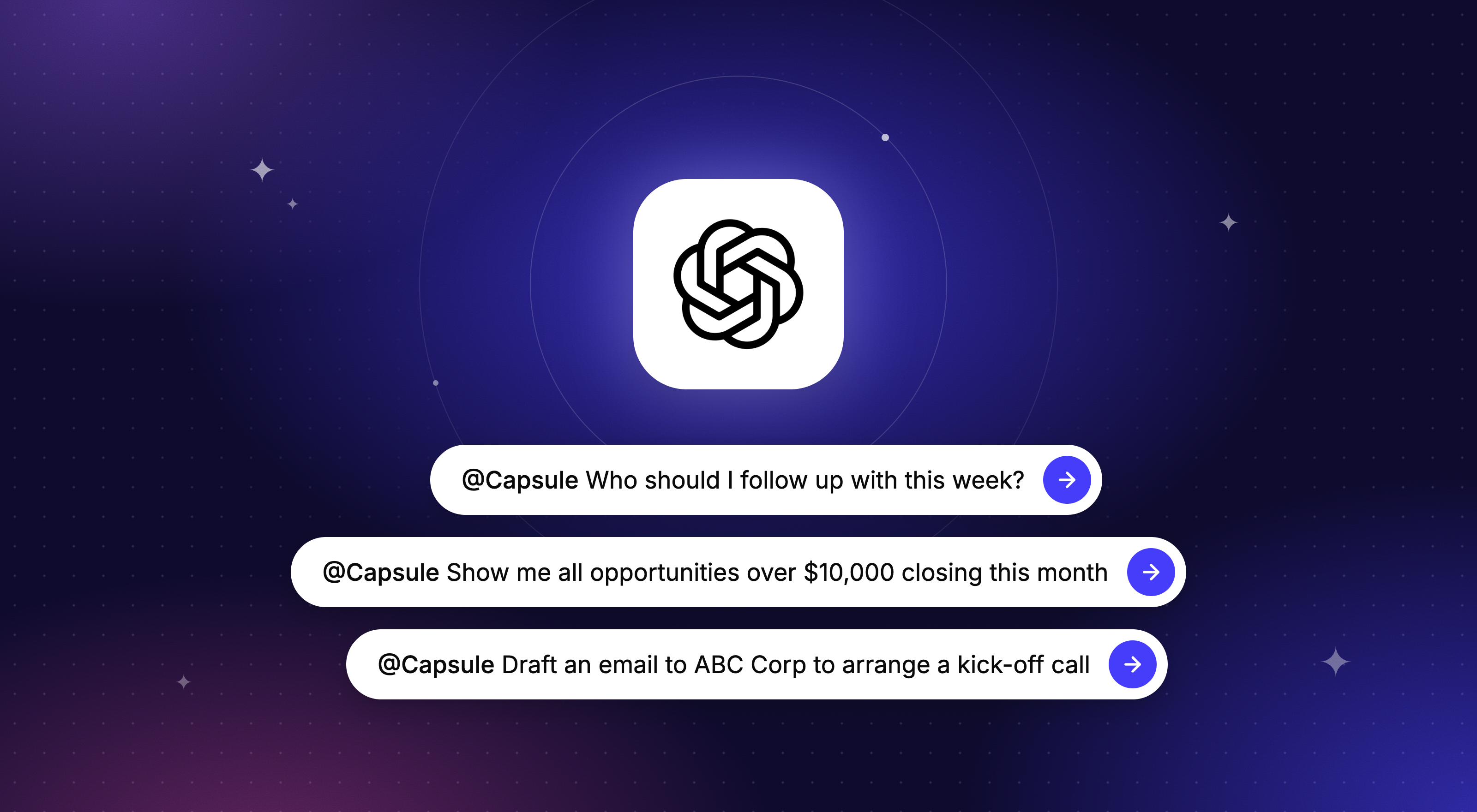
Almost every major CRM vendor combines AI with CRM in some form now. That answer is technically accurate and practically useless. When every platform claims AI capabilities, the question shifts from "which platforms have AI?" to "what kind of AI, doing what, and how does it actually integrate into how my sales team works?"


Not all AI-CRM combinations are built the same. AI technology has evolved faster than most CRM platforms have been able to adapt, which means the way a platform weaves AI into its core workflow varies enormously, from a handful of surface-level automations to models that reshape how an entire organization manages its sales operations.
How AI and CRM integration works
There are three meaningfully different ways platforms bring AI and CRM together. Understanding which category a platform falls into tells you more about whether it will work for your team than any feature comparison table.
Purposefully integrated AI
Established CRM platforms that have added a focused, well-considered set of AI tools directly into the core workflow. Not as architecturally native as the third category, but more immediately useful than the second because the AI is designed around actual daily work. This category tends to deliver the strongest results for small and mid-sized teams, where adoption speed matters as much as capability depth.
Bolted-on AI
Traditional CRM platforms that built their core product before AI was a realistic capability, and have since added it as a layer on top. Often powerful, but sits somewhat separately from the core workflow, requires clean historical data to produce reliable outputs, and typically lives behind higher-tier plans.
Natively built AI
Newer platforms are built from the ground up with AI as a core architectural assumption. Data capture, enrichment, and workflow automation are handled by AI models from the first interaction. The automation is baked into the data model itself.
Category one: purposefully integrated AI
Capsule CRM
Capsule is the clearest example of purposefully integrated AI – an established CRM that has added a focused set of AI features directly into the core workflow, designed to work from day one with no configuration expertise required.

What the AI does:
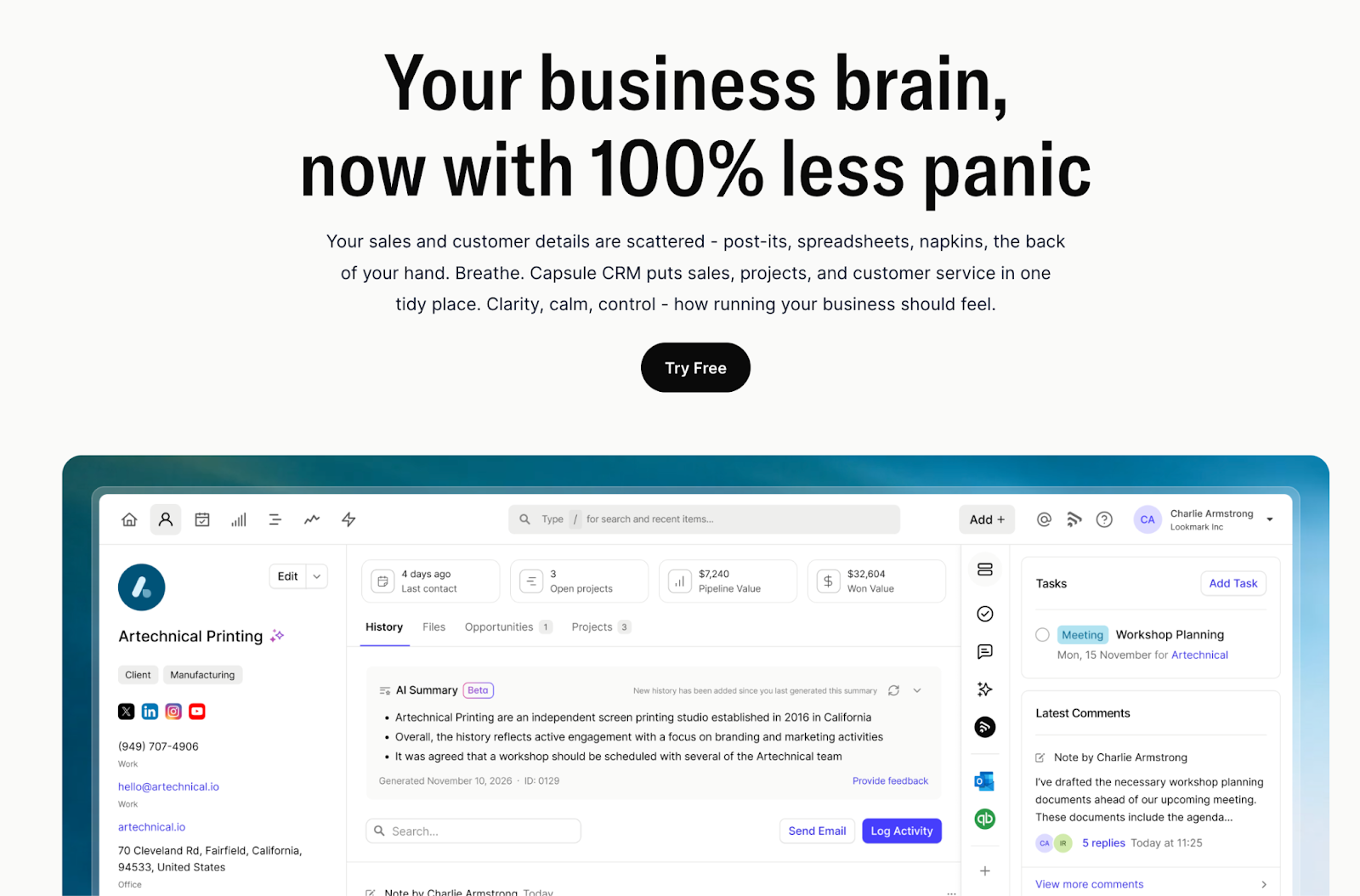
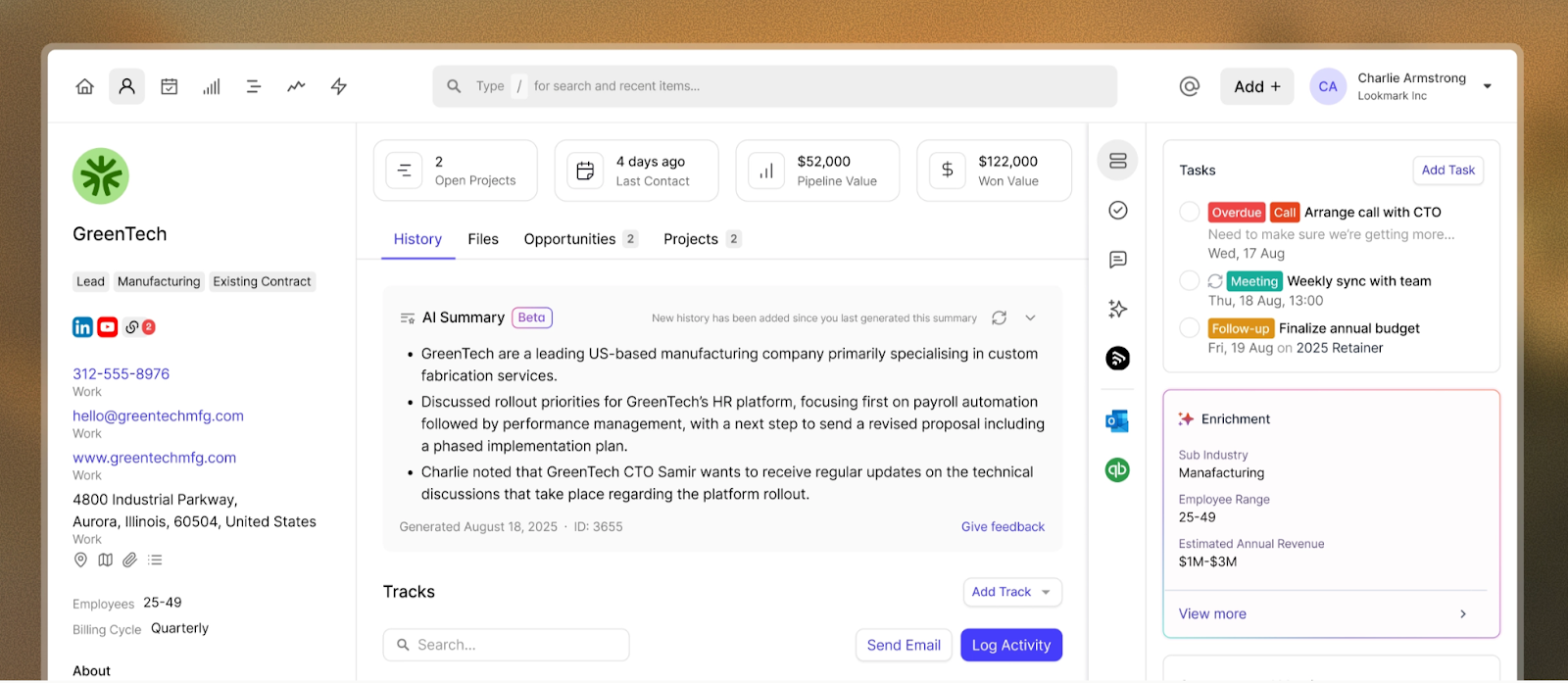
- AI Summaries condense the full history of any customer relationship into a readable brief before a call – every email, note, task, and deal update distilled into the context a sales rep needs.
- AI Contact Enrichment pulls company and contact data from public sources automatically, keeping records current as a byproduct of normal work.
- AI Email Assist drafts contextual outreach based on the specific relationship history. The difference between a message that references what was actually discussed and one that could have been sent to anyone shows up in response rates.
- AI Pipeline Generator builds a customized pipeline from a plain-language business description, removing the blank-slate setup problem that stalls many CRM implementations.
- Workflow automation via Tracks handles the repeating processes on every deal — onboarding sequences, follow-up cadences, and task assignment at each stage.
- The visual sales pipeline provides clean deal management across every active opportunity, with multiple pipeline support for parallel processes. Contact management gives every customer relationship a complete activity timeline, and sales analytics surface actionable insights for your sales team.

Capsule doesn't try to compete with Salesforce on AI depth or with Lightfield on architectural ambition. What it offers is AI that's immediately useful – backed by a 4.7/5 G2 rating across 449 reviews.
Pricing: Free plan available (2 users, 250 contacts). Starter $18/user/month, Growth $36/user/month with AI features.
Best for: SMB sales teams looking to seamlessly integrate AI into their daily workflow, yet without added complexity.
Category two: AI bolted onto an established CRM
Salesforce with Einstein AI
Salesforce is the reference point for bolted-on AI done at enterprise scale. Einstein covers predictive lead scoring, opportunity insights, automated activity capture via AI agents and generative AI sales forecasting across the platform.

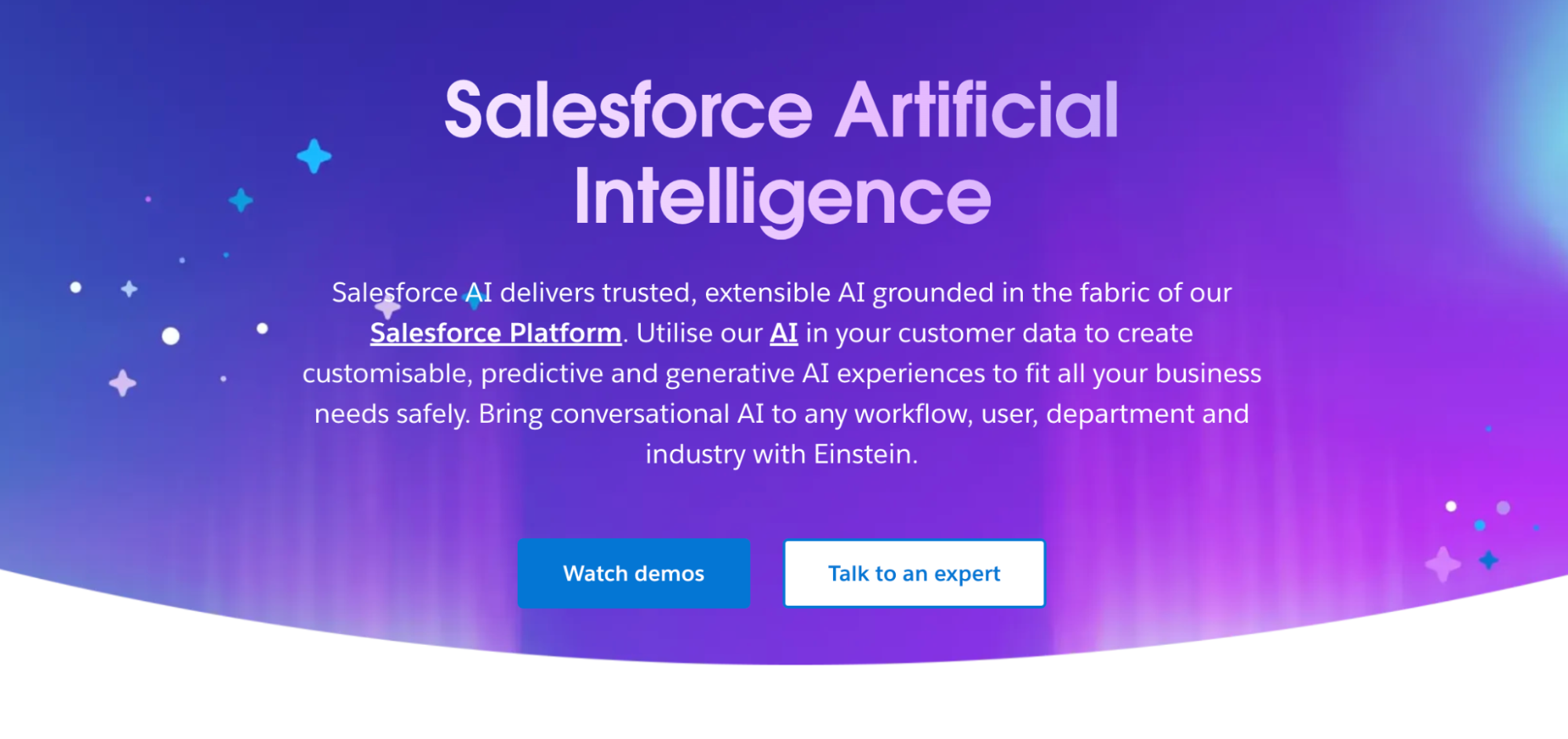
The combination is powerful for large sales teams with the data volumes and technical expertise to configure it properly. Getting full value comes with a significant configuration investment. The capabilities that impress in a demo – predictive analytics, sentiment analysis, AI-powered sales assistant functionality – require data maturity that the platform didn't create automatically. Teams with incomplete or inconsistently maintained records find the AI outputs less reliable than the marketing suggests.
The bolted-on category isn't a criticism but a description of a real trade-off between depth and accessibility.
Compare Capsule vs Salesforce here.
Best for: Enterprise sales teams with dedicated CRM administration and the budget to configure Einstein properly.
Zoho CRM with Zia
Zoho CRM sits in the same structural category as Salesforce – an established platform with a substantial AI layer added via Zia – but at a price point that makes it accessible to small businesses and mid-market teams.

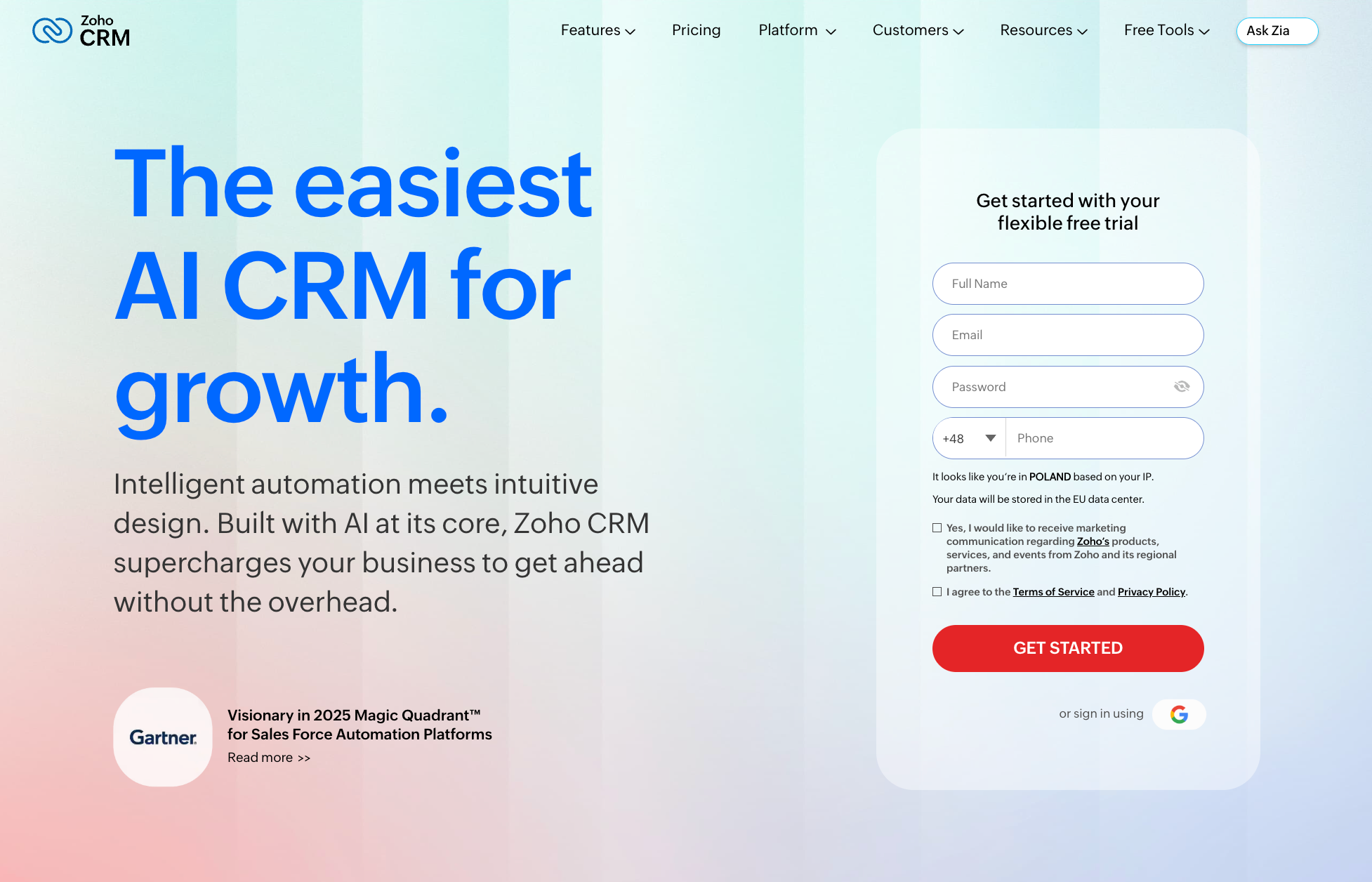
Zia powers workflow guidance, identifies sales data anomalies, interprets customer sentiment, and lets teams explore pipeline data on their own. Teams already using other Zoho products get additional value from the integrated ecosystem, where data flows between email, analytics, and project management tools in one view.
Best for: Mid-sized businesses that want broad AI capabilities at a competitive price and are prepared to invest in configuration.
HubSpot with Breeze AI
HubSpot's AI capabilities have expanded considerably under the Breeze brand: Breeze Copilot as an embedded assistant across the platform, Breeze Intelligence for contact enrichment and buyer intent signals, and AI agents for prospecting and customer service automation.

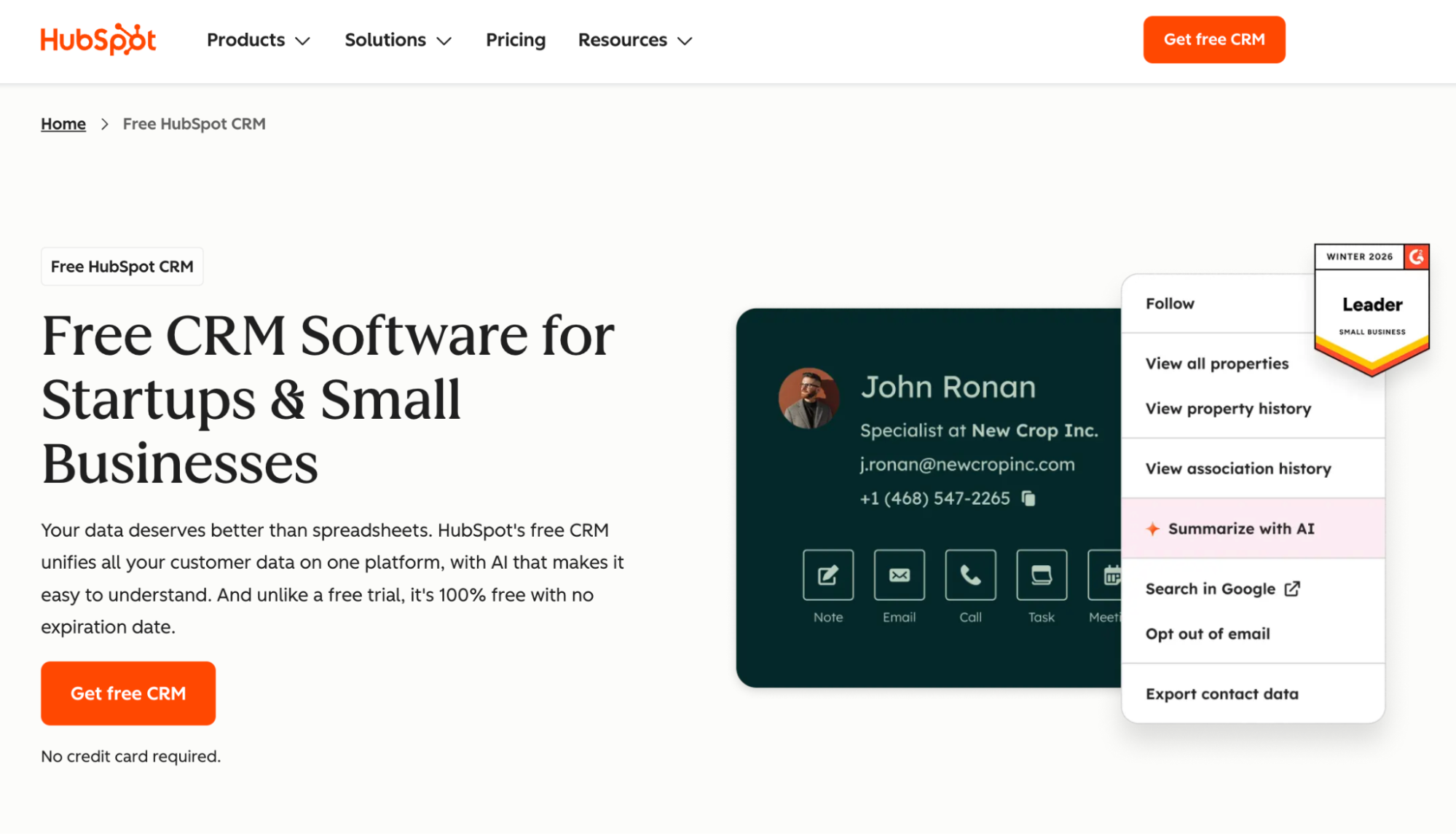
The breadth covers the full customer journey from marketing through to post-sale engagement.
The bolted-on reality shows up in the pricing structure. The free plan and the fully AI-enabled platform are meaningfully different products, and the features that make HubSpot's AI competitive sit behind paid tiers that escalate faster than most buyers anticipate.
Compare Capsule vs HubSpot here.
Best for: Growing businesses that need AI across various teams, with the budget to reach the paid tiers where the AI is fully realized.
Freshsales with Freddy AI
Freshsales added Freddy AI as a layer on top of a platform built primarily around communication tools: phone, email, and chat, integrated directly into the CRM.

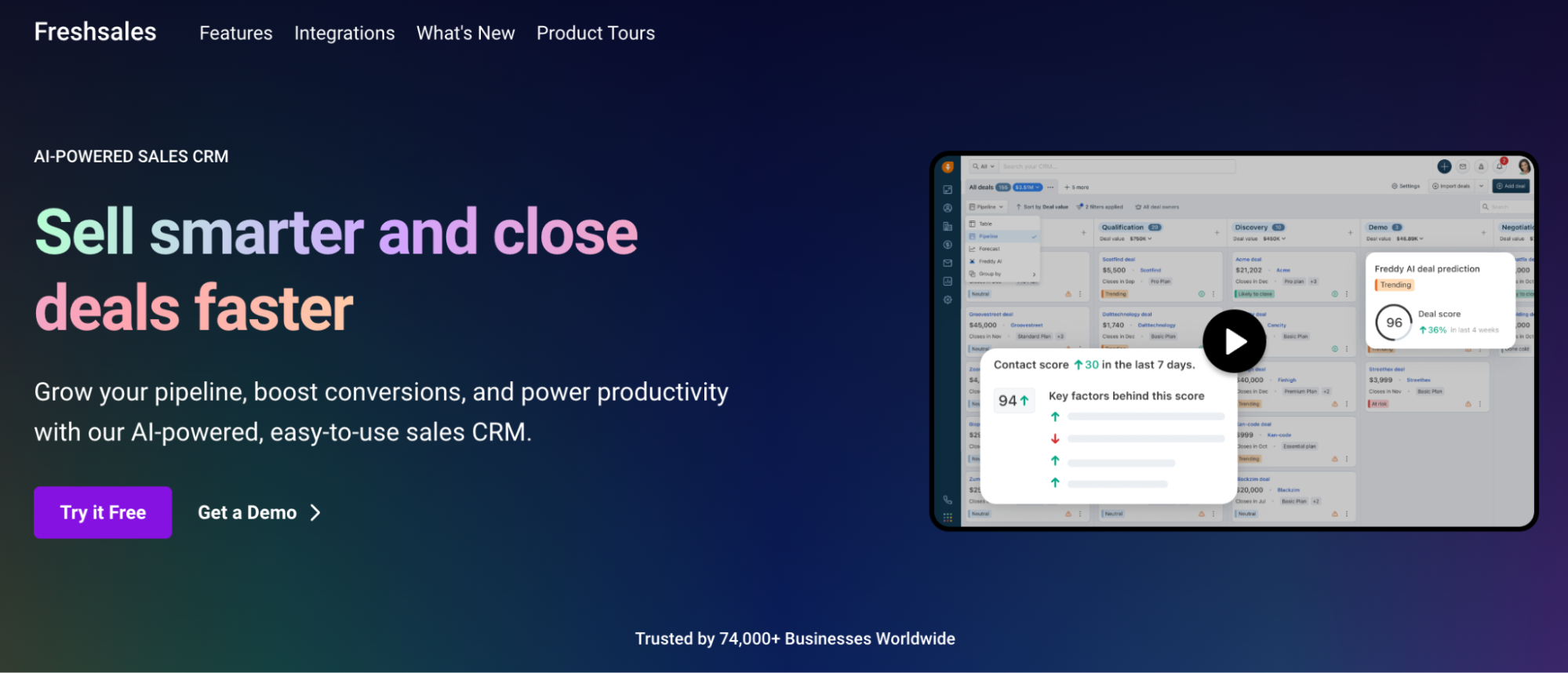
With Freddy, teams get intelligent lead scoring, actionable deal insights, and outreach support, all backed by automatic interaction tracking across various channels.
The AI integration is most effective for teams already using Freshworks products, where the native connection with Freshdesk creates a unified view across sales and service.
Best for: sales teams seeking built-in communication tools paired with AI, especially those already using Freshworks.
Category three: natively built AI
Lightfield
Lightfield represents a modern take on a natively built AI CRM.

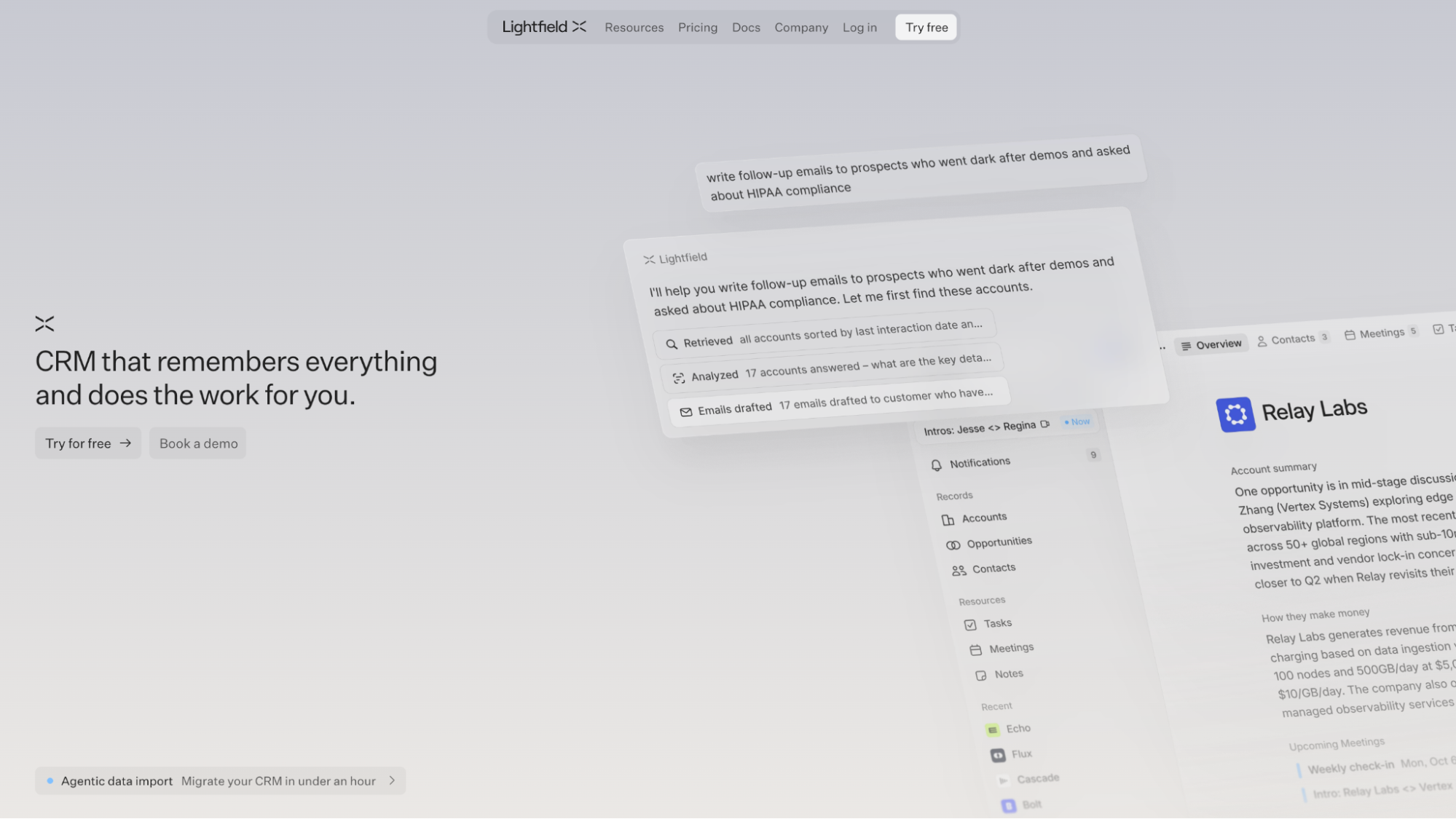
It was built from scratch around a single concept: complete customer memory. The platform reads emails and conversations to compile an exhaustive history of every customer relationship, and then acts on it autonomously.
Where bolted-on AI is applied to existing records, Lightfield's AI is the record. There's no upfront data model configuration; the platform captures everything from day one and lets teams evolve the structure over time.
The honest caveat? Lightfield is still in its early stages, with broader market adoption yet to follow. The architectural ambition is real, but the maturity at scale is still being established.
Best for: tech-forward sales teams that want AI operating as the core of their CRM, not a layer on top of it, and are comfortable being early adopters of a platform still proving itself at scale.
Attio
Attio takes a different angle on natively built AI; it’s built around flexible data modeling, not a fixed CRM structure.

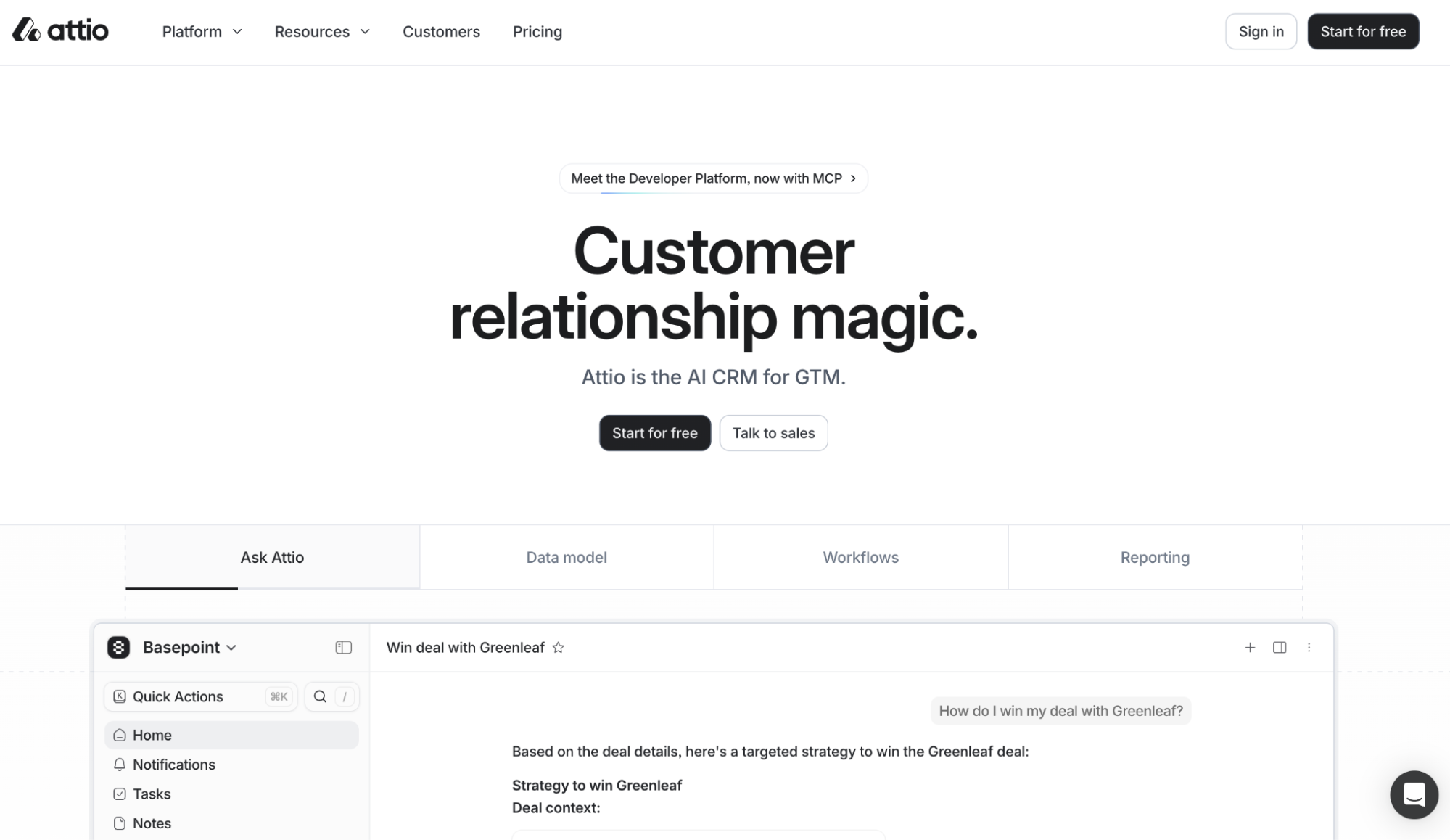
Where traditional CRM platforms impose a standard template, Attio lets teams define their own objects, relationships, and automated workflows, with AI enrichment and behavior-triggered automation built into the data model from the ground up.
The honest caveat: Attio is still building its track record. Well-reviewed by its early adopter base, but with a smaller verified review sample than the more established platforms here.
Compare Capsule vs Attio here.
Best for: Tech-forward teams with non-standard customer lifecycle structures who want AI built into a flexible data model.
Which combination is right for your business
The framework above suggests a straightforward way to narrow the choice.
- AI that works from day one, no technical expertise required → purposeful integration category (Capsule). Most immediate value for most small and mid-sized teams.
- Large dataset, dedicated technical resources, complex workflows → bolted-on category (Salesforce, Zoho, HubSpot, Freshsales). Offers the most depth and flexibility, but typically comes with a heavier setup, ongoing maintenance, and a longer path to realizing value.
- AI as the core architecture, not a feature → natively built category (Lightfield, Attio). Represents a newer approach, but is still evolving, often requiring teams to adapt to less mature tooling and changing capabilities.
The practical test across all three: run the platform against your actual sales operations for two weeks with real data, and see whether the AI reduces time spent on routine tasks or adds another layer of complexity to an already full workflow.
Capsule's free plan covers two users and 250 contacts, and the 14-day free trial gives full access to the AI features that make the purposeful integration approach work in practice.