
Every sales professional knows the feeling. The deal you nursed for months goes quiet, then the email lands: they went with someone else.
Rejection is part of sales, but knowing that doesn’t make a loss sting less. What separates top performers from everyone else is what happens next. This guide covers how to handle sales rejections in a structured way: a four-step recovery framework, the buyer objections you’ll hear most, and the habits that help B2B sales reps come back stronger.
Rejection hurts: why every “no” lands harder than it should
Your brain treats social rejection much like physical pain. The same neural regions light up in both cases, which explains why a lost deal can ruin a week even when you know the math was against you from the start.
Even top performers get rejected, constantly. The difference is in how quickly they metabolize it.
The volume makes it worse. A rep making dozens of calls a day hears more negative responses before lunch than most people hear in a month. Stack that against a monthly quota and the pressure compounds: each “no” feels like it’s pulling you further from a number you’re publicly measured on.
Left unprocessed, this does real damage. Fear of rejection in sales is one of the most common causes of call reluctance, and call reluctance quietly kills activity levels. Sales reps often start avoiding the exact behaviors that produce revenue: cold outreach, tough follow-ups, trial closes, and the ask itself. Over time, unaddressed losses impact sales results far more than the losses themselves ever did.
So the goal isn’t to stop rejection from happening. It’s to build a system for absorbing it, learning from it, and getting back into the conversation faster than your competitors do. Teams that build this habit improve sales performance not by winning a higher share of identical deals, but by losing far less time and energy between them.
Rejection vs. objections in sales: spot the difference
These two get lumped together, but they behave differently and deserve different responses:
- A rejection is a closed door. The buyer has decided, the deal is lost, and pushing harder at this point damages a relationship you might want later.
- An objection is an open door with a question mark on it. The buyer is still in the conversation; they’re telling you what stands between them and a purchase.
That distinction matters because reps may treat every pushback as final. When a buyer says “I’m not sure this fits us,” they’re rarely ending the conversation. They’re asking you to handle objections they can’t fully articulate yet. Answered well, that exchange can move the sale forward.
A rejection requires recovery; an objection requires response. Most of what feels like the former is actually the latter. The framework below covers recovery from real losses, and the sections after it cover the responses that prevent losses in the first place.
Types of sales objections and what they tell you
Most pushback falls into one of four categories. Learning to classify them on the fly is one of the highest-leverage sales skills you can build, because each category points to a different gap in the deal.
Price objections
A price objection can mean two things: the money truly isn't there, or your perceived value falls below your price.
The first is a qualification issue, and it should have come up in discovery. The second is a messaging issue, and it's fixable: tie the purchase to ROI the buyer already cares about, or restructure the offer so it fits their budget this quarter. Price objections late in the sales cycle are usually a sign the business case wasn’t made concrete early enough.
Stakeholder objections
"I need to run this by my boss" points to a sign-off gap. You've been selling to a champion instead of a decision-maker. The fix is to arm your champion with materials they can present internally, and to ask early in the sales process who else needs to approve the deal. Mapping the buying committee in week one is cheaper than discovering it in the final week.
Relevance objections
Here the buyer doesn't connect your product to a pain point they feel. The pitch focused on capabilities when it needed to anchor on business impact. These objections call for discovery before persuasion. Dig into the problem before you re-pitch the solution, and let the buyer describe the cost of the status quo in their own words.
Timing objections
"Circle back next quarter" is sometimes real and sometimes a polite deflection. The way to tell them apart? Ask what changes next quarter. A concrete answer means the timing concern is real; a vague one means there's a hidden objection from one of the other three categories.
Reading these types of objections through a scoring lens helps too: price and stakeholder objections tell you about fit, relevance, and timing objections tell you about intent and urgency. Logging that signal on every deal sharpens your sales forecasting and your qualification over time.
How to deal with rejection in sales: a 4-step recovery framework
When a major deal collapses, “shake it off” isn’t a strategy. Work through these steps in order. The early ones are about psychology, the later ones about process.

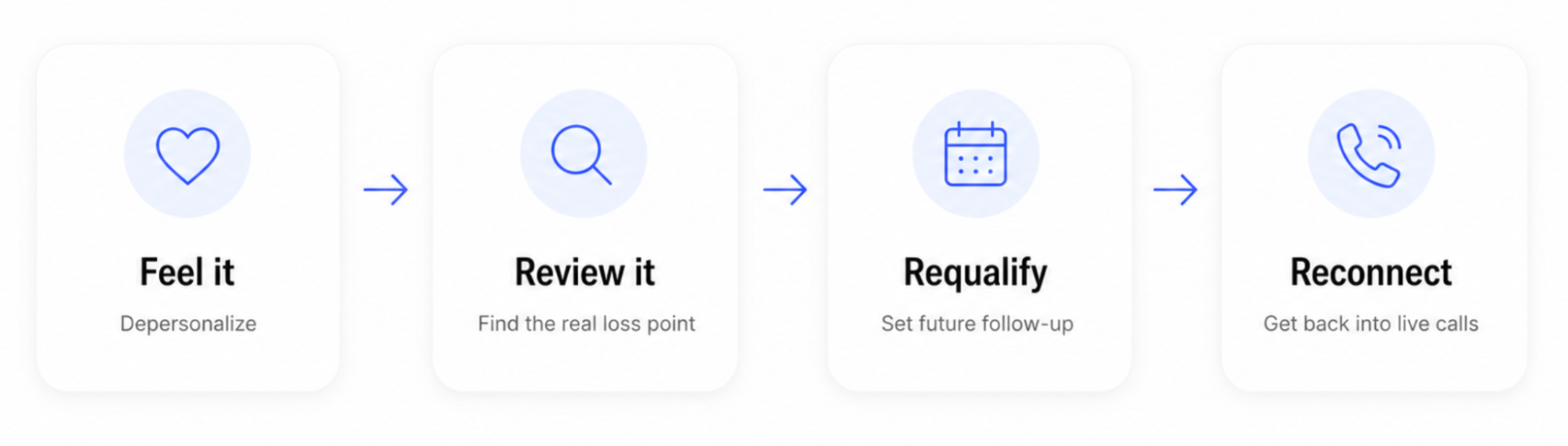
Step 1: feel it, then depersonalize it
Give the loss a defined window: an hour or an evening, no more. Suppressing the frustration tends to leak into the next sales call anyway, so acknowledge it on your own terms first.
Then separate the decision from your worth. The buyer rejected a proposal, at a price point, under a set of constraints you mostly couldn’t see… but they didn’t reject you. The fastest way for a salesperson to burn out is to take it personally every time, and the math backs this up: loss rates run high even for elite teams. Sales is a numbers game in the literal sense that no conversion rate is 100%, so internalizing every miss means absorbing damage that was statistically guaranteed before you ever picked up the phone.
Step 2: run a post-loss review
Once the emotion settles, treat the loss as data. The most resilient reps treat losses as learning opportunities, and they do it systematically. Loss reviews should be a standing part of the sales process, not a crisis ritual you only perform after the painful ones.
Review the full deal history: discovery notes, email threads, call summaries, the moments where something changed. The sooner leads live in your CRM, the cleaner the review. One place to check, twenty minutes to diagnose, zero inbox archaeology.
Ask three questions:
- Where did the deal really die (usually earlier than the final email)?
- Which signals did I rationalize away?
- What would I change in my sales approach if I could rerun it?
Write the answers down on the deal record, and tag the loss reason so it’s reportable later. A lost deal you learned from is an opportunity to improve; a lost deal you buried is just a loss. Over a quarter, those tags turn individual disappointments into a pattern you can act on.
Step 3: requalify the relationship
A “no” today is rarely a “no” forever.
Before archiving the deal, reread your notes on the prospect’s objections and ask what they tell you about the future. Maybe they weren’t ready to buy yet? Maybe the competitor they chose locks them into a contract that expires in twelve months? Or, maybe the champion who loved you will change jobs within a year?
This is where you reframe the loss. The deal is closed, but the relationship can outlive it.
Set a long-range follow-up task, keep them on relevant nurture content, and find a low-pressure reason to stay visible. A structured approach to following up on leads turns this from a good intention into a scheduled behavior. Reps who do it consistently close the gap between a lost deal and a reopened one far faster than reps who start every quarter from zero.
Step 4: get back into live conversations
Confidence comes back through action. Reflection had its window, and it closed in step two. The longer the gap after a tough loss, the more the loss calcifies into hesitation, so the priority is to get sales conversations moving again within a day.
Top reps use a reset ritual here. They review their open deals, pick the three warmest, and make contact with each one before the day ends.
Small wins compound. Close the next deal you can, then keep going – the conversation ahead carries more weight than the one behind you.
How to overcome sales objections before they turn into losses
Recovery is essential, but prevention is way better. Strong objection handling in sales follows a simple rhythm: listen fully, clarify, then respond to the real concern.
The clarifying step is the one most reps skip.
When a buyer pushes back, don’t immediately counter. Rather than pushing your rebuttal, ask a question: “Can you tell me more about what’s driving that?”
Half the time, the stated objection isn’t the real one, and the question surfaces what is. A buyer who says the rollout looks too complex may actually be worried about looking bad internally if adoption fails, and those are two very different conversations.
Then shift the focus from cost to outcome. Price pushback in a sales negotiation is almost never about the number itself; it’s about the buyer’s confidence in your product or service’s value at that number. Quantify the outcome and reference customers in a similar situation. From there, help the prospect see the value in terms they’d comfortably repeat to their CFO.
Finally, differentiate your solution on the dimension the buyer cares about most.
If they’re worried about adoption, ease of use beats feature depth. If they’re worried about risk, support quality beats price. Treating each objection as an opportunity to sharpen positioning, deal by deal, is the quiet engine behind any durable sales strategy.
Examples of common sales objections and ways to respond
Most reps run into the same handful of objections repeatedly. Having a natural answer ready is part of the job.

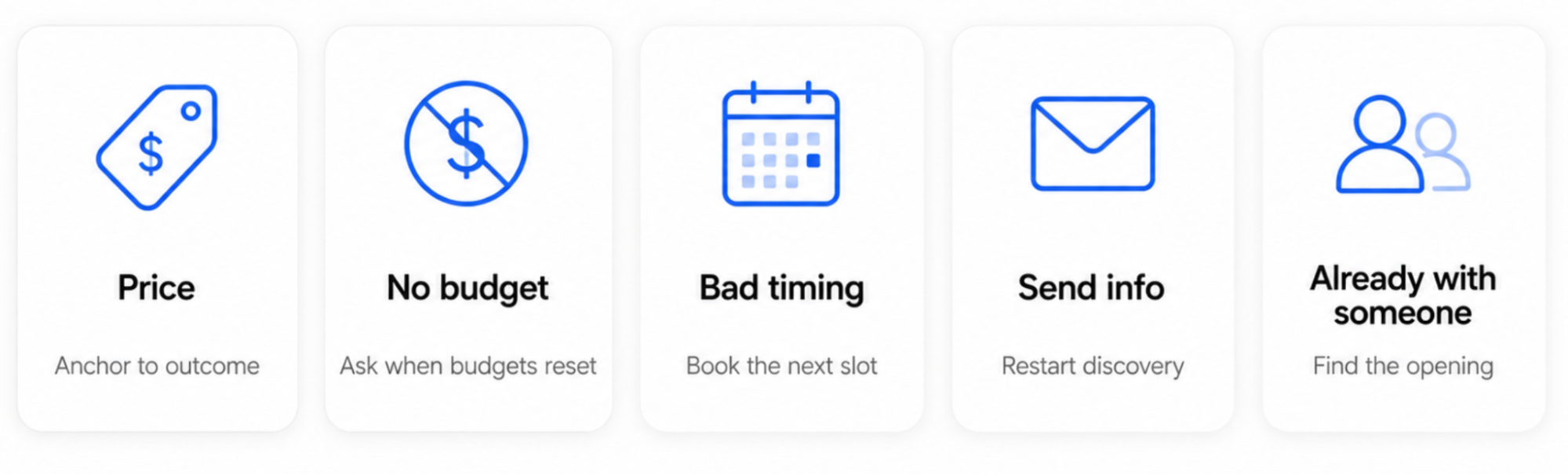
The phrasing below can be adjusted, but the underlying structure is what you’ll reuse in your own deals.
#1 “The price is too high”
Don’t defend the number. Anchor it to a result.
“Compared to what?” is a fair opening question, because it reveals what the buyer is benchmarking against. Then recast cost as cost of inaction: what does the current problem cost per month in time, errors, or lost revenue? A price that looked high against a competitor often looks small against the problem.
#2 “We don’t have the budget”
Distinguish “no budget ever” from “no budget now.” Ask when budgets get set and who owns the line item. If the value case is strong, offer a phased rollout or a smaller starting plan – buyers routinely find money for things they’ve decided they need.
#3 “Now isn’t a good time to talk”
Respect it, then book the next step before hanging up: “Totally understand. Does Thursday at 10 work better?” The objection is about timing, so keep the conversation moving by securing a specific slot that does work.
#4 “Send me some information”
Agree, and attach a condition that keeps the conversation alive: “Happy to. So I send the right thing, what’s the main problem you’d want it to address?” The reply either brings discovery back to life or makes it clear there was never real intent.
#5 “We already work with someone”
Avoid attacking the incumbent. Ask what’s working well and what they’d change if they could. The answer either reveals an opening or qualifies them out, and both outcomes save you time.
How to help your sales team handle rejection
Sales managers shape how losses land. On teams where every miss is interrogated like a failure, reps hide losses and stop learning from them. On teams where losses are reviewed like game film, the same misses become shared intelligence.

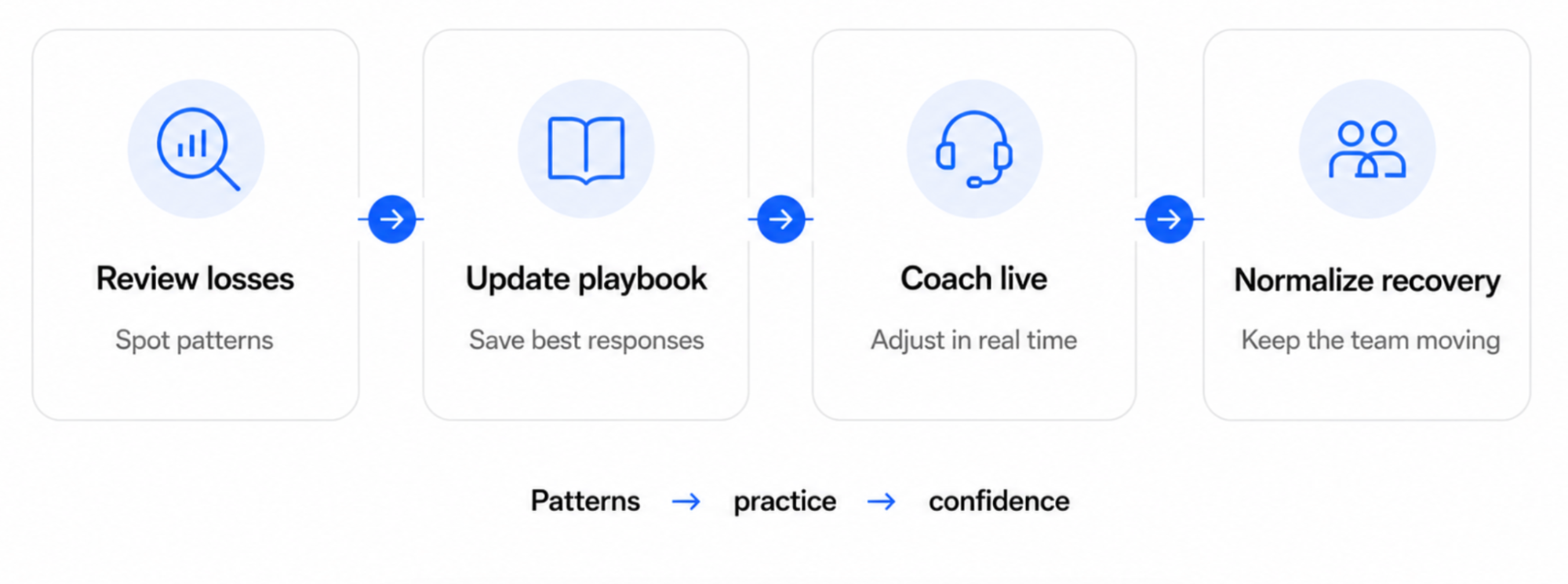
A few practices make the difference.
- Build loss reviews into your regular sales training cadence, focused on patterns instead of blame.
- Maintain a shared playbook of common objections with the best current responses, and update it whenever the same objections keep surfacing across deals; a recurring objection is a positioning problem, not a rep problem.
- Coach sales conversations live where possible, because frequent rejection is far easier to absorb when reps can see exactly what to adjust next time.
Culture matters as much as process. Recognition for smart at-bats does more for resilience than perks and benefits ever will. Top-performing sales teams use loss data the way product teams use bug reports: openly and with a bias toward fixing the system. The job is to help sales reps decompress fast, give them tools that help them sell with less friction, and normalize dealing with sales losses out loud. Do that, and the recoveries start taking care of themselves.
How Capsule can help reps bounce back faster
The whole framework above runs on one prerequisite: complete, accessible deal history. That’s where Capsule does its quiet work.
Every email, call note, file, and task sits on the contact record through contact management, so a post-loss review starts with the full story instead of a reconstruction.

The visual sales pipeline shows exactly where deals stall, and the Opportunity dashboard breaks down won and lost deals so patterns surface across the whole team, not just in one rep’s memory. Getting your deal stages structured properly makes those reports sharper, and if you’re losing deals you never should have chased, they’ll also help you weed out tire kickers earlier.
Recovery steps become scheduled behavior, too.
Tasks and Calendar hold your long-range follow-ups, and Workflow Automation can trigger a re-engagement sequence the moment a deal is marked lost. Capsule’s AI features speed up the comeback: AI Summaries condense a deal’s full history before a review, and AI Email Assist drafts the re-engagement note that’s otherwise easy to postpone forever.
Pair that with AI tools across your marketing stack, plus integrations for email and calling, and a clean handoff to marketing teams through shared marketing use cases, and nothing about the recovery process depends on a rep’s willpower on a bad day.
It’s a deliberately simple platform for small businesses that want structure with minimal admin. You can explore the full feature set on a free 14-day trial, with plans that scale as your team grows.
The next “no” is already on its way. With a recovery system in place, so is the next “yes.”
Start your free 14-day trial of Capsule today and give every loss somewhere productive to go.