Nobody wants to sound like they're pushing a lemon off the lot. Yet the fear of coming across that way is exactly why so many deals drift into silence: the rep never asks.
Closing well has little to do with pressure or canned one-liners. The skill is recognizing the moment a buyer is ready and making the decision easy. Our guide walks through eight closing techniques that feel like a conversation, the signals that tell you when to use them, and the mistakes that quietly kill deals at the finish line.
What does closing a sale mean?
Closing a sale is the process of converting a buyer's interest into a firm commitment: a signed contract, a processed payment, or a confirmed start date. It sits at the end of the sales cycle, but treating it as a separate event is the first mistake most people make.
Closing starts much earlier than the final call, because every discovery question and every demo either builds toward an easy yes or stores up friction for the end. The close is part of the sales process, not a trick bolted onto it. A salesperson who has qualified well (frameworks like MEDDPICC exist for exactly this) understood the problem, and confirmed the product can solve it doesn't need theatrics at the end.
The buyer already believes. The close just makes it official.
That's also why the same line delivered by two different people produces opposite results. Words borrowed from a top performer fall flat when the work behind them is missing, and reps who put in the time during discovery find that most of these closes take one sentence.

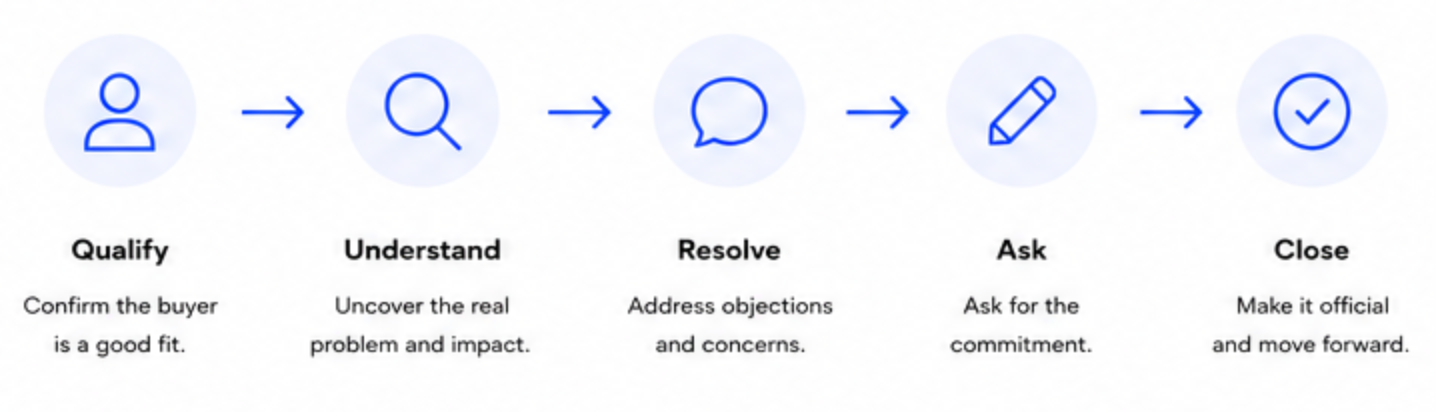
How long the close takes varies by context. A transactional purchase might close on the first conversation, while an enterprise agreement can take a quarter of legal review after the verbal yes. What stays constant is the sequence. Confirm the fit, resolve the open concerns, then ask.
By the time you ask, the buyer should be choosing between two good options: start now or start soon. Trust shouldn't be on the ballot anymore. Every technique below is a way of presenting that choice, and none of them can manufacture it.
Proven sales closing techniques (and when to use each)
There's no single best way to get the deal over the line. Each of these fits a different buyer, mood, and moment. Formal methodologies like the Challenger model build entire playbooks around these conversations. Think of the techniques below as the lighter, everyday toolkit you draw from once the groundwork is done.

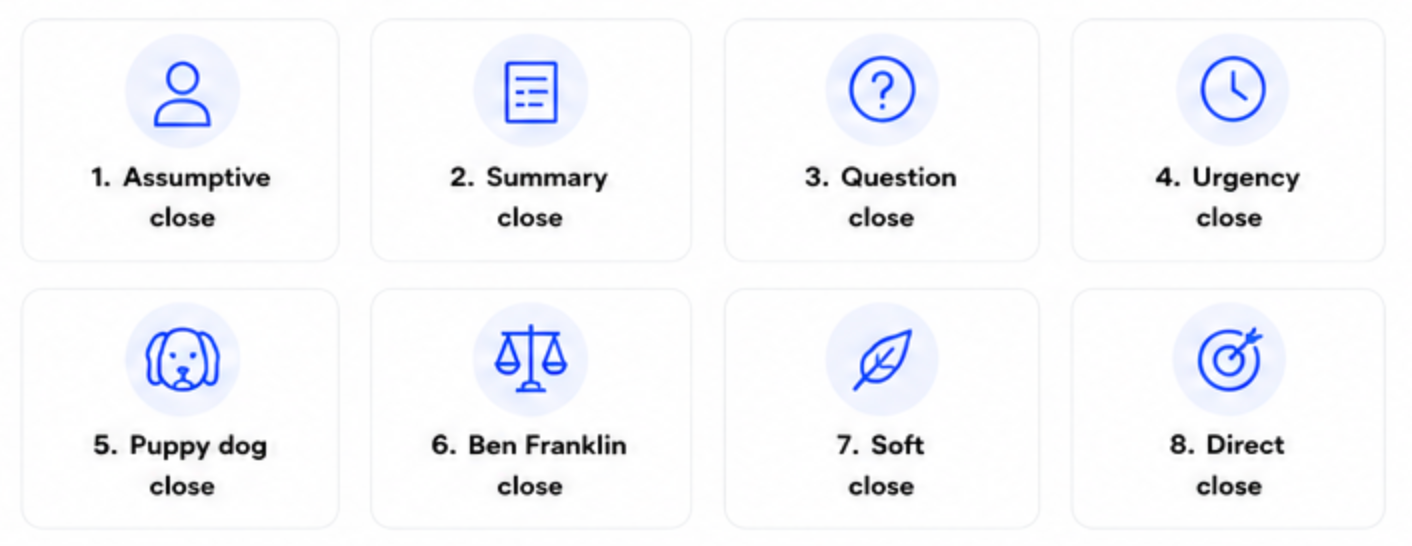
1. The assumptive close
This one treats the purchase as the natural next step. You speak as if the prospect has already decided, and you move the conversation to logistics: "Would you like onboarding to start Monday or Wednesday?" It works because it removes the awkward decision ceremony. The buyer simply confirms details, and momentum does the rest.
Use it only when the signals are strong, and trust is already established. Deployed too early, it reads as presumptuous and can set the deal back by weeks, because the buyer now feels handled.
Best for: Warm, high-intent buyers who have already shown strong buying signals and are comfortable moving forward.
2. The summary close
With this close, you recap everything the buyer has agreed on: the problems identified, the outcomes promised, the terms discussed. Then you restate why your solution fits, name the pain it relieves, and stop talking. The recap helps the customer hold the full picture in mind at the exact moment of decision, which is harder than it sounds after a six-week evaluation involving four stakeholders and 40 emails.
This is most effective near the finish line of a long sales cycle, when the deal has gotten complex, and the original pain has faded into the background. It's also the close most improved by good notes. A recap built from memory misses the customer's own words, and those words are the most persuasive material you have.
Best for: Complex or lengthy sales cycles with multiple requirements and decision criteria to bring back into focus.
3. The question close
This technique uses a targeted question to surface the real status of the deal: "Is there anything that would stop us from moving forward this month?" Either you get agreement, or you uncover the actual blocker and can address it on the spot. The best closing questions have one job: reveal whatever stands between today and a signature.
The trick is to ask a question that invites a concrete answer, then stay quiet. The first person to speak after the question usually concedes the frame, and it shouldn't be you.
Best for: Deals that seem close but may have one or two hidden objections, unanswered questions, or internal blockers.
4. The urgency close
This one creates a sense of legitimate time pressure: a pricing change, an expiring discount, a capacity limit on onboarding slots. Done honestly, it nudges a hesitant prospect to buy now – fear of missing out is a real motivator when the deadline is real.
Manufactured countdowns are the fastest route to used-car territory, and experienced buyers can smell them from the subject line. Reserve this close for constraints that actually exist on your side, and name the reason openly. A deadline with a visible cause builds credibility, while a deadline with no cause spends it.
Best for: Hesitant buyers who already see the value but need a legitimate, time-sensitive reason to make the decision now.
5. The puppy dog close
Named for the pet-shop tactic of letting a family take the puppy home overnight, this close puts the product in the prospect's hands before any commitment. A free trial, a pilot project, or a sandbox account lets the product sell itself. If it proves its value within two weeks, the purchase conversation becomes a formality, and the contract is paperwork.
It suits products with fast time-to-value and buyers who trust hands-on experience more than slide presentations. One caveat: an unguided trial is just a login. Set up the pilot around their real use case, check in at the halfway mark, and the puppy sells itself.
Best for: Hands-on buyers and products with a fast time-to-value that can prove their usefulness through a trial, pilot, or demo environment.
6. The Ben Franklin close
This close helps the buyer build a two-column list of pros and cons, together, in real time. Walking through the trade-offs openly demonstrates confidence in your offer, surfaces every lingering objection in one sitting, and gives analytical buyers the material to defend the decision internally later.
It also protects you after the meeting. A decision the buyer reasoned through is far less likely to unravel during procurement, because they've already rehearsed the counterarguments. Reach for this one with engineers, finance buyers, and anyone who answers questions with spreadsheets. Just make sure the pros column is built from their stated priorities; built from your feature list, the exercise works against you.
Best for: Analytical, risk-conscious buyers who want to compare trade-offs carefully and justify the purchase with logic and evidence.
7. The soft close
A soft close gauges interest with almost no pressure: "If we could solve the reporting problem you mentioned, would that be worth a deeper look?" It asks for an opinion, not a commitment, so it carries little risk of damaging the relationship and still moves the conversation forward.
Reach for it early in the relationship or with cautious buyers. It's also a low-stakes way to test the waters when you're unsure the buyer is ready for a direct ask, because the answer tells you exactly how far away the real close is.
Best for: Early-stage conversations, cautious prospects, and situations where you need to test buying readiness without creating pressure.
8. The direct close
Sometimes the most professional move is to simply ask for the business, plainly: "It sounds like this fits. Shall we draw up the agreement?" Buyers expect to be asked. Evaluating vendors is part of their job, and a confident, plain-spoken ask respects their time more than another nurture email does.
Go direct when every signal points to yes and the only thing missing is the question. Asking for the deal converts more often than reps fear it will, and the worst realistic outcome is useful information about what's still unresolved. You have to ask for the sale eventually; the direct close just skips the theater.
Best for: Decision-ready buyers when the value, fit, and terms are clear, and the only thing left is to explicitly ask for the business.
How to spot buying signals before you ask
Timing beats technique. The same words that close a deal in a week can kill it in a minute, so the real skill is reading readiness before you ask.

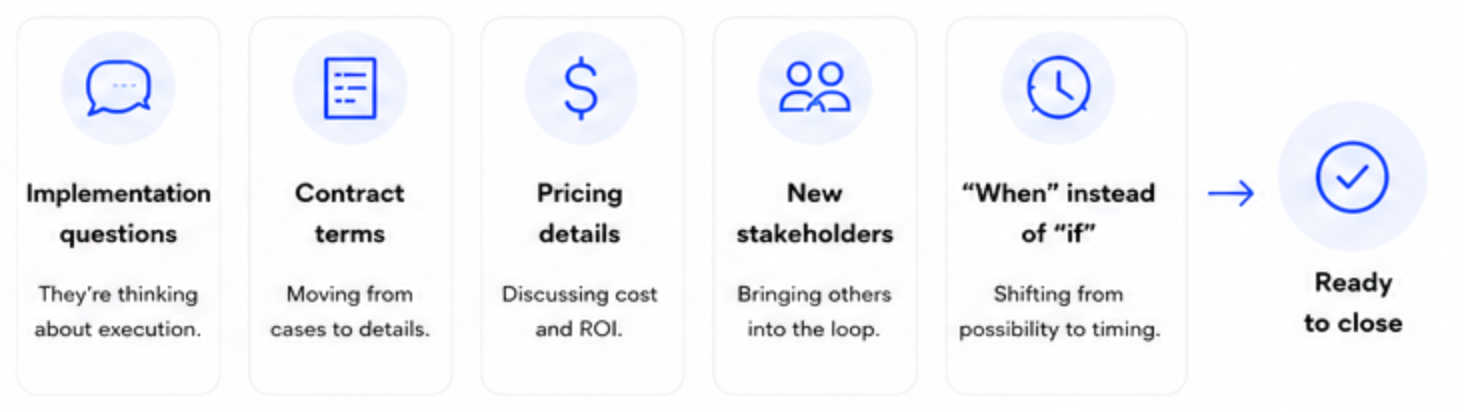
The clearest signals show up in the questions buyers ask.
When someone shifts from "what does it do" to "how does implementation work," they're ready to buy in their head and are now derisking the decision. Questions about contract terms, onboarding, or volume pricing all point the same way. So does the introduction of new stakeholders late in the process; people don't bring their CFO to meetings about products they plan to reject.
Behavioral cues count too. A buyer who responds quickly, asks how to receive the paperwork, or starts saying "when" in place of "if" has mentally moved in. Your job now is to get them across the line with minimal friction: confirm the decision, agree on next steps, and make it easy to say yes today.
Hesitating at this stage is its own mistake. Readiness has a half-life, and enthusiasm that isn't converted gets re-evaluated as budgets shift, sponsors change roles, and a competitor's email lands in the gap you left. Speed at the moment of readiness is the cheapest improvement available to most teams.
A single enthusiastic champion is not a ready account. Before you ask, confirm the person in front of you can actually sign. Otherwise, you're asking someone you've never met to close the deal, through a messenger who controls the framing.
Common sales closing mistakes to avoid
Most lost-at-the-finish-line deals trace back to a handful of patterns, and almost all of them come down to timing or silence.
❌ Closing before the value is established
If the buyer can't yet articulate what the product changes for them, no closing line will compensate, and pushing creates resistance that lingers for the rest of the deal.
❌ Waiting for the deal to close itself
The reverse error is just as costly. Deals rarely volunteer a signature, and hoping the buyer does the asking is a closing strategy in name only.
❌ Talking past the yes
The buyer agrees, and the seller, running on adrenaline, keeps pitching until a new doubt surfaces. When you hear yes, stop selling and start scheduling. The buyer made the decision, so let them keep it.
❌ Closing harder against pushback
An objection at the close is rarely a rejection. It's a signal to slow down and diagnose. If the buyer hesitates, ask what's behind the hesitation, and if the same concern keeps appearing across deals, fix it upstream in your pitch. And in every scenario, follow up promptly – a deal that's warm on Friday is lukewarm by Wednesday and forgotten by month-end.
Closing skills worth developing
Techniques are scripts. Skills make them sound human.
Listen as the deal depends on it
Every close in this list depends on hearing what the buyer actually said, and never what your forecast hoped they said. A recap built on bad notes fails, a question asked over bad attention fails, and both failures happen weeks before they're visible.
Get comfortable with silence
The instinct to fill quiet moments is strong, and in sales conversations it's expensive. Every word after the ask gives the buyer a reason to wait. Most people need deliberate practice to build this one.
Learn to read the moment
Knowing it's time to close is pattern recognition, built across many deals, and techniques like the assumptive approach only work when the read is right. Reviewing recorded calls in coaching sessions teaches pattern-spotting far faster than trial and error. The strongest teams treat closing as trainable, and the reps who close month after month are usually the ones who got coached hardest early.
Stay organized
Closes collapse when context is missing: a forgotten commitment, a stakeholder who never saw the proposal, a follow-up that slipped. No technique rescues a rep who shows up to the decisive call missing half the history. In B2B especially, the close is a team sport played over months, and the winners are simply the ones who never lose the thread. Log every commitment the moment it's made, and the decisive moment stops depending on memory.
How Capsule helps you close more deals
Most of what makes a close land happens in the boring weeks before it, and that's where Capsule quietly does the work.

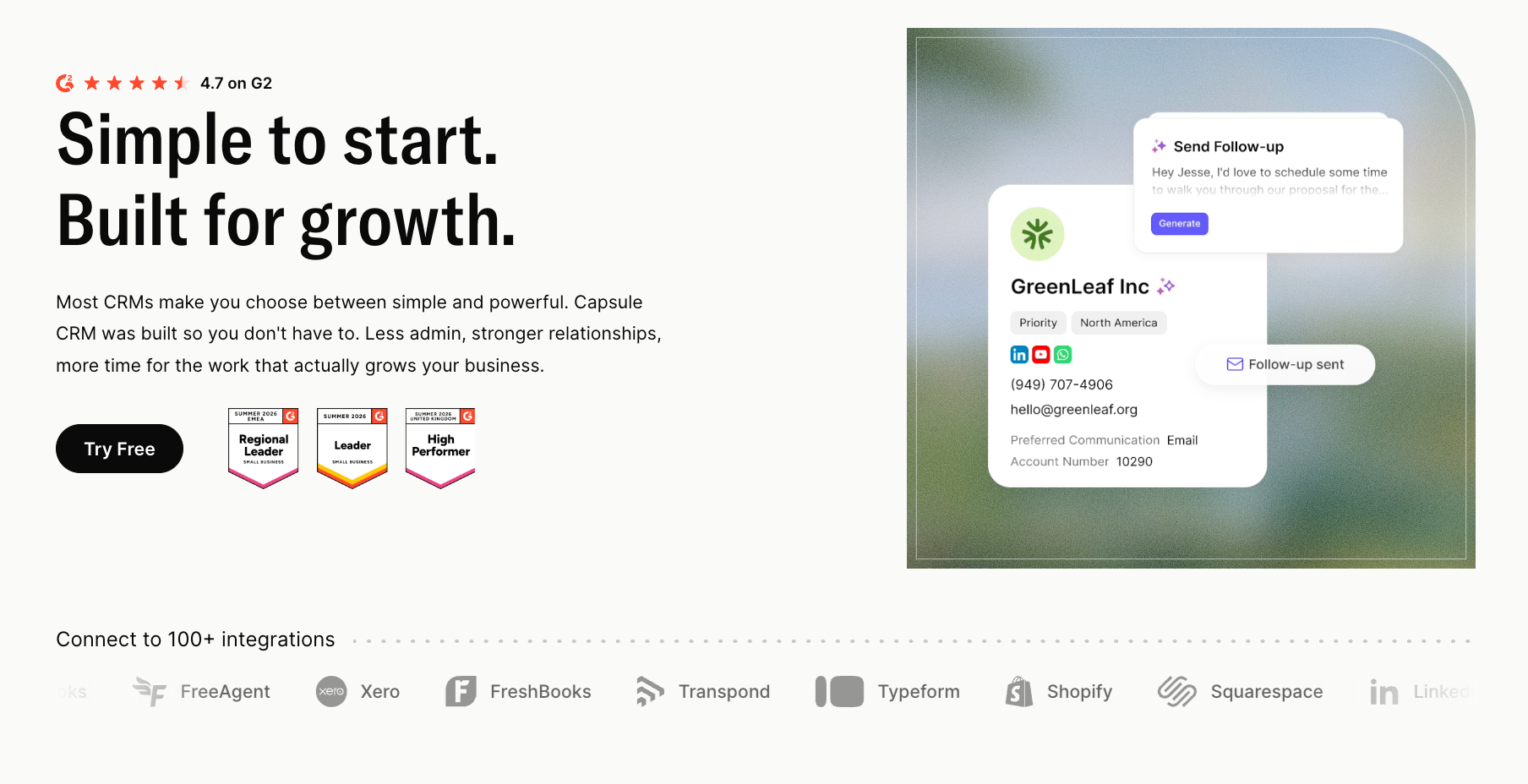
Every conversation, commitment, and file lives on the contact record in contact management, so you walk into the decisive conversation with the full history at hand and your summary close writes itself.
The visual sales pipeline shows which deals are approaching the decision stage, and the Opportunity dashboard reveals where deals stall, so you can tune your deal stages around reality. If too many bad-fit deals are reaching the finish line, reports spot the tire kickers early, and a clear lead management setup keeps qualification honest from the first touch.
The follow-through gets automated, too. Tasks and Calendar make sure the post-yes steps happen on schedule, Workflow Automation can kick off contract and onboarding sequences the moment a deal is marked won, and a consistent follow-up routine stops warm deals from cooling.
Capsule's AI features carry their weight here: AI Summaries condense months of deal history before the final call, and AI Email Assist drafts the post-meeting recap that decision-makers forward internally.
Consistency closes more deals than charisma, and consistency is a system. Capsule is that system for thousands of small teams: running before lunch, priced for a team that's still small, and simple enough that logging the deal never competes with working it. Put next quarter's pipeline in it and see what a fully-prepared close feels like.
Go seal the deal
You won't close every deal, and you don't need to. Pick the technique that fits the moment, take the next step the second a buyer is ready, and let preparation do the persuading. The easiest yes is the yes you set up weeks ago.