
Moving companies in 2026 are operating in a tougher market than five years ago.
Lead costs climb every quarter, customers expect AI-driven virtual surveys before they'll get on a phone call, and crews need offline mobile tools that push data back into pricing and billing automatically. The companies that grow through these conditions run on tight software, not spreadsheets and paper estimates.
A CRM is one piece of that operational stack. Today, we'll walk through a few CRM options for moving companies, from industry-specific platforms to flexible general-purpose CRMs that adapt cleanly to the moving workflow.
Core CRM needs of a moving company
Moving company CRM needs span the intersection of four workflows that many generic CRMs miss:
- Lead intake and qualification. Online quote requests and phone inquiries, plus referrals from past customers, all need to land in one system, with response time measured in minutes for the highest conversion. Many moving companies lose new bookings to slow follow-up.
- Estimate and booking pipeline. A lead becomes a booked move through a multi-step process: virtual survey or in-home estimate, quote sent and followed up, deposit received, and move confirmed. The CRM has to track each lead through these stages cleanly.
- Customer communication around move day. Confirmations and reminders go out before the move, with day-of updates and post-move follow-up running afterward. Missing one step at any point creates a service issue.
- Reactivation and referral. Past customers and unconverted leads represent real revenue. The CRM needs to identify dormant contacts and run outreach campaigns that don't feel templated.
A platform that handles these four workflows well is a real moving CRM. A platform that handles one of them and assumes another tool covers the rest is a partial solution that creates handoff problems.
How CRM needs vary by moving company type
Not all moving companies need the same CRM features. The customer journey looks different across local, long-distance, and specialty operations.
- Local moving companies lean heavily on lead volume and conversion speed. Many bookings come from online quote requests or phone inquiries, with decision cycles measured in days. The CRM needs strong lead intake and fast quote generation, with follow-up automation that runs while the team is on the road.
- Long-distance and interstate movers look more like a B2B sales operation. Each move involves multiple touchpoints and larger quote values, with decision cycles that can stretch over weeks. The CRM has to track each prospective move through clear stages and run nurture sequences for customers who haven't yet committed.
- Specialty movers (pianos and art, for example) operate closer to a relationship-driven model. Each customer is high-value and often becomes a repeat client or referral source. The CRM needs deep contact history and custom fields for specialty requirements, with referral source tracking that maps which past customers produce the most new business.
A company that picks a CRM with no match to its actual workflow ends up with the wrong tool. A high-volume local mover doesn't need elaborate pipeline tracking, while a long-distance interstate mover does.
Leading CRM solutions for moving companies in 2026
#1 Capsule CRM
Capsule is the strongest fit for moving companies that want a flexible CRM running alongside their dispatch or operations software, focused on lead acquisition and the booking pipeline.

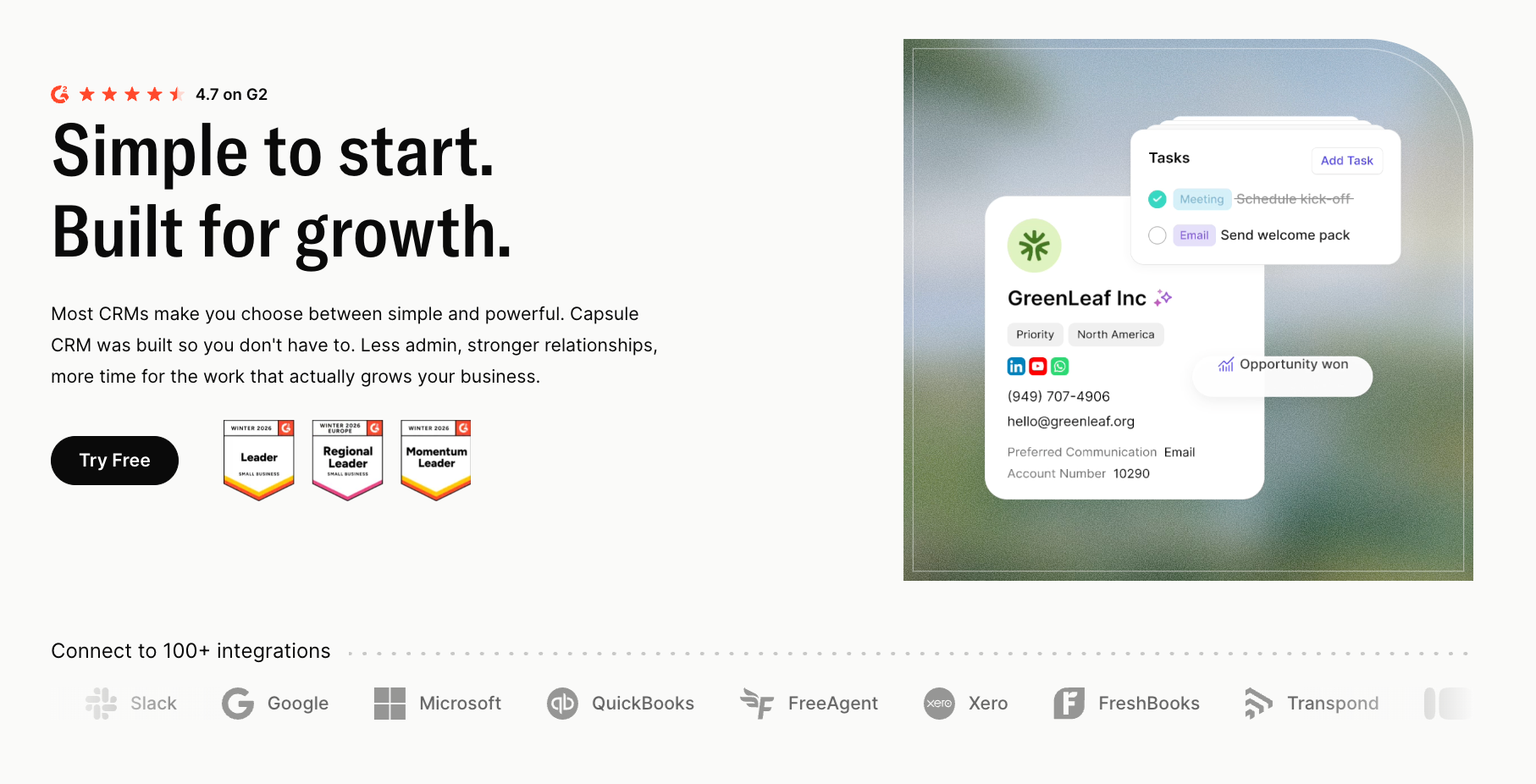
Many moving company platforms handle operations and dispatch well, but their CRM and marketing depth is shallow. This is precisely where a dedicated CRM proves its value.
Capsule keeps the customer relationship layer separate from the operational layer, so the sales and dispatch teams can each work in the system that fits their job. A booking coordinator focused on converting quote requests doesn't need to navigate crew scheduling screens, and a dispatcher routing trucks doesn't need to see lead nurture campaigns.
Capsule's contact management gives every lead and customer a full timeline of communication and notes, with active move opportunities attached to the record. When a customer who got a quote four months ago calls back, the company has the original conversation and the quoted price, along with the reason they didn't move forward at the time. Such continuity turns cold callbacks into warm conversations, and warm conversations close at meaningfully higher rates than fresh inquiries.
Capsule features moving companies like
1. Pipelines for quote requests and booked moves
Moving companies can use separate pipelines for new inquiries and confirmed bookings. A quote request pipeline might run from initial inquiry to estimate scheduled. A booking pipeline might move from estimate sent to deposit received and move confirmed.
This gives the intake team a clean view of new leads, while the booking team can focus on jobs closer to moving day.
2. Tracks for estimate follow-ups
When crews are on the road and phones keep ringing, follow-up is easy to miss. Capsule Tracks help moving companies standardize the next steps after a quote request or estimate.
A new inquiry can trigger immediate outreach, while an estimate can prompt a follow-up call two days later and another email a week after. Dormant leads can also be added to a quarterly nurture sequence.
3. AI summaries before customer callbacks
Before calling a customer back, reps can use Capsule AI Summaries to catch up on recent notes, quote details, and activity history.

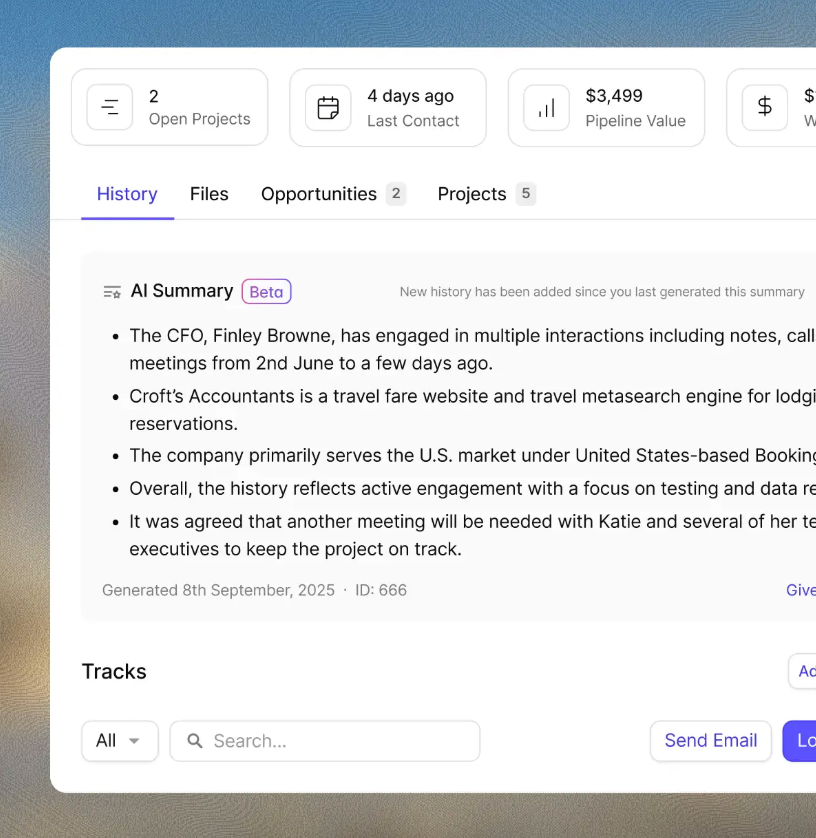
For movers, this means the team can quickly see whether the customer asked about packing, storage, stairs, long carry fees, or a specific move date before picking up the phone.
Capsule positions its AI tools around faster preparation, summaries, and customer communication.
4. AI email help for quote and move-day messages
Moving companies send a lot of repeat-but-important emails: quote follow-ups, estimate reminders, deposit confirmations, packing instructions, and move-day check-ins.
Capsule’s AI email support can help turn CRM context into quicker customer messages, so coordinators are not rewriting the same emails all day.
5. Contact records for every customer detail
A moving quote depends on details: origin and destination, home size, inventory notes, access issues, elevator requirements, storage needs, and preferred move date. Capsule gives teams a central place to keep customer information, interactions, notes, files, and sales opportunities, helping everyone work from the same customer record, anywhere.
6. Sales analytics for lead sources and booking rates
Capsule’s reporting helps owners understand what happens between first contact and confirmed booking. Movers can track which lead sources bring the best customers, which estimates stall, and how long it takes to move from inquiry to deposit. Those insights can guide marketing spend, sales coaching, and capacity planning during peak moving season.
Capsule won’t handle crew scheduling, truck routing, vehicle tracking, or bills of lading.
It works best alongside the operational software a moving company already uses.
And if you need marketing automation beyond basic outreach, Capsule integrates with Transpond, which supports email campaigns, automations, contact syncing, and results flowing back into Capsule.
Pricing: Free plan for up to two users and 250 contacts. Starter from $18/user/month. AI features from $36/user/month.
#2 SmartMoving
SmartMoving is the most widely-deployed moving company platform in North America, with built-in CRM and lead management features that work alongside dispatch and billing integrations.

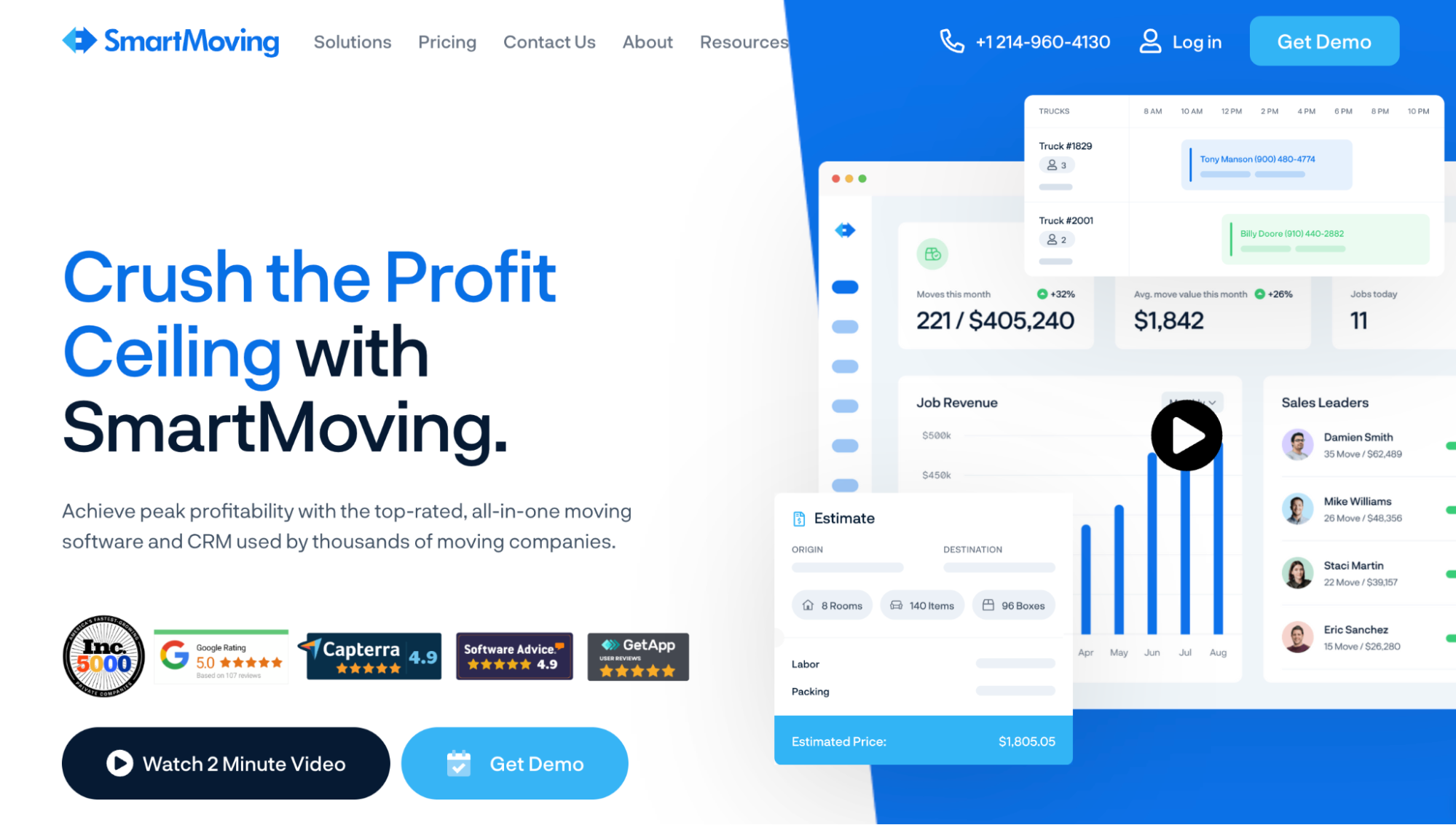
The strength is breadth. It connects lead capture and quote generation with dispatch and accounting in a single platform. A company that wants one tool replacing the entire stack will find SmartMoving's all-in-one approach appealing.
The recently launched SmartMoving 2.0 added updated features around AI and automation, including smarter lead routing and faster quote generation.
Where SmartMoving narrows is the pure CRM layer. Its lead management and customer communication features are functional, but they were built around the operational workflow first. Teams that want serious pipeline reporting outside the booking flow often find the CRM layer thinner than dedicated tools.
SmartMoving fits established moving companies that want consistency across teams and value operational depth over CRM sophistication.
Pricing: SmartMoving doesn't publish standard CRM pricing. Plans depend on company size and selected modules, with custom quotes through a demo process.
#3 Supermove
Supermove is a cloud-based moving CRM and operations system designed to help established movers automate various business processes.

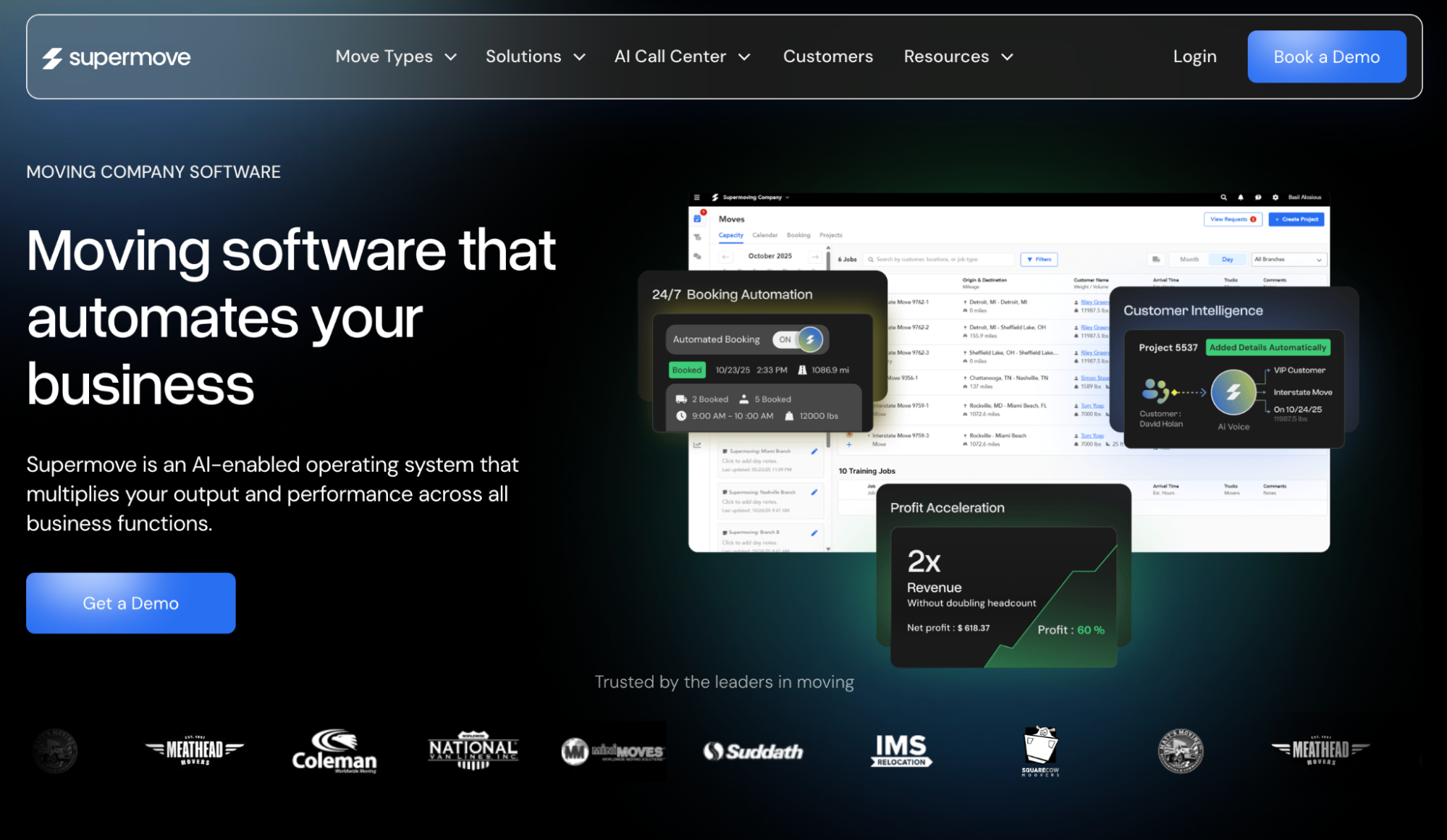
The product covers dispatch alongside billing and company communication in one platform. The interface is cleaner than older industry tools, and the mobile apps for crews in the field get strong reviews. Real-time communication between the office and crews is a particular strength, since dispatchers can push updates directly to crew phones and receive job status changes back in seconds.
The price is where Supermove sets itself apart, and not always in a good way. It costs more than simpler moving CRMs, which makes sense given the feature depth, but can stretch the budget of smaller operations. Single-truck operators rarely get value proportional to what they pay; larger fleets running multiple crews per day usually do.
Supermove suits growing moving companies that have outgrown spreadsheet workflows and want a modern interface across office and field teams. Smaller operations happy with their existing dispatch system will struggle to justify the cost.
Pricing: Supermove uses custom pricing on request, typically positioned for established moving companies.
#4 Movegistics
Movegistics is a moving company CRM that integrates sales and operations, with features built specifically for the moving industry workflow.

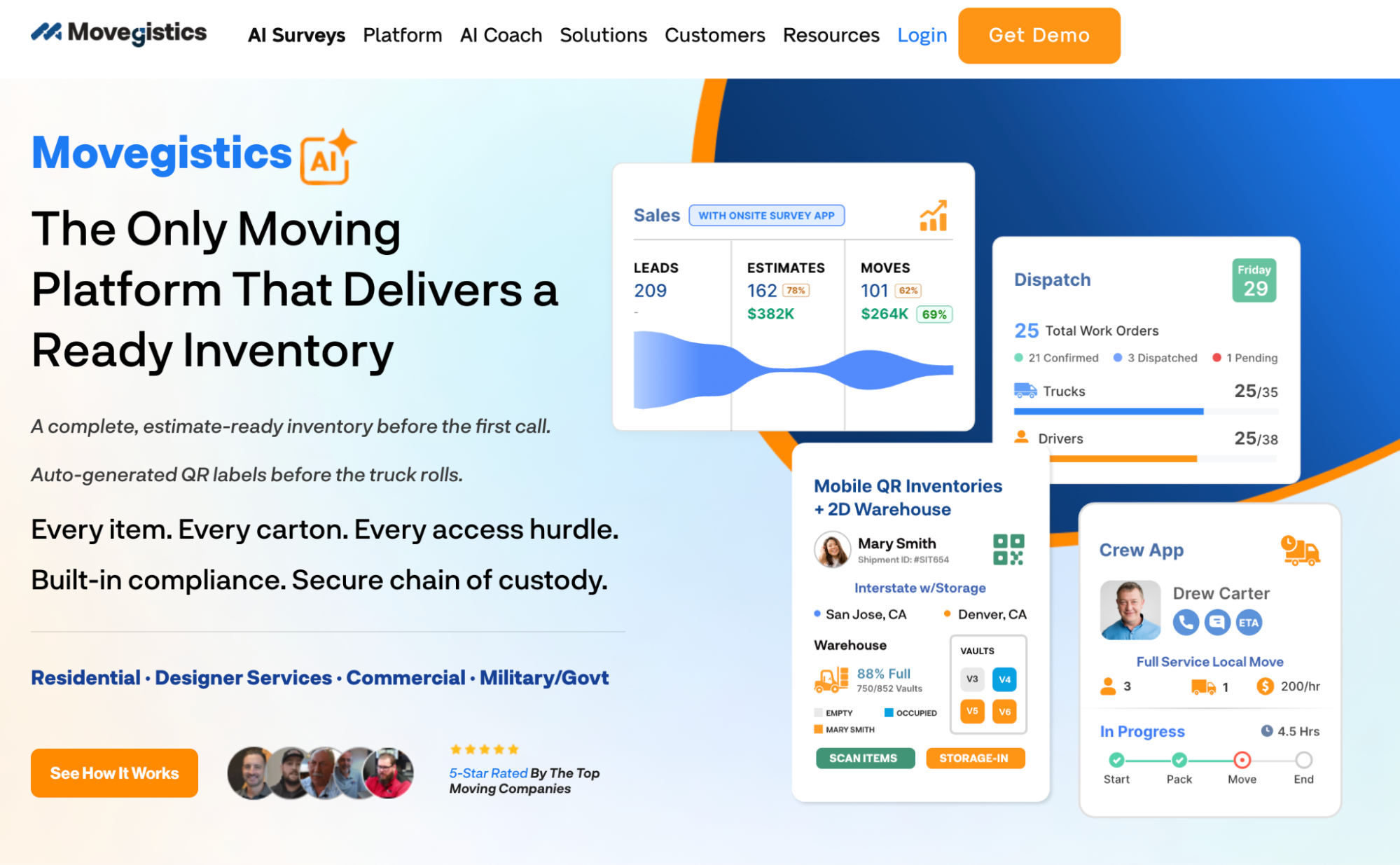
The platform handles two-way texting and email campaigns alongside live chat, with sales automation and wireless dispatch built into the same system. Storage management and QuickBooks integration round out the toolset. Movegistics covers more ground on the customer outreach side than pure dispatch platforms.
The marketing-first orientation is the actual differentiator. Movegistics treats customer outreach as a first-class concern, not an afterthought layered on top of operations. The flexibility comes at a setup cost: configuration takes longer than simpler tools, and small operations may find the learning curve heavier than expected.
Movegistics works best for moving companies that take marketing seriously and want the CRM and operational systems closer together.
Pricing: Movegistics doesn't publish clear standard pricing on its plans page. Companies should confirm current pricing directly with the vendor.
#5 MoversTech CRM
MoversTech is a cloud-based moving CRM built around customization, designed to adapt to how a specific moving company actually works.

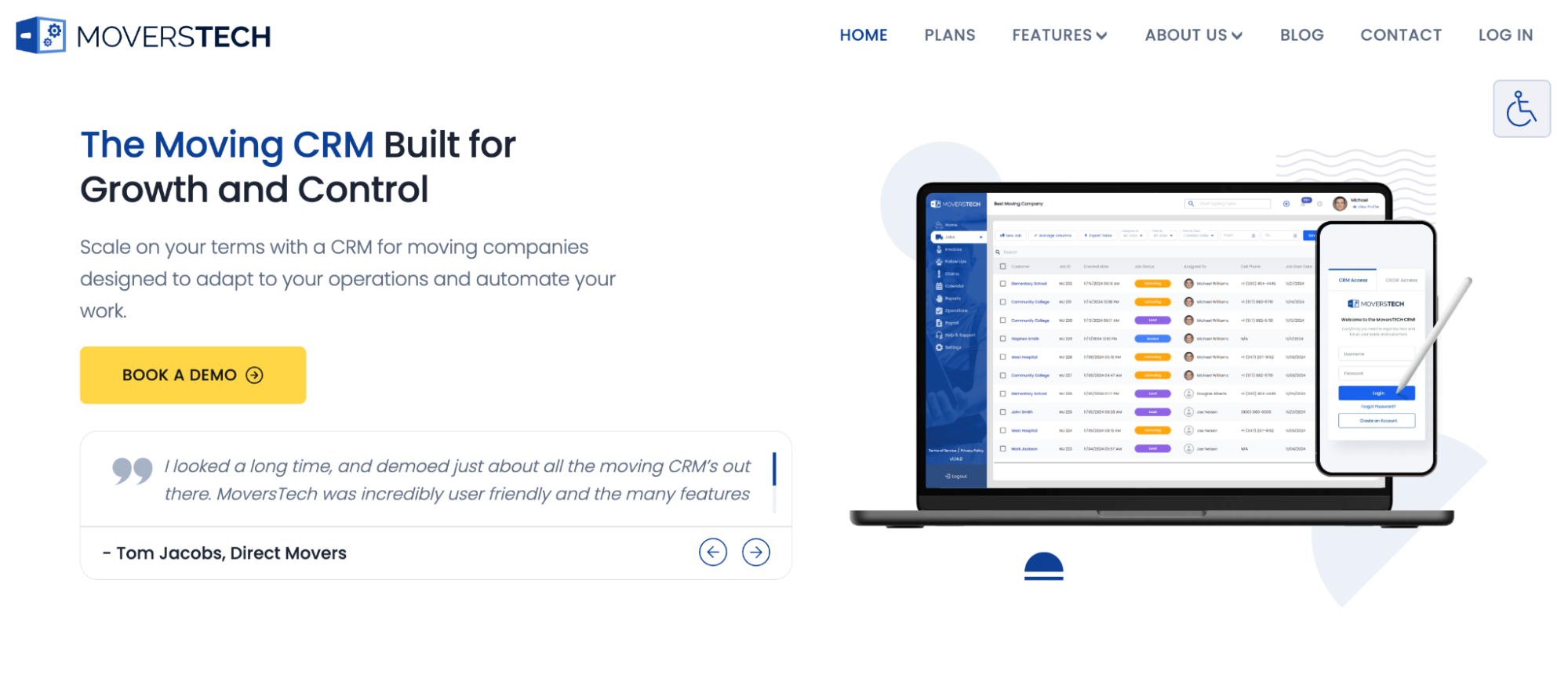
The product positions itself as configurable. Companies that don't fit a standard workflow, or that have processes built around specific operational needs, find MoversTech easier to adapt than more rigid alternatives. The platform supports scheduling too, with communication and reporting tools that revolve around the company's actual sales process.
Configurability comes with a setup cost. The flexibility pays off later, but the first few weeks demand real attention to map workflows, define stages, and configure automations. Companies that skip the setup investment end up with a system that looks customizable on paper and feels generic in practice.
MoversTech fits moving companies with clear ideas about how they want their CRM to work and the patience to invest in setup. Operations that want a system running by the end of the week will get more out of a templated platform.
Pricing: MoversTech offers tiered pricing based on user count and selected modules. Standard plans start around $99/month per user.
#6 HubSpot CRM
HubSpot is a general-purpose CRM with strong marketing automation features, used by some moving companies that want CRM and marketing under one roof.

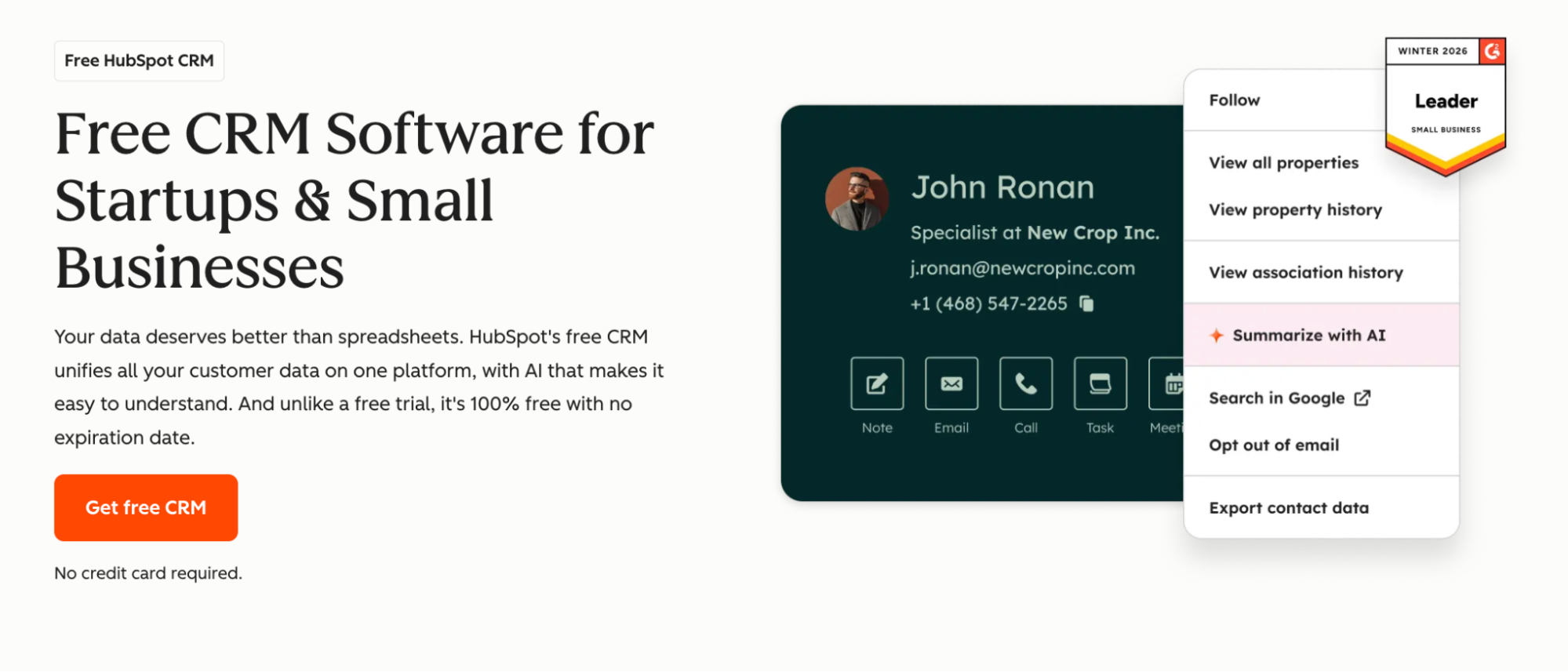
The platform handles contact management and pipeline tracking, with online booking and email/SMS marketing built in. Reputation management rounds out the bundle. A moving company that wants one tool covering acquisition and reputation will find HubSpot's bundled approach appealing.
The general-purpose nature shows up in fit. HubSpot wasn't built for moving specifically, so deep workflow modeling around estimates and dispatch handoff doesn't exist natively. Companies that need those features end up pairing HubSpot with a dispatch platform, or picking a moving-specific tool instead.
HubSpot is a credible choice when marketing depth matters more than operational depth. Companies focused on the operational side typically get more from an industry-specific platform or a focused CRM like Capsule.
Pricing: Free plan available. Marketing Hub paid plans from $20/user/month.
#7 Chariot
Chariot gives moving companies one place to manage the work around every move, from the first lead and estimate to dispatch, payment, and move-day paperwork.

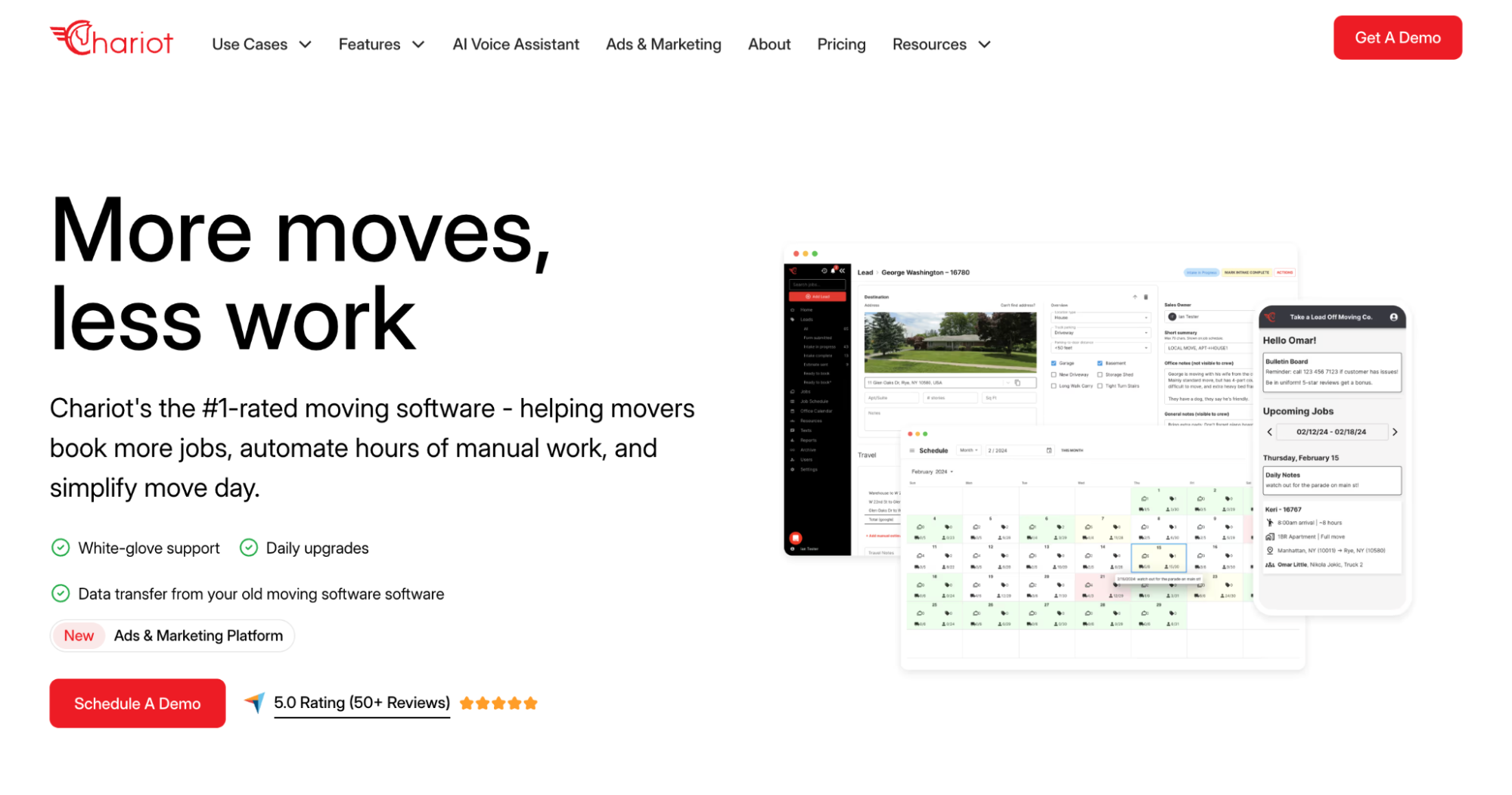
The platform’s strength is usability. Chariot focuses on making the day-to-day flow easier for office teams and crews, with tools for leads, estimates, job scheduling, dispatch, customer communication, payments, storage, and reporting. It also has an AI Voice Assistant that can answer calls, collect move details, and create qualified leads inside Chariot’s CRM, which is useful for movers losing jobs to missed calls or after-hours inquiries.
Where Chariot fits best is with small to mid-sized moving companies that want a cleaner, more modern system than legacy moving software. The dispatch and crew-facing features make it more operationally complete than a general-purpose CRM, while the AI call handling gives it a sharper lead-capture angle.
The limitation is the same one many all-in-one moving platforms have: companies that already have a dispatch or operations system they like may not need the whole stack. Chariot makes the most sense when the company is ready to centralize more of the business in one moving-specific platform.
Pricing: Chariot uses company-size-based pricing and says it does not charge per user or per SMS, but movers need to speak with the vendor to confirm exact pricing.
#8 MoverBase
MoverBase is a moving CRM built for smaller moving companies that want a practical way to manage leads, quotes, jobs, scheduling, crews, vehicles, and payments without jumping into a heavy enterprise platform.

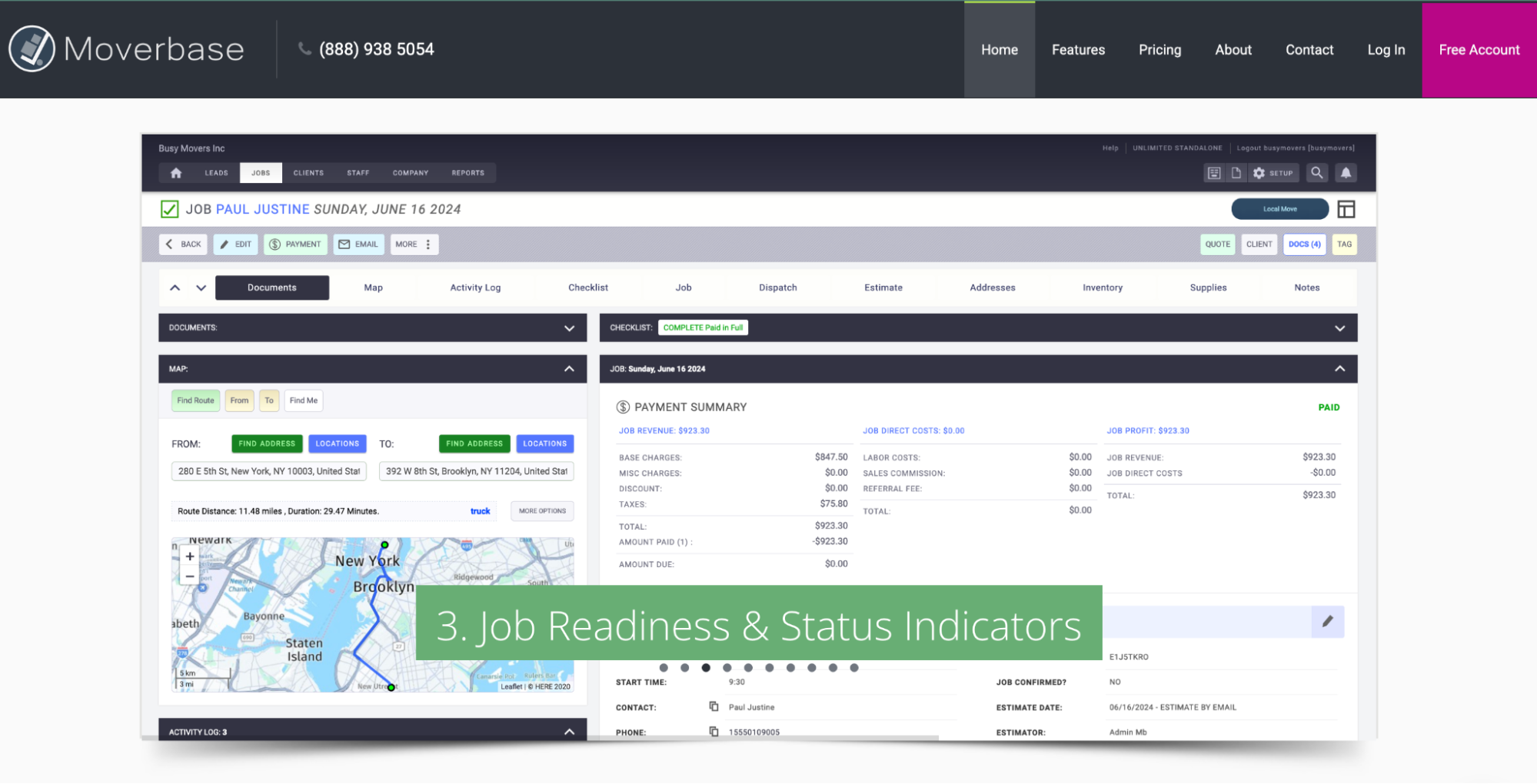
The product covers the core moving workflow: lead capture, online quotes, client and sales management, scheduling, dispatch, mover and driver allocation, job status tracking, notifications, and reporting. Its estimator tools can calculate job pricing based on company rates, trucks, inventory, supplies, move duration, and travel time, which makes it useful for movers who want quoting and job management in one place.
MoverBase’s biggest advantage is accessibility. It is not positioned like a large, custom enterprise system. It works well for movers who need a usable CRM and operations hub without the complexity or cost of a bigger all-in-one platform.
The trade-off is depth. Larger moving companies with multiple branches, advanced automation needs, or more complex operational reporting may outgrow it faster than they would outgrow other platforms.
Pricing: MoverBase offers a free trial account, with premium plans starting at $19, according to its pricing page.
Why Capsule leads the list for moving company CRM
Moving companies rarely lose jobs on move day. They lose them in the space between the first quote request and the booked deposit.
Capsule is built for that space.
It gives movers a simple way to manage new leads, estimates, follow-ups, deposits, and confirmed bookings before the job reaches dispatch. Teams can add custom fields for move size, distance, access issues, storage needs, lead source, and preferred move date, with Capsule supporting custom fields across people, organizations, opportunities, and projects.
That makes Capsule a strong fit for companies with dispatch, routing, or billing tools already in place. It keeps the sales side clean: faster responses, clearer ownership, better follow-up, and one customer record everyone can trust.
For movers paying more for every lead, the CRM has one job: help more quote requests become booked moves. Capsule does that well.
Try Capsule today.