
What’s worse for a banker than not knowing the right person?
Knowing the right person too late.
A founder starts thinking about a sale. A CFO mentions growth plans in passing. A sponsor begins looking at a sector your firm knows inside out. Somewhere in the firm, there may already be a warm path in. But if that context sits in an old email, a private note, or someone’s memory, the moment can pass before anyone acts on it.
That’s exactly why CRM matters so much in investment banking.
Banking is built on long-term relationships, quiet signals, warm introductions, and deals that may take months to materialize. They often need more than just a name and a number, but also the surrounding context: who knows the person, what came up last time, which angle matters now, and who should follow up next.
A good CRM for investment bankers makes it easy to find this information. This guide looks at the best CRM tools for investment bankers in 2026, from practical options for boutique advisory firms to deeper platforms built for relationship intelligence.
Why standard CRMs struggle with investment banking
Most CRMs assume a deal starts when someone enters the pipeline.
Investment banking doesn’t work that way.
A mandate may start as a quiet comment from a founder, a warm intro from a board member, or a relationship that has been dormant for two years. By the time the opportunity looks “active” in a standard CRM, the real work may already be late.
Here is where generic CRMs usually start to break:
#1 They treat relationships like owned records
In a typical CRM, a contact belongs to one user or one account owner. That makes sense in a simple sales team. It makes less sense in investment banking, where the most valuable question is often:
Who in the firm has the strongest path into this person?
A senior banker may know the CFO, while an associate may have previously worked with the founder. A partner may have a board-level relationship that never made it into the system. If that context stays buried in private notes, the firm’s network looks smaller than it really is.
#2 They make deal work look too linear
Investment banking deals rarely move through a clean set of stages.
A conversation can sit in coverage mode for months, move into a live sales process quickly, slow down during diligence, then come back with a new structure or buyer set. Several people may touch the relationship before anything becomes a formal mandate.
A basic pipeline can track “stage,” but it often misses the shape of the work around it: relationship history, internal ownership, client sensitivities, timing, follow-up discipline, and the small signals that tell a banker whether an opportunity is warming up or drifting.
#3 They ask busy people to do too much admin
This is where many CRM projects lose bankers.
If the system depends on people logging every interaction manually after long calls, late nights, and client deadlines, the data won’t be up-to-date. Once the data feels incomplete, people stop trusting it. Once they stop trusting it, they go back to email and spreadsheets.
#4 They don't always match the risk profile
Investment banking teams also need tighter control over access, activity history, and sensitive deal information. A CRM used across a regulated advisory firm has to support clean permissions, reliable records, and visibility without creating unnecessary exposure.
If those controls feel bolted on, teams create workarounds, which is when risks appear.
The best CRM tools for investment bankers in 2026
1. Capsule CRM

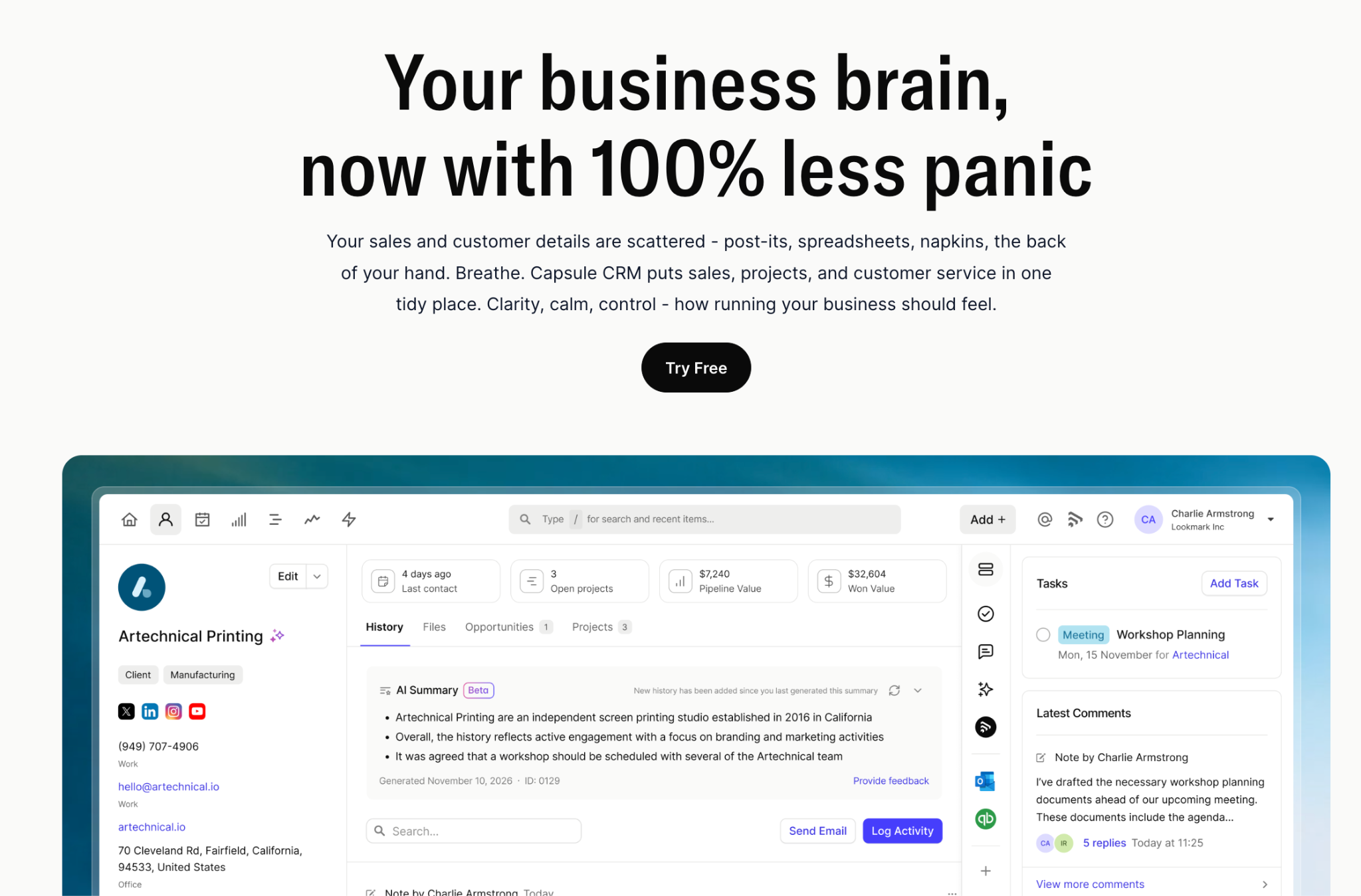
Capsule won't be the first name that comes to mind when most investment bankers think of CRM software, but it earns its place at the top of this list for a specific. It's the platform that investment banking teams with simple deal workflows and limited IT overhead can deploy and actually use from day one.
Game-changing features for bankers
1. A full relationship timeline before every call
Capsule keeps emails, notes, calls, tasks, and previous activity in one client timeline. That means a banker can see the full relationship history before a meeting.
For long-running mandates or slow-burn client relationships, that saves time and reduces the risk of walking into a conversation underprepared.
2. Pipeline tracking that fits real deal stages
Capsule’s pipelines can reflect the way a smaller investment banking team actually works: origination, early conversations, pitch, mandate, execution, close, and follow-up.
Teams can also run multiple pipelines for different deal types or client segments.
3. Custom fields for deal-specific context
Not every deal can be tracked with a generic “stage” and “value” field. Capsule lets teams add the details that matter to their process, such as sector, deal size, referral source, buyer type, intermediary relationship, or diligence notes.
Your CRM becomes more useful for business development and internal review.
4. Tracks for repeatable follow-up
Capsule’s Tracks feature helps teams create repeatable task sequences for common deal workflows. After a meeting, proposal, intro, or mandate update, the next steps can be assigned automatically.
When a banker has five promising conversations moving at different speeds, “I’ll remember” isn't a system. Capsule keeps the next step attached to the opportunity.
How Capsule AI can help bankers move faster
The awkward moment isn't the client call. It’s the ten minutes before it, when someone asks, “Wait, where did we leave this?”
Capsule AI helps answer that faster.

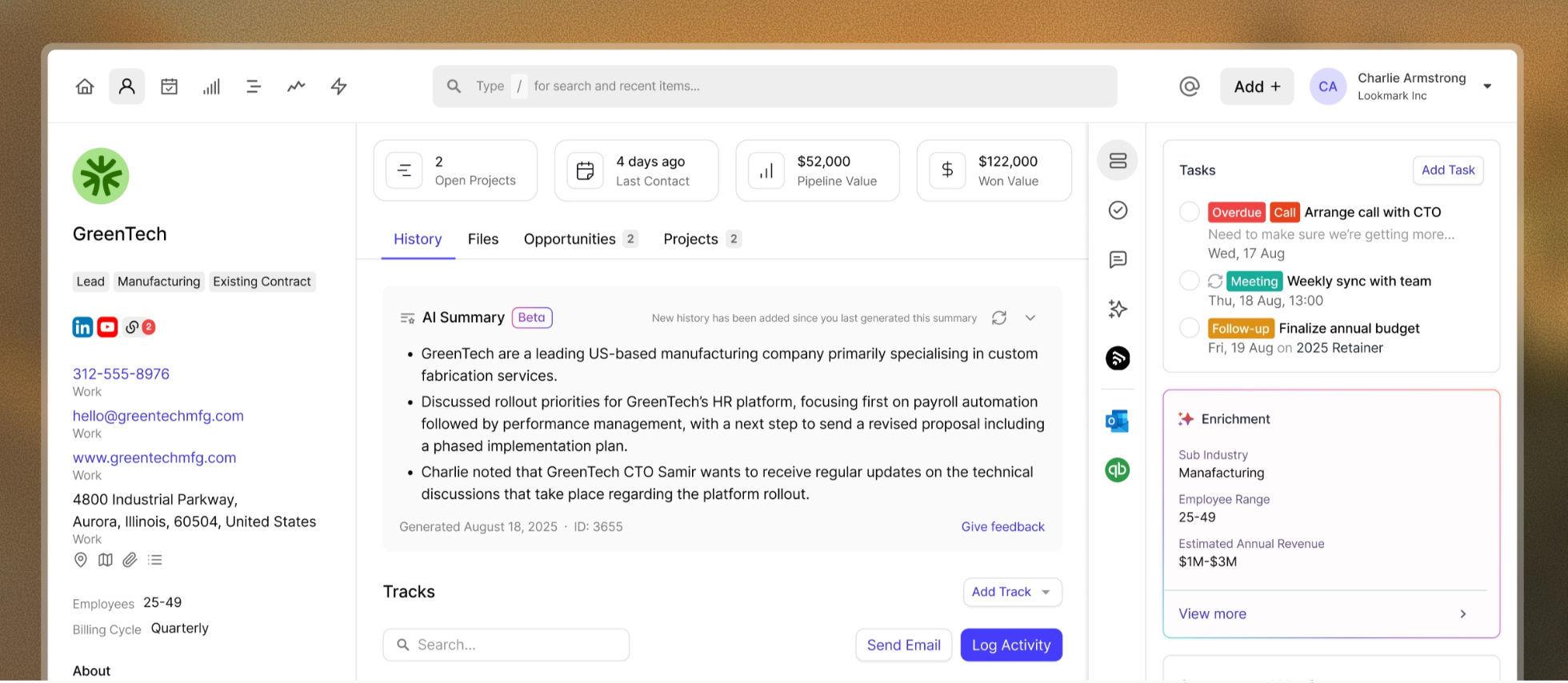
AI Email Assist can help with the follow-up after that call: the recap, the next-step note, the polite nudge that should go out today and not next Thursday. The AI Pipeline Generator is also helpful for boutique firms setting up CRM around their own deal stages instead of forcing everything into a generic sales flow. For lean deal teams, Capsule AI is less about “doing banking with AI” and more about removing the small delays that make good relationships work harder than it needs to.
Pricing: Free plan available. Starter from $18/user/month; AI features from $36/user/month.

2. 4Degrees
4Degrees was built by former investors specifically for deal-driven industries (venture capital, private equity firms, M&A, and investment banking), and the product reflects that origin in ways that matter.

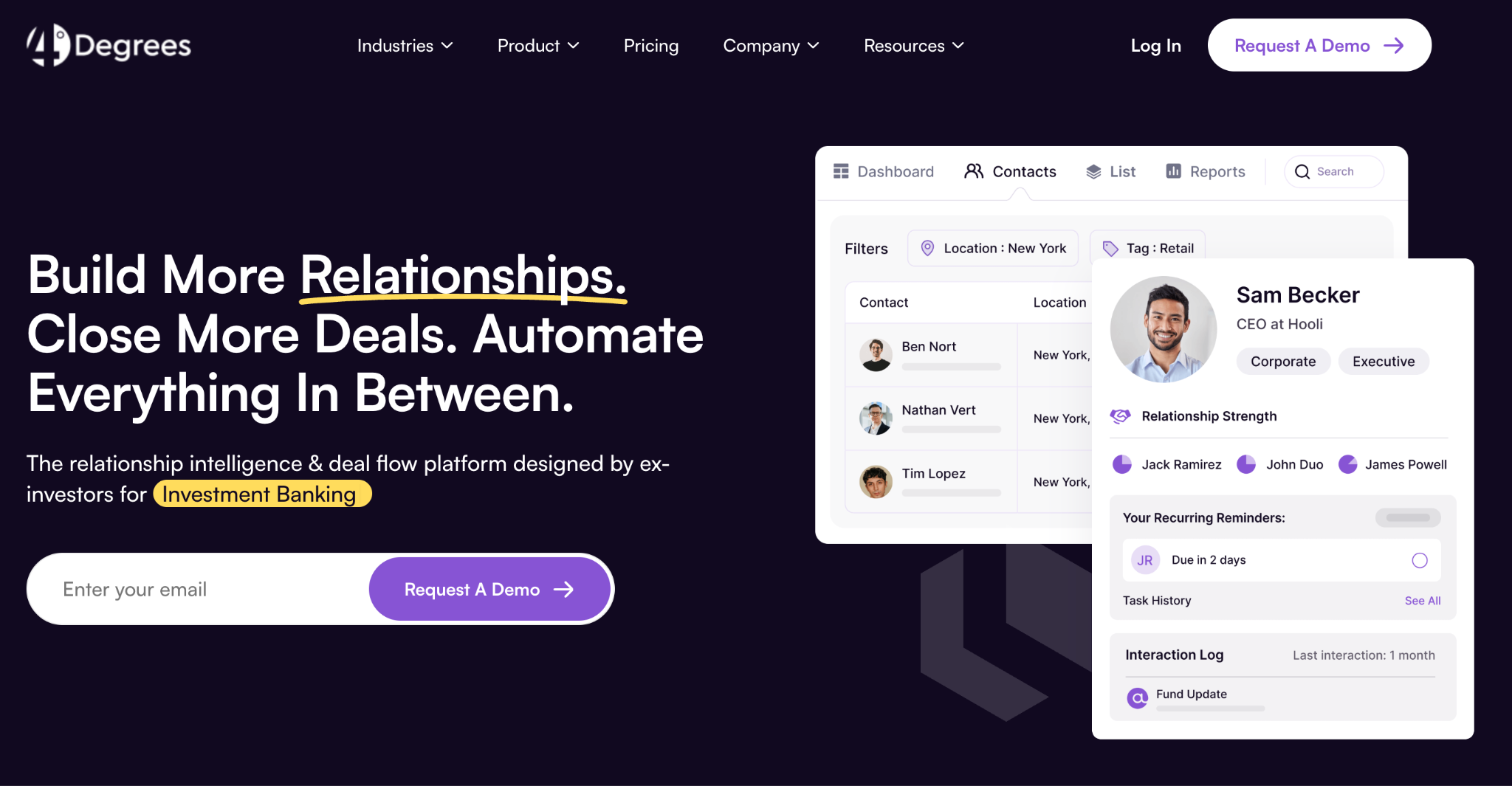
Its strongest feature is relationship intelligence. The platform can map who across the firm has the best path into a company or contact, then weigh that relationship based on signals like communication history and recency. That's useful when a banker needs to reach a CFO, founder, sponsor, advisor, or board member and wants to know who can open the door fastest. 4Degrees positions this directly around warm introduction paths and relationship strength scoring for private markets teams.
The product also reduces the CRM admin that usually kills adoption. 4Degrees syncs with email, calendars, and third-party sources such as Crunchbase and PitchBook. Its own CRM page also highlights automatic enrichment, plus synced email and calendar history in one place.
The trade-off is that 4Degrees makes the most sense when relationship intelligence is truly central to how the firm wins work. If the team mainly needs clean contact management and a simple pipeline, it may feel heavier than necessary. Reviews and market comparisons also point to a learning curve, and reporting that may not satisfy firms that need very complex analytics.
So the fit is clear: 4Degrees is strong for investment banking teams that want a purpose-built private markets CRM for relationship-led sourcing. It's less compelling for smaller teams that need a lighter system they can roll out quickly.
Pricing: Custom pricing on request.
3. Affinity
Affinity works best for investment banking teams that want their relationship map to update itself instead of relying on bankers to log every touchpoint by hand.

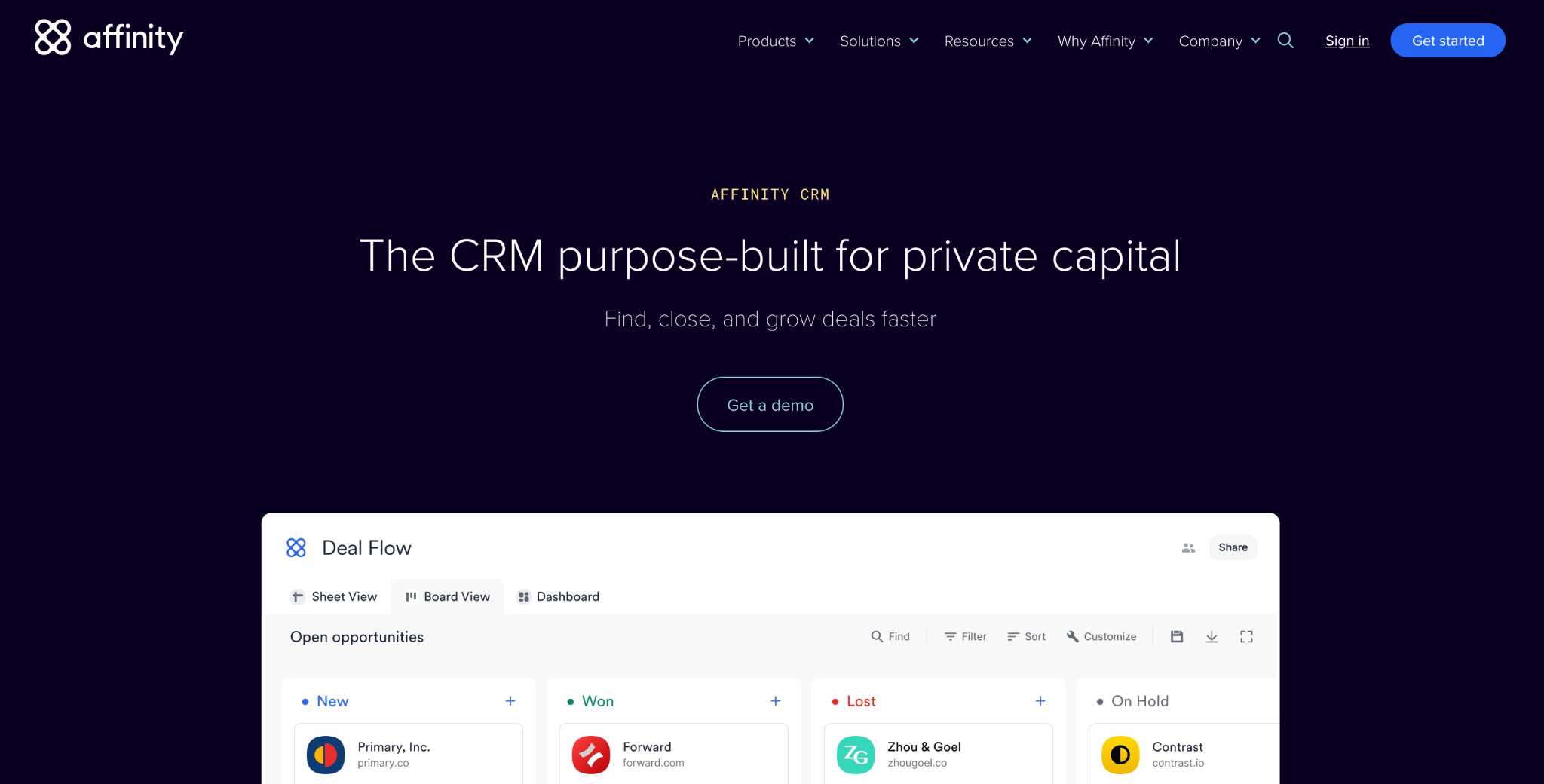
Affinity offers automatic activity capture. That gives bankers a clearer view of what's happened with a prospect or client. Affinity also highlights this use case on its investment banking page, where it frames automatic interaction capture as a way to track engagement and spot the right time to move a discussion forward.
The relationship layer is where Affinity gets more specific. The platform shows previous meetings, email communication, relationship strength ratings, and smart lists, so teams can see which contacts are active, which relationships are cooling, and which people may create a warm path into a deal. It can also show inferred connections, including shared work history outside the firm’s immediate network.
That makes Affinity useful for coverage-heavy banking teams. Thanks to integrations with APIs, and data permissions, Affinity sits closer to a private-capital CRM than a general sales tool.
There are limits, though. Affinity makes the most sense when the team will use those relationship signals day to day. A boutique firm that only needs a clean pipeline, shared notes, and basic follow-up reminders, may not need this much relationship infrastructure.
The best fit is an investment banking team that wants a clearer view of client engagement across the firm. Affinity is less about creating the next warm intro from scratch and more about making sure the firm’s existing relationship activity does not disappear into inboxes.
Pricing: Custom pricing on request; typically $2,000–$3,000 per user annually.
4. Intapp DealCloud
Intapp DealCloud is the heavy-duty option in this list. It makes the most sense for larger investment banking and advisory firms that need real deal infrastructure.

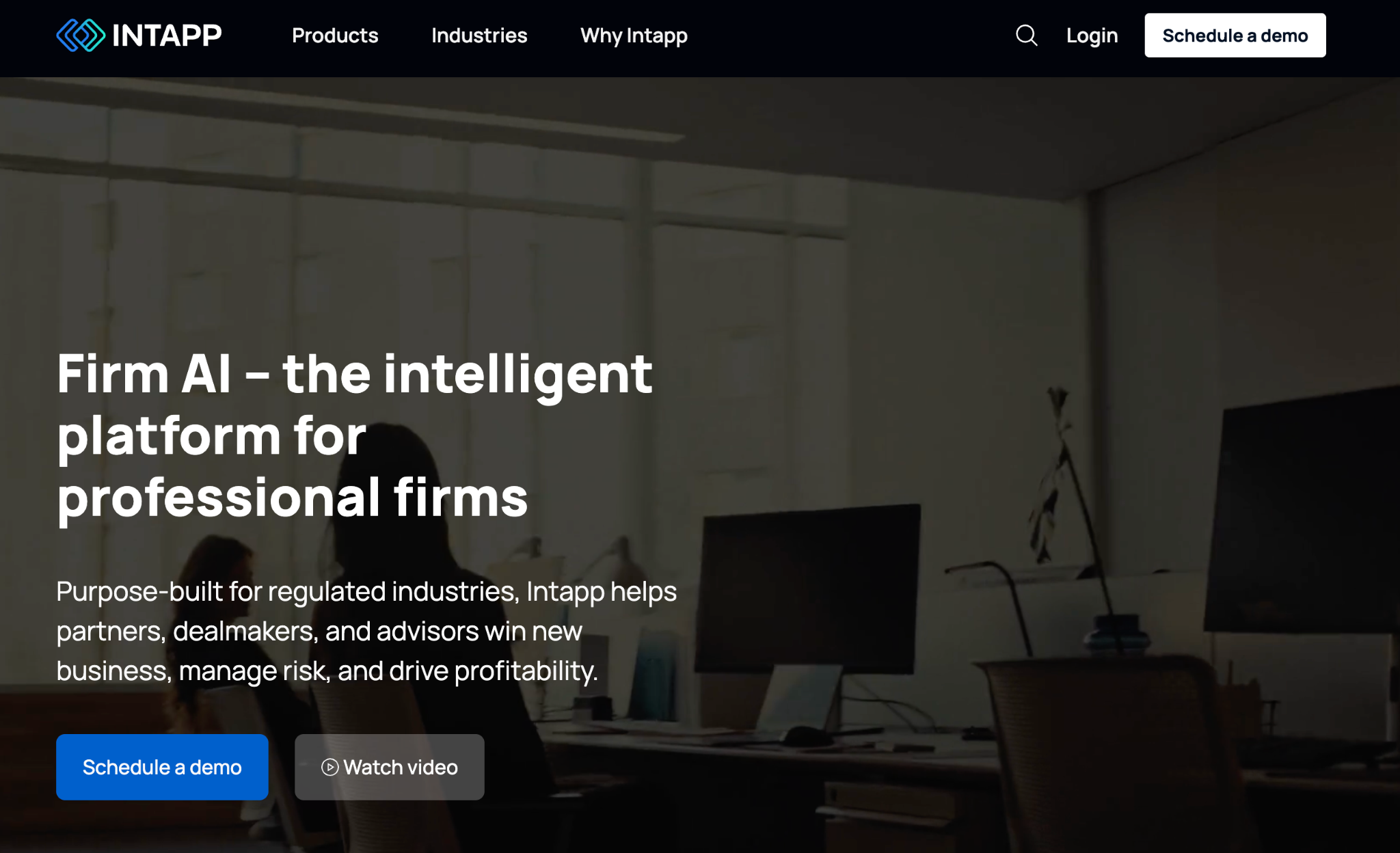
The platform is built around pipeline and deal management. DealCloud gives teams a central view of deal flow, relationships, sourcing activity, staffing details, workflows, and reports, so senior bankers can see what is moving without chasing updates across the firm. Its pipeline product also supports automated task workflows, notifications, configurable reporting, market intelligence, and AI-generated deal signals.
Where DealCloud stands out is how specific it is to investment banking work. Intapp describes the platform as built for regulated markets, with AI-driven deal and relationship intelligence inside the workflow. Its investment banking CRM materials focus on the full lifecycle: sourcing, execution, closing, compliance records, relationship intelligence, and integrations with tools such as Microsoft 365 and market data providers.
DealCloud also covers the controls that generic CRMs often leave to custom setup. Teams can manage audit trails, data retention, conflict checks, user permissions, and secure access inside the platform. That matters when client information and deal activity need proper control.
The downside is obvious: this is not a plug-and-play CRM for a lean team. DealCloud is powerful because it can model complex deal workflows, reporting needs, permissions, and firmwide data. That also means setup, ownership, training, and budget need to be taken seriously. Intapp does offer an accelerated investment banking deployment option, with materials describing a two-to-three-week implementation path and go-live in under a month, but firms should still expect a much heavier CRM decision than choosing a lightweight tool.
DealCloud is best for firms that need enterprise-grade deal management, compliance-ready workflows, and deep pipeline visibility across teams. Smaller advisory firms may get more value from a simpler CRM unless their workflows already justify this level of structure.
Pricing: Enterprise pricing on request.
5. Salesforce Financial Services Cloud
Salesforce needs little introduction as a CRM for investment banking context; the question is always whether the flexibility justifies the complexity. Financial Services Cloud is Salesforce's industry-specific configuration, with pre-built data models for financial advisors, wealth managers, and banking relationships that reduce the customization burden compared to standard Salesforce.

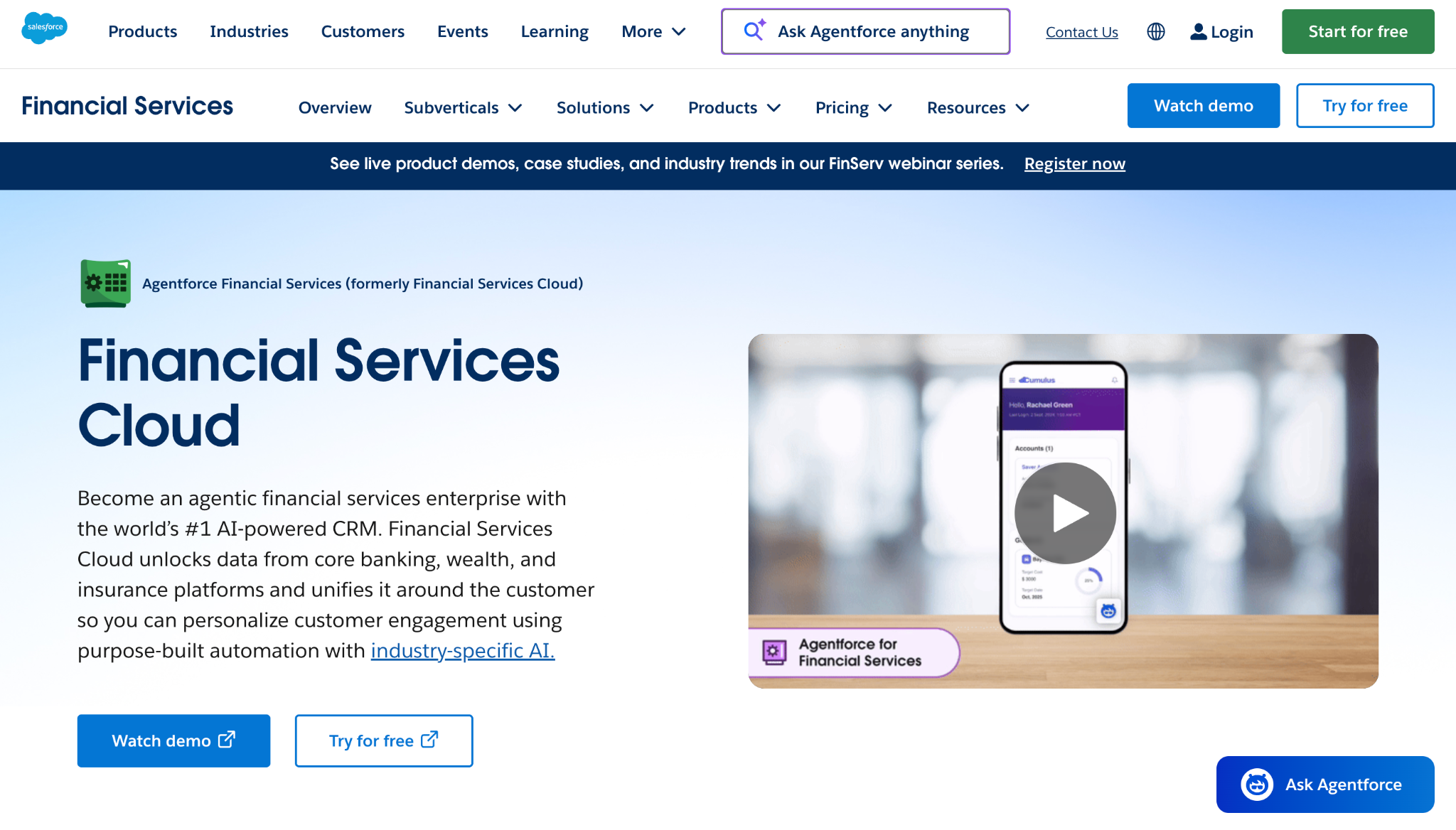
Salesforce’s main advantage is how much it can connect to. It can connect with data sources, communication tools, reporting systems, and back-office platforms that a larger investment banking team may already use. Financial Services Cloud also gives financial institutions industry-specific relationship management features on top of the wider Salesforce platform.
Einstein AI adds another layer for teams that want predictive insights and stronger analytics across client and deal activity. That can be useful at scale, especially when leadership wants more than a static pipeline view.
The compliance and data privacy setup is strong, but it still needs proper configuration. Role-based access, audit trails, sensitive data handling, and security controls can all be built into the platform, but Salesforce usually works best with an experienced admin or implementation partner behind it.
That's the main thing to understand. Salesforce Financial Services Cloud can be shaped around very complex banking workflows, but it's rarely the fastest or lightest CRM to roll out. The platform can do a lot. Making it do the right things for an investment banking team takes time, budget, and someone who knows the system well.
The value is clearest when Salesforce expertise already exists in-house. A firm evaluating CRM from scratch should treat implementation as part of the real cost, not a detail to sort out later.
Pricing: From $300/user/month (Financial Services Cloud).
Choose the CRM for investment bankers your team will use
The right CRM for investment bankers should make relationship work easier to manage, not harder to maintain.
Before you choose, look at the moments where your current process breaks down.
Do bankers lose track of follow-ups? Do client notes sit in private inboxes? Do principals have to chase the team for pipeline updates? Does the firm know who has the strongest relationship with a target contact, or does that still depend on asking around?
Those answers matter more than a long feature list.
A boutique advisory team may get more value from a CRM that is easy to set up, easy to keep current, and strong enough to manage client relationships, opportunities, tasks, and follow-ups. A larger firm may need deeper relationship intelligence, stricter permissions, compliance workflows, or enterprise-level reporting.
Neither route is automatically better. The best fit depends on how the firm sources deals, manages mandates, and shares client context across the team.
The real test is simple: can a banker open the CRM before a call and quickly understand the relationship, the last meaningful touchpoint, the next step, and the state of the opportunity?
If yes, the CRM has a chance to become part of the workflow. If not, it becomes another system people update when they have to.
Capsule CRM offers a 14-day free trial with no credit card required, so smaller investment banking and advisory teams can test whether a lighter, relationship-led CRM fits their day-to-day work before committing.