
Creatio isn't only a CRM. It's also a no-code platform for building workflows, applications and AI-powered processes around sales, marketing and service.
That changes what counts as a real alternative.
A small sales team may want to leave Creatio because it needs far less software. An enterprise buyer may still need complex automation but prefer Salesforce or Microsoft. Another company may want customization without committing to a platform with a $10,000 annual minimum purchase.
The six alternatives below cover those different paths.
Why are companies looking for Creatio alternatives?
Creatio's biggest selling point is flexibility.
Sales, marketing and service products sit on top of Creatio's Studio and AI platform. Teams can create workflows, change processes and build applications without relying on traditional development for every adjustment. Creatio currently positions AI agents and no-code configuration as core parts of the platform.
Reviews support that positioning.
Creatio scores 4.6/5 across more than 300 G2 reviews, with flexibility, customization and low-code capabilities appearing repeatedly among the positive themes. Reviewers also mention a learning curve and setup complexity once organizations move beyond straightforward configurations.
Pricing narrows the audience further.
Creatio Growth currently costs $40 per platform user per month and the Sales product adds another $15 per user. Enterprise starts at $75 plus the Sales product. New customers face a $10,000 minimum annual purchase, with a standard three-year contract term. AI usage packages can add further costs.
For a company that wants to build workflows and applications around CRM, that investment can make sense. But for a team that mainly needs contacts, pipelines, follow-up and reporting, the buying process should start somewhere else.
Best CRM alternatives to Creatio
1. Capsule CRM
Capsule is almost the opposite of Creatio.

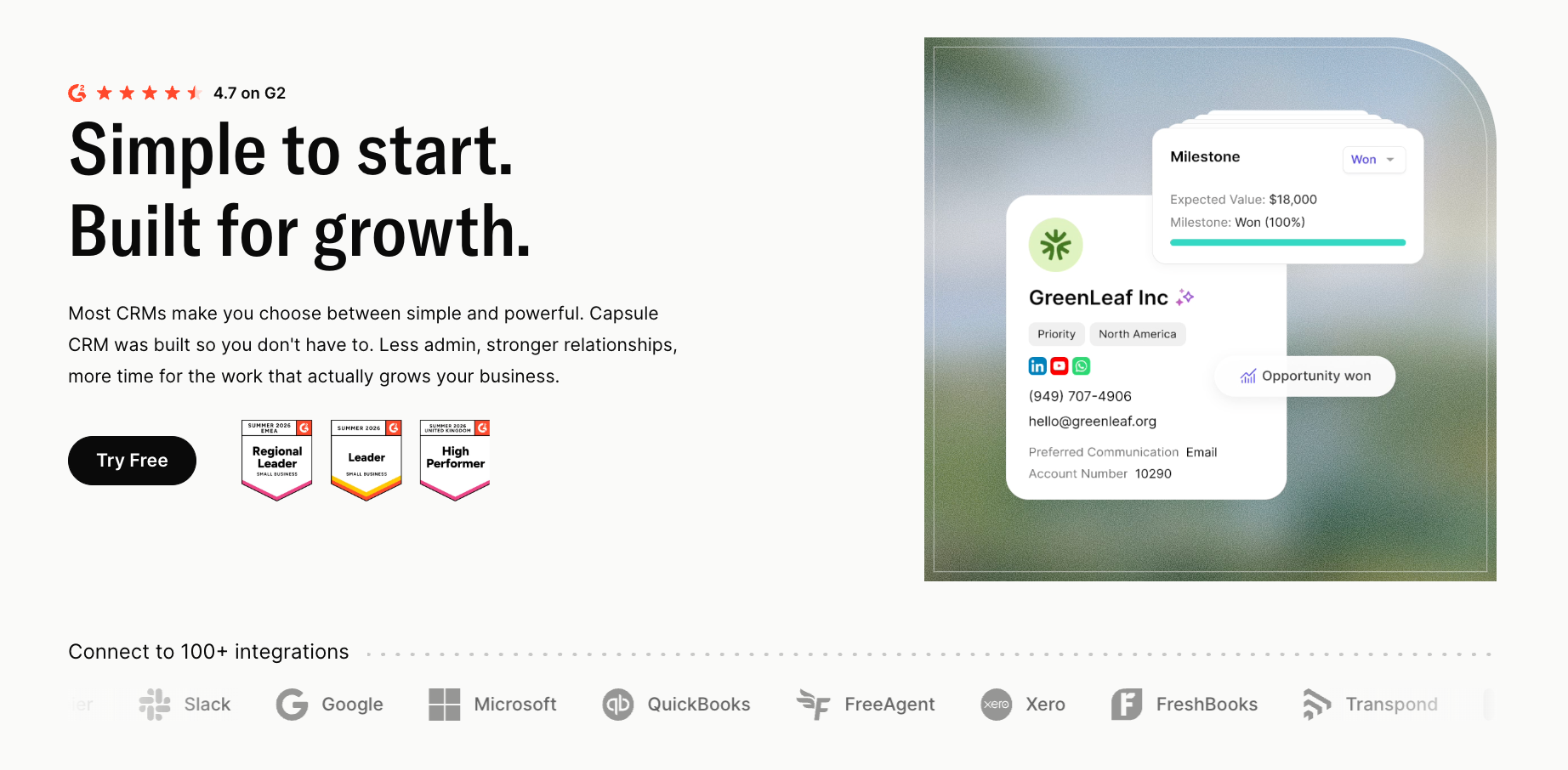
Creatio invites companies to shape the platform around their processes. Capsule assumes most growing businesses need a solid CRM first: customer records, opportunities, tasks, reporting, and automation that doesn't require a major implementation project.
A team can build several sales pipelines, add custom fields, automate repetitive work and manage communication without designing an application around every sales process.
There's still room to adapt the system. Capsule's workflow automation can assign tasks and automate repeatable actions, while Projects can take over once an opportunity becomes client work.
But Capsule isn't trying to compete with Creatio Studio. That's the reason to shortlist it.
A 20-person consulting firm probably doesn't need a no-code development platform to track prospects, prepare follow-ups and manage client relationships. It needs a CRM employees can understand without weeks of configuration.
Current G2 reviews reflect that difference. Capsule scores 4.7/5, with users regularly highlighting easy setup, straightforward pipeline management and low training requirements. Some reviewers want more advanced customization, which is exactly where a product such as Creatio starts moving ahead.
For companies comparing CRM complexity more broadly, the line between standard and custom CRM software is worth defining before paying for functionality nobody plans to configure.
- Best for: SMBs and growing teams that want CRM ready to use without a platform implementation.
- Price: Free for up to two users. Starter from $18/user/month; Growth from $36 when billed annually.
- Review signal: 4.7/5 on G2; usability and quick adoption are recurring positives.
The catch: Capsule won't recreate complex Creatio applications or deeply customized cross-department workflows.
2. Close CRM
Close takes a different route from Creatio.

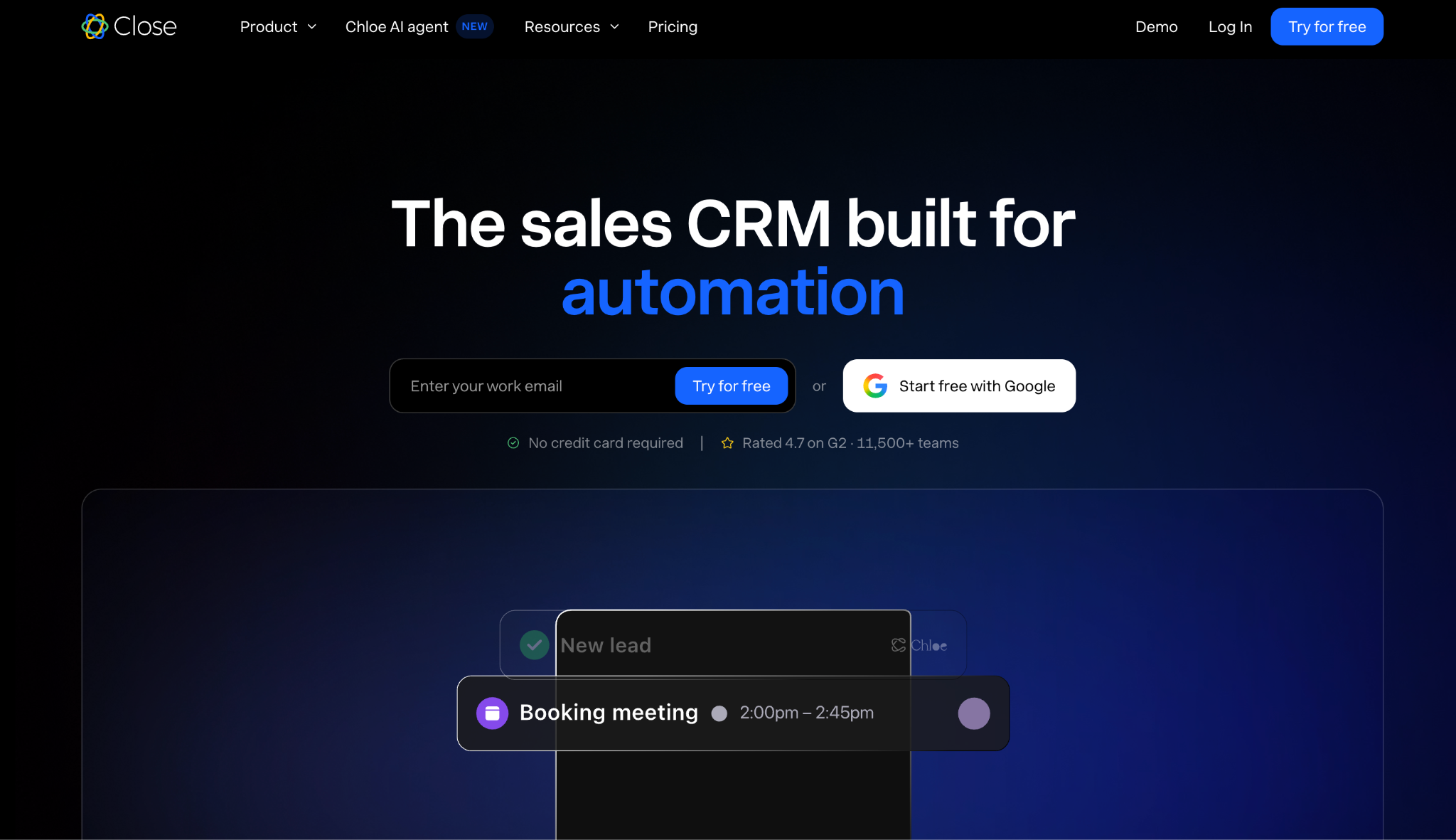
Instead of giving companies a no-code platform for building applications, it puts the day-to-day tools of an inside sales team directly inside the CRM. Reps can manage leads and opportunities, send and receive email, make calls, send SMS messages and work from a centralized inbox without stitching together several separate sales tools.
That makes Close a strong alternative when Creatio is mainly being used to keep outbound sales organized rather than to run custom applications across the business.
Automation is part of the appeal, but the plan level matters. Close's Growth plan adds automated Workflows that can trigger outreach, assign leads and tasks, update CRM records and create opportunities. It also includes the Power Dialer, while the Scale plan adds the Predictive Dialer and more advanced permissions and controls.
The trade-off is that Close is much more opinionated about the job it is designed to do.
It can adapt to different sales processes through pipelines, custom fields and higher-tier customization, but it isn't a replacement for Creatio Studio. Teams that rely on Creatio for deeply customized cross-department workflows or no-code applications would be giving up substantial platform flexibility.
G2 currently rates Close 4.7/5 from more than 2,000 reviews. The sales-focused interface, built-in communication tools, and workflow capabilities are recurring strengths, while the product is less suited to companies looking for a broad all-department CRM platform.
- Best for: Inside sales and outbound teams that want calling, email, SMS, and follow-up automation inside the CRM.
- Price: Solo $9/user/month annually, Essentials $35, Growth $99, and Scale $139.
- Review signal: 4.7/5 on G2 from 2,000+ reviews; sales execution and integrated communication are the main strengths.
The catch: Full automated Workflows start on the Growth plan, and Close doesn't offer Creatio-style no-code application development.
3. Salesforce
Salesforce is the closest option here for companies that still want CRM to function as major business infrastructure.

Sales Cloud covers the familiar CRM layer, but Salesforce can expand through custom objects, automation, integrations, apps and Agentforce. Large companies can build highly specific customer processes without having to move away from enterprise CRM.
Compared with Creatio, the difference isn't “powerful versus simple.”
It's a choice between two large ecosystems.
Creatio puts no-code workflow design at the center. Salesforce gives businesses a vast CRM platform, AppExchange ecosystem and mature administrator/developer environment.
G2 now lists Agentforce Sales, formerly Salesforce Sales Cloud, at 4.4/5 from more than 25,000 reviews. Automation, centralized data and customization receive strong feedback. Complexity and learning curve appear just as consistently among the drawbacks.
One recent enterprise review summarizes the problem neatly: even small workflow changes can require an administrator because changes can affect other parts of a heavily interconnected setup.
So Salesforce isn't the escape route for a company tired of administering Creatio.
It's the alternative for a company that still wants enterprise CRM but prefers Salesforce's ecosystem.
- Best for: Mid-market and enterprise organizations with dedicated CRM resources and complex sales processes.
- Price: Free Suite available; Starter €25/user/month, Pro €100, Enterprise €175, with higher tiers reaching €350 and €550.
- Review signal: 4.4/5 from 25,000+ G2 reviews; customization and automation are strengths, complexity remains a common complaint.
4. Pipedrive
Some Creatio implementations become complicated because the company can customize them, not because sales requires that level of customization.
Pipedrive tests that assumption.

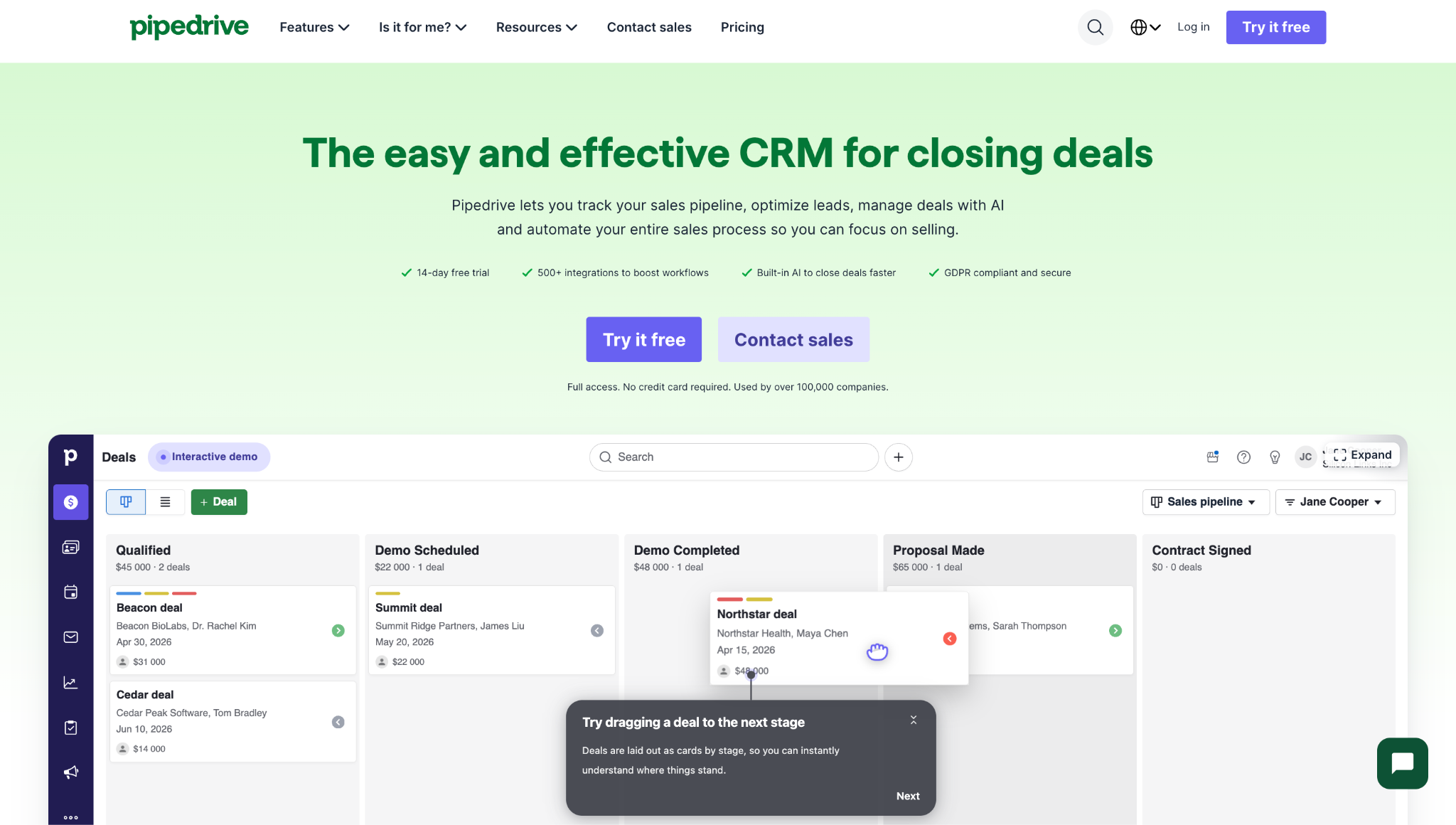
Its interface starts with deals and pipeline stages. Reps can track activities, sync email, build automations and create nurturing sequences without turning CRM administration into a separate discipline.
Current plans also include AI-assisted reports, sales feeds and a large integration ecosystem. Pipedrive advertises more than 500 app connections.
The contrast with Creatio is sharp.
- Creatio asks: How should we build this process?
- Pipedrive asks: What needs to happen next to move the deal forward?
For plenty of sales teams, the second question is enough.
G2 rates Pipedrive 4.3/5 across roughly 3,000 reviews. Recent reviewers repeatedly mention the visual pipeline, straightforward setup and ease of navigation. More advanced customization and complete customer lifecycle management appear among the limitations.
A sales organization that mainly built Creatio workflows to enforce deal stages, reminders and follow-up may get most of the required behavior from a much simpler setup.
- Best for: Sales-led teams that want CRM organized around deals rather than custom applications.
- Price: Lite $14/user/month annually, Growth $39, Premium $59 and Ultimate $79.
- Review signal: 4.3/5 on G2; pipeline usability is the recurring strength, deeper customization is more limited.
The catch: Pipedrive won't replace Creatio Studio or complex workflows spanning multiple departments.
5. HubSpot Sales Hub
HubSpot sits somewhere between Capsule and Creatio.
It gives sales teams a ready-made ecosystem like Capsule, but doesn't push customers as heavily toward building custom business applications as Creatio.

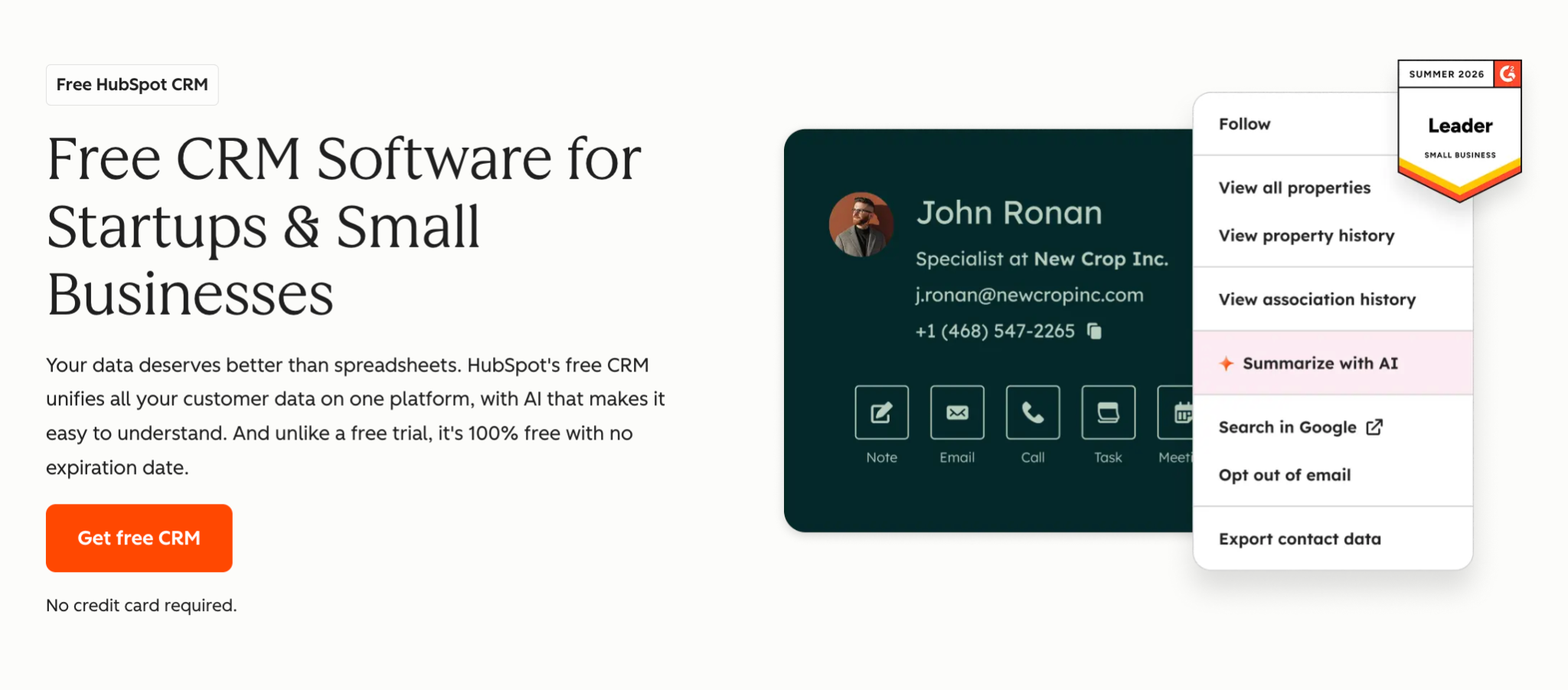
Sales Hub covers pipeline management, prospecting, automation, sequences, calling and forecasting. The wider HubSpot platform can then add marketing, customer service and content tools around the same customer record.
For a company using Creatio across several customer-facing departments, that can provide enough breadth without requiring the same no-code development mindset.
HubSpot is also easier to enter gradually.
The free CRM handles basic customer and deal management. Starter adds more functionality before Professional brings serious sales automation and reporting.
That's where the economics change.
HubSpot currently lists Professional from $90 per seat per month on annual billing. Current G2 reviews praise usability, pipeline management and centralized communication, but higher-tier pricing appears frequently among the negatives.
HubSpot scores 4.4/5 across more than 13,000 G2 reviews, so the review base is much larger than Creatio's. Ease of use is one of the strongest positive signals.
The product suits companies that want a broad platform but would rather configure existing CRM capabilities than design many processes from scratch.
- Best for: Growing companies bringing sales, marketing and customer service into one customer platform.
- Price: Free for up to two users; Starter currently promoted from $7/seat/month annually, Professional from $90.
- Review signal: 4.4/5 on G2; ease of use and pipeline management score well, pricing at higher tiers draws criticism.
6. Zoho CRM
Zoho gives companies plenty to configure: multiple pipelines, custom modules, workflows, Blueprint process management, approval rules, cadences and inventory-related functionality. Higher editions support hundreds of custom modules.

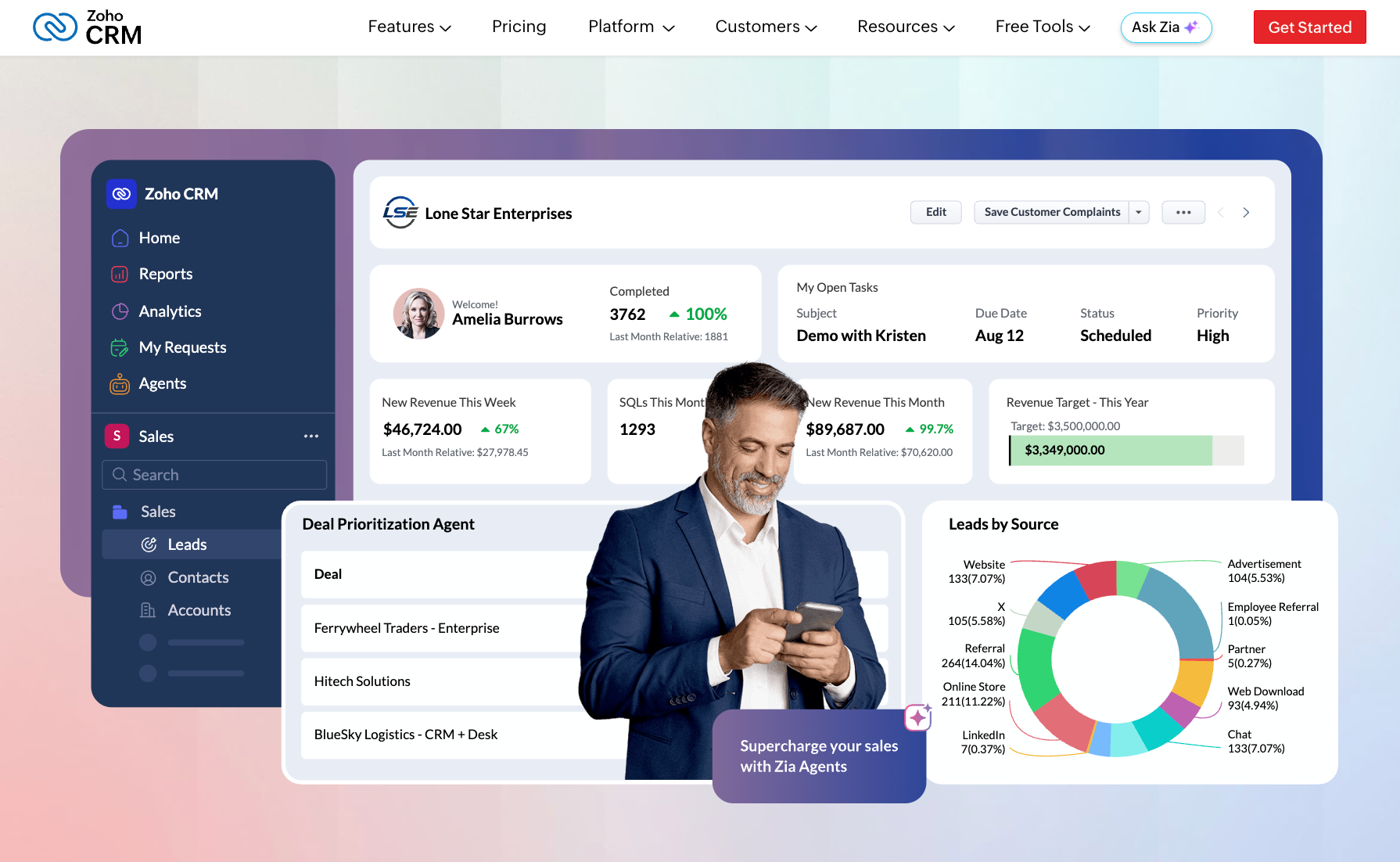
So a company moving away from Creatio doesn't have to give up process customization completely.
The scale is different.
Zoho CRM can work for smaller companies that would struggle to justify Creatio's $10,000 minimum annual purchase. Standard starts around the price of many SMB CRMs, while Enterprise still costs less per user than the combined Creatio platform and Sales product at comparable annual rates.
Reviews show the predictable trade-off.
Zoho has 4.1/5 from about 2,900 G2 reviews. Users praise its feature set, customization and integrations. Once workflows and modules become more complex, reviews increasingly mention learning curve, interface complexity and the expertise needed to configure everything properly.
In other words, Zoho doesn't eliminate the configuration problem; it lowers the financial barrier to having one.
- Best for: SMB and mid-market teams that still want custom workflows, modules and automation.
- Price: Free edition available; Standard $14/user/month annually, Professional $23, Enterprise $40 and Ultimate $52.
- Review signal: 4.1/5 on G2; customization performs well, advanced setup generates more friction.
The catch: Feature depth can make Zoho feel fragmented once administrators start customizing heavily.
If Zoho ends up competing with Capsule rather than Creatio, the Capsule vs Zoho CRM comparison makes that decision easier.
Which part of Creatio are you actually trying to replace?
A Creatio migration can go in three directions.
You want much less CRM infrastructure
Start with Capsule or Pipedrive.
Both give sales teams pipelines, contacts, tasks and automation without recreating the no-code development layer. Capsule goes further into relationship management and client work through Projects, while Pipedrive keeps the sales pipeline at the center.
You still want customization, just not Creatio
Look at Zoho CRM.
It offers far more process configuration than lightweight CRM while keeping entry pricing accessible.
You still need a platform
Compare Salesforce, Close CRM and HubSpot.
Salesforce makes sense when enterprise CRM customization remains a strategic requirement.HubSpot provides breadth across customer-facing teams with less emphasis on application building.
Creatio should stay on the shortlist if no-code workflow design is one of the reasons the system was purchased in the first place.
Its G2 reviews show that customers genuinely value flexibility and process automation.
Leaving only makes sense when another priority has become more important.
Is Capsule a good Creatio alternative?
For a small or midsize company that mainly needs CRM, yes.
For a business that uses Creatio as a no-code development platform, no.
Capsule gives teams contact management, customizable pipelines, sales analytics, automation, tasks and project tracking. It can be customized enough to handle different sales models without turning every new workflow into a development project.
Before migrating, list every Creatio workflow your team actively uses.
If most of the list consists of pipeline stages, reminders, assignments and reporting, a focused CRM may cover far more than expected.
If the list includes custom applications, deeply connected service workflows and business logic built in Studio, you're comparing platforms rather than CRMs.
Don't replace complexity with different complexity
Creatio can be a powerful choice when a company intends to use its no-code capabilities.
The problem starts when a sales team buys a platform but works like a normal CRM team.
If your process is contacts → opportunity → follow-up → close → client work, Capsule covers that path without asking someone to become the internal CRM architect.
Try it today.