
If every deal ends in a discount conversation, price is rarely the real problem. The buyer just never saw anything else to weigh.
Our guide to value-based selling shows you how to change that: what it involves, the principles behind it, a step-by-step way to implement it, and the tactics your team can start using this quarter.
The promise is simple. When buyers understand what an outcome is worth, price stops being the only number in the room.
What is value-based selling?
Value-based selling is a sales approach that focuses the entire conversation on the measurable outcomes a buyer gets, with the features of the product or service in a supporting role. Value selling is a sales methodology built on the same idea, and in practice the terms are interchangeable.

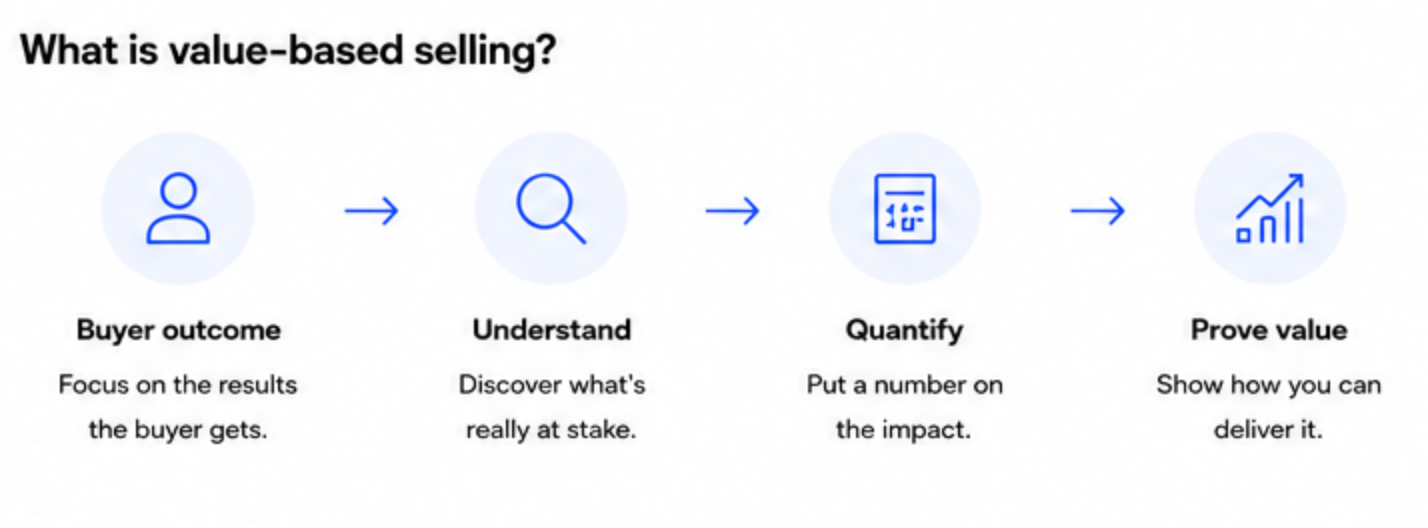
Value-based selling prioritizes the buyer's result over the seller's pitch. The question driving every interaction shifts from "how do I present my offer" to "what is this problem costing them, and what is solving it worth?" Buyers consistently choose value over price when someone takes the trouble to make the value visible. The discount conversation happens when nobody does.
The fundamentals are easy to state and hard to fake: understand the buyer deeply, quantify what change is worth to them, and prove you can deliver it. Everything else in this guide is detail on those moves.
The case for the shift is stronger now than a decade ago. Buyers research alone and arrive late, with options already compared in a spreadsheet, so the seller's last unique contribution is the part a spreadsheet can't do: connecting the offer to this buyer's economics.
Value-based selling vs. traditional sales
A value-based selling approach inverts most of the habits the old playbook rewards.
Consultative selling and solution selling sit right next door. Consultative selling supplies the posture: the salesperson acts as an advisor first, an advocate second. Solution selling supplies the diagnosis: find the problem, then fit the remedy. Structured methodologies like Sandler formalize pieces of the same instinct. Value selling takes it all a step further by putting a number on the outcome, which is exactly the step that ends price-only negotiations.
The consultative instincts stay. They finally get a denominator.
The practical tell is what happens under pressure.
A traditional seller answers a discount request with a counteroffer, while a value seller answers it with the model. One conversation is about a number, the other is about a decision, and only one of them can be won. The model also gives your champion something to forward, and the final conversation about your deal almost always happens with no seller in the room.
Principles of value-based selling
The principles below are the operating system. The implementation steps in the next section are the apps that run on it.
1. Understand before you pitch
Every conversation starts in the buyer's world. Your deck can wait. Uncover the pain points behind the stated request, because the stated request is usually a symptom. A buyer asking about reporting features may really be fighting a credibility problem with their board. The deeper need, once named, reframes everything that follows, including what your offer is worth.
2. Quantify everything
Vague value is no value, and adjectives are not numbers. Translate problems into figures a CFO would recognize: hours lost, cost savings missed, productivity gained, revenue delayed. Return on investment is the language of decisions, and the seller who arrives with a credible ROI model controls the frame of the entire negotiation. The model doesn’t have to be perfect. It needs to be built from their own inputs, which makes it theirs to defend.
3. Sell the outcome, not the feature
Features describe what your offer does. Outcomes describe what changes for the buyer, so lead with the change and let the mechanism stay backstage. Nobody buys the dashboard itself. They buy the Monday meeting that no longer needs an analyst to prepare it, and the analyst who finally gets to do analysis.
4. Build trust through generosity
Trust is the currency this whole approach spends. Build it by being useful before being paid: share a relevant benchmark, point out a risk that has nothing to do with your offer, send case studies that match their situation. Reps who add value in every interaction get told things their competitors never hear, and what a prospect tells you is the raw material every other principle depends on.
5. Align with the buyer's definition of success
In this conversation, only the buyer's metrics count, and they're usually written down somewhere. Ask how the buyer personally gets measured, then align your proposal with that scoreboard. Customer value defined by the customer is the only kind that closes deals. If your champion is measured on uptime, your business case is an uptime story, even if the brochure says efficiency.
6. Price on value, not on cost
Pricing your products and services on value follows naturally once the outcome is quantified. If solving the problem is worth half a million a year, a five-figure price reads as obvious. Presented bare, the same number reads as expensive. Perceived value is set long before the pricing slide appears, so the pricing conversation is mostly decided by everything that preceded it.
How to implement a value-based selling framework
Implementing value-based selling is about building a consistent sequence into every meaningful deal.

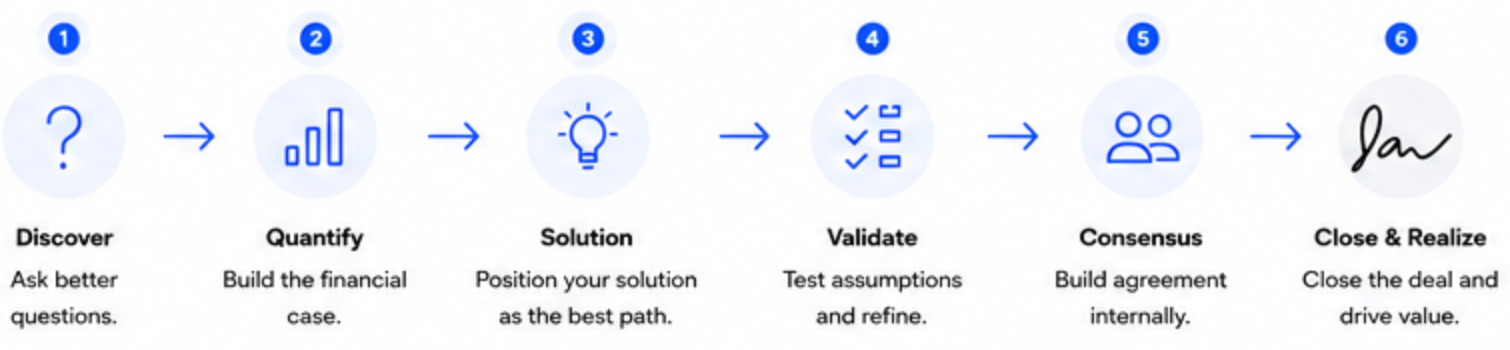
Follow these steps until the process becomes second nature.
Step 1: Research before the first call
Walk into the first sales call already knowing the company's market, their recent moves, and the likely pressures on your contact's role. A value-based approach to discovery lets your questions start at level two, which signals seriousness and saves the buyer the briefing they've already given three other vendors. A few minutes with their annual report, recent press, and your own notes on similar companies is usually enough to ask a question nobody else has asked, and one such question changes how the whole meeting treats you.
Step 2: Uncover and quantify the current cost
Through questions, establish what the status quo costs: in money, in time, in risk, in morale. Get the prospect to say the numbers out loud. A cost they articulate themselves is believed, where the same cost on your slide is debated. Rough numbers agreed together beat precise numbers presented alone.
Step 3: Map your unique value to their gap
Now connect the quantified problem to the value of your solution, specifically the parts competitors can't match. Articulate the value in one plain sentence per stakeholder: what changes, by how much, by when. If you can't, the discovery isn't finished. That distinct edge rarely lives in the headline feature. Look for it in the overlap between what they need most and what only you do well – finding that overlap is the actual craft of this job.
Step 4: Prove it with evidence
Claims need witnesses. Demonstrate the value with real-world examples: case studies from similar companies, benchmark data, a pilot with success criteria agreed in advance. This is where you must communicate value effectively to people who weren't in the room, because every B2B deal is eventually re-sold internally by your champion.
Step 5: Hold the line in the price conversation
When the discount request comes, return to the model you built together. Emphasize value delivered against price paid, and reframe any reduction as a reduction in scope. Waiting shouldn't buy a discount. A clear value story keeps the whole exchange calm – a compelling value narrative is the best discount-prevention tool ever invented.
Step 6: Follow through to value realization
The finish line sits past the signature, at the realized outcome. Track the value you deliver after go-live, report it back, and turn the proof into expansion and referrals. Sellers who create value for buyers after the contract have effectively zero competition at renewal. The quarterly value review you actually hold is worth more than any closing technique you'll ever learn.
Value-based selling examples
Three short scenarios show what the shift looks like in practice.
SaaS: from feature list to ROI model
A CRM vendor's traditional pitch lists integrations and dashboards. The value pitch establishes that the prospect's reps each lose six hours a week to manual data entry, prices that loss at roughly $90,000 a year across the team, and positions a $12,000 subscription against it. Same product, different conversation, no discount requested. The numbers came from the prospect's own answers in discovery, which is why nobody argued with them in the approval meeting.
Agency: from deliverables to revenue
A marketing agency stops selling "eight articles a month" and starts selling the pipeline those articles feed. Tied to lead value, the proposal moves off the marketing budget's line items and onto the client's revenue plan, and it survives the next cost-cutting review for exactly that reason. The retainer even grew at renewal, because growth was now the thing being purchased.
Manufacturing: from unit price to lifetime cost
An industrial supplier loses on per-unit price by 8% and wins anyway, by quantifying downtime. Their component fails half as often, and a single line stoppage costs the buyer more than the entire annual price difference. The value proposition was always there – someone finally did the arithmetic. Most industries hide a version of this math, and the first vendor to surface it usually keeps the account for years. If you can't find your version, ask your happiest customer what changed after they bought. The answer is your next pitch.
When value-based selling isn't the right fit
A value-based approach has a cost, and the cost is time.
Deep discovery and custom business cases make sense where deal sizes, complexity, or lifetime value justify them.
For low-ticket transactional sales with short consideration windows, a crisp offer and a fast checkout beat a consultation nobody asked for. The same is true where your product is a true commodity. If the prospect is right that all options are identical, manufacturing a value story erodes the trust the method depends on.
Many teams land on a hybrid: a lightweight value framing for smaller deals, the full treatment above a revenue threshold. Knowing which lane a deal belongs in is itself a selling skill, and the table earlier in this guide is a decent first filter. When in doubt, ask one quantifying question early. If the answer reveals real money at stake, switch lanes and slow down.
Value-selling tactics and best practices for your sales team
Rolling out value selling across a sales organization takes more than announcing a new methodology.
Pilot it before you scale it
Start with one team for one quarter. Use the pilot to test the process and collect feedback, but also to see where reps struggle before expanding it across the wider sales organization.
Share the results openly. A visible pilot gives the rest of the team proof that the approach works and makes the rollout feel more practical.
Put value into the training itself
Discovery and quantification should sit inside your sales enablement program, not beside it. Sales reps need practice uncovering business impact, estimating the cost of inaction, and connecting product capabilities to outcomes.

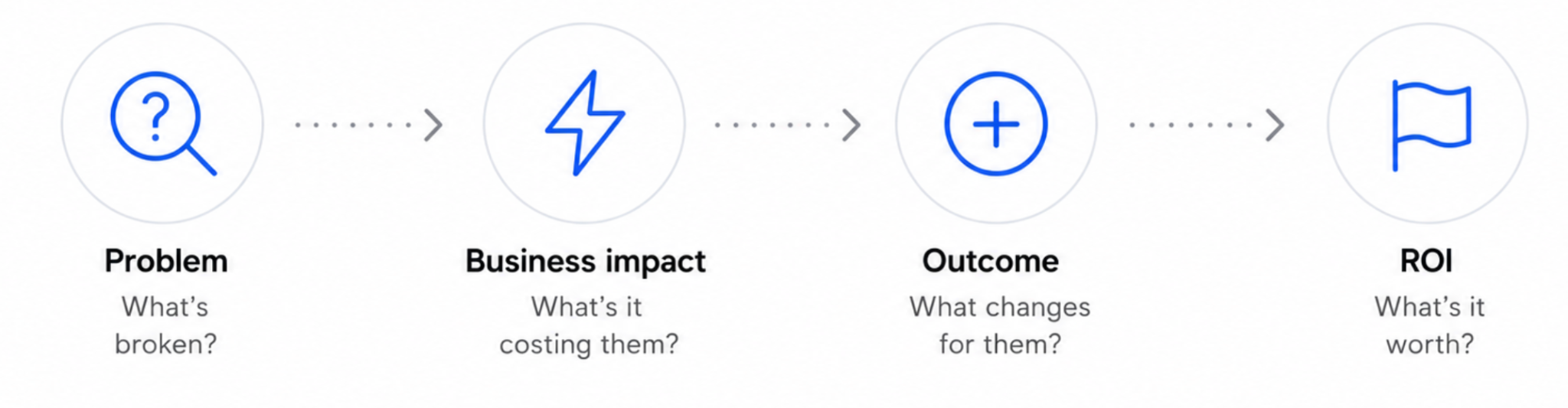
Give them a simple value-calculation template they can use during live deals. The easier the process is to apply, the more consistently it will show up in conversations.
Change the questions managers ask
Pipeline reviews shape sales behavior faster than most training sessions.
Before asking about close dates, ask: “What is the quantified cost of the customer’s status quo?” That question forces the rep to show whether the opportunity is built on real business value or little more than interest.
Salespeople pay attention to what their managers inspect.
Don’t panic when discovery takes longer
The first month may feel slower. Strong discovery requires more time than a standard product pitch, especially while reps are still learning how to ask better questions and quantify the answers.
The payoff tends to come later in the quarter through better-qualified deals, shorter negotiations, and less pressure to discount. Leaders who abandon the approach during the early dip rarely see those gains.
Turn customer proof into a shared asset
Create a searchable library of customer outcomes, case studies, ROI examples, and relevant metrics. Tag each asset by industry, company size, problem, and use case so reps can quickly find the strongest evidence.
This library becomes more valuable with every closed deal.
Capture what happened after the sale
Don’t let the value story disappear once the contract is signed. Record the original problem, the business case used during the sale, and the outcome the customer achieved.
Those details give future reps stronger proof and make the next value conversation easier to lead.
Let AI handle more of the preparation
AI can reduce the manual work surrounding value selling. Research tools can speed up account preparation, note-takers can preserve discovery details, and AI can draft an initial ROI model from meeting notes.
The judgment still belongs to the salesperson, but the administrative work doesn’t have to.
How Capsule supports a value-based sales methodology
This way of selling lives or dies on remembered detail, and that's precisely what Capsule is built to hold.

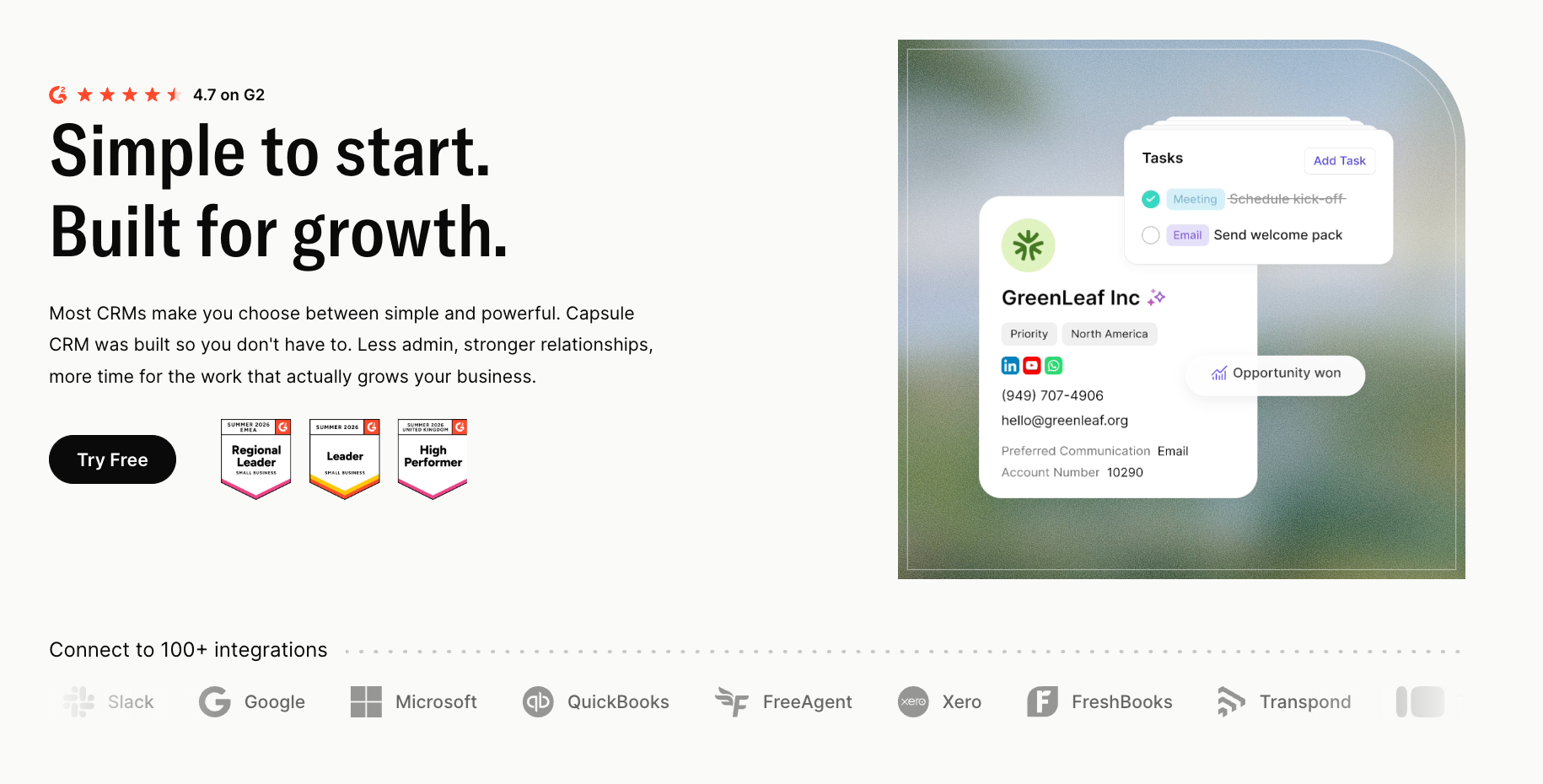
Every pain point, metric, and stakeholder note from discovery sits on the record in contact management, so the quantified story survives handoffs, vacations, and six-month sales cycles.
The sales pipeline tracks expected value on every opportunity, the Opportunity dashboard shows where value conversations stall, and well-designed deal stages can require a quantified cost-of-problem before a deal advances, which quietly enforces discipline and reports flag the tire kickers before they consume your best discovery hours.
The follow-through gets structural support, too.
Tasks and Calendar schedules the post-sale value reviews that most teams intend and forget, Workflow Automation triggers them when a deal closes, and a consistent follow-up routine keeps long value-driven deals warm.
AI Summaries condense months of discovery before a pricing call, AI Email Assist drafts the recap that restates the model in the buyer's numbers, and email templates keep your strongest value framing in everyone's hands.
A rep can only sell the outcome they can still remember. Capsule's job in this methodology is exactly that: nothing from discovery gets lost, so nothing from the value story gets improvised. Try it on a 14-day free trial and run your next meaningful deal through the full framework.
Make price the smallest number in the room
Buyers will always ask about price. This approach just makes sure it's never the only thing on the table. Quantify the problem, prove the outcome, and the discount conversation gets shorter every quarter – some quarters it never starts at all.