Productivity in a CRM context is easy to promise and hard to deliver.
Every platform markets itself as a time-saver. The reality for most sales teams is more complicated: the CRM that was supposed to simplify sales processes becomes another system to maintain, another tab to update, another source of incomplete data that makes the next customer interaction harder than it needs to be.
AI changes this, but only when it's applied to the right problems. The AI features that actually improve sales team productivity are the ones that handle the specific friction points that slow sales reps down every day. When intelligent automation handles its tasks reliably, the CRM stops feeling like overhead and starts functioning as the productivity tool it was always supposed to be.
This article covers the top AI CRM software for productivity in 2026, evaluated specifically on what the AI adds to the daily workflow.
The CRM productivity checklist: what good AI actually gives your sales team
Use this as an evaluation framework when assessing any AI CRM software.
- Context before customer interactions. Does the CRM automatically show a summary of the full relationship history before a call or meeting so the sales rep arrives prepared? AI-powered insights that enhance customer interactions before they happen are worth more than analytics that explain what went wrong after.
- Automated data capture. Does the AI capture and update customer data from emails, calendar events, and public sources automatically? Automating data entry is the single biggest productivity gain available in any CRM, and the prerequisite for every other AI capability producing reliable outputs.
- Intelligent follow-up triggering. Does the CRM use intelligent automation to trigger follow-ups based on actual customer behavior, or does it leave that to the sales rep's memory?
- AI-assisted outreach drafting. Does the AI draft contextual emails based on the specific relationship history, or does it produce generic templates that need heavy editing before sending?
- Pipeline setup and management. Does the AI help configure and maintain the sales pipeline, reducing the blank-slate setup problem and keeping deal management current?
- Workflow automation across business processes. Does the CRM automate the repeating processes that run on every deal so the sales process runs consistently even when the team is at full capacity?
- Actionable reporting. Does the CRM provide AI-driven insights about sales performance, pipeline health, and customer engagement in a format that informs decisions immediately?
The platforms below are evaluated against each of these criteria. No tool scores perfectly across all seven – the differences reveal which platform fits which kind of sales team.
Seven top AI CRM tools for productivity
1. Capsule CRM
Capsule is built around a clear productivity philosophy: the AI should handle the parts of customer relationship management that consume time and don't require judgment.

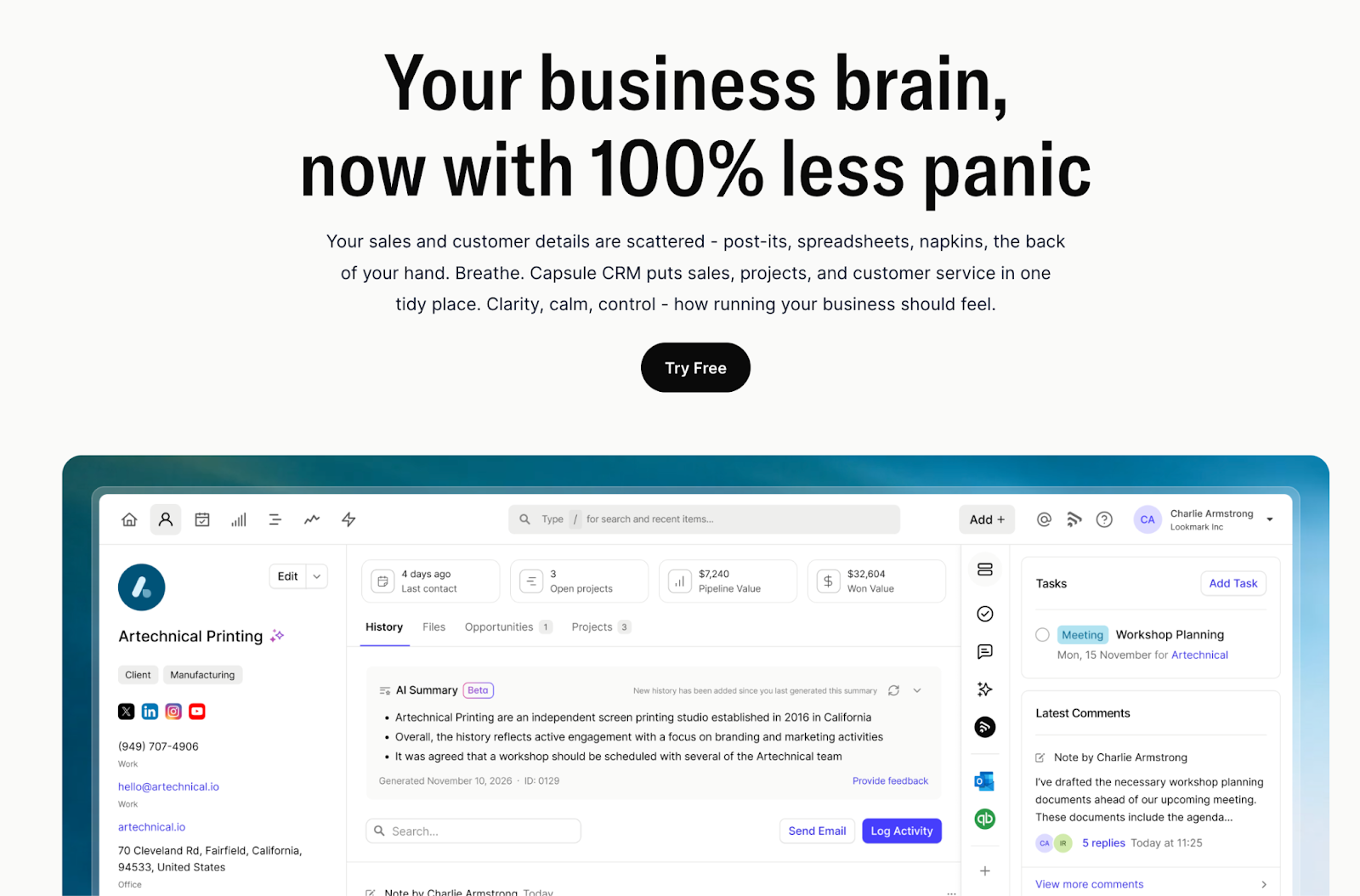
AI Summaries address the context problem directly – every relationship history condensed into a readable brief before any call or meeting, drawn from the full record of emails, notes, tasks, and deal updates associated with that contact. A sales rep picking up a conversation after three weeks of silence arrives informed, not improvising.
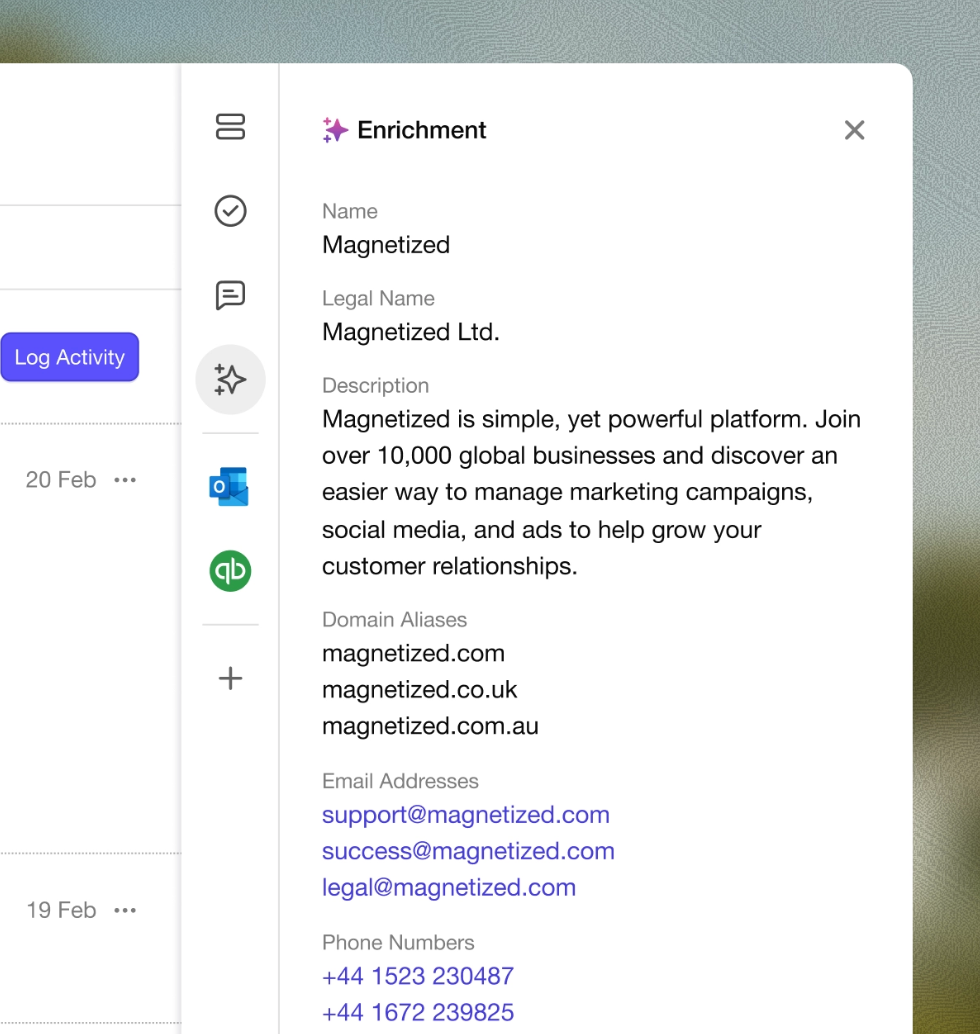
AI Contact Enrichment pulls company and contact information from public sources continuously, so customer data stays current as a byproduct of normal work. This matters because when the AI provides insights and suggests next actions, the quality of those outputs depends entirely on the completeness of the underlying records. Enrichment solves the input problem at the source.

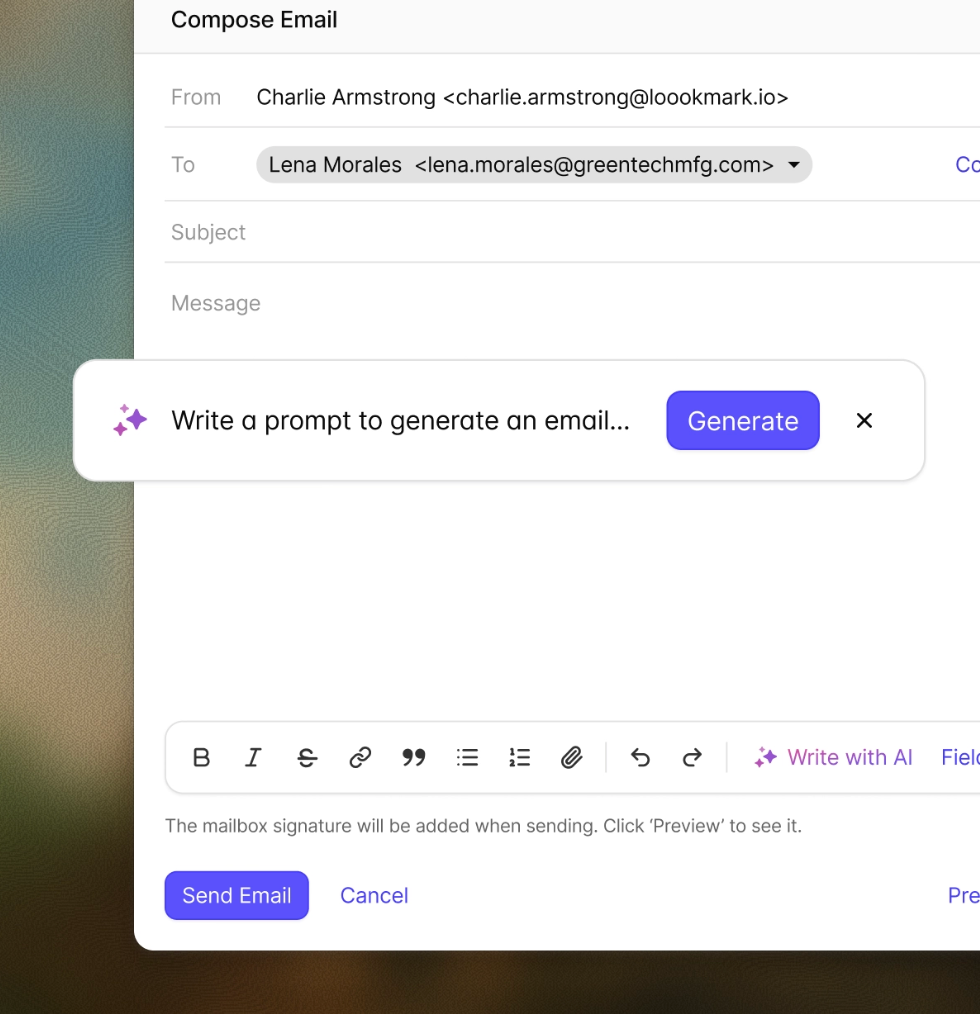
AI Email Assist drafts contextual outreach based on the specific relationship history. The difference between a message that references what was actually discussed and one that could have been sent to anyone is measurable in response rates.

AI Pipeline Generator builds a customized pipeline from a plain-language business description, removing the configuration barrier that stalls many CRM implementations before they produce value.
Workflow automation via Tracks automates the repeating processes on every deal so the sales process runs consistently regardless of how busy delivery is.
Sales analytics and reporting tools deliver insights about pipeline health and team performance in a format that informs decisions at a glance. The visual sales pipeline provides clean deal management across all active opportunities, with multiple pipeline support for parallel processes.
The AI capabilities are designed around the daily productivity moments that matter most to small and mid-sized sales teams, with no configuration expertise required to get value from day one.
Pricing: Free plan available. Starter $18/user/month, Growth $36/user/month (AI features included). Free trial here.
Best for: Small and mid-sized sales teams, service businesses, and customer management operations that want AI to deliver practical daily productivity gains with a low learning curve.
2. HubSpot CRM
HubSpot's AI capabilities under the Breeze brand span the entire sales funnel – from lead capture and marketing tools through to customer service automation and post-sale engagement. The integrated approach reduces the tool-switching overhead that fragments attention across a sales day.

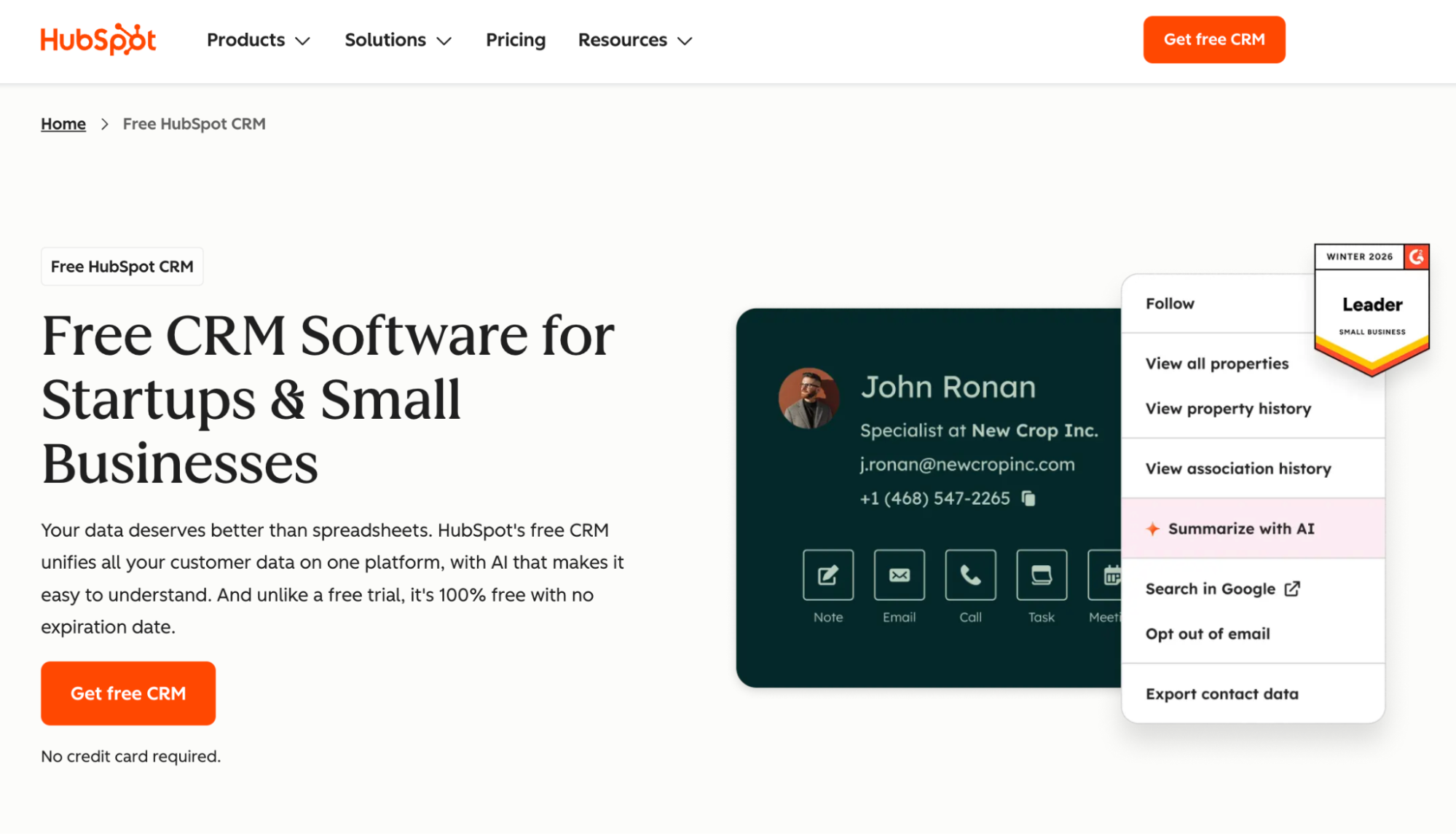
Breeze Copilot acts as an AI assistant embedded across the platform, drafting communications and handling routine tasks. Breeze Intelligence enriches contact records and identifies buyer intent signals. AI agents handle prospecting, support responses, and content creation autonomously – covering more of the productivity checklist in one platform than most alternatives.
The honest caveat: the free plan and the AI-enabled paid platform are meaningfully different products. The advanced features that make HubSpot productive for sales teams sit behind paid tiers that escalate faster than many buyers anticipate. For growing businesses, where sales and marketing alignment is a strategic priority, the platform earns its position. However, for smaller teams considering it mainly as a sales CRM, it’s worth carefully weighing whether the productivity gains truly justify the cost before making a commitment.
Best for: Businesses that need AI across sales, marketing, and service in one platform and have the budget for the paid tiers, where the productivity gains are fully realized.
3. Salesflare
Salesflare is built on a simple thesis: reps shouldn’t be stuck filling in fields when they could be moving deals forward.

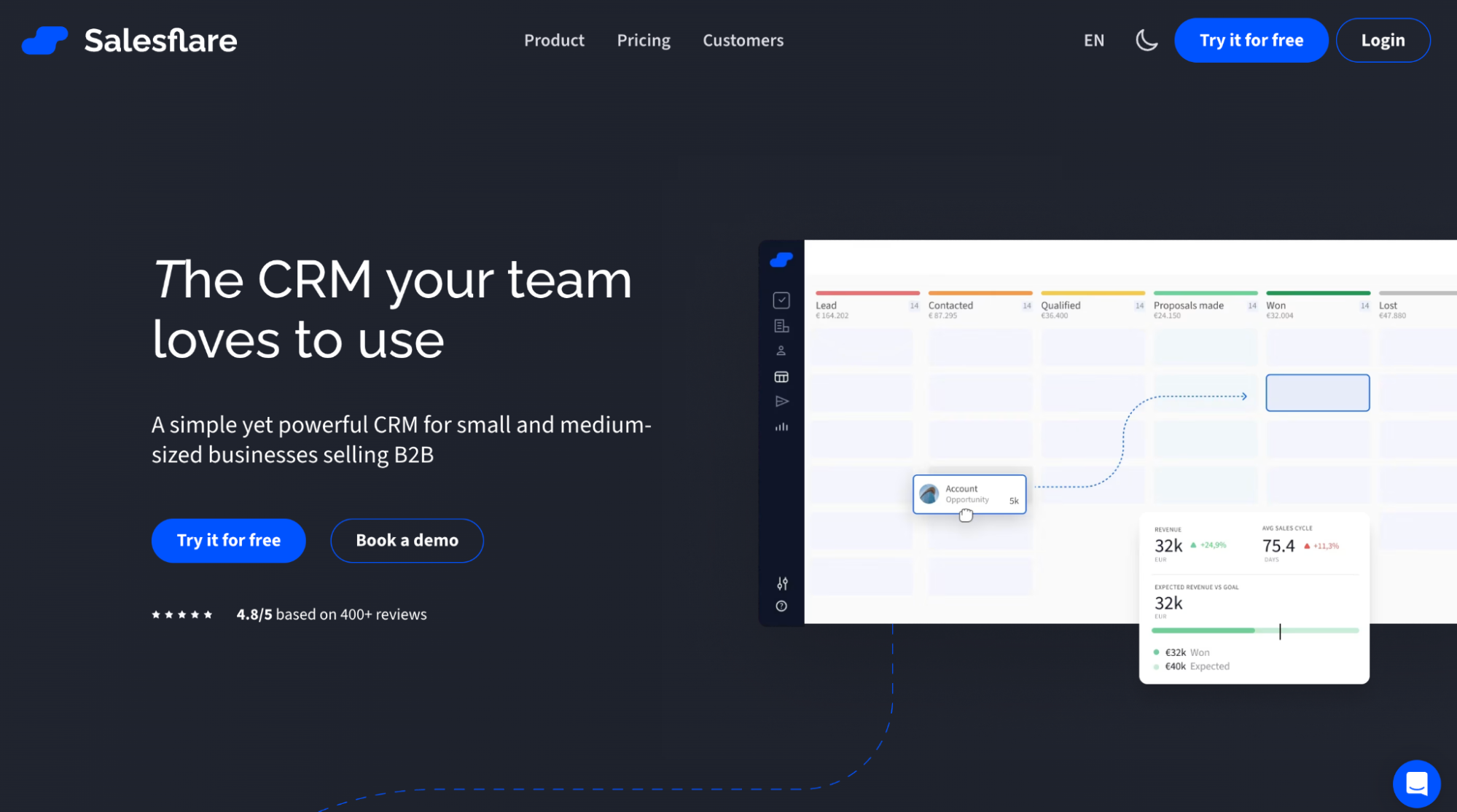
Its AI captures customer data from email, calendar, LinkedIn, and company databases automatically, building complete contact and company profiles that update continuously. The outcome is a CRM that updates itself in the background, with accurate data emerging organically from day-to-day sales operations.
Salesflare leads the productivity checklist on automated data capture: it's the most thorough implementation of automatic data collection available at this price range. Automated customer timelines give full relationship context before every interaction.
The platform is less strong on complex workflows, generative AI outreach drafting, and deep analytics. Sales teams often lose more time to keeping the CRM updated than to managing complex workflows. Salesflare tackles that friction at its source instead of layering AI on top of a data entry burden that still exists. From $29/user/month. Capsule vs Salesflare here.
Best for: Small B2B sales teams where CRM data maintenance is the primary productivity drain, and the sales process is relatively straightforward.
4. Zoho CRM with Zia
Zoho CRM's productivity case rests on Zia's AI capabilities combined with the platform's deep configurability.

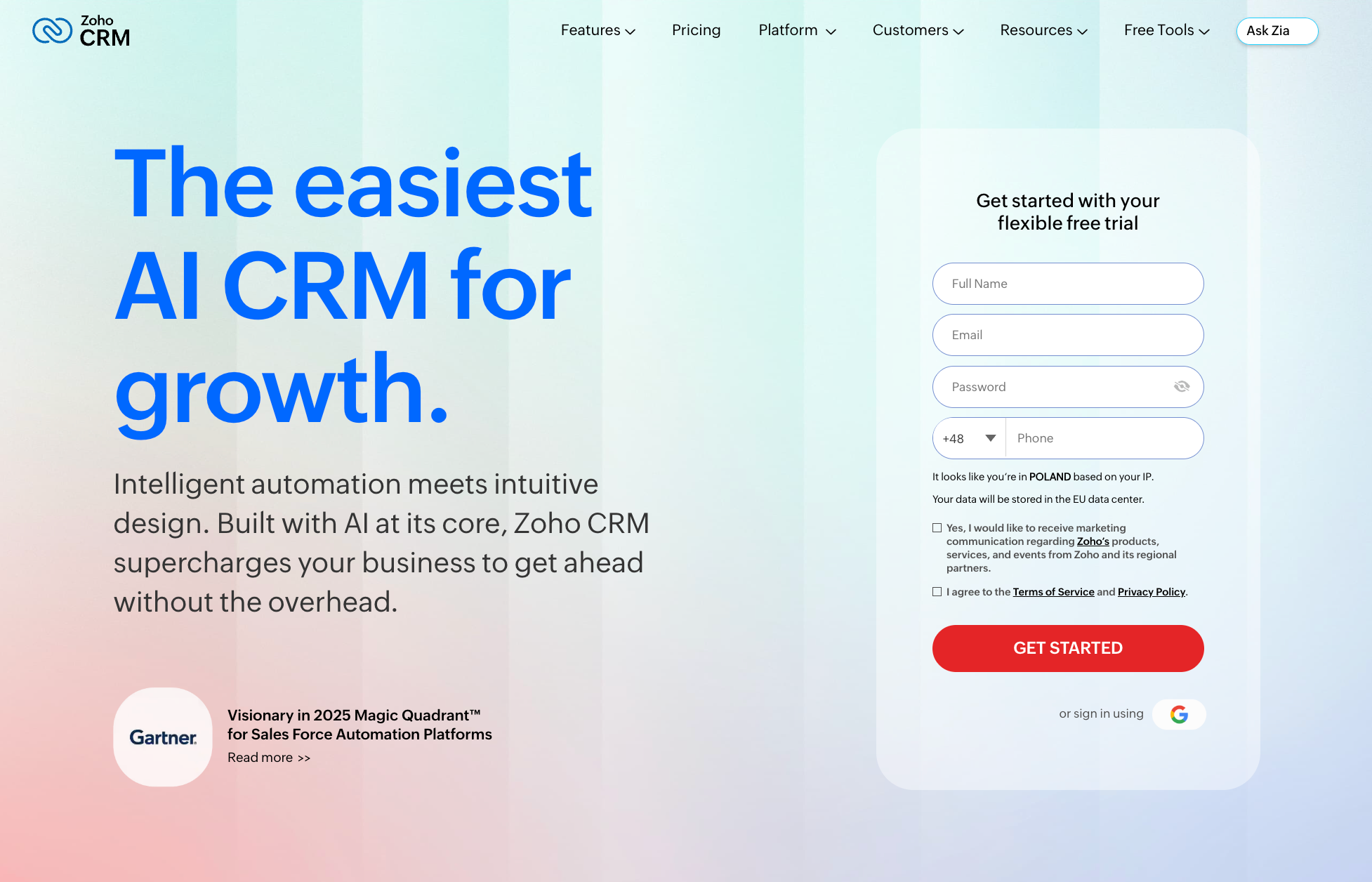
Zia handles workflow suggestions, anomaly detection in sales data, sentiment analysis on customer interactions, and natural language queries. An account executive can simply pose a question about their pipeline and get an immediate, insight-backed response.
The ability to query CRM data conversationally is a useful productivity differentiator for teams that need fast answers. The platform's automation tools cover complex sales scenarios that simpler CRMs can't handle, making it well-suited to businesses with non-standard sales processes.
The productivity trade-off? Zoho's configurability is both its strength and its demand. Getting full value from Zia requires setup investment that simpler platforms don't.
Best for: Mid-sized businesses with complex workflows that want deep AI capabilities and are prepared to invest in configuration to unlock them.
5. Salesforce with Einstein AI
Salesforce Einstein represents the most comprehensive AI productivity suite available in any CRM – predictive lead scoring, opportunity insights, automated activity capture via AI agents, and generative AI across the platform.


When you’re dealing with years of sales data, Einstein starts to earn its keep – connecting the dots on what’s likely to happen next and taking care of the heavy lifting behind the scenes.
Einstein scores highly across all seven checklist criteria in principle. The productivity caveat is implementation. Salesforce requires a large technical investment to configure properly, and the AI features that make it fully productive require clean, extensive historical data and dedicated administration to maintain.
Large organizations with dedicated CRM admins – and the kind of data volume where Einstein performs best – are in a position to fully realize Salesforce’s productivity value. For smaller teams integrating AI into CRM for the first time, the implementation overhead typically exceeds the near-term productivity gain.
Best for: Enterprise sales teams with complex automation requirements.
6. Freshsales with Freddy AI
Freshsales approaches CRM productivity through built-in communication tools, combined with Freddy AI's deal insights and lead scoring.

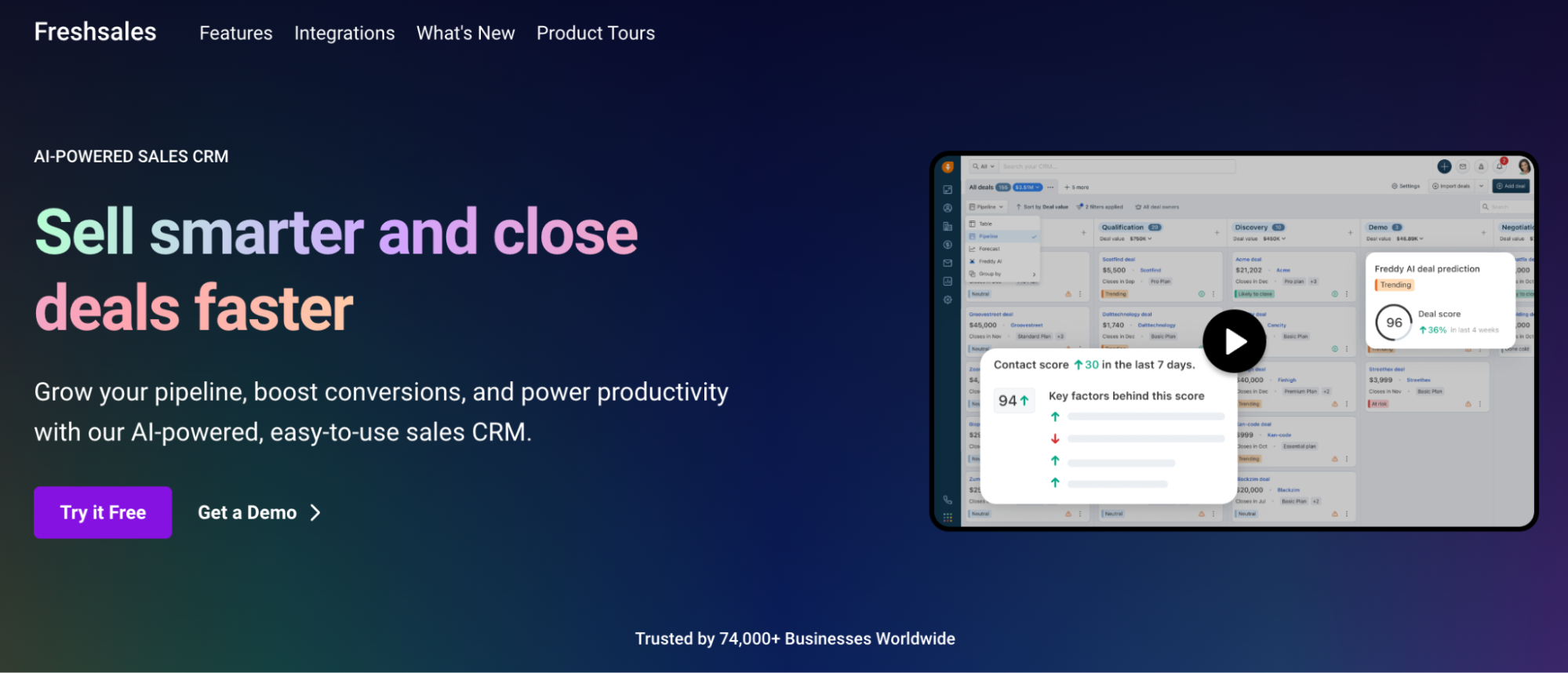
The productivity argument is straightforward: every tool-switch between the CRM and a separate communication platform costs time and loses context. Keeping everything in one place takes that hassle out of the equation.
Freddy AI's deal insights flag stalled opportunities and suggest next actions. The native integration with Freshdesk means customer service and sales data share a unified view; useful for teams where customer interactions span both pre- and post-sale relationships.
One challenge that appears consistently in review:– customer support responsiveness after the free trial period is variable, which creates a hidden time cost when troubleshooting issues.
Best for: teams that want built-in communication tools alongside AI capabilities, particularly those already using the Freshworks ecosystem.
Applying the checklist to your own evaluation
The checklist above is a diagnostic for identifying where your current CRM is costing productivity and what to prioritize in a replacement or upgrade.
A few patterns are worth noting across the seven platforms.
The AI capabilities that deliver the most immediate productivity gains are the simplest ones.
Automated data capture, relationship summaries before calls, and intelligent follow-up triggers don't require large datasets or complex configuration to work. They produce a visible impact within weeks. The more sophisticated capabilities usually depend on data maturity and technical investment before they produce reliable outputs.
Productivity and feature depth are not the same thing. A CRM with well-implemented AI that a sales team uses consistently outperforms a sophisticated platform that requires ongoing configuration to maintain. The best AI CRM for productivity is the one your team logs into every day and builds habits around.
Reporting should inform decisions rather than creating more work. The CRM tools that actually boost productivity are the ones where useful insights surface automatically, without turning report-building into a project of its own.
The learning curve is a productivity cost that most evaluations ignore. Every hour spent configuring a new platform, training the team, or troubleshooting integration issues is an hour not spent on customer engagement and selling.
Platforms that work well from day one – Capsule consistently earns callouts for fast setup in its reviews – have a lower total productivity cost than enterprise platforms whose full capability takes months to unlock.
For teams starting the evaluation, Capsule's free plan covers two users and 250 contacts with core CRM and task management features, and the 14-day free trial gives full access to AI features with no credit card required. Running the checklist against real data during a trial period is the most reliable way to assess whether the productivity gains translate into actual daily workflow.
Over to you
The best CRM for productivity is the one that gets out of the way. The productivity gains compound over time as the data gets cleaner, the workflows get more refined, and the team builds habits around the system.