Almost every CRM vendor with a product update in the last few years has attached "AI-powered" or "AI-native" to their positioning.
It creates a problem for buyers: the feature list looks compelling, but the marketing all sounds roughly the same. The question that cuts through it is simpler: what do actual users say, months or years into using the platform?
Review platforms like G2 and Capterra are imperfect but useful. They capture patterns that vendor marketing never will: the AI features that really change daily workflows versus the ones that sound impressive and get ignored after week two. The customer data quality issues that make predictive analytics unreliable. The gap between what the AI promises in a demo and what it delivers at 9am on a Tuesday when a sales rep is trying to manage ten open deals.
This article covers the best AI CRM tools in 2026, rated against what verified users report.
It also highlights something most AI CRM comparisons overlook: the distinction between platforms built around AI from the ground up, and established systems that have gradually integrated AI over time. That distinction matters less than the vendor positioning suggests. What matters is whether the AI makes the CRM work better for the people using it, consistently, in real business conditions.
AI-native versus AI-mature: why the distinction is overstated
The term "AI-native" implies that a CRM built from the ground up around AI architecture will outperform one that's added AI capabilities to an established platform. In practice, the reviews tell a more complicated story.
AI-native platforms have real advantages: they tend to integrate AI more deeply into the data model, and usually, require less manual configuration to get the AI working. But they also tend to have shorter review histories, smaller user bases, and less proven track records at scale.
Established platforms with well-implemented AI – what you might call AI-mature – bring years of customer data, deep integration ecosystems, and large enough review samples to reveal patterns in what works and what doesn't. When a platform has 5,000 reviews and the AI features consistently appear as positive callouts across hundreds of them, that's a more reliable signal than a newer platform's smaller but enthusiastic early-adopter base.
The best AI CRM is the one where the AI capabilities hold up in daily use for your team, not the one with the most advanced architectural positioning.
Seven AI CRM platforms ranked by what users actually report
1. Capsule CRM
G2 rating: 4.7/5 (449 reviews) | TrustRadius: 8.6/10 | Trustpilot: 4.1/5
Capsule is AI-mature rather than AI-native – an established platform that has added a practical set of AI features instead of rebuilding its architecture. What the reviews reveal is that this approach works extremely well for the sales teams, service teams, and small businesses it serves.

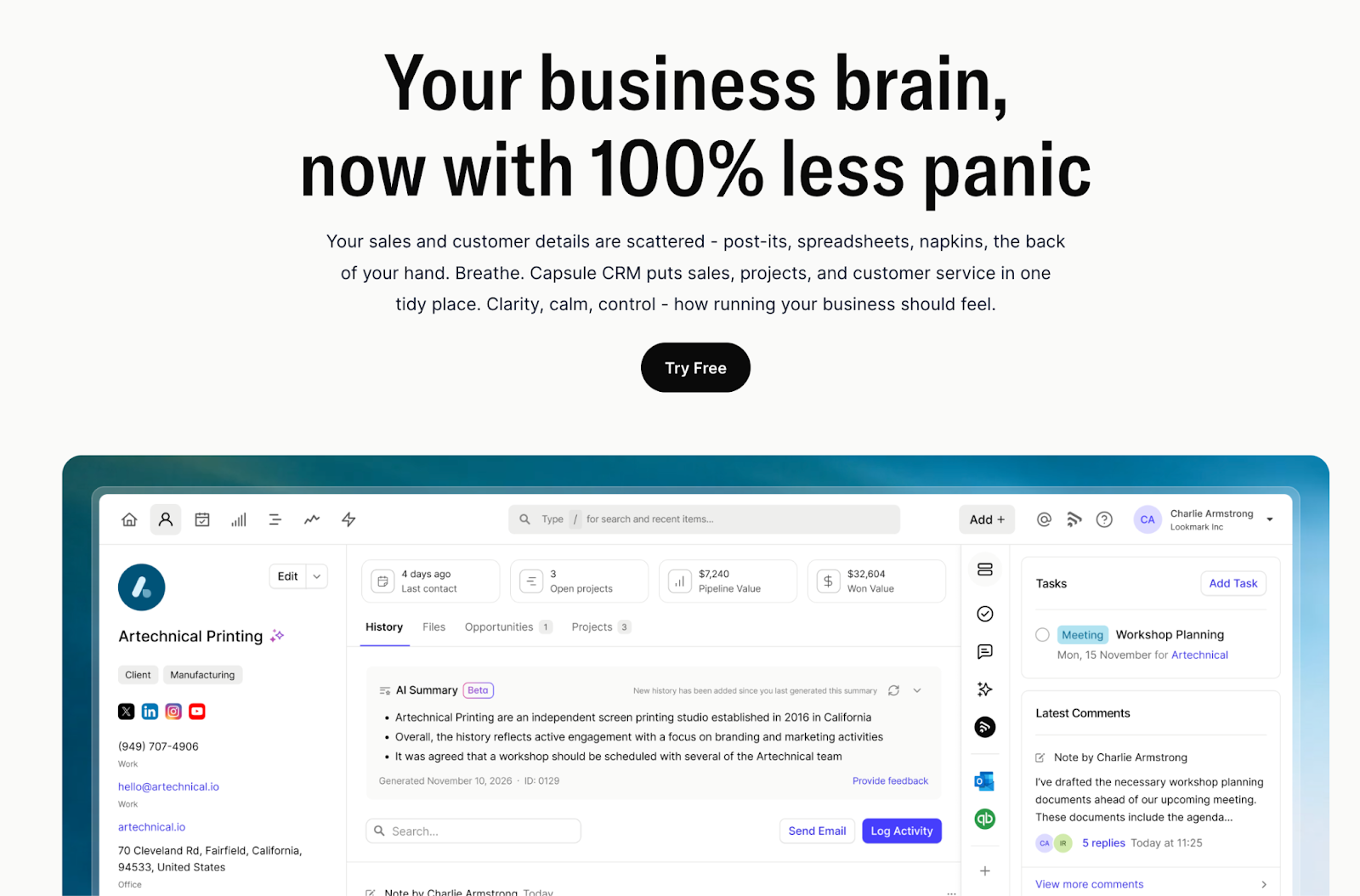
Across G2 reviews, the most consistent patterns are ease of use (131 mentions), customer support quality (60 mentions), and simplicity (51 mentions). The AI features appear repeatedly as positive callouts in user feedback, specifically for making customer interactions feel informed and personalized.
One G2 reviewer with over twelve years of daily use describes it as "by far the easiest and well-thought-out platform of its kind I've used in over 20 years. Slick and simple pipeline management." Another notes "it continues to surprise me with new features, such as email templates, which have streamlined my communication process."






A third calls out specifically that "it saves time by automating repetitive tasks." On Capterra, reviewers repeatedly describe it as "incredible" and "the best CRM solution for us".
What makes Capsule a smart CRM choice for businesses that want AI capabilities they'll actually use every day:
- AI Summaries condense the full history of any customer relationship into a readable brief before a call or meeting. A sales rep picking up a conversation after weeks of silence arrives prepared, with full context on past customer conversations, deal status, and any open tasks.
- AI Contact Enrichment automatically pulls in company and contact information from public sources, keeping CRM data current without manual input. Clean, reliable historical data is the foundation that makes every other AI capability work properly.
- AI Email Assist functions as an AI sales assistant directly within the CRM, drafting contextual responses to customer communication based on the full history of the relationship. Timely and relevant communication at the right stage of the sales process, handled in seconds.
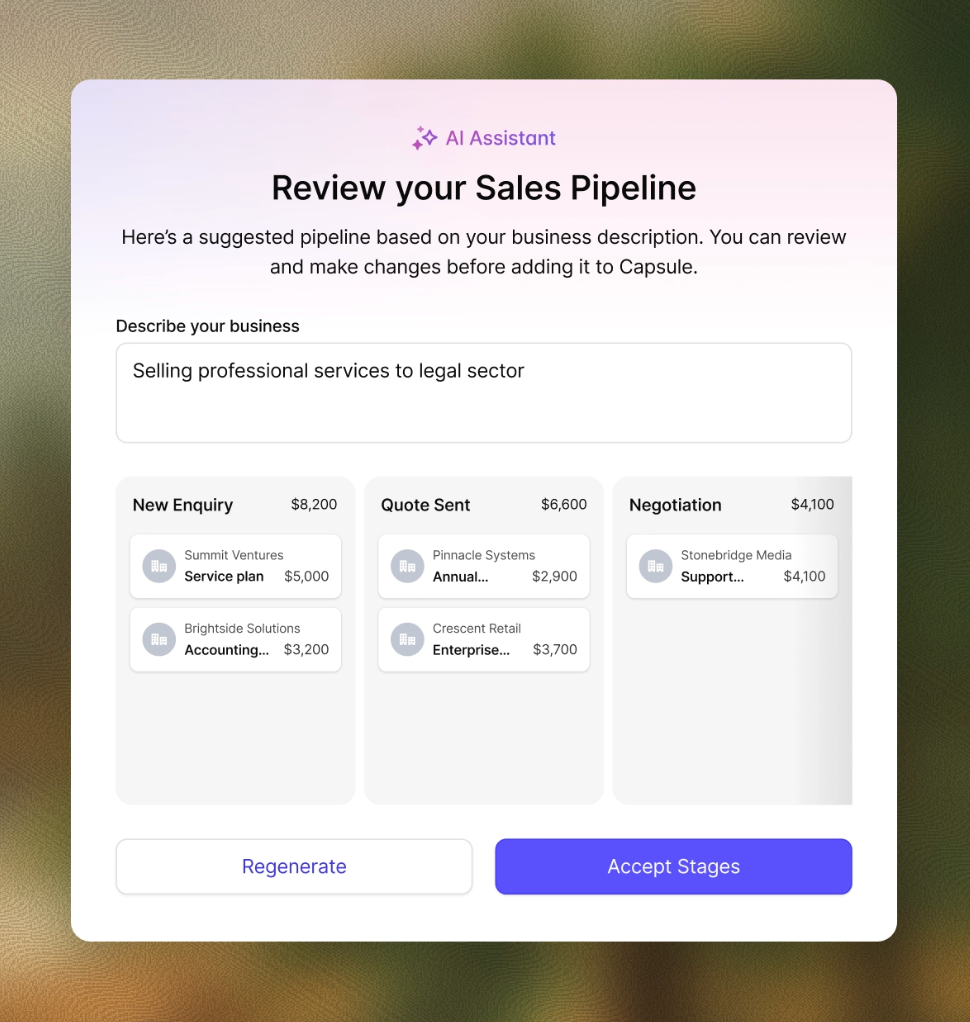
- AI Pipeline Generator builds a customized sales pipeline from a plain-language description of the business – one of the more practical applications of natural language processing in CRM, and one that removes the blank-slate setup problem that derails many CRM implementations before they start.

- Workflow automation via Tracks handles the business processes that repeat on every deal: onboarding sequences and task assignment at each pipeline stage.
- Sales pipeline management gives the entire team clear visibility into deal management across every active opportunity, with multiple pipeline support for businesses running parallel sales processes.
- Sales analytics and reporting dashboards translate CRM data into actionable insights about pipeline health, team activity, and sales performance – giving sales managers the visibility they need to predict sales trends and make data-driven decisions about where to focus.
- Transpond integration adds marketing automation tools directly connected to the CRM, so customer engagement campaigns, drip sequences, and personalized customer interactions run from the same platform as the sales process.
Capsule isn't trying to be an all-in-one CRM with advanced AI forecasting across every dimension of sales and service. It's a well-executed AI powered CRM platform that delivers advanced AI features where they matter most for small and mid-sized sales teams – keeping data clean, customer communication timely, and the sales process moving.
For businesses looking for an easy-to-use CRM with built-in automation, user reviews are consistently positive, especially around how quickly it delivers value with minimal setup.
AI features are available from the Growth plan at $36/user/month.
You can start your trial here or use a forever-free version here.
2. Salesflare

G2 rating: 4.7/5 | Capterra: 4.7/5
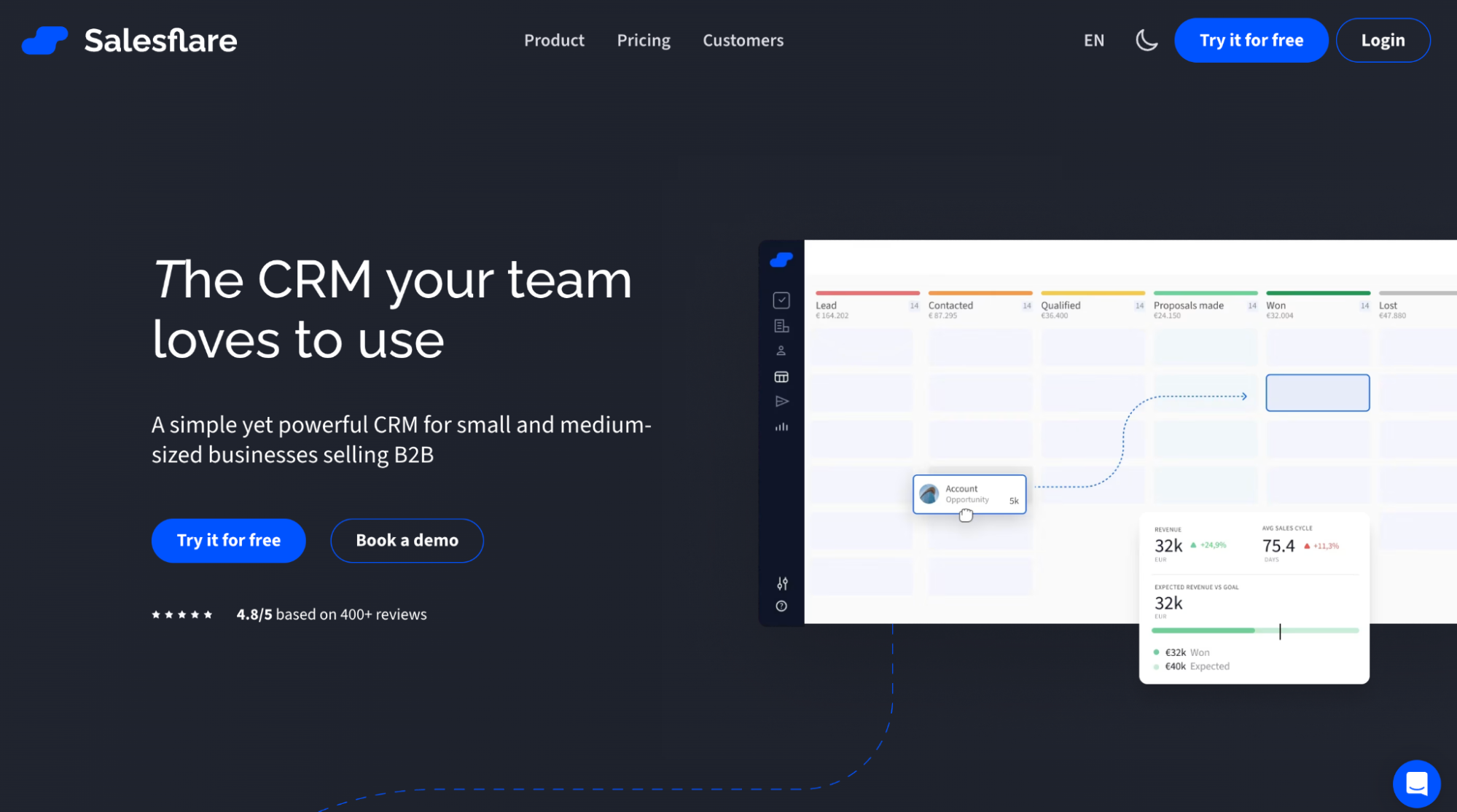
Salesflare is the closest thing to an AI-native CRM in this list, built from day one around the premise that sales reps shouldn't have to enter data on their own. Its AI captures customer data automatically from email, calendar, phone, LinkedIn, and company databases, building unified customer data profiles that update in real time.
G2 reviewers consistently highlight two things: the quality of the automated customer timelines, and ease of use. One reviewer captures the positioning precisely: "It takes data from social media, company databases, phone, email, calendar and hands it to you in automated customer timelines that tell you everything you need to know. You just have to write the emails, make the calls, and have the coffee."
The AI doesn't offer deep predictive analytics or generative AI content creation. What it does is solve the data quality problem that undermines every other AI capability in a CRM: if the underlying customer data is incomplete or out of date, predictive lead scoring and sales forecasting produce unreliable outputs. Salesflare's AI fixes the input problem first.
The limitation noted across reviews: Salesflare is less suited to larger enterprise sales teams with complex workflow requirements, and the customization options are thinner than more established platforms. For small B2B sales teams where the primary CRM problem is data entry burden and follow up consistency, the review signal is strongly positive. Starts from $29/user/month.
See how Salesflare compares to Capsule.
3. Freshsales with Freddy AI

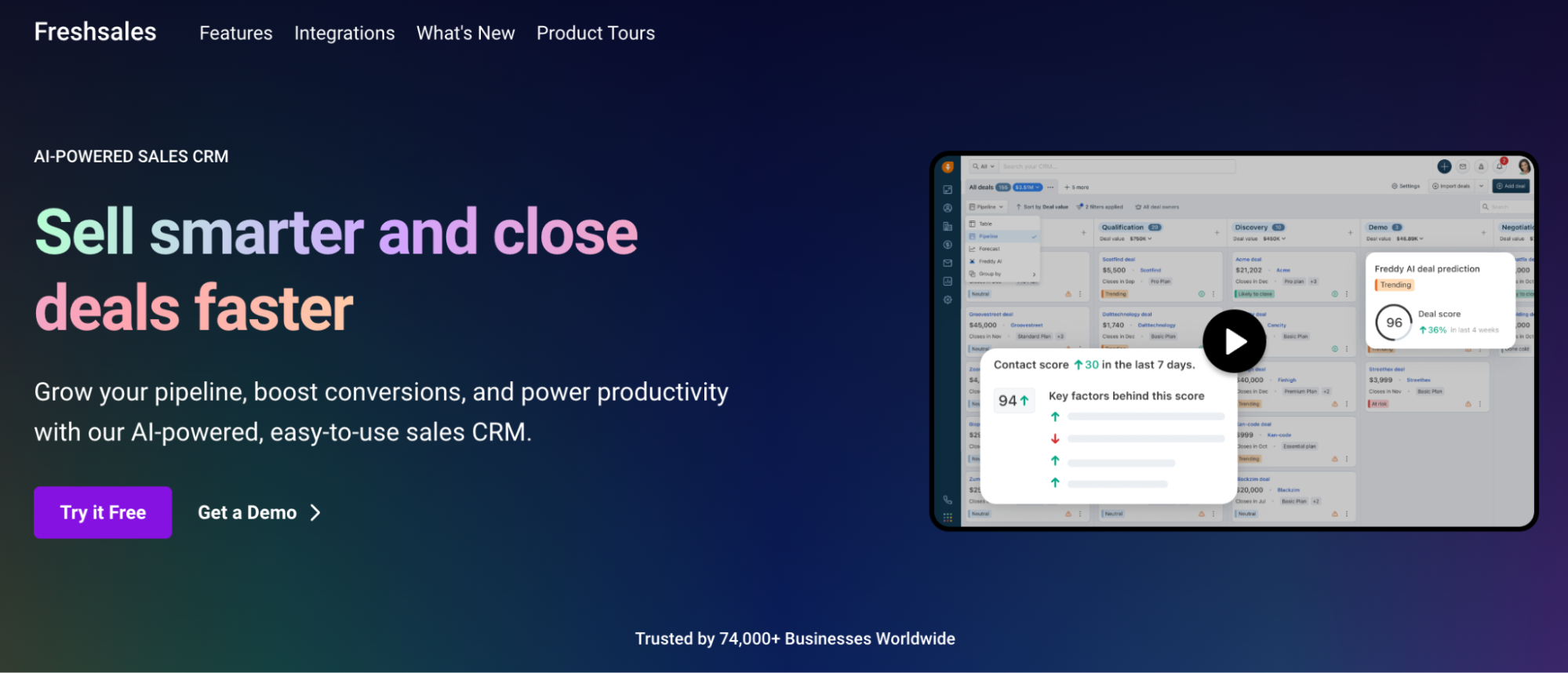
G2 rating: 4.5/5 (3,000+ reviews) | Capterra: 4.5/5
Freshsales has one of the largest verified review bases among AI CRM software. The headline is positive: G2 reviewers report going from signup to a functioning pipeline in under an hour, and Freddy AI's lead scoring gets specific callouts for helping sales teams prioritize high-intent leads.
The honest picture from Capterra and G2 is more nuanced. One frequently cited review captures it clearly: "It works well and looks great, but the pricing and support let it down." Customer service responsiveness after the free trial period is the most consistent negative across both platforms – a pattern important enough to weigh when evaluating for a business where support access matters.
On the AI side, Freddy AI handles predictive deal insights and AI-powered email drafting. The deal insights that flag stalled opportunities and suggest next actions are specifically called out as useful by multiple reviewers. The reporting tools get mixed reviews – several G2 reviewers note that custom reporting requires more technical capability than the core CRM interface suggests.
Worth noting: Freshsales integrates natively with Freshdesk and Freshservice, which means customer service teams using those platforms see CRM data and support ticket history in one view – an advantage for businesses where sales and service teams need unified customer data. From $15/user/month; Freddy AI on higher tiers.
Read more about Freshsales pricing.
4. HubSpot with Breeze AI

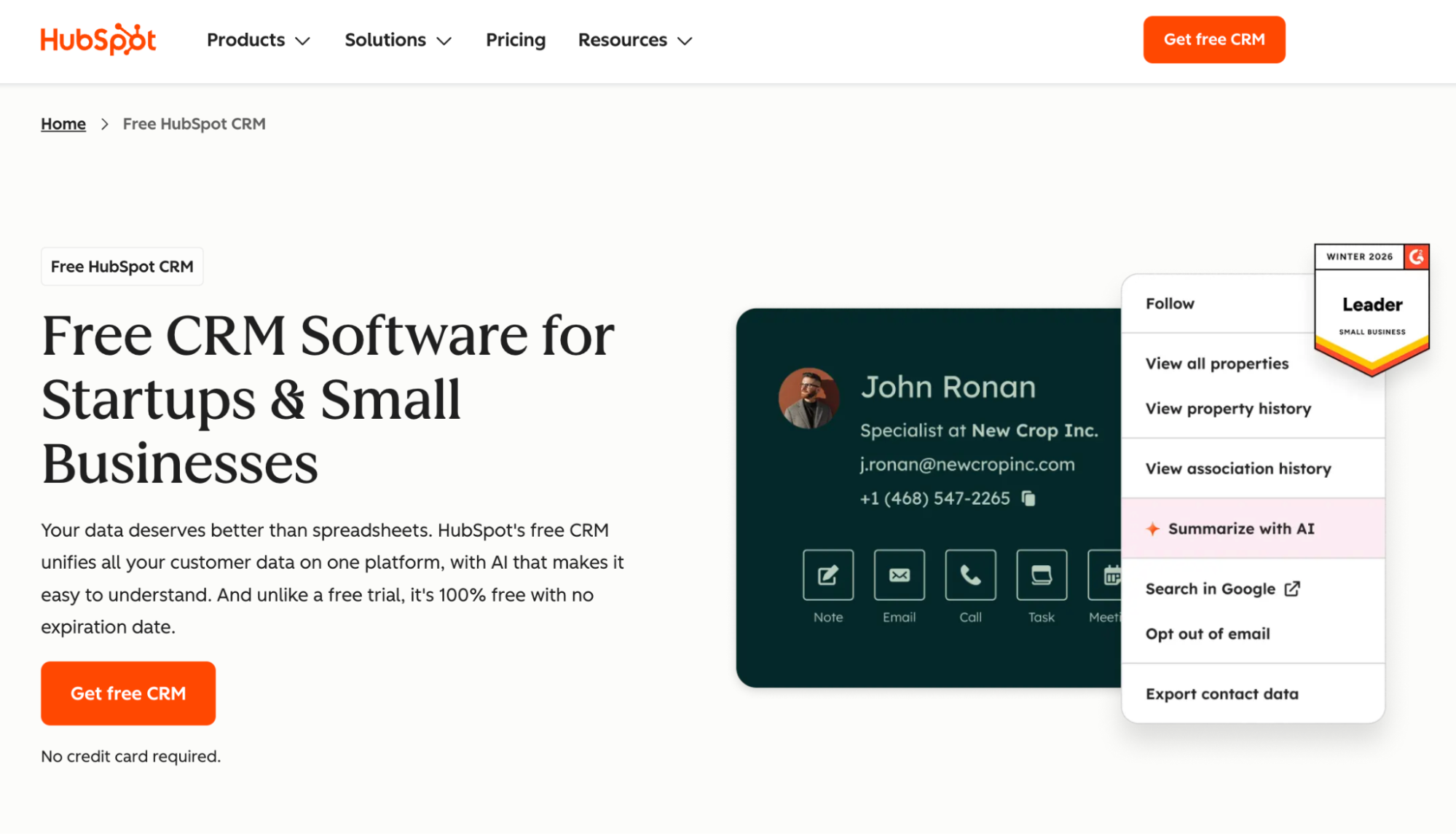
G2 rating: 4.4/5 (12,914 reviews) | Ease of use score: 8.7/10
HubSpot's review volume on G2 is large enough to be statistically meaningful, and the patterns are consistent. Ease of use scores 8.7/10, the highest of any platform at this scale. A free plan that lowers the barrier to entry, driving strong adoption and a high volume of reviews from smaller sales teams. The AI capabilities – now branded as Breeze – span the entire customer lifecycle: Breeze Copilot for AI-assisted tasks, Breeze Intelligence for contact enrichment and buyer intent signals, and specialist agents for prospecting, customer service automation, and content creation.
Where reviews diverge from marketing: the free CRM and the AI-powered CRM are meaningfully different products. The AI features that make HubSpot competitive sit behind paid tiers that escalate in cost faster than most buyers anticipate. Several G2 reviews specifically highlight the gap between what the free plan offers and what the full paid tier costs as a source of frustration.
For sales and marketing teams that need AI-powered tools across the entire customer journey – from marketing campaigns through to customer service – HubSpot's integrated approach has few rivals at its price point.
Check the full pricing comparison.
5. Zoho CRM with Zia

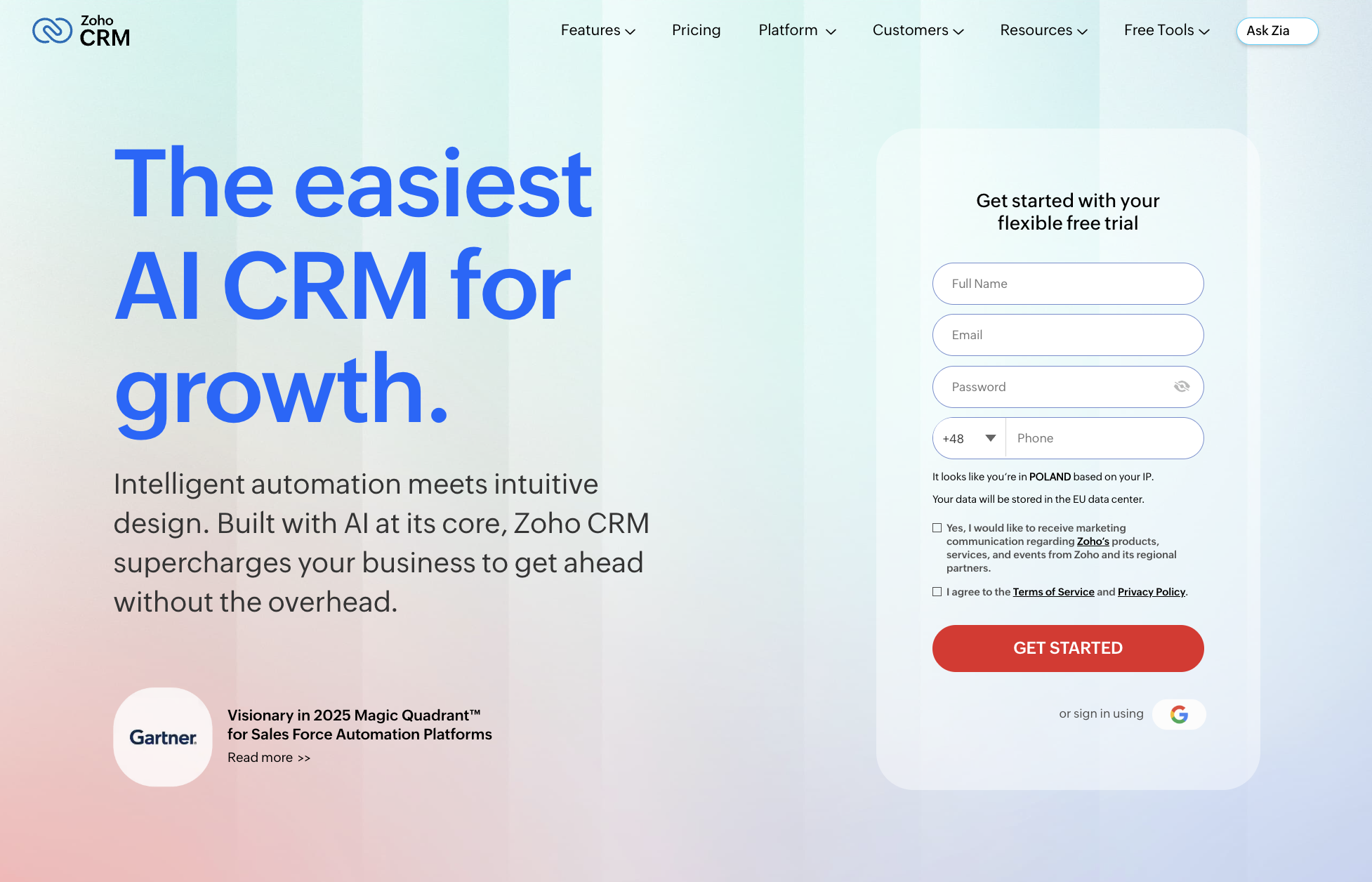
G2 rating: 4.3/5 | Overall market rating: ~4.2-4.3 across platforms
Zoho's reviews tell a consistent story across platforms: competent AI through Zia, and a breadth of features that make it particularly attractive for businesses already using other Zoho products. One frequently cited G2 review calls it "Bang for the buck." Another describes Zia as accessible enough that sales teams can use AI capabilities for the first time with zero technical expertise.
Zia handles predictive lead scoring, anomaly detection in sales data, sentiment analysis on customer interactions, and conversational queries. A sales rep can ask a natural language question about their pipeline and get a data-driven answer immediately. The reviews indicate these features work reliably at the price point, even if they don't match the analytical depth of other solutions.
The consistent negative across reviews: customer support quality. Multiple reviewers on both G2 and Capterra note that support responsiveness and quality varies by tier and region. For a business where CRM support access is a priority, this is part of the trade-off against its feature-to-price value.
For a more detailed breakdown, see the Capsule vs Zoho comparison.
6. Attio

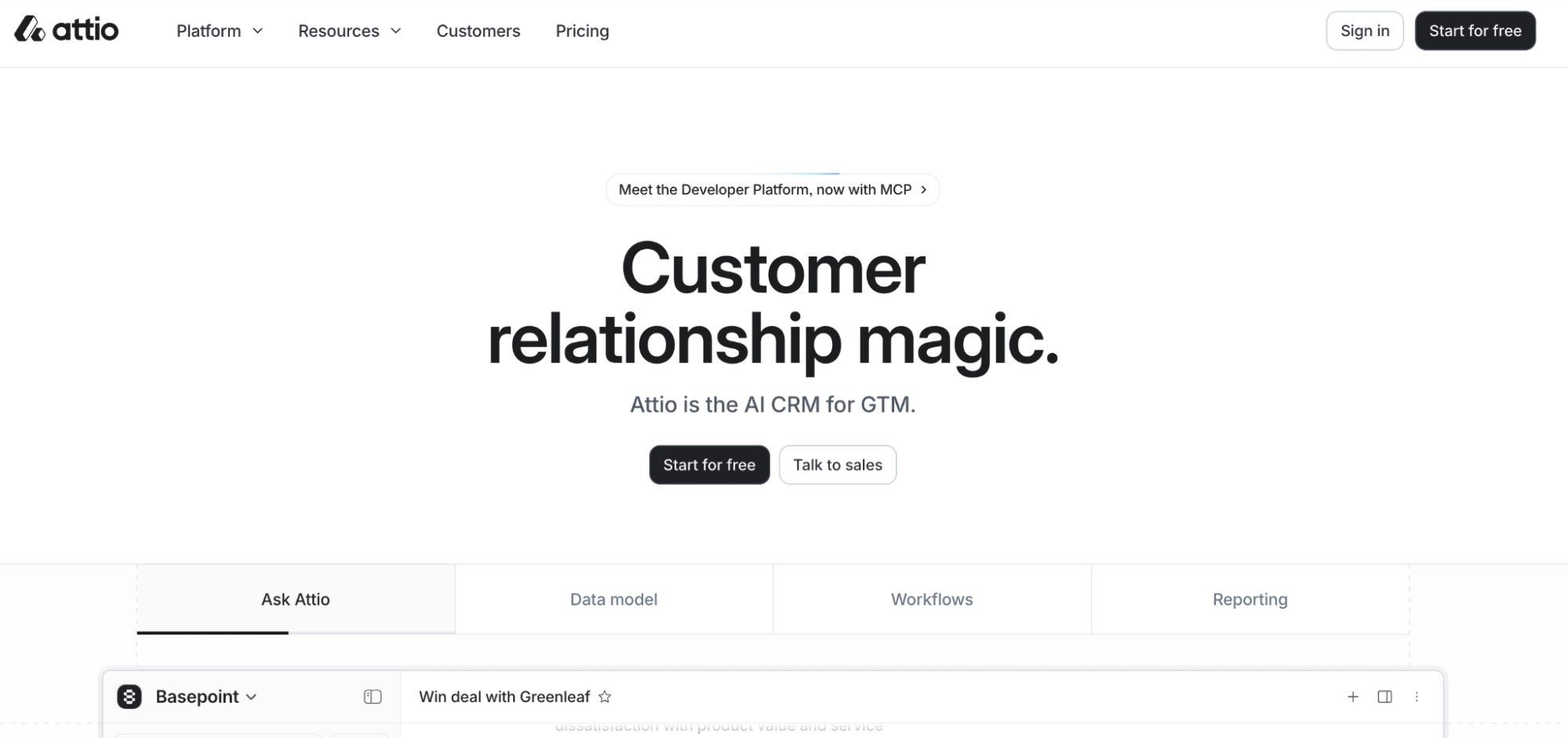
G2 rating: 4.5/5 (158 reviews)
Attio is the newest platform on this list with a meaningful review base, and its G2 rating of 4.5 from 158 reviews reflects a smaller but notably enthusiastic early adopter community. Built around flexible data modelling, it's designed for businesses whose customer relationship management doesn't fit a standard sales funnel template.
The AI capabilities focus on automated enrichment that keeps customer data current across the entire contact database, and workflow automation triggered by real-time customer behavior signals. What reviewers highlight most is the flexibility – the ability to define custom objects and relationships that match the actual business model – combined with an interface clean enough to make that flexibility usable.
The honest limitation: 158 reviews is a relatively small sample, and the platform is still building its track record at scale.
Among tech-forward teams with non-standard requirements, the feedback is consistently positive. Those who prefer the reassurance of a large, mature review base may hesitate.
Check our Capsule vs Attio comparison.
7. Salesforce with Einstein AI

G2 rating: 4.4/5 (24,266 reviews) | Ease of use: 8.0/10
Salesforce has the largest review base of any CRM platform on G2. The picture those reviews paint is consistent across years of feedback: impressive depth of AI capability through Einstein, but also a cost structure that escalates as teams add the features that make Einstein powerful.
Einstein AI covers predictive opportunity insights, automated activity capture, sales forecasting, and conversational intelligence – the most comprehensive AI feature set available in any CRM system. The G2 ease of use score of 8.0/10 versus HubSpot's 8.7/10 reflects what reviewers describe consistently: the platform is capable of almost anything, but requires dedicated admin support and large investment in configuration to deliver it.
The most cited review pattern: "Salesforce is a CRM you need a team to manage." For enterprise sales teams and large customer service teams with dedicated CRM administrators and the budget to match, Einstein is the reference point against which every other AI CRM is compared. For small businesses evaluating whether that depth is worth the complexity, the review data suggests the answer is usually no.
You can review Salesforce pricing in detail here, and compare Capsule vs Salesforce here.
What the reviews tell you that the feature lists don't
Reading across thousands of verified reviews for these platforms, a few patterns stand out that vendor marketing consistently obscures.
The AI tools that get used are rarely the most advanced ones
The capabilities that appear most frequently in positive reviews are not deal-scoring algorithms or complex sentiment analysis engines. They're the ones that remove friction from daily tasks: automated data entry, an AI sales assistant that drafts the next email, AI summaries before a customer call, automation capabilities that trigger follow-ups based on what actually happened. The best AI CRM software is the one whose AI features become invisible because they've become habits.
Historical data quality determines whether advanced AI features are useful
Predictive analytics and future sales trends modelling are only as good as the customer data they run on. Platforms that capture data automatically produce more reliable AI than those that rely on patchy, manually entered data. Intelligent automation of data capture is a prerequisite for intelligent automation of everything else.
Deal management visibility matters more than AI complexity for most sales teams
Across every platform reviewed, the features that drive the highest satisfaction scores are those that give sales reps and managers a current view of where every deal stands – what needs to happen next, which deals have gone quiet, and how the pipeline looks against target.
This is not exotic AI; it's good deal scoring and clean pipeline views. Most businesses don't need a sales-focused CRM with natural language processing and machine learning-driven customer service automation. They need one that keeps the sales process moving in the right direction.
Support quality is a better predictor of long-term satisfaction than AI capability depth
The most consistent negative review pattern across multiple platforms is customer support responsiveness. A smart CRM with slightly fewer AI-powered CRM tools and responsive, knowledgeable support is a better operational choice for most businesses than a technically superior AI-powered CRM platform where resolving a problem takes weeks.
The best AI CRM solutions are the ones your team will actually use
Review after review, across every platform, the CRMs with the highest satisfaction scores share one characteristic: sales reps find them easy enough to use consistently, which means the data stays clean, which means the AI features work as intended.
A simpler AI in a well-adopted customer service CRM produces better business outcomes than the most advanced AI features in a system that half the team avoids logging into.
The right AI CRM is the one that earns its reviews every day
Feature lists and AI capability matrices tell you what a CRM can do. Reviews tell you what it actually does: for real teams, in real business conditions, after the onboarding enthusiasm has worn off. The platforms with the strongest and most consistent review records are often the ones where the AI CRM solutions deliver on their promises reliably, so that users bother to leave a positive review months or years later.
Small and mid-sized businesses looking for an easy-to-use CRM with practical AI and strong user feedback will find Capsule a natural place to start. The free trial requires no credit card and lets you evaluate the solution against your actual sales process rather than another vendor demo.