
You spend six weeks on a deal. Weeks of calls and a custom proposal. Then: "We don't have the budget this year."
That deal was never real, and a 10-minute filter would have told you so on the first call.
IBM built that filter in the 1950s and called it BANT. Seventy years on, plenty of people call it outdated. But for a small business with short sales cycles, it's still the fastest way to tell a buyer from a browser. This guide covers what BANT is, why it fits SMB sales so well, the questions to ask, a simple scorecard, and where it runs out of road.
First, the case for an old idea. Sales reps lose close to two days of every week to non-selling work, by Forrester's count, so the cheapest productivity win is to stop spending the other three on deals that can't close. That's the job BANT was built for, and it's why it refuses to die.
What BANT stands for
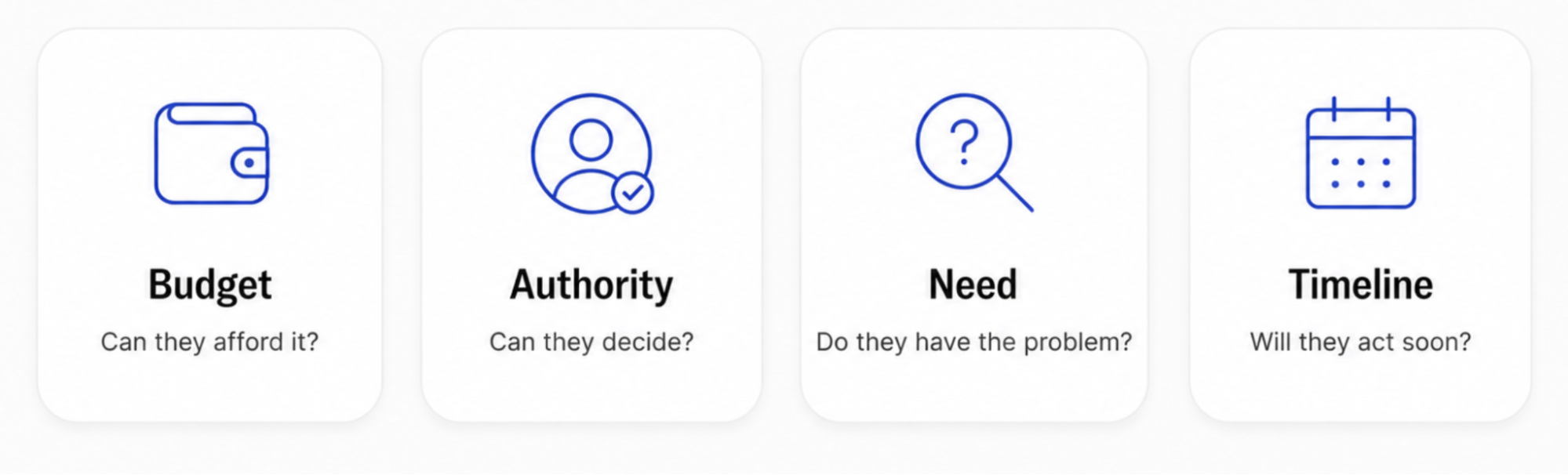
BANT is an acronym, and it stands for budget, authority, need, and timeline.
It's a sales qualification framework: four criteria that tell a salesperson, fast, if a prospect is worth pursuing.

IBM created it in the 1950s, when a mainframe sale took years and reps couldn't afford to chase the wrong accounts, then made it public in the 1960s.
The framework spread across B2B sales and was later popularized in modern software. More than 70 years on, it's still one of the most widely taught qualification frameworks anywhere, used by B2B (business-to-business) sales and marketing teams from startups to the Fortune 500.
Here's what each letter asks:
- Budget. Can they afford it, and have they allocated money to solve this? You're checking the budget criteria, not demanding a number on the first call. A buyer who has set funds aside, or can build the ROI to justify them, is a real one.
- Authority. Are you talking to the decision-maker, or to someone who'll forward your email? Map the job titles and the real decision-making authority behind the purchasing decision. On a larger deal, find the economic buyer who controls the money.
- Need. Do they have a problem your products and services solve? This is the prospect's needs and pain points, the part that matters most. A prospect who needs a solution and knows it is worlds apart from one who is idly curious.
- Timeline. When will they buy? A clear timeframe separates "this quarter" from "someday," and real urgency is the sign a prospect is close to ready to buy.
Meet all four, and you have a BANT-qualified prospect: the money, the decision-making power, a real problem, and the urgency to act. Miss one and you've still learned something useful, beyond a flat yes or no.
A strong need with no budget is a nurture, not a dead end, because budget can appear next quarter. That nuance is what separates BANT used well from BANT used as a blunt checklist.
Why BANT still works for SMB sales
BANT gets criticized, fairly, for being seller-centric and built for a world where the seller held all the information. Buyers now research long before they talk to you, and a B2B purchase can pull in six to ten people. A rigid budget-first interrogation can kill the conversation before it starts.
For a small business, though, that critique mostly misses.
Your deals are smaller, and your sales cycle is shorter. You also can't spend an hour scoring a lead on a 12-point methodology when the deal is worth a few thousand dollars.
BANT filters a lead in a single conversation. It tells a busy founder where to spend valuable time and streamlines the whole thing down to four questions anyone on the team can remember. It also helps you focus on leads that can really buy, instead of potential clients who just enjoy a demo. Speed is the feature here, and for B2B sales with a short cycle, speed is most of the battle.
Think about the economics, too.
On a $4,000 deal, an hour of qualification eats a real slice of the margin. A heavyweight methodology with a dozen fields is built for a $400,000 enterprise sale, where that hour is a rounding error. Matching the effort to the deal size is plain common sense, and for small and mid-sized deals BANT is the right-sized tool. It gives a two-person sales team a shared language, keeps the sales process to four repeatable questions, and means a new hire can screen prospects on day one instead of week six.
That consistency, more than any single deal, is what compounds over a year.
The modern way to run BANT: lead with need
The fix for BANT's stiffness is the order you run it in. The original puts budget first, which makes you sound like a gatekeeper. Flip it, and lead with need.
Start by understanding the problem and if your product or service solves it. Once a real need is on the table, budget, authority, and timeline come up naturally in the conversation. Treat each letter as a thread to pull instead of a box to tick. Used this way, BANT stops being an interrogation and becomes a way to tailor the conversation to where the buyer really is in their buying process. You still capture the four criteria; you just earn them instead of demanding them. That small reorder answers most of the "BANT is dead" criticism on its own.
In practice, it sounds like a conversation:
- "What is the problem costing you?" opens need.
- "Who else would weigh in if you moved forward?" uncovers authority with no blunt "are you the decision-maker?"
- "What would have to be true to start this quarter?" tests timeline and budget at once.
You are still running the BANT qualification process; the prospect just experiences a useful chat with someone who gets their problem.
A BANT qualification checklist
Here's a BANT checklist you can run on any discovery call. Ask a couple of questions per letter, then score each from 0 (no signal) to 3 (strong):
- Budget. What have you set aside to fix this? How do you usually fund a purchase like this? What's the cost of doing nothing?
- Authority. Who else weighs in on a decision like this? Who started the search? What did your last purchase of this size look like?
- Need. What's the problem costing you today? What happens if it goes unsolved? Why now?
- Timeline. When do you need this live? What's driving that date? What does the buying process look like from here?
Add the four scores.

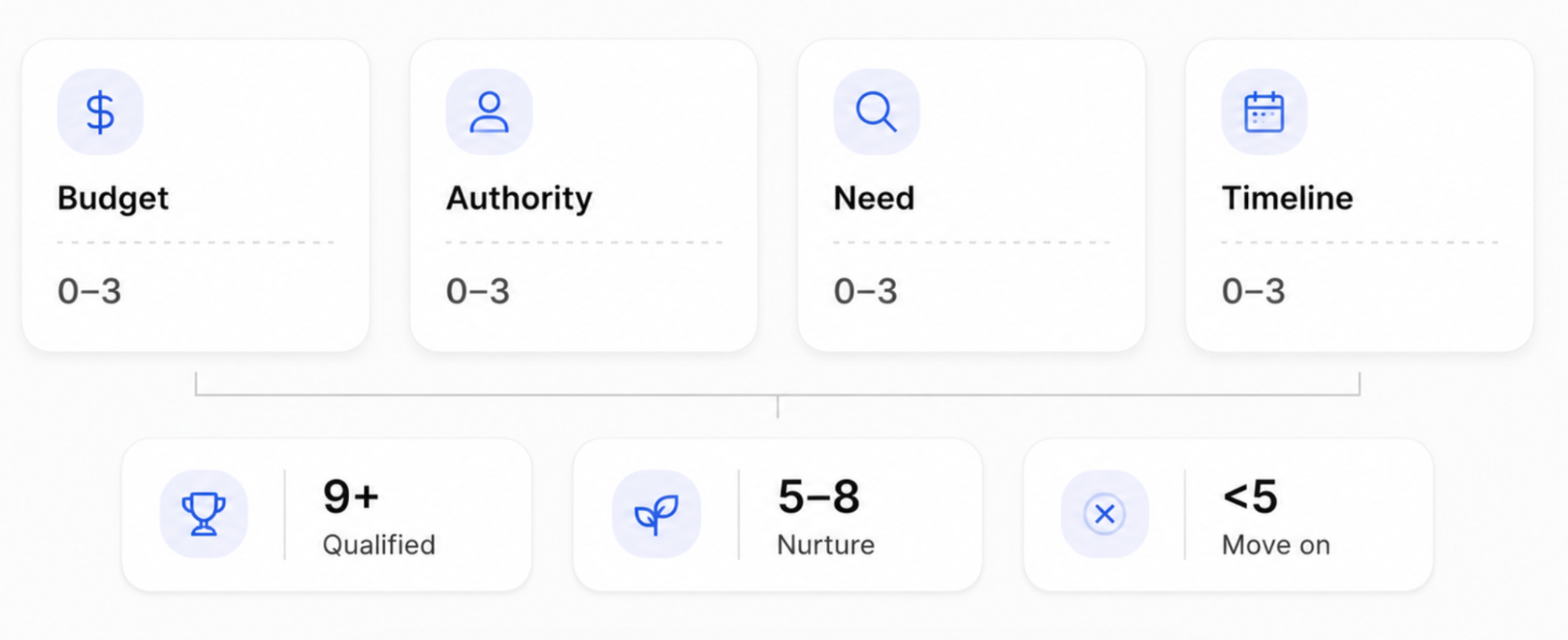
As a rule of thumb:
- 9 or above is a prospect worth pursuing, so send it to your pipeline.
- 5 to 8 means real but not ready, so nurture it.
- Below 5, disqualify and move on.
Some teams prefer an even simpler read: three of the four criteria met is qualified, a missing timeline drops it to nurture, and one box ticked means deprioritize. Either way, the score hands the whole team one consistent set of qualification criteria instead of everyone guessing what "good lead" means.
That scorecard is the original BANT in action: a fast, repeatable way to evaluate a prospect before you sink hours into them.
A worked example makes it concrete:
A prospect tells you the status quo is costing real money (need: 3), they own the budget line (authority: 3), they have set funds aside (budget: 2), but there is no firm date (timeline: 1). That is a 9: qualified, with a flag to nail down timing.
Another likes your demo but can't name a problem or a budget, and has no date. That is a 2, a polite no. Same calls, two clear decisions, no agonizing in between. Run it on a shared view of your leads and the pattern across a month tells you where your best prospects come from.
BANT and its cousins: ANUM, CHAMP, and MEDDIC
BANT isn't the only qualification framework, and it spawned a family of them.

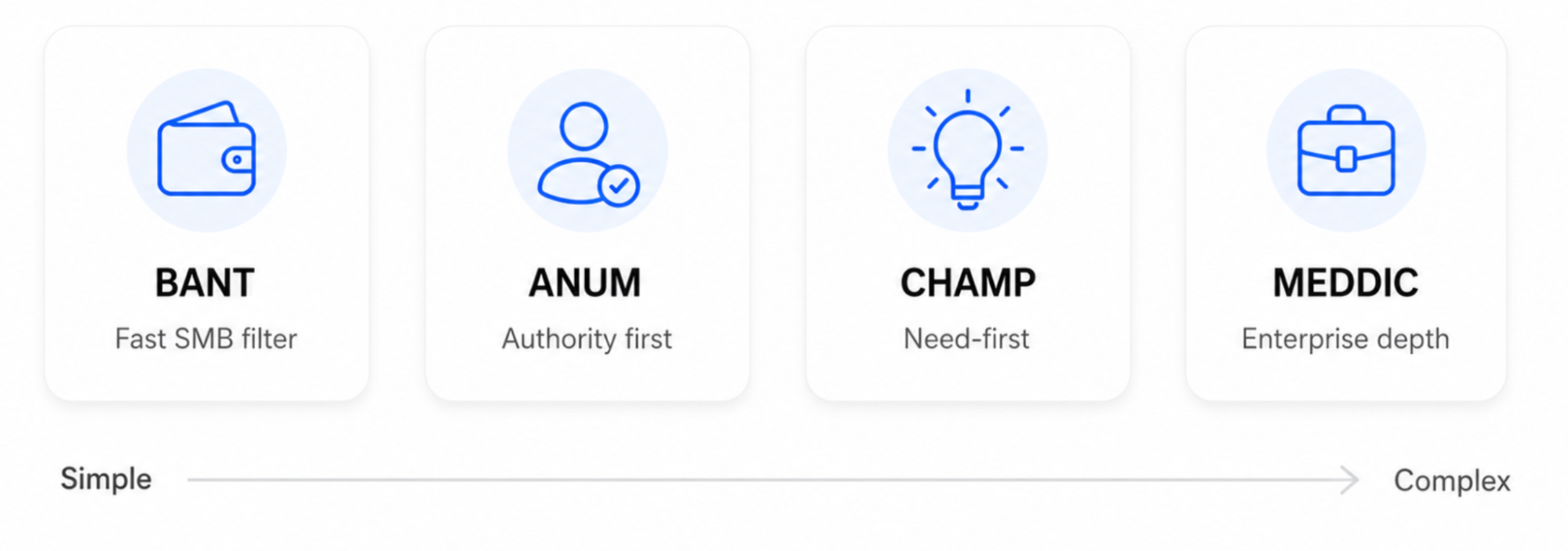
Knowing the cousins helps you pick the right one:
- ANUM reorders BANT to put authority and need first, which suits a market where reaching the decision-maker is the hard part.
- CHAMP leads with challenges, a need-first take that fits consultative, problem-led selling.
- MEDDIC is the heavyweight: metrics, economic buyer, decision criteria, decision process, identify pain, and champion. It's built for big, multi-stakeholder enterprise deals and the long sales cycle that comes with them.
For most small businesses, BANT or a needs-led version like CHAMP wins because it’s simple. MEDDIC is only worth the added weight when one deal can carry months of selling. The mistake is running an enterprise sales qualification methodology on transactional deals, where it slows you down for no payoff. Pick the lightest framework that still protects your time, and you can always layer on more when a bigger deal demands it. There's no prize for the most elaborate system. The best filter is the one your team will run on every single lead, which for many small businesses means the simplest one that does the job.
When BANT isn't enough
BANT has limits, and pretending otherwise does you no favors.
When a sale runs for many months, crosses several stakeholders, or needs a business case signed off by a committee, four questions don't capture enough. Longer sales cycles reward deeper qualification frameworks that map champions and the full decision-making process. Account-based plays, where you target named accounts with ABM and content syndication, also ask for more than a quick filter.
Use BANT as your first, fast pass, then reach for a heavier sales qualification methodology only when the deal size justifies it. For many SMB deals, that day never comes, and the four questions are plenty. Knowing which signals predict a win for your own business tells you exactly how much qualification you really need. As a rough guide: if your average deal closes inside 90 days and involves one or two people, BANT on its own is plenty.
Picture the other extreme: a six-figure platform deal with a buying committee of eight and a nine-month evaluation. A few questions can't hold that. You'd need to track several champions and the criteria each stakeholder cares about, with a formal business case behind it. That's a job for a heavier methodology layered on top, not a reason to throw the fast filter away.
Use the quick pass first to decide if the big deal is even worth the deeper work.
Three ways BANT goes wrong
Even the right framework fails if you run it badly; these three mistakes show up again and again:
- Treating it as an interrogation. Firing four questions at a stranger feels like a customs check. Weave them into a real conversation instead.
- Budget-first by reflex. Asking about money before you've established need makes you sound like you only care about the sale. Create value before making the ask.
- Scoring on hope. Marking "need: 3" because the prospect was friendly inflates your pipeline and burns the next month. Score on evidence, not on vibes.
None of these need a new tool to fix; they need a team trained to score the same way. Get the habit right, and the framework does what IBM intended: it hands back the time you'd have lost on deals that were never real.
The fastest way to make it stick is to write the questions on a sticky note by the phone and review the scores as a team once a week. Habits beat frameworks. A mediocre filter used every day beats a perfect one used never.
Where BANT fits across your funnel
BANT isn't only a sales-team tool; it's where marketing and sales stop arguing. A lead generation strategy that pulls in volume means little if half those names can't buy. By scoring inbound leads against these criteria, marketing teams pass along only prospects worth a salesperson's time, and the rest go into nurture until they're ready.
That shared filter changes the funnel. Generation strategies get judged on qualified prospects produced instead of raw form fills, and tactics like content syndication, which can flood you with low-intent contacts, get held to the same bar. Because it helps sales and marketing teams settle on one shared definition of a good lead, the handoff stops being a fight. A small business rarely has separate teams anyway; the same founder runs both, which makes one shared filter even more valuable.
Putting BANT to work in your CRM
A framework only helps if the whole team uses it the same way, every time. The place to enforce that is your CRM.

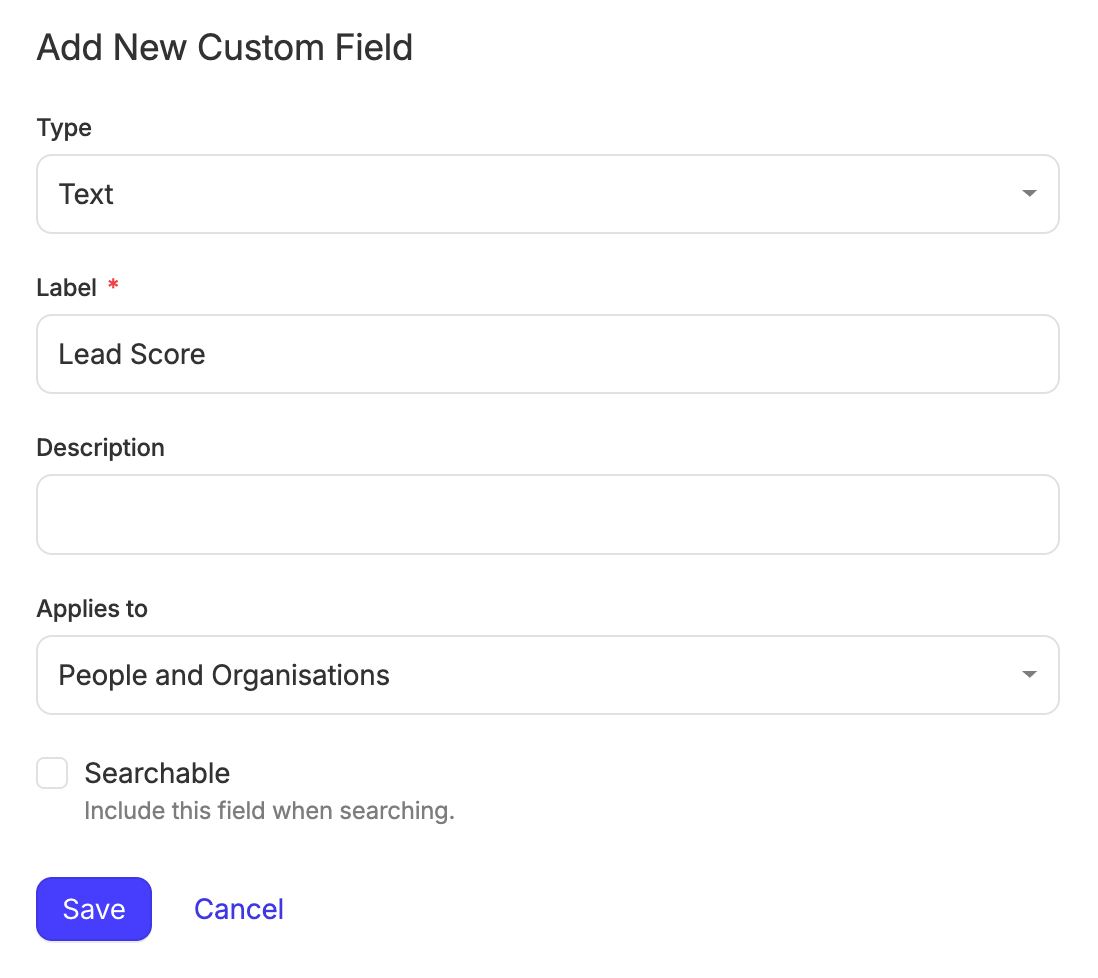
In Capsule, add four custom fields for budget, authority, need, and timeline, plus a fifth for the BANT score. Now every lead carries the same lead qualification process, and a saved filter surfaces the prospects worth a call.

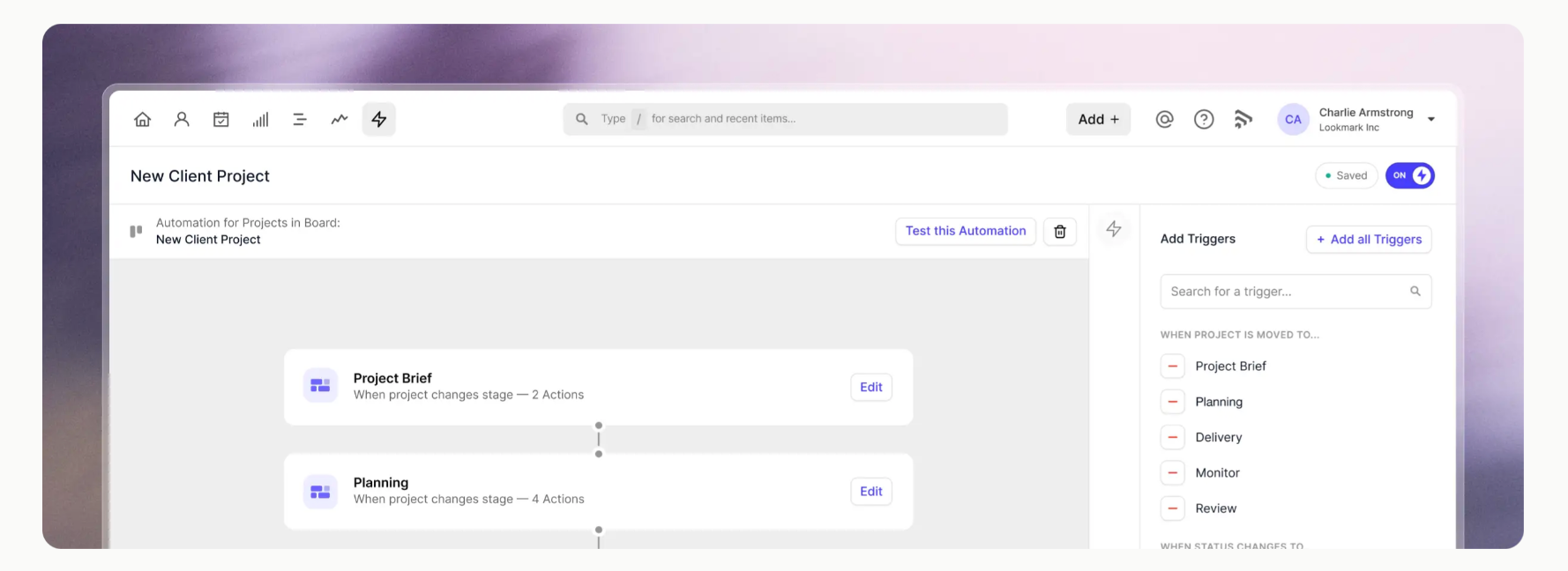
Route those into your sales pipeline and drop the rest into a nurture sequence built with Tasks and automation, so a "not yet" becomes a scheduled follow-up instead of a lost lead. You can shape the stages and win probability around the same criteria.

This is also where sales and marketing teams finally agree on what "qualified" means.
When marketing teams hand over leads from their lead generation, scored on the same criteria, the funnel stops leaking at the handoff.
Capsule keeps no native predictive scoring on purpose: the judgment stays human, and the four questions are the rubric. Train your team once, capture it on each contact record, and qualification gets consistent across every rep, with a free plan that covers two users and 250 contacts to start.
Capture the four answers as custom fields, and over time your reports show which criteria really predict a win for your business, so you can tune the rubric to your market on a clear sales dashboard.
The fastest filter you'll keep using
BANT earns its 70 years by doing one thing well: it tells you, fast, if a deal is real.
If you don’t have hours to spare, speed is worth more than complexity you won’t sustain. Run BANT need-first, score it honestly, and it filters out the browsers before they cost you a week.
Capsule turns the four questions into a system: custom fields to capture each answer, a pipeline for the qualified, automated nurture for the "not yet," and reports to see which criteria predict your wins.
Score your next ten leads with BANT, and watch how much time you get back.