
A SWOT analysis is the fastest way for a small business to see itself clearly before it makes a big call. The trouble is that many SWOTs end up as four lists of vague words nobody acts on. This guide fixes that. You'll get a free SWOT analysis template, five worked examples by industry you can borrow from, and the one step that turns a SWOT matrix into an action plan. Run it in 30 minutes, and you'll make better decisions about the next quarter.
What a SWOT analysis is, and what the letters stand for
SWOT stands for strengths, weaknesses, opportunities, and threats.

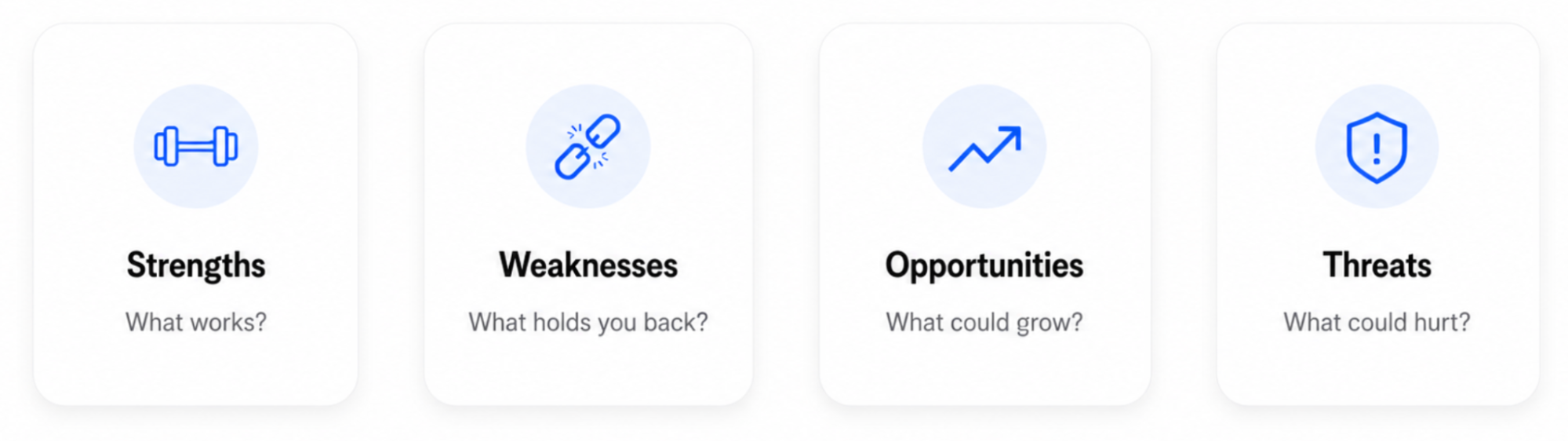
It's a simple strategic-planning tool that maps your business across four quadrants.
- Strengths and weaknesses are internal factors, the things you control, like your team or your brand recognition.
- Opportunities and threats are external factors, the things you don't, like market trends or a new competitor.
That internal-and-external split is the whole point. A SWOT matrix forces you to look inward and outward in one view, so you can leverage strengths against real openings and shore up weaknesses before they cost you. Many people draw it as a 2x2 grid, with one quadrant per letter, and pair it with a quick competitive analysis of the competitive landscape around them.
Use a SWOT analysis when something is changing: before you launch a product or write next year's plan. It's a snapshot of your position, so the value comes from running it at the right moment and acting on what it shows. It isn't the only framework, though it's the fastest. A business model canvas maps how you make money; a SWOT maps where you're strong and exposed. For a quick gut-check before a decision, SWOT wins on speed.
How to run a SWOT analysis in 30 minutes
You don't need a workshop to conduct a SWOT analysis.

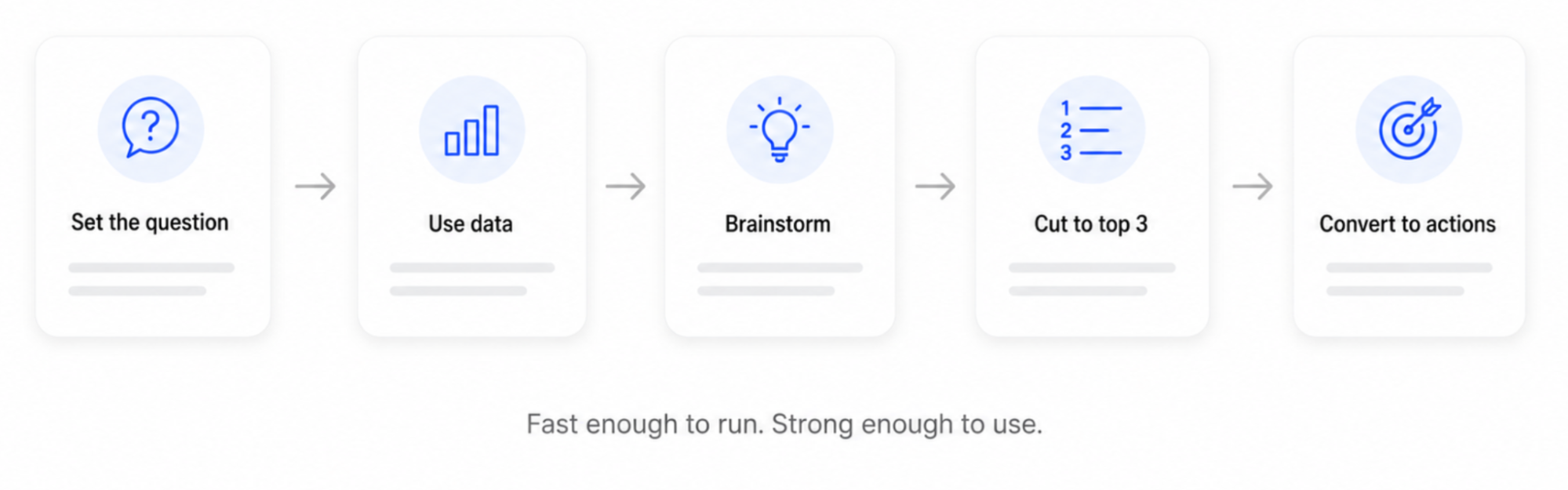
Use this checklist to perform a useful one in half an hour:
- Set the question. Decide what the SWOT is for, like launching a new product or entering a new market. A focused SWOT beats a generic one.
- Start with data. Pull your win rate and churn from your CRM so strengths and weaknesses rest on facts. Our guide to analyzing sales data shows where to look.
- Brainstorm each quadrant. Spend 5 minutes per box. Get the obvious entries down, then push for the possible weaknesses and threats you'd normally gloss over.
- Bring in one or two others. A SWOT done alone inherits your blind spots – a couple of key stakeholders catch what you don't see.
- Cut to the top three per quadrant. A SWOT with 30 items is noise. Keep the few that matter.
- Convert to actions. The last step, and the one teams skip, turns the matrix into an action plan.
A SWOT analysis helps you make informed decisions in less time than a single planning meeting usually wastes, because it ends in a short list of moves instead of a tidy grid.
Keep a SWOT framework loose enough to run fast and strict enough to stay honest.
What makes a strong SWOT entry
The difference between a SWOT that helps and one that gathers dust is specificity.
Vague entries feel productive and tell you nothing.
- Weak: "Good customer service." Strong: "94% of tickets resolved within a day, with a 4.8 review average."
- Weak: "Social media." Strong: "Instagram drives 30% of new leads; LinkedIn drives none yet."
- Weak: "Competition." Strong: "A national chain opens two blocks away in March."
Every entry should be specific enough that someone could act on it. If you can't picture the action, the entry isn't finished. A thoughtful SWOT analysis trades adjectives for evidence.
A quick test: read each entry and ask "so what?". If the answer is obvious and specific, keep it. If you shrug, it's filler. The strongest SWOTs read like a list of decisions waiting to happen.
5 worked SWOT examples by industry
Borrow from these. Each is a realistic small business SWOT, trimmed to the entries that would drive a decision, with a one-line read on the move it points to. Swap in your own details.
A local coffee shop
- Strengths: prime corner location, loyal regulars who order by name.
- Weaknesses: thin margins, no online ordering, a single site with no buffer if foot traffic dips.
- Opportunities: a nearby office block opening, wholesale beans to local restaurants, a loyalty app.
- Threats: a national chain two blocks away, rising bean and rent costs, a slow winter.
The move: the office block opening is the opportunity to plan around now. One strength → one opportunity → one clear action this quarter.
A B2B SaaS startup
- Strengths: a sticky product with low churn, a founder with deep industry credibility.
- Weaknesses: a small team, a long sales cycle, heavy reliance on one acquisition channel.
- Opportunities: an underserved market gap in a vertical, a partnership with a larger platform, demand for AI features.
- Threats: a well-funded competitor; a platform changing its API; a tighter budget climate.
The move: the market gap plus low churn is the growth story, and the single-channel reliance is the risk that could undo it. Diversifying acquisition is the first weakness to fix.
An e-commerce store
- Strengths: strong brand recognition in a niche, a high repeat-purchase rate, fast fulfillment.
- Weaknesses: dependence on paid ads, a thin product range, cart abandonment above the norm.
- Opportunities: a new market overseas, a subscription option, an emerging market trend in sustainable packaging.
- Threats: rising ad cost, a marketplace undercutting on price, supply-chain delays.
The move: a subscription option attacks two boxes at once, lifting repeat revenue and cutting ad dependence, which makes it the highest-leverage action on the board.
A professional services agency
- Strengths: specialized expertise, long client retention, a steady flow of referrals.
- Weaknesses: founder-dependent delivery, a feast-or-famine pipeline, no recurring revenue.
- Opportunities: productize a service, move upmarket to larger clients, add a retainer model.
- Threats: a key client leaving, freelancers undercutting fees, AI tools commoditizing the basics.
The move: founder-dependence and a lumpy pipeline are the same problem wearing two hats. A retainer model and one productized service fix both, and that's where the next quarter should go.
A trades business (HVAC, plumbing, or electrical)
- Strengths: licensed and insured, fast local response, a backlog of repeat customers.
- Weaknesses: hard to hire skilled techs, manual scheduling, cash flow tied to seasonal work.
- Opportunities: service contracts for steady revenue, commercial accounts, demand from new housing.
- Threats: larger franchises entering the area, rising material costs, a regional labor shortage.
The move: service contracts blunt the franchise threat. It’s a strength-and-threat combo worth anchoring the year on.
These SWOT analysis examples share a pattern: every line is concrete enough to argue about, and many point straight at an action you can track as a leading indicator. The bar to aim for.
Build your action plan with a SWOT analysis
A SWOT matrix is a diagnosis. The action plan is the treatment, and it's the step many people skip.

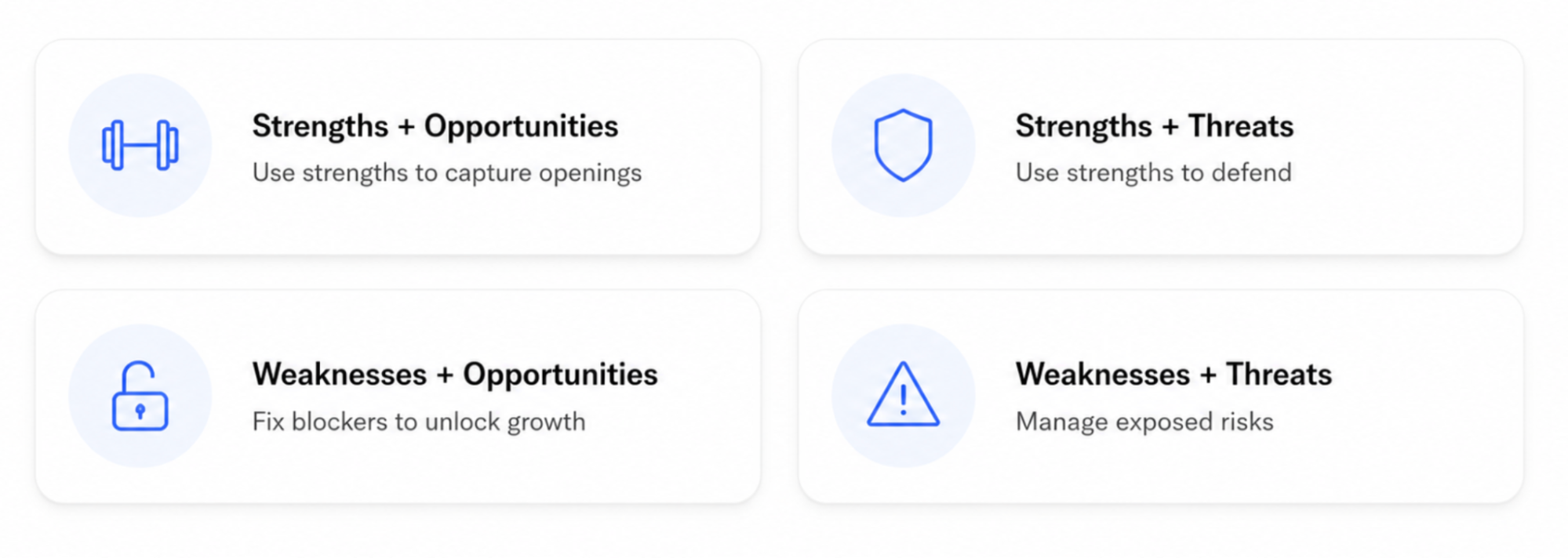
The method is simple: pair the quadrants.
- Strengths and opportunities. How do you use a strength to capture an opening? Leverage strengths to capitalize on opportunities you've already spotted.
- Strengths and threats. How do you use a strength to defend against a threat before it lands?
- Weaknesses and opportunities. Which weakness, fixed, would unlock an opportunity? Address weaknesses that block your best openings first.
- Weaknesses and threats. Where does a weakness leave you exposed? These are the risks to manage now.
Each pairing produces specific strategies you can resource. Borrow the discipline from a marketing playbook and write each as a SMART goal, then give it an owner and a due date.
Keep the list to three to five actions so the team can deliver them, and your SWOT becomes a plan instead of a poster, supporting the strategic decisions you'd otherwise keep putting off. This is where a SWOT feeds your wider marketing strategies, and helps you address challenges before they compound.
Worked through, it looks like this:
The coffee shop above has a strength in loyal regulars and an opportunity in a new office block, so the action writes itself: launch a pre-order app and flyer the new building in week one; owner the manager, due month-end. Strength, meet opportunity. That single line is worth more than the whole grid it came from.
Common SWOT mistakes to avoid
A few mistakes drain the value from a SWOT. Run this quick check before you call it done:
- Vague entries. If an item could apply to any business, sharpen it or cut it.
- No action. A SWOT with no action plan is a journaling exercise.
- Mixing up internal and external. Strengths and weaknesses are internal; opportunities and threats are external factors you don't control.
- Too many items. 30 bullet points hide the few that matter.
- Doing it once. Markets move, so revisit your SWOT each quarter, the same way you'd refresh a business plan.
- Only optimists in the room. Name the real weaknesses and potential threats, even the uncomfortable ones.
One habit guards against all of these: write the action plan in the same session.
A SWOT and its actions captured together stay honest, because the moment you separate them, the actions never get written. Use the SWOT analysis as a decision trigger, and teams that use SWOT analysis this way revisit it far more often.
When to run a SWOT, and how often?
A SWOT is a checkpoint, not a habit you do for its own sake. Run a full one once or twice a year, and a quick one whenever something material shifts, like a new competitor or a fork in the road such as testing new business ideas in a new market.
The trap is treating it as a one-off. A SWOT you ran two years ago describes a business that, possibly, no longer exists. Markets move, your strengths erode or compound, and yesterday's opportunity becomes today's threat. Diarize a 30-minute refresh each quarter, compare it with last quarter's, and a static grid becomes a record of how your position is changing. That trend is often more useful than any single SWOT analysis. Teams that run it on a rhythm spot threats earlier and act on opportunities before the window closes.
A personal SWOT for founders
The same four boxes work on a person.

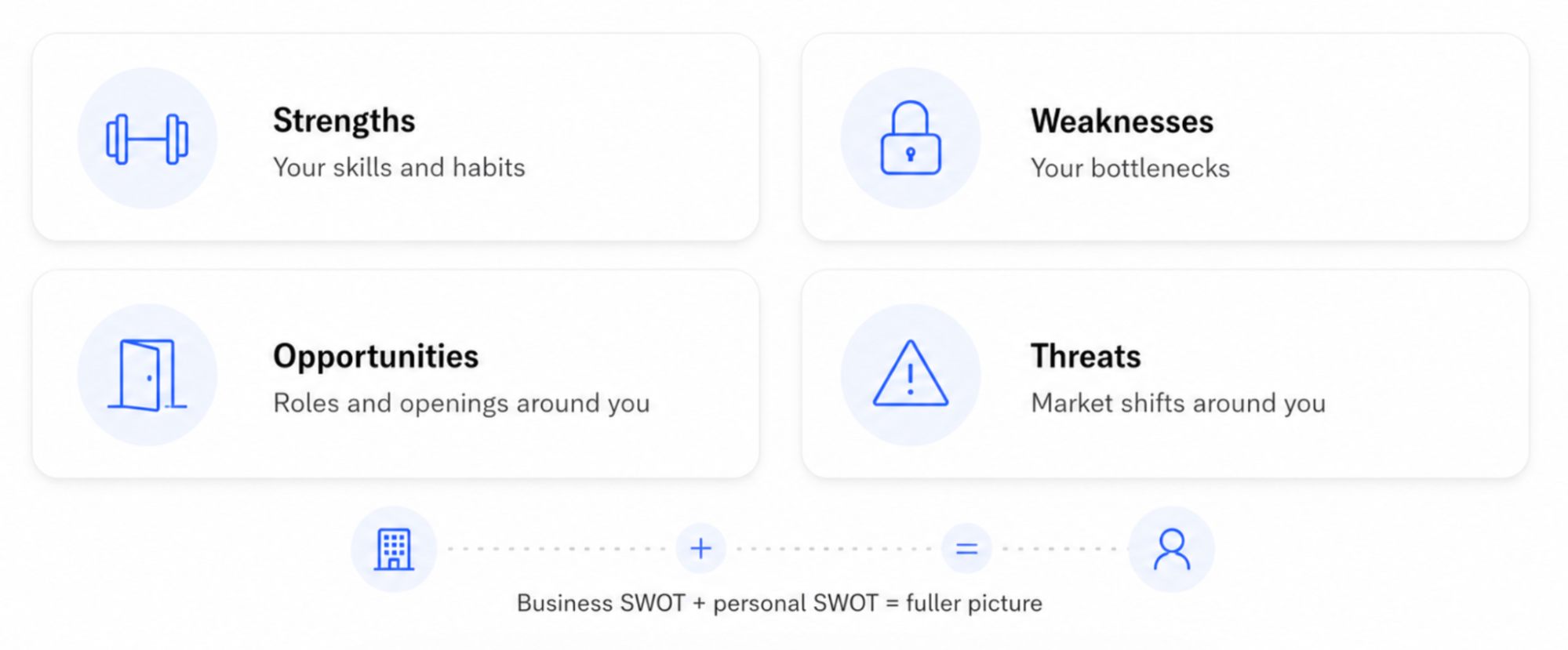
A personal SWOT analysis template helps a founder or a key hire see where they add the greatest value and where they're the bottleneck. Strengths and weaknesses are your own skills and habits; opportunities and threats are the roles and market shifts around you. For a small business where the owner is the business, a personal SWOT often shows the single change that moves everything else. Run it once a year, the same as the business version, and the two together give a fuller picture than either alone.
Your free SWOT analysis template
It's a simple SWOT analysis template, an editable workbook with three tabs:
- A SWOT matrix. The 2x2 grid, with prompt questions in each quadrant so you're never staring at a blank box.
- An action plan. The four pairings above, ready to turn findings into owned actions.
- A checklist. The 30-minute process, so anyone on the team can use it.
It works in Excel or Google Sheets, and the SWOT matrix template drops cleanly into Microsoft Word and PowerPoint for a board pack, or Google Slides for a deck. The template is a strategic starting point you build on, and because every prompt is editable, you customize it to your sector in minutes.
Many free downloads hand you a static SWOT analysis chart, a pretty grid with nowhere to act. This SWOT template provides a structured workflow instead: the matrix, the pairings, and the checklist in one file.
The same workbook flexes into different customizable SWOT analysis templates, a coffee shop one week and a SaaS the next, which makes it a sensible business planning SWOT template to standardize on. It's a great starting point with the five examples above already filled in, so you're adapting SWOT analysis templates with examples instead of facing a blank box.
The template helps most when you treat it as a living document, beyond a one-time download, and the checklist makes the process easier each time. It pairs naturally with the reports you already have. Treat the matrix as a swot diagram you can drop into any deck, and the action-plan tab as the part you live in. Download this template, and your second SWOT takes half as long as the first.
From SWOT notes to next steps in Capsule
A SWOT is only as honest as the data behind it, and much of that data already lives in your CRM. Your win rate and best customers tell you your real strengths and weaknesses, beyond a hunch.

Capsule gives a small business two things a SWOT needs.
First, the evidence. Capsule’s sales reports and customer records turn your internal factors into strategic insights instead of opinions, the same numbers you'd lean on to pick a sales CRM.
Second, the follow-through. Every action from your plan becomes a task with an owner and a due date through Tasks and automation, and the opportunities you spotted go straight into your sales pipeline.
Capsule's free plan covers two users and 250 contacts, so you can act on a SWOT with no new software.
For a small sales team, that closes the loop a SWOT usually leaves open: the analysis points at a move, and the same tool holds the task and the customer history that prove it worked.
The easiest strategy session you can run
A SWOT is simple for a reason. It doesn’t need a big workshop or weeks of prep. Give it a focused half hour, look honestly at what’s working and what’s getting in the way, then decide what changes.
Capsule helps you keep that conversation grounded. Reports show where the business is strong, the pipeline points to opportunities, tasks turn weak spots into follow-up, and customer data helps you notice risks earlier.
SWOT helps you move from shared understanding to a decision the team can own. Download the template, run your SWOT this week, and leave with something to act on.