
The hardest part of personal training rarely sits in the workout itself.
It hides in gaps between sessions, late replies, missed renewals, and clients who slowly drift without anyone noticing in time. That pattern repeats fast once a fitness business grows past a handful of people. Fortunately, a solid CRM for personal trainers brings order to that pressure.
This guide shows how CRM software fits the real workflow of trainers, what tools perform best in practice, and how to choose a setup that protects income while keeping coaching front and center.
What personal trainers actually need from a CRM
Client profiles that protect training quality
A usable CRM in personal training software must store injuries, movement limits, nutrition notes, and history next to basic client data. Client profiles need to support real coaching decisions, not just contact storage. Without that layer, trainers switch tools mid-session and lose focus on the workout.
Scheduling that reflects real gym life
True client scheduling means instant changes, no double bookings, and clean visibility across the week.
The ability to manage schedules from a phone matters since most fitness professionals work on the floor. Automated reminders protect attendance and reduce last-minute gaps.
Payments and follow-ups that stay connected
A proper CRM solution links payment tracking with renewals and follow-ups. When payment processing lives outside the CRM, trainers miss warning signs that affect cash flow and client retention.
Lead tracking from social traffic
Many clients online come from Instagram, TikTok, or referrals. A personal trainer CRM software must capture that interest and support early client communication before motivation cools.
Progress signals that support retention
Built-in progress tracking, workout tracking, and even habit tracking help trainers track client progress in a way clients actually notice. That visibility drives client engagement and long-term client satisfaction.
Many generic CRM systems fail in the fitness industry because they sell deal flow.
Trainers manage behavior change, energy dips, and real human limits.
That gap breaks most tools at the source.
Best CRM software for personal trainers
Capsule CRM: The best flexible CRM for personal trainers
Capsule CRM works for personal trainers because it adapts to how training businesses actually run.
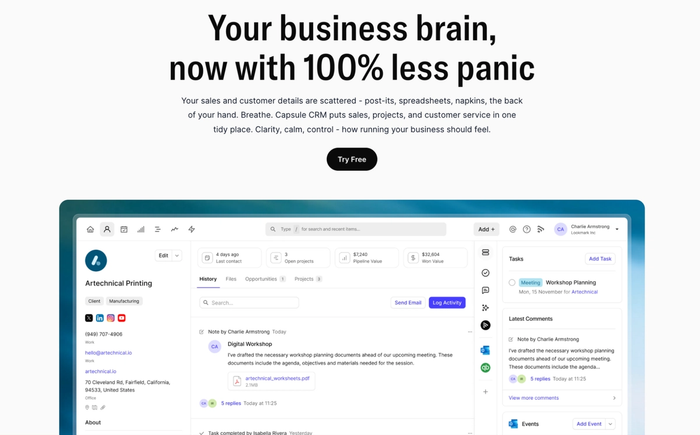
It does not push sales jargon into daily coaching. It supports long-running client relationships and real-world scheduling without friction.
Each client record becomes a working profile. Trainers can store client data, session history, health notes, and package details inside one view. That matters when a knee issue resurfaces after six months or when a nutrition plan needs context before program changes. Capsule CRM handles that perfectly.
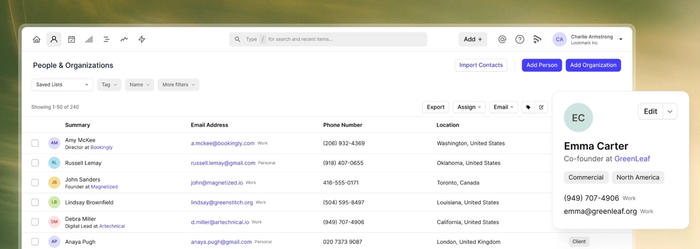
Capsule also fits the way trainers sell. Training packages move through a visual pipeline that works for consultations and upsells. That structure supports client retention. Follow ups attached to clients as tasks, and cash flow stays clear due to built-in payment tracking links with renewal logic.
Mobile access sits at the core of its value. Trainers update notes between sets, check client scheduling on the walk to the next session, and handle client communication without desk time.
This cuts down on unnecessary bureaucracy and administrative overhead, a common drain on a personal trainer's limited time.
Capsule scales cleanly from solo trainers to growing fitness studios. It works without heavy automation for early-stage businesses, then supports deeper workflows once the client base grows.
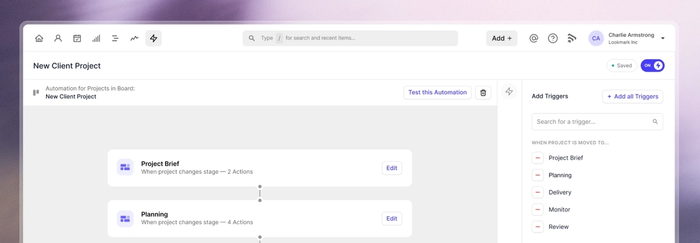
Capsule offers trainers the precise control they need, focusing on practicality rather than complex, unnecessary spectacle.
ABC Trainerize
ABC Trainerize aims to be a full-fledged app for personal training. It lets fitness coaches build custom training programs, meal plans, habit tracking, and workout routines for clients. Trainers can deliver workouts (live or on-demand), monitor client progress, manage nutrition plans, enhance client engagement, and communicate by in-app messaging or video calls.
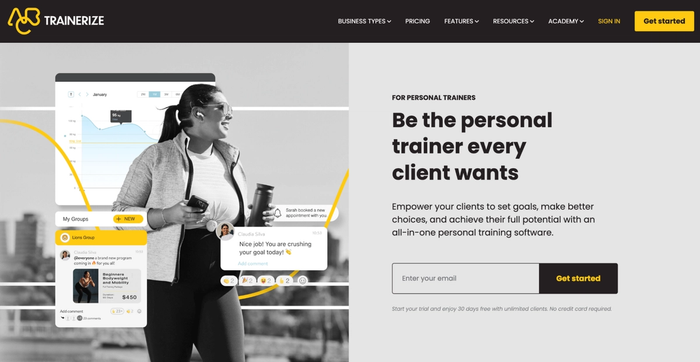
Clients see their training schedule, log workouts or meals, and update body stats in the same interface. It’s a neat all-in-one solution if you deliver workouts, nutrition, and behavior coaching directly, especially for online or hybrid training.
But Trainerize puts its weight on coaching delivery and client experience rather than on backend CRM functionality. Its strength lies in managing sessions and workouts, not in handling lead flows, sales pipelines, structured follow-ups, or long-term business workflows. As your client base grows, those limitations start to show: renewals, upsells, or onboarding new clients become harder to track consistently.
If your goal is to scale beyond delivering programs – to run a growing coaching business or a studio – you may run into friction. That’s where Capsule CRM proves more flexible.
MINDBODY
MINDBODY delivers a broad set of tools for fitness businesses: class and appointment booking, membership management, payments, and even a branded app for clients. Gyms, studios, and wellness centres use it to manage schedules, staff, classes, and client bookings under one roof.
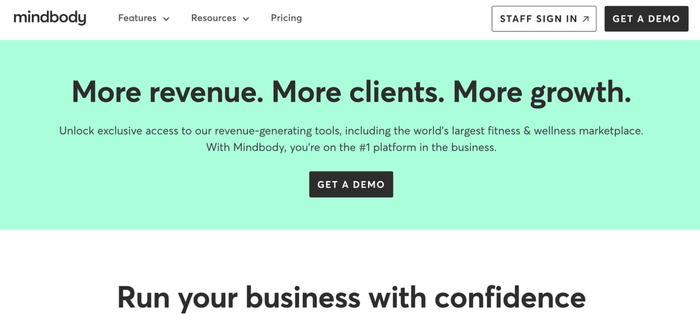
It handles client management, membership plans, billing/payment processing, and offers marketing tools such as automated email/text campaigns, referral features, and waitlist management – a comprehensive set for gyms or wellness businesses aiming for business growth beyond individual training.
MINDBODY also supports group scheduling, class check-ins, multiple trainers or staff members, and can scale to handle many members, which makes it attractive for studio owners, boutique gyms, or anyone running group classes alongside personal training.
However, that strength can also be its weakness if you focus on personal training and want flexible, intimate client relationships and minimal admin overhead. The system is often seen as heavy, with a complex interface and a steep learning curve for smaller operations.
ZenPlanner
Zen Planner tries to give gyms and studios a full-service tool. It covers member management, class and session scheduling & booking, payment processing, and even workout tracking, so you get a platform that handles clients, memberships, and operations in one place.
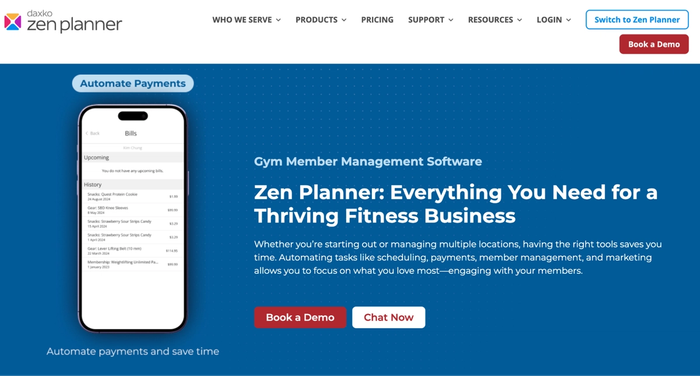
You can let members book via an app or portal, log workouts or attendance, and pay or renew memberships: useful if you run group classes or a multi-trainer facility.
For studio owners, especially those managing classes, staff, many clients, or multiple locations, Zen Planner offers a lot of what a fitness business needs: automated billing and payments, scheduling across staff or classes, and reports that track attendance, revenue, and member life-cycle.
On the other hand, if you focus on individual coaching, custom programming, and long-term client relationships, Zen Planner may feel heavy and less adapted to personal-trainer-style flows. Its gym-oriented design sometimes sacrifices flexibility around personalized client data, nuanced follow-ups, or non-membership-based coaching plans. Some users report that the interface gets complicated when you try to treat clients more like individuals than “members.”
Zen Planner works well as a backend for group gyms, studios, or membership-based facilities that need structure for many clients. But for coaches whose strength lies in one-on-one training, custom programming, and tight client relationships, a more flexible CRM-oriented solution may remain the right fitness CRM software.
FitSW
FitSW gives personal trainers and small studios a robust set of tools built around actual coaching workflows. You can design workouts, assign training programs, create nutrition plans, and let clients log workouts or meals. That helps you track progress and manage workout programming while giving clients a clean client app experience for logging and following plans.
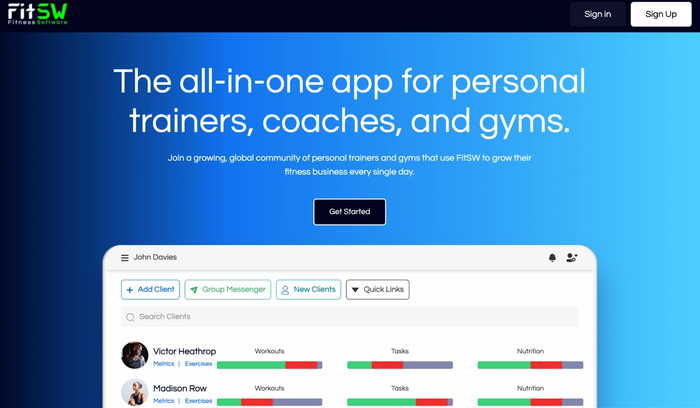
Its features support client management and client interactions more deeply than spreadsheets. Trainers get easy access to each client’s history, nutrition tracking, program compliance, and logged data: good for personalized coaching and existing clients.
FitSW keeps admin overhead low: scheduling, program delivery, progress tracking, communication, and basic billing live in a single interface; it’s handy if you want to reduce administrative overhead and keep coaching time focused on clients.
Still, FitSW isn’t built around deeper business operations. For lead flows, renewals, upsells, or long-term relationship tracking – especially if you plan to scale or adopt a CRM mindset – its focus on training delivery can feel limiting. It lacks full-fledged customer relationship management logic. For coaches who want flexible workflows and growth-ready business operations, a dedicated CRM remains a more adaptable long-term path.
ABC Glofox
ABC Glofox offers a broad set of features that appeal to gym owners, studios, and fitness professionals who run group classes, manage many clients, or operate memberships rather than one-on-one coaching. It supports member management and appointment booking, handles payments and billing automation, delivers a client app for bookings and check-ins, and supports class scheduling and attendance tracking.
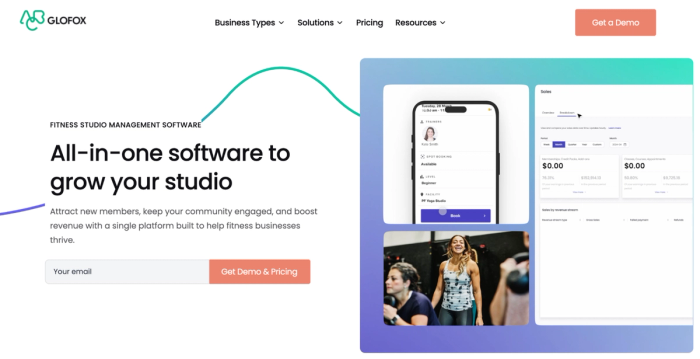
This tool shines when you want to streamline business operations across classes, memberships, and recurring payments. For studios or gyms offering group sessions and multiple services, it can help automate billing cycles and reminders and support marketing efforts – great if you treat your business more like a club than a boutique coaching practice.
However, ABC Glofox’s strong suit is group and membership-based operations. If your focus is on individual coaching, personal training programs, and building client relationships for long-term progress tracking, it may start to feel too broad and impersonal. The logic around memberships and classes can overshadow the nuanced needs of one-on-one training, where flexibility, custom data per client, and tailored follow-ups matter more than group scheduling or membership cycles.
In short, ABC Glofox can be a compelling choice if you're a gym owner or a studio running many clients across classes or memberships, especially when you value automation, member convenience, and operational efficiency. But for trainers aiming to manage clients individually and deliver custom programs, a more CRM-oriented system might offer better control and a cleaner fit for those workflows.
Fitness-CRM / Gym-software Picking Checklist
- Does it help you manage client relationships and streamline client management? Look for a system that keeps all client information (contact, history, notes, progress) in one place.
- Does it offer the right mix of core features like scheduling, workout programming or progress tracking, and payment/membership tools?The best personal-training software balances coaching-specific functions (training programs, progress tracking, nutrition/workout logs) with practical tools (billing, appointments, class or session scheduling).
- Is its interface user-friendly and built with fitness professionals in mind?A good tool should feel straightforward for trainers: not like a sales CRM shoe-horned into fitness. Easy access, intuitive layout, and clear user flow matter.
- Does it support effective communication and client engagement?Features like in-app messaging, real-time messaging or notifications, reminders, automated follow-ups, and a client-facing app or portal help you maintain good communication with clients and support long-term relationships.
- Does it include marketing automation and business-growth tools?For fitness professionals who want to grow, automation for leads, follow-ups, renewals, reminders, or membership churn prevention can make the difference. Systems tuned for gyms often offer email/SMS automations, member segmentation, and marketing-effort features.
- Will it scale with you as your client base or business model evolves?If you plan to expand (more clients, group classes, hybrid training, membership tiers), choose a solution that handles both one-on-one training and studio- or gym-level operations without forcing you to switch tools every time.
- Does it help reduce administrative overhead so you spend more time coaching and less time managing spreadsheets?Automation of bookings, payments, reminders, follow-ups, client onboarding, and progress tracking saves time and mental energy, letting you focus on training and coaching.
- Is there a trial or demo available so you can explore key features before committing?Testing in real conditions (scheduling a few sessions, adding a couple of clients, logging workouts, checking communications) is an essential step to see whether the tool truly fits your workflow.
Conclusion
In the search for the best personal trainer software, you want a system that truly helps you manage client relationships and delivers essential tools for daily work. The ideal solution feels intuitive: a user-friendly interface that caters to fitness trainers and other fitness professionals alike.
A tool that lets you communicate effectively, offers real-time messaging or notifications, and helps you automate follow-ups can elevate service and boost engagement across your client base. For coaches eyeing business growth, good software should combine coaching-first features with operational support like billing, reminders, and member management.
For many trainers and gym owners – especially those building long-term fitness journeys with clients – a balanced platform becomes more than an app: it becomes a hub for client information, training delivery, and ongoing relationships. A system built around both coaching and business operations delivers the flexibility you need now and the stability you’ll want as you scale.