
CRMs are a crucial tools for sales teams, helping teams manage relationships and move deals forward. AI now sits squarely inside that evolution. After the rise of ChatGPT and large language models, CRM vendors started adding AI features that support daily sales work.
This guide goes beyond a list of the best AI CRM tools. It shows how AI fits into real sales workflows, with practical ideas your sales team can use right away.
What's an AI CRM anyway?
There is no such thing as "AI CRM software".
In most cases, this label describes a standard CRM that uses machine learning and language models to help with everyday CRM tasks. The AI portion of the CRM is there to analyze patterns or generate suggestions without human input.
So, it would be more accurate to call these tools AI-powered CRM platforms since the core of the product remains the same, with added AI capabilities.
What an AI-powered CRM can do for your sales processes
They won’t magically fill your sales pipeline, but AI-powered CRM tools save sales teams time and surface insights that actually drive action. Here’s how:
AI summaries for customer interactions
How do you walk into a sales call fully prepared without skimming pages of CRM notes?
When the goal is to close or upsell, digging through emails, messages, call transcripts, internal notes, and past touchpoints is the last thing you need. The context is there, but it’s buried in noise.
AI-powered CRMs cut through that. They summarize customer interactions and surface only what matters for the call at hand, such as open issues, deal status, or recent signals worth addressing.
For small businesses, this makes handovers far less fragile. Sales and support teams get instant context before a call, without relying on memory or interrupting others. It also speeds up re-engagement, especially with leads that went quiet and need a fast, informed follow-up.
Improved communications with content creation tools
Small businesses send a high volume of similar messages, from cold outreach to quick check-ins. AI features inside CRMs use existing contact data to personalize those emails automatically, based on context like past interactions, deal stage, or industry.
The impact is practical and immediate:
- Messages follow a consistent tone and style across the team
- Non-native speakers or less confident writers can send clear, professional emails
- Routine communication takes minutes instead of eating up the day
Less time rewriting emails, more time engaging prospects who are ready to move.
AI pipeline summary and forecasting
Sales teams often spend hours every week reviewing pipelines and updating forecasts, yet many still rely on gut feeling to decide what needs attention. AI-powered CRMs change that dynamic.
When your data is clean and current, an AI sales assistant can summarize pipeline health, highlight what is moving, flag stalled deals, and point out risks based on activity patterns and deal history. You get a clear view of where revenue is likely to come from and where follow-ups matter most.
For small businesses, it means a fast pulse check on the pipeline without deep analysis.
A CRM copilot that provides actionable insights
How often do you open a CRM to answer one concrete question and end up clicking through reports that don’t help?
CRM copilots are built for exactly this problem. You can ask a direct question in plain language and get a clear answer pulled from live data:
- Which deals didn't close this month?
- Which tasks are overdue?
- Who closed the most deals in the last quarter?
For small business owners, this removes much of the friction that makes CRMs feel heavy. You don’t need to master the tool before it becomes useful. The CRM responds when you need clarity and helps you decide what to focus on next.
What AI CRM software cannot help you with
AI can be incredibly powerful, but at the same time, there are certain things that cannot be automated.
- An AI CRM won't fix a broken sales process if it lacks documentation or consistency.
- It won't create relationships with customers. It can personalize messages and summarize conversations, but you have to reach out, follow through, and keep your promises.
- AI features in your CRM won't replace sales or account managers. No CRM can think strategically about a deal or adapt to complex human signals.
- It won't help you make better decisions if the data isn't organized. Data entry is your responsibility. If you have missing notes or outdated sales data, AI won't be able to do things like predictive lead scoring.
- AI doesn't understand nuance. No LLM can understand why a deal is sensitive or valuable, why a customer is upset about something in a call, or why a decision is blocked internally.
- It won't make you more accountable. While AI can show and predict patterns, it can't make your reps pick up the phone or start emailing.
- Last but not least, the AI won't run the CRM for you. You'll still have to maintain the pipeline, update your contacts, log activity and customer behavior, and everything else in your daily operations.
However, you'll find that different customer relationship management tools are getting better AI features with each passing day.
The best AI CRM tools for small businesses in 2026
If you're looking for a smart CRM with AI features, there are a lot of choices, as almost every CRM software provider is baking in new AI tools into their offer daily. These are some of the best options in the market as of early 2026.
Capsule CRM
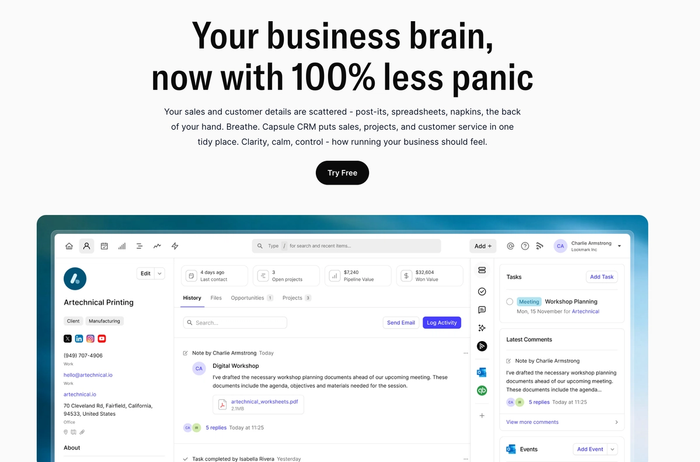
Capsule CRM is a sales-focused CRM built for small businesses that want structure and a strong set of core features without any of the unnecessary extras.
Instead of bolting on flashy automation, Capsule has been adding AI features that reduce friction in everyday sales work and help teams understand their data faster. Capsule gives small businesses more clarity and usability, instead of a heavy prediction model that they can't use every day.
Key AI features:
- AI contact summaries. Capsule automatically summarizes the last six months of activity on a contact, pulling from notes, calls, emails, updates, and other details logged in the CRM. This gives you a clear snapshot of recent conversations and open threads without scrolling through the full history.
- Content Assist for customer communication. Content Assist helps users write and edit emails directly inside Capsule using guided prompts connected to GPT. It is designed for day-to-day customer communication, like follow-ups or check-ins, helping your team write faster and keep a consistent tone.
- CRM copilot for questions and insights. Capsule’s upcoming copilot feature lets users ask questions about pipelines, contacts, tasks, and more in plain English. Instead of running reports, you can ask questions such as what is in your pipeline or what tasks are overdue.
- AI pipeline summaries and forecasting. Similar to contact summaries, Capsule applies AI to sales pipelines to surface what is moving and what needs attention. This gives your team a quick understanding of pipeline health.
AI features in Capsule are available starting on the Starter plan, which is priced at $18 per user per month when billed annually.
Monday CRM
Monday CRM is a flexible CRM built on their work management platform, so it feels more like configurable boards than a traditional database-first CRM. In the last couple of years, Monday has added AI features that help sales teams summarize activity and fill in CRM data faster. Most of these features run on an AI credits model, so access depends on the plan and whether AI is enabled for the account.
Key AI features:
- AI email generator. Monday CRM can generate outreach emails and follow-ups from prompts inside the CRM. It is meant for quick first drafts that reps can edit before sending.
- Emails and activities timeline summaries. AI can summarize recent interactions on a record so a rep can catch up before a call. This is useful when multiple people touch the same account or when a lead has been quiet.
- AI-assisted data entry and column fill. AI can populate board fields by converting unstructured notes into structured values, cutting manual updates and keeping CRM records current with less effort.
- AI blocks for common actions. Monday includes ready-made AI actions you can apply to CRM items, like drafting text or summarizing content. These actions consume AI credits as they run.
- AI Sidekick for guided help. Some plans include an AI assistant experience that helps users work faster inside Monday, depending on plan level and AI activation.
The lowest plan where Monday CRM AI features are available is the Standard plan, listed at 20EUR per seat per month, and AI must be enabled by an admin. AI usage is credit-based, and accounts typically start with a one-time trial allocation of AI credits, with more available for purchase once those are used.
You can learn more about Monday CRM pricing in a separate blog post.
Freshworks CRM and Freddy AI
Freshworks CRM is a sales and customer engagement platform designed for small and growing teams. It has been enhancing its CRM with Freddy AI, a built-in assistant that helps users understand data and draft communications.
Key AI features:
- Freddy AI insights. Freddy looks at your pipeline and activity history to surface patterns and flag deals that may need attention. It highlights where deals have slowed and where engagement is trending up.
- Conversation summaries. AI can review logged calls and emails to generate short summaries you can scan before a follow-up, so reps spend less time digging through past activity.
- AI-assisted email drafting. Freddy can generate or improve email content for outreach and follow-ups using CRM context. The drafts are suggestions that you can edit before sending to keep your voice and intent intact.
- Predictive scoring. Scoring updates automatically based on how prospects engage and how similar deals performed in the past.
- Smart alerts and recommendations. Freddy notifies you when opportunities stall or when activity drops below expected levels. It also suggests follow-up actions based on what has worked in similar situations.
Freshworks CRM with Freddy AI features is available on the Growth plan, which starts at $47 per user per month. We covered Freshworks CRM pricing in another post, too.
Salesforce and Einstein AI
Salesforce is an enterprise CRM that has been layering AI into its platform for nearly a decade through Einstein. In recent years, it expanded those capabilities with generative AI across sales and reporting. The result is a CRM where AI is deeply embedded, but also more complex than most small teams need.
Key AI features:
- Einstein deal insights and predictions. Einstein analyzes historical pipeline data and activity patterns to flag deals at risk and highlight opportunities likely to close. These insights appear directly on deal records and forecast views.
- AI-generated summaries for accounts and opportunities. Salesforce uses generative models to summarize recent activity across emails, calls, notes, and tasks. This gives reps quick context before meetings or handovers without scrolling through long timelines.
- Forecasting and pipeline intelligence. AI reviews pipeline trends and rep behavior to produce revenue forecasts and identify gaps between expected and actual performance. Forecasts update automatically as deal data changes.
- Email and message drafting. Generative AI can draft sales emails and follow-ups using CRM context, such as deal stage and recent conversations. Users can edit and approve content before sending.
- Next step recommendations. Einstein suggests actions like follow-ups or stage changes based on what has worked in similar deals.
Salesforce AI features are available starting with the Starter Suite Plan, which begins at $25 per user per month. Learn more about Salesforce pricing in this blog post.
Zoho CRM
Zoho CRM is a flexible CRM used by small and midsize businesses that want deep customization. It has been building AI features for years through its Zia assistant, which is woven into reporting and contact management. The AI focus is on pattern detection and practical guidance rather than generative features alone.
Key AI features:
- Zia AI assistant. Zia analyzes CRM data to answer questions about pipeline and deals in plain English. It can also surface anomalies, such as sudden drops in conversions or unusual deal behavior.
- Predictive lead and deal scoring. Zoho uses historical data and engagement signals to score leads and deals automatically. Scores adjust as contacts interact with emails and workflows, helping reps prioritize follow-ups.
- Sales forecasting and trend analysis. AI reviews pipeline performance over time to predict revenue and highlight stage-level bottlenecks. These insights update dynamically as deals move.
- Email suggestions and sentiment analysis. Zia analyzes email content to suggest better timing and detect customer sentiment. This helps reps understand tone and urgency without reading every message in detail.
- Data quality and anomaly detection. AI flags missing fields and unusual activity patterns. This helps keep the CRM reliable as data volume grows.
Zoho CRM’s AI features are available starting on the Standard plan, which is priced at 20EUR per user per month.
HubSpot
HubSpot is an all-in-one CRM that combines sales, marketing, and customer service in a single platform. Over the past few years, it has pushed heavily into AI features, layering them across email, forecasting, reporting, and data management. The focus is on helping teams move faster while keeping everything tied back to the CRM record.
Key AI features:
- AI-powered email writing and editing. HubSpot uses generative AI to draft sales emails and replies directly inside the CRM. The content is generated using deal context and contact history, with users able to edit before sending.
- Predictive lead scoring. AI analyzes historical customer data to score leads based on how likely they are to convert. Scores update automatically as new data comes in, helping reps focus on the most promising opportunities.
- Forecasting and deal insights. HubSpot applies machine learning to pipeline data to predict revenue, flag deals at risk, and surface trends across stages. These insights appear directly in forecasts and deal views, with no need to build custom reports.
- Conversation summaries and call insights. AI summarizes logged calls, emails, and conversations to give reps quick context before meetings. Especially useful for handovers and re-engaging older leads.
- Data cleanup and enrichment suggestions. HubSpot uses AI to detect duplicate records, missing fields, and inconsistent data. It suggests fixes to keep the CRM usable as the database grows.
HubSpot’s AI features become available starting with Sales Hub Professional, which starts at $100 per user per month plus a required platform fee. This is the lowest tier that includes predictive scoring, AI-assisted content creation, and advanced forecasting tools.
Pipedrive
Pipedrive is a sales-focused CRM built around clear pipelines and activity tracking. Over time, it has added AI features that help small teams prioritize deals and spot problems earlier in the sales cycle. The AI layer is meant to guide decisions, not take control away from sales reps.
Key AI features:
- AI Sales Assistant. This assistant analyzes your pipeline and historical deal data to surface insights inside the CRM. It flags stalled deals, highlights risks, and suggests next steps based on patterns seen across similar opportunities.
- Deal probability and revenue forecasting. Pipedrive uses past win and loss data combined with current activity levels to estimate the likelihood of closing each deal. These probabilities roll up into simple forecasts that give small teams a clearer view of expected revenue.
- Email writing assistance. AI-powered email tools help sales reps draft follow-ups and responses directly inside the CRM. Suggestions are based on deal context and recent interactions, with full control left to the user before sending.
- Activity and follow-up recommendations. The system monitors deal momentum and engagement signals to suggest when to reach out or take action. This helps prevent deals from going quiet, and your team doesn’t need any reminders to follow up.
- Pipeline performance insights. AI highlights trends across pipeline stages, such as where deals commonly slow down or drop off. These insights help managers adjust processes without building complex reports.
Pipedrive’s AI features start on the Lite plan, which is priced at $24 per user per month.
Start using AI-powered tools in your CRM today
AI-powered features make good CRMs even better. If your team is struggling with CRM adoption and understanding how it fits into the entire sales process, generative AI can be the differentiator you need. Senior team members can get insights more quickly, while junior sales reps can access data and features that would otherwise take months to learn.
And if you need a sales-focused CRM with a wide range of AI automation features, choose a CRM system built for small businesses. Try Capsule today, completely free.