You know that sinking feeling when your sales pipeline looks full on paper, but nothing seems to move? Leads sit in stages for weeks, and your best reps spend more time updating spreadsheets and entering CRM notes than actually selling.
It’s not just you. Data shows sales reps spend roughly 70% of their time on tasks that aren’t direct selling: admin, data entry, basic follow-ups, manual scoring… everything that drains energy and slows deals.
That’s where an AI sales pipeline changes the game. Not because it magically closes deals for you, but because it shifts the burden of busy work off your sellers’ plates and onto systems that can handle the grunt work while still learning what actually drives outcomes.
When you stop letting manual tasks dictate pace, you start actually accelerating deal flow, and that’s what separates teams that stall from teams that scale.
This blueprint walks through how to build, optimize, and scale an AI-powered pipeline you and your reps will actually use – and how tools like Capsule CRM fit into that picture so you can put theory into practice.
What is an AI sales pipeline?
When we talk about a sales pipeline, we’re really talking about a simple idea: tracking a lead from first contact all the way to close so you can see what’s happening, where it’s stuck, and what needs to happen next. At its core, a pipeline lays out the stages a deal goes through: from prospecting and qualification through proposal, negotiation, and finally signing the contract.
It’s a visual way to keep your whole team aligned.
Now, an AI sales pipeline takes that foundation and adds some muscle.
Instead of just seeing where deals are, AI helps you understand things you used to only guess at. It can automate the repetitive stuff, like scoring leads based on patterns in behavior or past deals, triggering follow-ups, and even predicting how likely a deal is to close next week versus next quarter.
This doesn’t mean AI replaces your sales team. If anything, it shifts grunt work off your reps’ plates so they can focus on conversations and judgment calls that only a human can make.
AI helps you prioritize intelligently, not replace instincts. It simply gives you context and clarity faster.
Why every sales team should care about AI
Routine work wastes hours
Sales reps often spend a large portion of their day handling repetitive tasks like updating CRM records or adding activity notes. These actions fill up time that could be spent in direct conversations with potential customers.
Smart systems can take over these kinds of tasks. Teams that adopt AI pipelines often see meaningful improvements in how many hours reps have available for selling.
Leads lose momentum
In most pipelines, opportunities stall because engagement signals (whether an email open or a product demo click) go unnoticed by simple tracking. Intelligent sales tools watch behavior over time and highlight accounts showing movement. When you respond to what’s happening right now, deals spend less time stuck in a stage.
Lead ranking is more reliable
Deciding which leads deserve attention based on basic rules or gut instinct risks pushing effort in the wrong direction. Machine learning models can analyse patterns across past wins to provide a lead ranking with a stronger basis in actual client behaviour. Teams using predictive scoring often see a clearer understanding of signal versus noise in their pipeline.
Projections become more relevant
Revenue forecasting used to be drawn from old numbers and manual interpretations that could lag behind fast-moving buyer behaviour. Today’s models knit recent activity together with historical trends to deliver a more current view of likely outcomes. Many organisations report higher accuracy in projections once they adopt these tools, which gives sales leaders an earlier gauge of where revenue is headed.
Core components of an AI-powered pipeline
Lead capture and enrichment
Your pipeline starts with leads, but not all leads arrive with complete info. AI systems can pull data from multiple sources:
- interactions on your website,
- email behavior,
- firmographics,
- and more,
and tie it back to the right contact. That gives you more context on every person or company in your pipeline without requiring manual research or piecing together notes from different places.
Intelligent scoring and prioritisation
Knowing which leads matter most changes how you work. Rather than guessing based on limited rules, machine learning evaluates patterns from engagement and performance to suggest which opportunities are statistically more likely to move forward. You get a clearer sense of where your team’s energy will produce the strongest results.
Automated communication support
Reps don’t need to draft every single message or figure out what to say to each contact. AI can generate context-aware next action suggestions and draft personalised messaging based on past interactions, engagement signals, and learning from successful outreach.
Predictive projections
Forecasting isn’t just “where were we last quarter?” anymore. Predictive models look at current activity in your own data to provide a view of where deals are likely headed. That gives leadership an early sense of pipeline health and relative timing, so you can adjust priorities on the spot.
Ongoing insight and adjustment
A pipeline should improve as you use it. Intelligent systems can analyse what has worked and what hasn’t (which sequences generate replies, what engagement patterns precede wins, etc.) and adjust scoring or recommendation logic as outcomes become visible. Such a loop means your pipeline gets more refined over time.
Step-by-step guide to building your AI sales pipeline
Most teams fall into the same trap when they start with AI: they begin with tools, not work signals. In real sales environments, AI only delivers when it’s built on a clear process and solid data flows. Sales reps who succeed with AI in the pipeline take a methodical approach and adapt as early signals emerge.
1. Get the pipeline framework right first
Before you introduce AI agents or scoring engines, make sure your pipeline stages are tightly defined and mapped to real sales behaviour. If one rep thinks a “qualified” lead means a shared demo and another thinks it’s just a form completion, models can’t read patterns accurately.
→ Write a clear rule for each stage
Define what each pipeline stage means in terms of customer behavior and deal outcomes. For example, a lead moves from prospecting to qualification when they meet your criteria for qualified prospects (budget, need, authority), not just because a rep clicked a label. Clear stage rules improve sales pipeline management and give AI sales pipeline management tools consistent signals to analyze.
→ Agree with reps on what action signals progression
Bring sales professionals together and agree on what engagement data or customer interactions actually signal stage movement. If reps have different interpretations, lead scoring and AI-powered pipeline management won’t reflect real patterns in sales data or deal patterns. Shared criteria help the entire sales organization use pipeline management software in the same way.
Review hand-offs in a short team workshop
Run through a handful of recent opportunities in a structured session with sales managers and AEs. Look at what really happened in sales calls or demos and agree on which behaviours should trigger stage changes. This gives sales leadership insight into sales workflows, aligns the team’s understanding, and improves data integrity for AI-assisted forecasting or automated follow-ups later on.
Getting stage movements unambiguous early reduces noise in every signal that comes later.
2. Sort your data like you mean it
AI learns from data patterns, not hopes. If your CRM records are inconsistent or missing engagement context, models will chase noise. Focus on basic structuring: consistent job titles and reliable timestamps for interactions. When leaders invest time here first, downstream AI signals get sharply more useful.
Good signals to track:
- When prospects engage (email open, link clicks).
- How often contacts interact across channels.
- Time between activities.
- Rep response time.
- Quality of engagement.
- Historical conversion outcomes.
Clean, structured data supplies context that AI uses to predict instead of just reflecting your sales reality.
3. Introduce AI scoring in small, measurable steps
Predictive scoring tends to be the first place teams begin to see real value from an AI-powered pipeline, because it turns data into a lead score your team can act on, rather than a vague gut feeling. Modern tools evaluate behaviour, how prospects interact with content, and past outcomes across multiple data sources to give each contact a dynamic score. This score reflects the likelihood a lead converts based on signals your sales process has already proven matter.
For example, some scoring systems use a range (such as 0–100), where a lead above a certain threshold is statistically more likely to close within a standard timeframe (e.g., scores above ~100 close faster and show bigger deal sizes than lower-scoring contacts). High-scoring prospects often show richer engagement data – they revisit pricing, request demos, and match desirable firmographic traits – while lower scores often correlate with slow movement or little activity.
Think of predictive scoring as smart prioritisation in your sales workflow: it elevates high potential prospects in your sales funnel based on behaviours that have actually led to wins in the past without relying on traditional methods or static point lists.
4. Align automation with workflows reps already use
AI can automate playbook steps, but only where they match real rep activity patterns. You don’t need every stage automated on day one. Instead, identify points where action timing impacts outcomes and embed those into existing workflows.
Patterns worth automating early:
- Alerts when engagement spikes after inactivity. For example, if a contact hasn’t interacted in days and then clicks on pricing or product content several times in one session. These kinds of signals often precede real sales conversations and can help sales teams jump in quickly when customer behaviour shows renewed intent
- Task creation after a key activity (demo booked, RFP received). When a meaningful event happens, automate the creation of a follow-up task or reminder in your CRM. Doing so ensures administrative tasks don’t slow down your relationship building efforts, and it makes sure reps pick up exactly where they left off while supporting continuous improvement in pipeline throughput.
- Suggested text or next action prompts based on engagement history. Use AI to provide context-aware suggestions for what to say next. For instance, if a lead has clicked a case study and a pricing page, a prompt might be “Share insights from a similar customer success story and ask about budget timing.” These suggested actions turn engagement data into practical cues for sales calls or email outreach.
5. Make the CRM the hub, not a side tool
Your CRM must absorb and reflect every AI insight. Whether it’s a score, a behavioural signal, a suggested next step, or a risk flag – it should appear where reps already work. That way, you don’t fragment activity across multiple dashboards and risk losing context about deals in motion.
Helpful check → Weekly, spot-check records for:
- Lead scores are populated consistently.
- Recent engagement signals logged.
- AI-generated reminders tied to actual next actions.
This reinforces a single source of truth and avoids data silos.
6. Decide where human judgment still calls the shots
AI shines at recognizing patterns and suggesting timing or priorities, but strategic decisions live with your reps. Good setups let AI feed suggestions into rep workflows, not automatically move stages or send final messaging. The human touch remains essential on key decisions like closing, pricing changes, or negotiation strategy.
A practical rule teams use:
- AI suggests priorities and next actions. Let AI powered tools analyse signals from multiple data sources and historical data to deliver actionable insights; a list of likely next steps or a ranked set of active deals based on past wins.
- Reps confirm and personalise final steps. Your salespeople review the suggestions, tailor them for context (whether it’s a complex negotiation, a pricing nuance, or a sensitive referral), and then act.
- Managers monitor biases and edge cases. Teams intentionally check where automated suggestions differ from human judgment. For example, when AI flags a deal as low potential but the rep senses strong relationship momentum or there’s late-stage engagement not reflected in the score.
7. Treat metrics as feedback loops, not final results
Once the pipeline is live with AI assistance, watch how signals correlate with outcomes:
- Do higher scores actually link with closed wins?
- Are flagged behaviours predictive of stage movement?
- Are forecasts tightening as activity unfolds?
AI in a pipeline isn’t a set-and-forget project. It learns and improves with real results, and you must adjust thresholds, signals, and scoring logic as patterns clarify in your context.
Useful reviews to schedule:
- Weekly short reviews with SDRs/AEs.
- Monthly analysis of scoring accuracy.
- Quarterly pipeline behaviour evaluations with revenue ops.
How CapsuleCRM fits into an AI sales pipeline
Visual pipeline & opportunity tracking
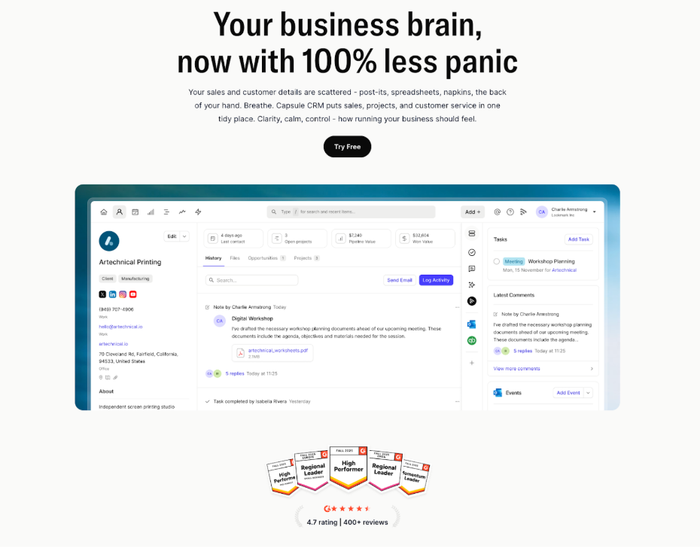
At its core, CapsuleCRM gives you a visual sales pipeline with a Kanban-style board where every opportunity is a card you can drag through stages from early interest to won or lost. You can also switch to a list view for advanced filtering (e.g., show only open deals or those expected to close soon).
This clear, visual layout is essential for sales pipeline management. You need a reliable foundation before adding AI-powered prioritisation.
Automated workflows
CapsuleCRM includes built-in workflow automation where you can define triggers (like stage changes or events) and corresponding actions (such as reminders, task creation, or status updates).
Having routine work already automated lets AI systems focus on intelligent tasks (pattern detection, scoring, and recommendations) rather than simply replacing manual updates. In a sales pipeline software context, this lays the groundwork for AI-powered pipeline management by reducing time spent on repetitive chores.
Integrations that bring AI intelligence to Capsule CRM
CapsuleCRM connects with external tools across your tech stack: email platforms, marketing tools like Mailchimp, support systems, accounting apps, and third-party automation platforms such as Make.com or Zapier.
These integrations let you push and pull data between Capsule and AI-enabled systems. For example:
- Sync open and click data from email campaigns back into CRM contact records.
- Use automation platforms to enrich contact profiles or trigger predictive alerts.
- Connect support ticket history to sales records so reps see the full context during pipeline review.
Capsule doesn’t need native AI scoring to be part of an AI sales pipeline. You can extend it with external AI services tuned to your sales heuristics, and the integration layer keeps all customer data aligned.
AI-assist features in Capsule CRM
Capsule CRM now offers AI-generated summaries of contact history. These give you a quick narrative of recent activity, recent emails, task outcomes and engagement patterns: all without combing through every note manually.
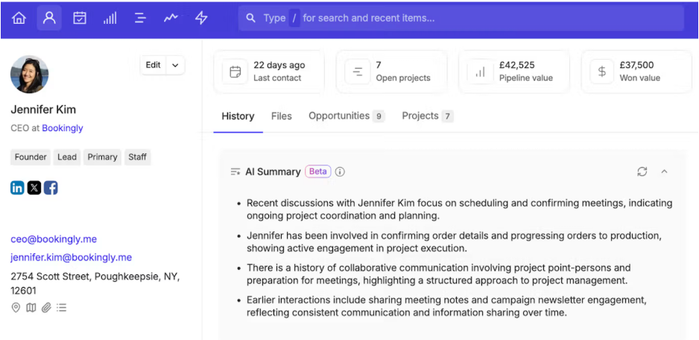
For sales professionals dealing with many customer interactions, these summaries provide rapid context ahead of calls or sales conversations.
Try Capsule today.
Myths to bust about AI sales pipelines
Myth 1: AI will replace your sales team
Some people think artificial intelligence will make salespeople obsolete: that robots will run calls, close deals, and manage customer relationships without human interaction. In reality, AI excels at repetitive work (handling data entry, enrichment, and routine follow-ups) but strategic decision-making, relationship building, and negotiation still require human judgment. AI frees sales teams to focus on high-value activities like conversation intelligence.
Myth 2: AI solves everything overnight
There’s a misconception that you can plug in an AI tool and instantly generate more deals, shorter sales cycles, perfect forecast revenue, and a competitive edge. Modern AI tools don’t fix broken processes or poor data quality overnight; they amplify what’s already there. AI needs structured sales data, clear pipeline stages, and repeatable workflows to generate meaningful insights. Treating AI like a magic wand often leads to disappointment; real gains come from thoughtful implementation and continuous improvement.
Myth 3: AI and automation are the same thing
Some sales teams assume that sales automation (scheduled emails, simple triggers, task reminders) is the same as AI-driven sales pipeline management. They’re not. Automation executes predefined steps; AI learns patterns from customer data and market trends, looks across multiple data sources, and surfaces real-time insights like likely conversion signs. Confusing the two can lead to under-leveraging AI’s value. True AI adds actionable insights, lead scoring based on patterns, and suggested next actions.
Myth 4: AI will uniformly fix all sales pain points across the board
A common belief is that once you plug artificial intelligence into your sales platform, every bottleneck will magically disappear. In truth, AI doesn’t automatically fix structural issues in your process. It amplifies what’s already there, meaning if your data quality is poor, your pipeline stages aren’t well defined, or your team isn’t aligned on strategic decision making, AI will surface confusing signals.
AI works best as a complement to human expertise: helping identify patterns across customer interactions and historical data that humans might miss, but not compensating for lack of process discipline or meaningful data. Teams that treat AI as a standalone solution often miss out on its potential to shorten the sales cycle, improve forecast revenue accuracy and give a competitive advantage because they haven’t aligned the tech with how their reps actually sell.
Over to you
Building AI sales pipelines is complicated, but it doesn’t have to feel messy or overengineered. When you ground AI in real lead generation signals and clean data, it supports better sales performance and more consistent revenue growth. The real win is practical: allowing sales teams to spend more time on customer conversations, spot cross-sell opportunities, and use insights for deal coaching or sales enablement instead of chasing admin.
A CRM like CapsuleCRM becomes the centre where pipeline activity, industry insights, and AI workflows meet, with data security built in. Done right, this kind of setup doesn’t just add tools – it helps teams drive revenue growth with less friction and clearer decisions.