It feels like AI is all people can talk about right now. But it’s not all buzzwords and LinkedIn posts; AI is quickly becoming an invaluable tool for small businesses looking to maximize their time and efficiency.
When you think of AI, most of us think of basic prompt tools like ChatGPT or Google Gemini. Tools that can aid in content creation and data management. But AI is much more than that, and if you don’t know what's possible, you could find yourself missing out on some great time-saving opportunities.
We asked over 500 Capsule users what they think about AI, what tools they use, and how they implemented it across their business. The results were varied, honest, and gave us some great practical tips.
What do people think?
Over three-quarters of users surveyed are actively using AI tools in their day-to-day tasks. Over 80% of Capsule accounts with 6 or more users are actively adopting AI, with the largest teams showing the most enthusiasm. What’s interesting is that these businesses aren’t just using AI to write emails or schedule follow-ups; they’ve heavily integrated it into their sales pipelines as well.

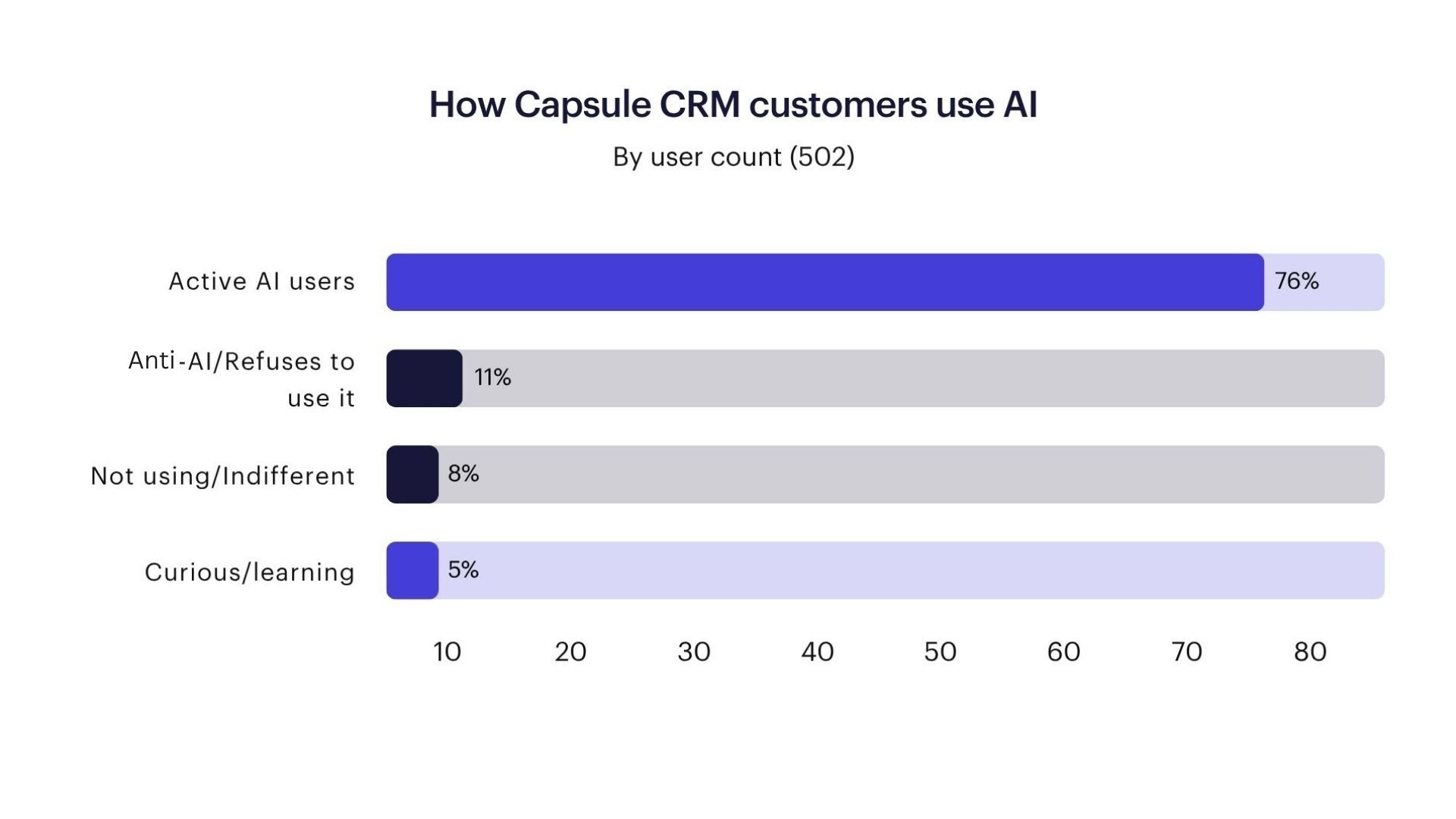
Nearly a fifth of those surveyed (19%) said they are not using AI. Some users, particularly those working with government clients or in regulated industries, shared their concern about data security. Others have tried it and found it more trouble than it's worth, and a few are ideologically opposed to it, with concerns about environmental impact, copyright, and data practices.
Does business size matter?
You might assume that solopreneurs would be the first to embrace AI. When you're running everything on your own, time and resources are stretched thin. This is where AI can step in, freeing you up to focus on the work that really matters. But the opposite is true.
Over a fifth of solopreneurs are actively against AI, the highest rate of any group we surveyed. When it comes to teams of 2-5, this drops to 10% and again to 5% in teams of 6-10.
Teams with more than 10 users were the most pro-AI, with 89% of teams identifying themselves as active users.
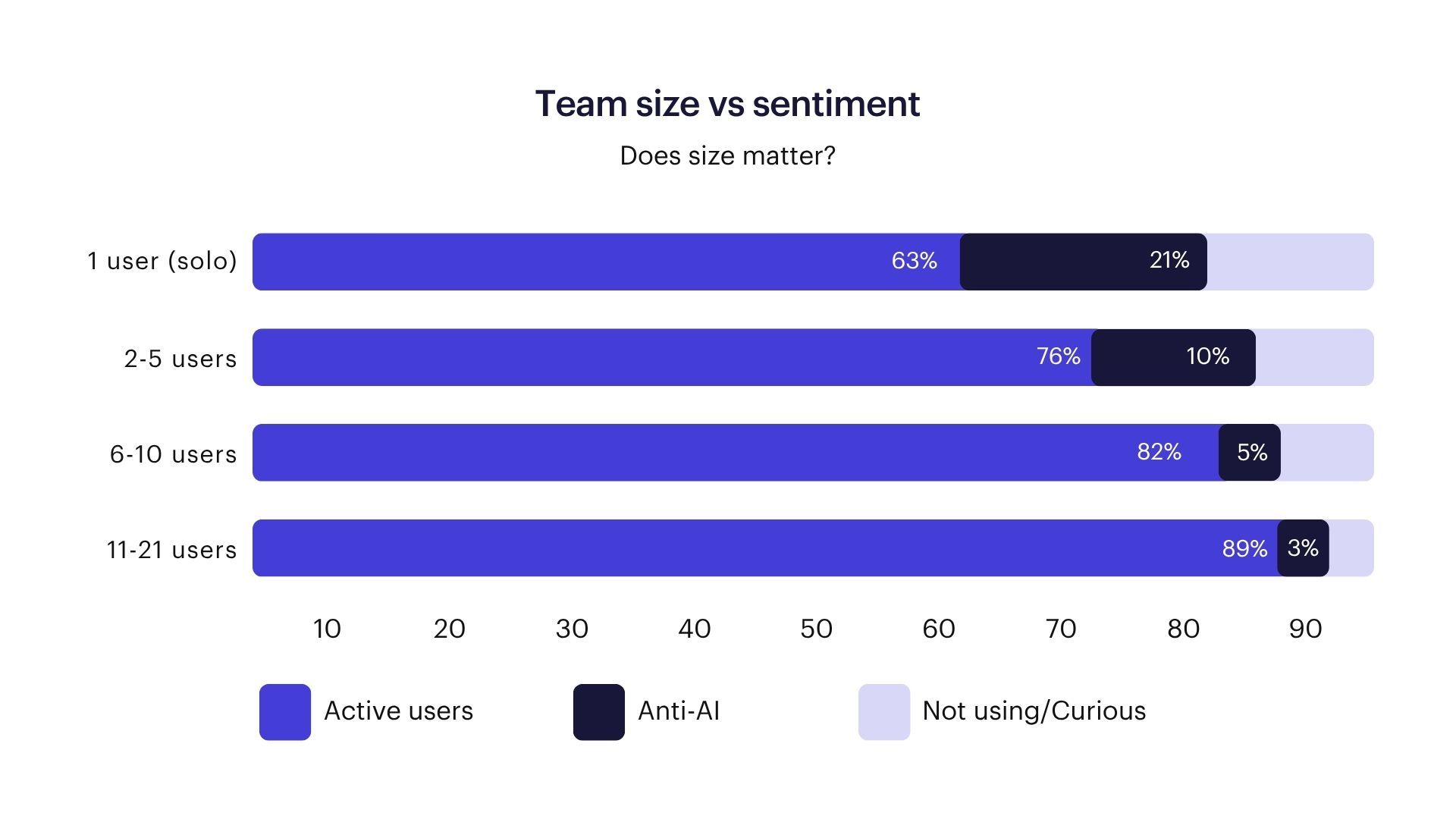
Bigger teams juggle more contacts, follow-ups, and handovers, exactly where AI adds value by keeping things organized and stopping things from being missed.
On the other hand, solopreneurs tend to work more intuitively, with processes in their heads. This can make AI feel like friction rather than help.
Regardless of the results, AI is not just for larger businesses; instead, its value increases with complexity. If it doesn’t feel useful yet, you may not have the processes laid out correctly or have found the right tool for your problems.
But it’s not just the adoption numbers that are interesting; it’s what teams are doing with it.
The tools people are using
ChatGPT is by far the most widely used, appearing in nearly half of all responses (43%).
Google Gemini (16%) and Microsoft Copilot (16%) were also popular choices, and businesses tended to pick one based on whether they already use Google Workspace or Microsoft 365.
Claude (14%) is often used for more complex writing and client work. Some customers are also using transcription tools like Fireflies.ai and Otter.ai (4%) to capture meeting notes. Meanwhile, research tools like Perplexity are becoming more popular, and automation platforms such as n8n, Make.com, and Zapier are helping teams connect all these tools together.
To create successful workflows, teams can’t let their AI live in a silo; it needs to integrate into daily workflows. Customers aren't using just one tool; they're building stacks that work together.
How are small businesses using AI?
Communications
Email writing is the most common use of AI, which is not surprising. Tools like ChatGPT, Gemini, and Claude can help by responding to prompts. Some software also includes these features, so you do not need to switch tabs.
There was little mention of using AI for long-form content like blogs or social media posts. This may be due to limited marketing use or a preference for human-written content.
Automating the prospecting pipeline
Some customers have built prospecting workflows that run mostly on their own. Using Google Gemini in Sheets, they create prospect lists and find new companies. ChatGPT then drafts and organises outreach, and Apollo.io handles email sequencing automatically.
Another customer uses Perplexity's Comet browser to manage CRM data entry. Contacts are added directly into Capsule without manual input, saving time.
Keeping the CRM clean without the admin
A practical use of AI is managing CRM hygiene. With ChatGPT's Atlas browser, overdue tasks can be rescheduled so that no more than five fall on the same day. It can also update expected close dates on delayed opportunities, so nothing is missed.
This type of work is not exciting, but it takes time and is often overlooked.
Turning calls into CRM records
AI meeting tools can connect directly to sales workflows. With Fireflies.ai, teams can record calls, generate summaries, and send them to Capsule under the correct contact or opportunity.
Once your meeting notes are logged, Capsule’s AI Summaries can pull them together with the rest of your contact or opportunity history. Get a quick, bulleted overview whenever you need to prepare for a call or catch up on an account.
Using it as a thinking partner
A less obvious use for AI is to treat it as a sounding board. One customer uses Claude to brainstorm difficult tasks, improve workflows, and find gaps or flaws in their thinking.
A corporate finance firm is building AI agents to create information memoranda and plans to automate its deal workflow. Another uses AI for funding applications, monitoring strategies, and business plans to test ideas rather than generate content.
Training it on your own business
Several customers have moved past basic prompts and are building custom setups trained on their own materials. This includes tone of voice, their products, and even their customer conversations.
One described building a ChatGPT project trained on copywriting books and their own marketing assets, then using it to polish all outbound communication.
AI tools in Capsule
AI isn’t just for big businesses. Small businesses are creating tailored workflows to remove friction, stay organized, and make the most of their time.
Looking for easy ways to get started? Capsule CRM has a range of practical AI features designed to take care of the routine work that takes time away from busy teams. Whether it’s prepping for calls, writing follow-ups, or setting up pipelines, Capsule can help you handle it in just a few clicks.
Find out more about AI in Capsule and try Capsule free for 14 days.