You're closing deals, managing investors, onboarding the first hire, and somehow supposed to remember what you said to that warm lead three weeks ago. A good AI-powered CRM doesn't just store that information; it provides it when you need it.
Here's how to pick one, and which tools are worth your time.
Why founders need an AI CRM specifically
Founder-led sales is a different sport from running a sales team. There's no handoff and no dedicated sales assistant. It's you, a full calendar, and a growing list of relationships that each need attention on a different timeline for a different reason.
The traditional CRM was built for sales teams with defined processes and people to maintain them. It assumed someone would handle the admin. For a founder, that someone is also the one building the product and dealing with whatever went wrong this morning.
A well-built AI-powered CRM system doesn't just store your customer data but reduces the overhead of maintaining it. It can automate repetitive tasks, enrich contact records, draft follow-ups, and surface valuable insights from your CRM data. The result is a system that stays useful even when you don't have time to tend to it.
According to Bain & Company, salespeople currently spend only 25% of their time on actual selling. The rest goes to admin, research, and data entry. For a founder managing everything alone, that ratio is often worse. AI-powered tools that claw back that time help founder-led sales teams stay competitive.
What makes an AI CRM work for founders specifically
Not every AI CRM platform is built with founders in mind. Some are designed for large sales teams with complex hierarchies. Others bolt artificial intelligence onto a traditional CRM as an afterthought, adding a chatbot to something that was already too complicated to use consistently.
What founders actually need from an AI-powered CRM is different.
- Low maintenance overhead. If keeping the CRM updated takes more time than the insight it gives back, it won't get used. The best AI CRM platforms for founders are ones where AI handles the data hygiene so you don't have to.
- Relationship breadth, not just pipeline depth. Founders manage relationships with customers, investors, partners, and potential hires; often in the same week. The CRM needs to handle that breadth.
- Speed to insight. You don't have time to run reports. You need insights delivered automatically: who needs a follow-up, which deal has gone quiet, and what patterns are emerging across your customer interactions.
- Intelligent communication support. Modern AI CRMs can analyze customer sentiment across emails and calls, flag shifts in customer engagement, and even suggest adjustments to communication style based on historical data.
- A tech stack that connects. Founders typically run lean with a handful of essential tools. An AI CRM that fits into existing workflows cleanly and doesn't require a dedicated ops person to maintain it is worth considerably more than one that needs custom configuration.
- Sensible pricing. Early-stage startups don't have enterprise budgets. Per-user month pricing that scales reasonably as the team grows matters, as does not having to pay for a sales hub you'll use 20% of.
The AI CRM checklist for founders
Before committing to any tool, run through this checklist. It covers the decisions that tend to bite founders later.
There's a meaningful difference between a CRM that reduces data entry and one that eliminates it. Look for automatic contact enrichment, email sync, and calendar events logging, not just prompts to fill in fields yourself.
Check specifically for Gmail integration, Google Workspace compatibility, and whether it connects with your existing workflows and data sources. An AI CRM that lives in a silo from the rest of your stack creates more work.
Generative AI features are table stakes now. Look for things like sentiment analysis on customer calls, and the ability to identify trends across your sales pipeline.
Founders track metrics across customer interactions, investor updates, partnership conversations, and hiring processes. A sales-focused CRM designed only for linear management will feel restrictive fast. Check whether it supports custom objects or flexible contact categories.
Historical data accumulates quickly. Make sure the CRM can handle growing contact databases, that CRM data is exportable if you need to switch, and that the pricing doesn't become punishing as the team grows.
AI-powered automation is often gated behind higher tiers. Map out which plan includes the workflow automation you need (follow-up reminders, pipeline stage changes, task creation) before assuming it's included.
Sales calls often happen away from desks. If the mobile app is an afterthought, you'll lose track of context between conversations and end up back-filling notes from memory. That's exactly what you're trying to avoid.
Not the free plan, but the plan with AI-powered features enabled. If the trial doesn't include the AI engine, you're not trialling the product you'd be paying for.
The best AI CRM platforms for founders
Capsule CRM
If you want a CRM that stays out of your way until you need it, Capsule is worth serious attention.
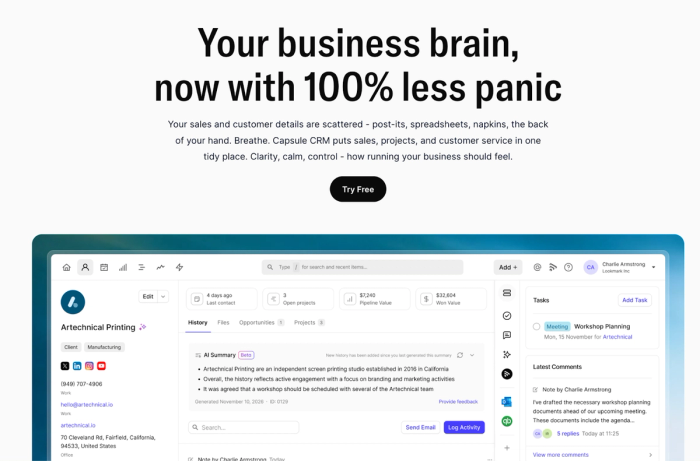
Capsule CRM is a customer relationship management platform built for small and growing businesses: clean, fast to set up, and designed around the idea that an easy-to-use interface and genuine capability aren't mutually exclusive.
It's used by over 10,000 businesses globally and rated 4.7 on G2, which says something about how well it actually works day to day.
Key AI features
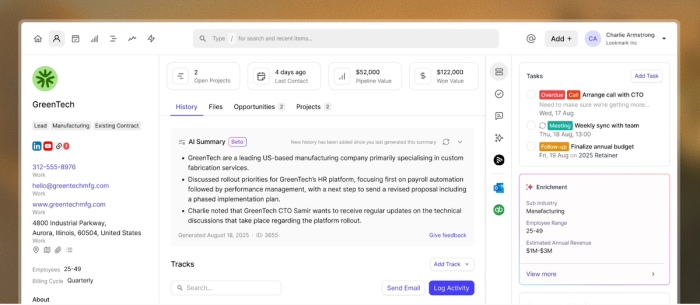
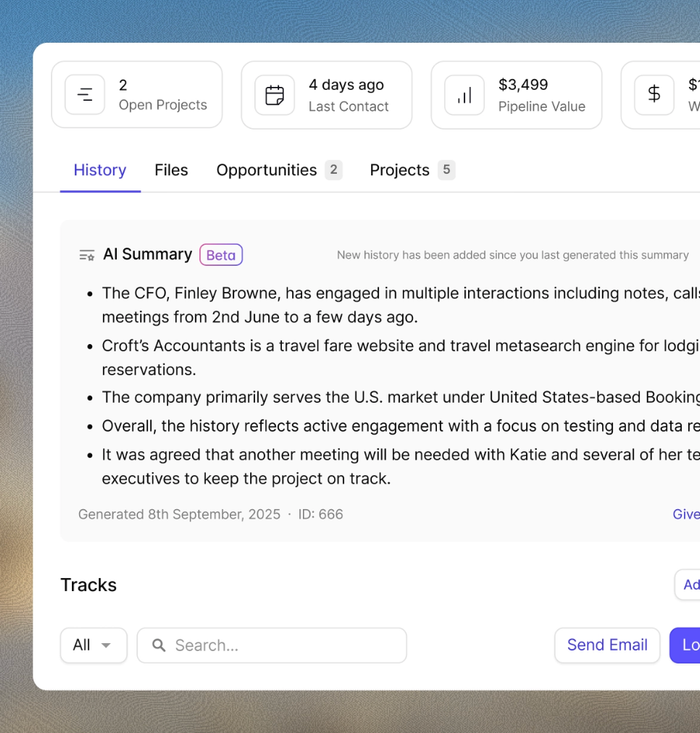
Capsule's AI suite covers the areas that matter most for founder-led sales. AI Summaries pull together the last interactions for any contact or project, giving you a briefing before a meeting.
AI Email Assist functions as an AI email writer that drafts follow-ups based on a brief description of what you need to say and the tone you want.
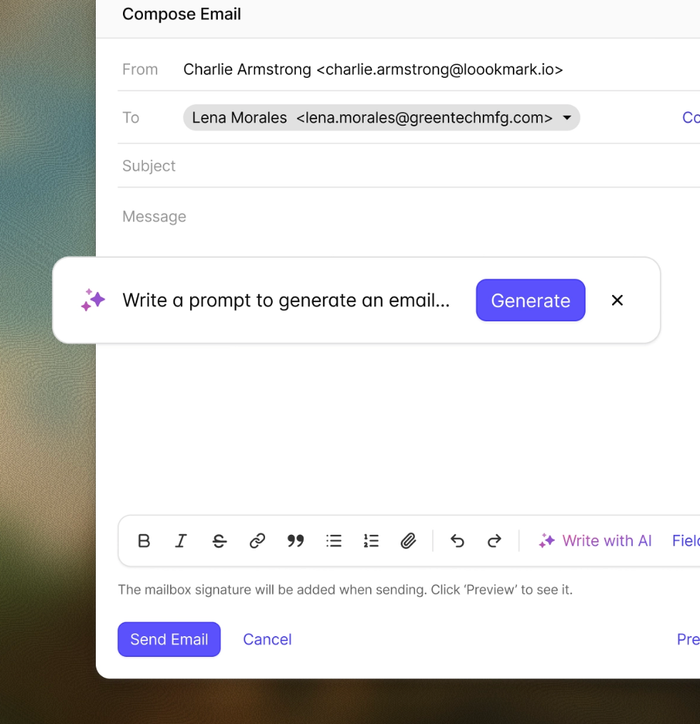
You review, adjust if needed, and send, removing the friction of writing routine customer communications from scratch at the end of a long day.
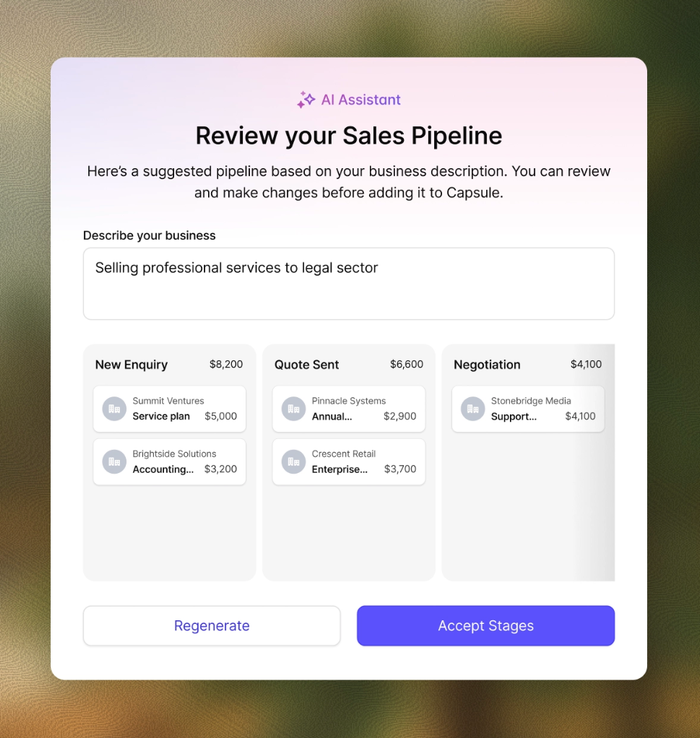
The AI Sales Pipeline Generator builds a custom pipeline from a description of your sales process, which means you start with something that reflects how you actually sell rather than a generic template you have to reshape.
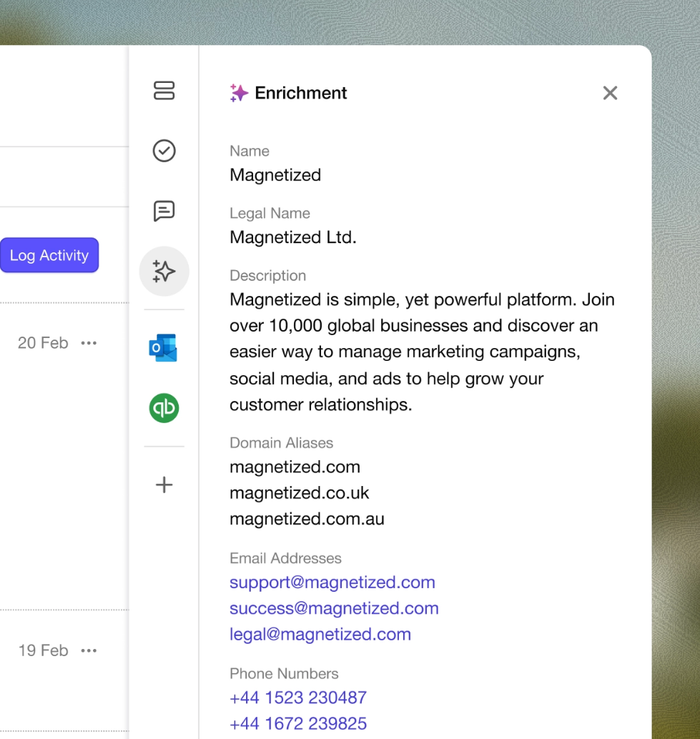
And AI Business & Contact Enrichment automatically populates contact records with company data (headcount, industry, revenue, LinkedIn) so your CRM data is complete.
Workflow automation via Tracks lets you automate repetitive tasks like follow-up reminders, task sequences, and pipeline stage changes. Capsule integrates natively with Google Workspace, Microsoft 365, Xero, QuickBooks, Mailchimp, Slack, and 60+ other tools, with a mobile app that works offline and syncs automatically.
Capsule never uses your data to train AI models; your customer data stays within your account.
Why founders love Capsule
It doesn't demand maintenance.
AI Contact Enrichment and email sync mean the CRM updates itself around your activity rather than requiring a dedicated effort to keep it current.
It covers relationship breadth.
Capsule isn't just pipeline management software. It handles the full range of relationships a founder manages, from customer interactions to project delivery, without forcing everything into a sales structure that doesn't fit.
The pricing makes sense at an early stage.
Starting at $18/user/month on the Starter plan, with AI-powered features unlocking on Growth at $36/user/month, Capsule scales with a zero pricing cliff that catches founders off guard when they add their first few team members.
Start your free 14-day trial — no credit card required →
HubSpot CRM
HubSpot is one of the most recognized names among AI CRM platforms, and its free plan is quite capable; making it a common starting point for early-stage startups that want to validate their sales efforts before committing budget.
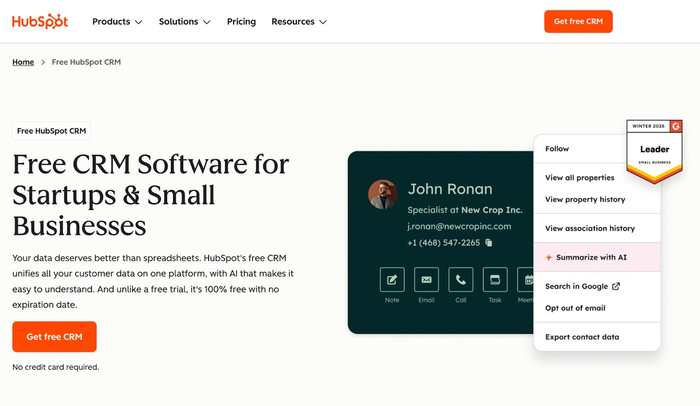
As an AI-powered CRM system, HubSpot has invested heavily in its AI engine across the product. Breeze, HubSpot's AI layer, includes a Copilot that acts as an AI assistant across the platform and Breeze Agents that can handle prospecting and customer inquiries with varying degrees of autonomy.
Key features
- AI-assisted email drafting, meeting scheduling, and deal status summarization via Breeze Copilot
- Lead scoring and predictive analytics on higher tiers, helping founders score leads
- Marketing automation features and email campaign management built natively, covering both sales efforts and broader marketing efforts in one place
- Extensive integration library covering most tools in a typical founder tech stack, including Google Workspace and Gmail integration
Considerations
- The free plan and the plan you'd actually need as a growing business are very different products; AI-powered automation and meaningful predictive insights are locked behind Sales Hub paid tiers
- Pricing escalates sharply; what starts as a free plan becomes a significant monthly cost as feature requirements increase
- HubSpot users often find themselves paying for multiple Hubs separately to get a unified platform
- The breadth of features can work against founders who need speed. There's a real risk of spending more time configuring the tool than using it
It's a powerful platform, but the gap between what the free plan offers and what a scaling founder actually needs means the real cost tends to arrive later than expected.
Folk
Folk has built a following among founders and small teams who want a CRM that feels more like a smart contact manager than a sales operations tool.
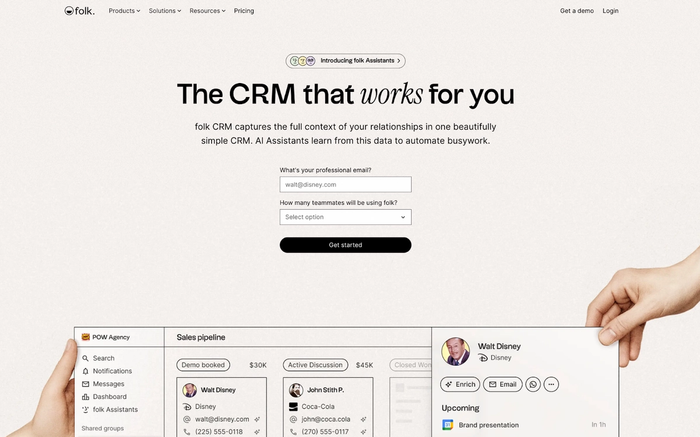
The interface is clean and modern, and Folk has leaned into AI from early in its development, making it one of the more credible options among AI CRM platforms for relationship-led use cases. It's particularly well-suited to founders managing a wide range of relationship types at the same time.
Key features
- AI email writer that generates personalized outreach in your own words based on contact data
- Automatic contact enrichment pulls publicly available data into records with no manual input
- Browser extension for capturing contacts directly from LinkedIn or a company website
- Flexible, tag-based contact organization that handles relationship breadth better than rigid visual sales pipelines
Considerations
- Reporting and predictive insights are limited; founders who need to identify trends seriously will find the analytics thin
- AI-powered automation is less mature than competing platforms, which limits how much Folk can handle repetitive tasks at scale
- Pipeline management is functional but basic; Folk works better as a relationship layer than a primary tool for managing complex business sales processes
- Some features that founders might expect from modern AI CRMs are on the roadmap
Folk is a good tool for founders who prioritize relationship building and personalized outreach over structured pipeline management, but teams that need deeper sales data will outgrow it.
Close CRM
Close is a sales-focused CRM designed specifically for inside sales and high-volume outbound; one of the more opinionated options on this list.
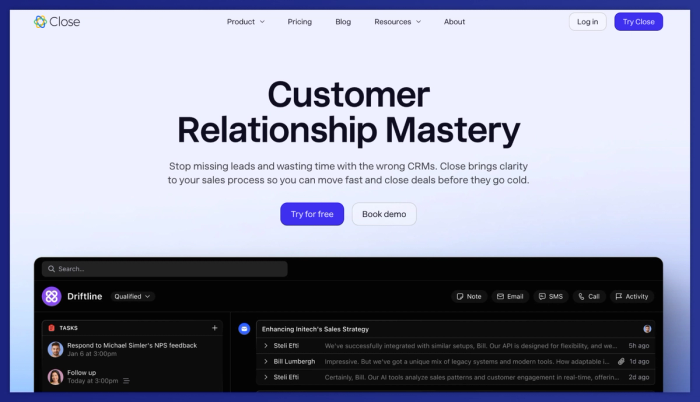
Where most CRMs treat calling and messaging as integrations, Close has them built natively: sales calls, SMS, and email all happen within the platform and log automatically, removing a source of logging for founders whose sales motion involves a lot of direct outreach.
Key features
- Native calling and SMS with automatic logging — no manual entry after sales calls
- AI-powered call summaries and transcription that capture key details from customer calls automatically, supporting better knowledge management across the team
- Email sequences built around customer engagement patterns, with personalisation that shows deal status changes and flags when follow-ups are needed
- Sales forecasting and pipeline reporting that surface real-time predictive analytics on deal progress
Considerations
- Priced at the higher end for early-stage startups, the per-user-month cost is harder to justify for solo founders or very small teams
- The feature set is optimized for outbound-heavy sales motions; founders doing inbound or relationship-led selling will find they're paying for infrastructure they don't use
- Project management tools and post-sale relationship management aren't Close's strength — it's built for closing deals, not what comes after
- Setup takes longer than simpler AI tools, which can slow down a founder who needs to be operational quickly
Close is a good tool for founders running structured outbound at volume – but for early-stage founders who need breadth across relationship types, the cost and complexity are difficult to justify.
Freshsales
Freshsales is an AI-powered CRM built by Freshworks, designed to help sales teams improve customer service. It is a reasonable CRM option for founders who want intelligent automation on the spot.
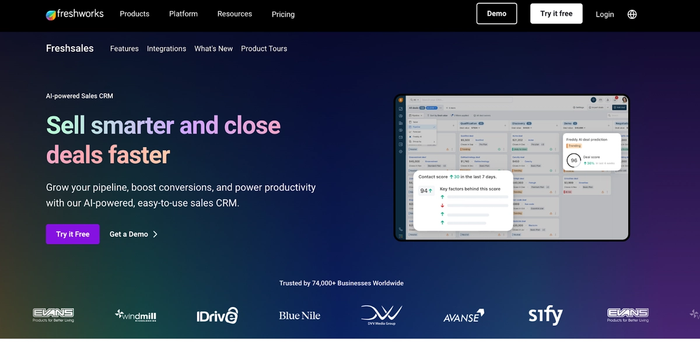
Beyond the pipeline, Freddy AI supports customer interactions directly, providing instant support via conversational AI that can handle routine customer inquiries, freeing founders to focus on the conversations that actually need a human. The result is a better customer experience across the sales cycle, with higher customer satisfaction driven by faster response times.
Key features
- Freddy AI for predictive lead scoring, deal insights, and customer behavior analysis that provides actionable recommendations
- Conversational AI for instant support on routine customer inquiries, improving response times and overall customer satisfaction
- Visual sales pipelines with AI-powered deal status tracking and follow-up reminders triggered by customer engagement signals
- Built-in phone, email, and chat with automatic logging
Considerations
- Freddy AI's most powerful features are locked behind higher-tier plans, which can make the entry-level offering feel underpowered relative to the marketing
- The platform's breadth means there's a learning curve; founders who need to be operational quickly may find the setup investment harder to justify than simpler alternatives
- Reporting is solid, but can feel complex to configure for founders who just need a clear view of pipeline health
- Freshsales sits within the broader Freshworks ecosystem, which is an advantage if you're already using Freshdesk or other Freshworks tools – but adds unnecessary complexity if you're not
Freshsales is a good tool for founders who want AI-driven sales intelligence, particularly around lead prioritization and customer satisfaction, but getting full value from Freddy AI requires a plan and a data foundation that startups don't always have from day one.
Attio
Attio is a newer CRM that has gained traction specifically among tech-forward founders and early-stage teams who want a highly flexible, data-rich alternative to the traditional CRM.
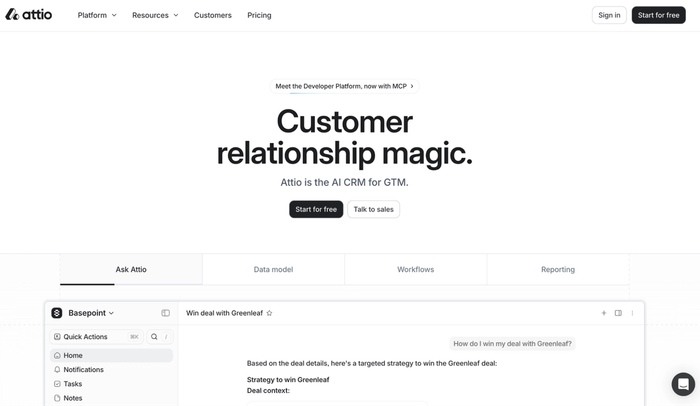
It's built around the idea that a self-driving CRM should adapt to how a team works. Attio handles custom objects, flexible data models, and real-time data analysis in a way that appeals to founders with more complex or non-standard relationship structures.
Key features
- Highly customizable data model with custom objects and flexible fields that go well beyond standard contact and deal structures
- AI-driven insights based on historical data in the system, with natural language processing that lets founders query their CRM data conversationally to identify trends and patterns
- Automatic enrichment and sync across data sources, including Gmail integration and Google Workspace
- Real-time reporting that shows predictive insights across any custom data structure the team builds
Considerations
- The flexibility that makes Attio powerful also means there's a setup investment; it rewards founders who know what they want to build, less so those who want something ready out of the box
- AI-powered insights require clean, well-structured CRM data to deliver on their promise; historical data that hasn't been organized won't yield much from the AI engine
- Pricing is at the higher end compared to simpler tools, particularly as team size grows
- The integration library is smaller than more established alternatives; founders with specific tools in their tech stack should check compatibility carefully
Attio is a good tool for technically confident founders who want a flexible, data-first CRM, but the setup overhead makes it a harder sell for founders who need to move fast.
Zoho CRM
Zoho CRM is a well-established AI-powered CRM system with a broad feature set and pricing that makes it accessible to early-stage startups and growing teams alike.
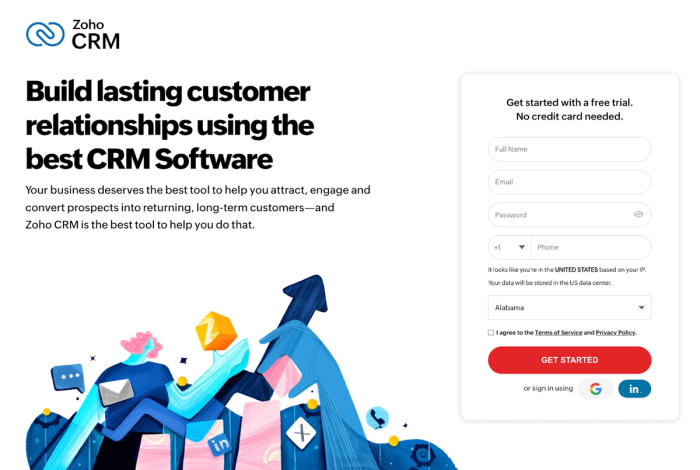
Its AI engine, Zia, functions as a conversational AI layer across the platform: handling customer inquiries and analyzing customer sentiment across emails and calls.
Key features
- Zia AI handles sentiment analysis on customer calls and emails, flagging shifts in customer sentiment that might affect deal status or customer satisfaction
- Predictive analytics and lead scoring that help founders score leads and identify trends across their pipeline
- Marketing automation tools covering email campaigns, social media posts, and personalized marketing materials from one platform
- Strong integration library with a wide range of business tools
Considerations
- The interface can feel dated and dense compared to more modern AI CRM platforms; the easy-to-use interface that newer tools prioritize isn't always Zoho's strongest suit
- The breadth of Zoho's product suite can be as much a source of confusion as capability; founders who just need a focused sales tool may find the options overwhelming
- Some AI-powered features, including more advanced predictive analytics and sentiment analysis, are only available on higher-tier plans
- Customer support quality can be inconsistent, which matters when a founder is trying to get up and running quickly
Zoho CRM is a good tool for founders who want a capable, affordable AI-powered CRM system with broad functionality, but the interface and product complexity mean it rewards patience more than some alternatives.
Monday CRM
Monday CRM is the sales-focused arm of Monday.com, the widely used project management platform. It could be a natural fit for founders who are already running their operations there and want to bring customer relationship management into the same environment.
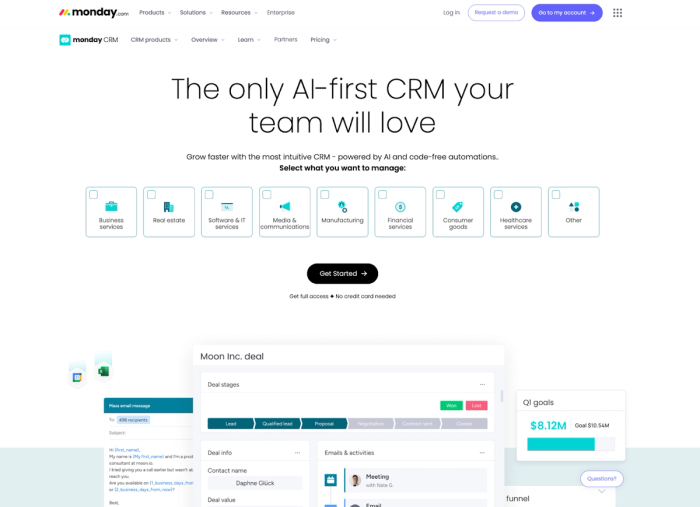
It's built around visual sales pipelines and a highly customisable board structure, with AI-powered features layered in to handle deal status updates and customer communications. The Monday CRM approach works well for founders who think visually and want to manage sales alongside project delivery in one place.
Key features
- Visual sales pipelines with drag-and-drop deal management and AI-powered automation for routine pipeline updates
- AI-powered features, including an AI email writer for customer communications and automated deal status tracking
- Strong project management integration; founders already using Monday.com for operations can connect sales and project delivery inside the same platform
- Flexible board structure with custom objects that adapt to various sales processes
Considerations
- Monday CRM is built on a project management foundation, which means the sales-specific depth is less developed than dedicated AI CRM platforms
- Pricing can add up quickly when combining Monday CRM with the broader Monday.com suite, particularly for teams that need features across both products
- The visual, board-based interface works well for some founders, but can feel less intuitive for managing high volumes of customer interactions compared to a dedicated CRM view
- Marketing automation features are limited; founders who need to run marketing efforts alongside sales from the same platform will find Monday CRM falls short
Monday CRM is a good tool for founders already embedded in the Monday.com ecosystem who want to add structured sales management without adopting an entirely new platform. As a standalone AI CRM solution, though, it lacks the depth that more focused tools offer.
Notion
Notion isn't a CRM, but a lot of founders use it as one, which is worth addressing directly.
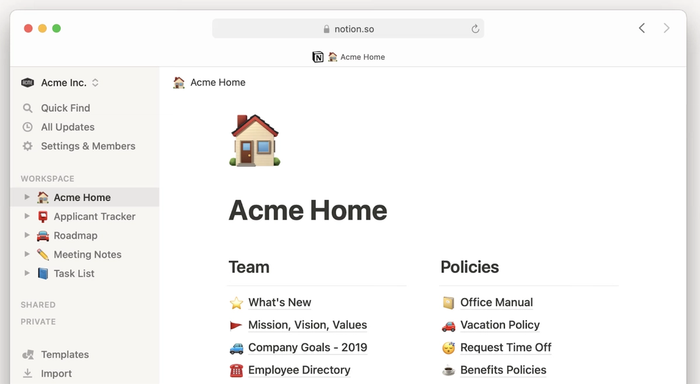
Notion's flexibility makes it a reasonable scratchpad for early-stage relationship tracking: you can build a contact database and use it to manage a basic pipeline alongside your existing workflows. For a founder at the very beginning, before there's a real sales process to speak of, that can work.
Key features
- Flexible database structure that can approximate contact management and project management in one place
- AI features via Notion AI that help with note-taking and drafting; useful for capturing key details from customer calls in your own words
- Strong project delivery and documentation capabilities that sit naturally alongside a founder's existing Notion workspace
- No dedicated CRM pricing; if the team is already using Notion, the incremental cost is low
Considerations
- Notion is not an AI-powered CRM system; it has no native email sync, no automated follow-up reminders, no lead scoring, and no AI-powered automation built for sales processes
- As volume grows, a Notion-based CRM might become a liability. You will lose track of customer interactions and have no reliable sales data to make decisions from
- There are no AI agents or predictive insights built around customer relationship management; Notion AI is a writing tool, not a sales assistant
- Migrating out of Notion into a proper CRM later is painful; starting with the right tool earlier is almost always the better call
Notion is a good tool for what it is: a workspace and documentation platform. As a CRM for founders who are actively selling, it runs out of road quickly.
The bottom line
The right AI-powered CRM for you depends on where you are and what you're actually doing. If you're in early-stage founder-led sales, start with a tool that automates the overhead rather than one that adds to it.
The best AI CRM platform is the one that keeps your customer data accurate and handles repetitive tasks so you can focus on stronger customer relationships and closing deals.
Capsule's free trial covers all paid plan features for 14 days, no credit card required. For a founder who needs to move fast, that's a reasonable place to start.
Try it today.