
The barrier to starting an AI business has never been lower. Pre-trained models, large language models, and AI platforms that handle the heavy infrastructure mean a small business owner can now build a service or product on top of existing AI capabilities without a technical co-founder, a data science team, or huge upfront capital.
The question isn't whether artificial intelligence creates business opportunities – because it clearly does – but which ideas are worth pursuing and what starting one actually requires.
Here are ten AI small business ideas with solid demand, realistic startup requirements, and honest assessments of what it takes to make them work.
1. AI automation agency
The idea: Small businesses know they should be automating repetitive tasks, but don't know where to start or have the time to figure it out. An AI automation agency does it for them – mapping workflows, identifying what can be automated, implementing AI solutions using tools like Make.com, Zapier, or n8n, and handing over a system that runs with no ongoing maintenance from the client.
Why it works: Demand is high, and the supply of people who can actually implement rather than just advise is limited. Most small businesses need someone to do it, not explain it.
What you need to start: Hands-on familiarity with automation platforms, an ability to map business processes quickly, and strong client communication. The technical setup is rarely the hard part. Initial setup costs are low; the model runs on project fees or retainers.
Revenue model: Project-based implementation fees plus ongoing maintenance retainers. Premium pricing is justified by the operational costs it removes for clients.
Managing a growing client base across multiple active projects is where an automation agency lives or dies operationally. Capsule's pipeline management and Tracks feature keep client delivery organized, which matters when you're simultaneously selling new work and delivering existing projects.
2. AI content studio
The idea: Businesses need a consistent flow of marketing materials – blog posts, social media posts, email sequences, ad copy – but can't afford a full content team. An AI content studio uses generative AI to produce high volumes of content faster than a traditional agency, at a price point small businesses can justify.
Why it works: Content creation remains one of the highest-demand services for small businesses, and generative AI has genuinely changed the economics of producing it. The differentiator isn't the AI; it's the human editorial layer that makes AI-generated content actually good.
What you need to start: Strong editorial judgment, a clear process for training AI tools on client brand voice, and the ability to manage quality control across multiple clients simultaneously. Intellectual property considerations around AI-generated content are worth understanding before you start.
Revenue model: Monthly retainers based on content volume. Clients paying for tens of thousands of words per month at a fraction of digital agency rates is a realistic proposition.
The market is getting crowded. Positioning around a specific vertical – legal, SaaS, e-commerce, healthcare – rather than general content is a stronger play than competing on price as a generalist.
3. AI translation and localization service
The idea: Businesses expanding into new markets need content translated, not just linguistically, but culturally. AI translation tools have made the first pass dramatically faster and more accurate than previous generations, but the human editorial layer that ensures tone, brand voice, and cultural nuance are preserved is still essential. A translation service that uses AI for speed and human expertise for quality delivers better results faster than either approach alone.
Why it works: Global e-commerce and digital-first businesses need localization at scale. Translation tools powered by large language models handle the volume; human intelligence handles the quality control that machine translation alone still misses.
What you need: Bilingual or multilingual expertise in your target languages, familiarity with AI translation platforms, and a quality control process that catches the errors AI generates reliably in idiomatic and culturally specific content.
Revenue model: Per-word or per-project pricing, with premium pricing for technical, legal, or marketing content where accuracy and brand alignment matter most.
4. AI SEO and market research service
The idea: Search engine optimisation and market research are time-intensive, data-heavy disciplines that AI tools have made dramatically faster. An AI-powered SEO service uses machine learning and natural language processing to analyze data at a scale that would take a human analyst days: keyword research, competitor analysis, content gap identification, and technical audits are often delivered at lower operational costs than a SEO agency.
Why it works: SEO demand is permanent, and the tools available (Ahrefs, Semrush, Surfer, combined with AI models for content and analysis) give a small operation the output capacity of a much larger team.
What you need to start: Solid SEO knowledge first, AI tools second. The ability to use AI to analyze data and surface valuable insights is the efficiency multiplier, but understanding what good SEO looks like requires human intelligence that the tools don't replace.
Revenue model: Monthly retainers with clear deliverables. Market research can be sold as standalone projects to product managers, founders, and marketing teams who need relevant data.
5. AI chatbot development for small businesses
The idea: Most small businesses know they should have a chatbot handling customer queries, answering questions, and qualifying leads outside business hours… but building one feels technical and expensive. An AI chatbot development service builds, trains, and deploys AI chatbots for small business clients using existing AI platforms. Your potential clients don’t even have to understand how any of it works.
Why it works: The demand is genuine, and the tools to deliver it have made the technical barrier low enough for a non-engineer to operate commercially.
What you need: Familiarity with chatbot platforms (Voiceflow, Botpress, Intercom, or similar), an understanding of how to build a useful knowledge base from client data, and the ability to train a chatbot on proprietary data and sensitive data responsibly. Data collection and data privacy considerations are part of every client conversation.
Revenue model: Initial setup fee plus ongoing maintenance retainer. Clients who see measurable improvement in customer behavior metrics renew reliably.
6. AI music and audio production
The idea: Content creators, podcast producers, advertisers, and app developers all need music and audio – and most can't afford bespoke composition. AI music production tools like Suno or Soundraw generate original music from text prompts, which a skilled operator can use to produce custom audio at a fraction of traditional production costs.
Why it works: Demand for royalty-free, custom audio is significant and growing as video content and podcasting have become mainstream business channels. The tools have reached a quality level where the output is commercially usable for a wide range of applications.
What you need: Musical ear and production judgment. Also, the ability to use AI tools to generate options, identify what's working, and edit toward a finished result. Intellectual property considerations around AI-generated music are an active area of legal development and worth monitoring before building a business around it.
Revenue model: Per-track or per-project pricing. Subscription packages for content creators with recurring audio needs represent a stable recurring revenue model.
7. AI video editing and production service

The idea: Video content is in consistent demand across social media, marketing, and internal communications – and video editing is time-consuming enough that most small businesses either don't do it or outsource it expensively. AI video editing tools have reduced the time cost of producing polished video content dramatically, making a small editing services operation viable at price points that undercut traditional production companies.
Why it works: The combination of AI-powered editing tools and human creative direction produces results faster than either could alone. Businesses that couldn't previously justify video production budgets are now able to reach customers.
What you need: Creative judgment, familiarity with AI video editing platforms (Descript, Runway, CapCut for Business), and a clear production process. The AI handles the repetitive tasks (cutting, captioning, basic colour correction) while the human handles direction and quality control.
Revenue model: Per-project pricing for one-off productions, retainer pricing for clients with ongoing video content needs. Social media posts, short-form content, and internal training videos are the highest-volume use cases.
8. AI-powered recruitment screening service
The idea: Hiring is one of the most time-intensive processes a small business runs. Screening applications and scheduling initial conversations consume hours that most small business owners don't have. An AI-powered recruitment screening service uses AI systems to analyze applications and handle initial communications with job seekers.
Why it works: Small businesses rarely have HR teams and consistently find hiring slow and distracting. Utilizing AI to handle the volume of work of early-stage screening is a clear value proposition with measurable time savings.
What you need: Understanding of recruitment process design, familiarity with AI screening tools, and careful attention to bias and fairness in how AI algorithms are applied to candidate data. This is an area where intelligent systems require ongoing human oversight – both ethically and practically.
Revenue model: Per-hire fees or retained search packages. The value delivered (a faster, better-filtered shortlist) justifies premium pricing relative to doing nothing.
9. AI-powered e-commerce optimisation service
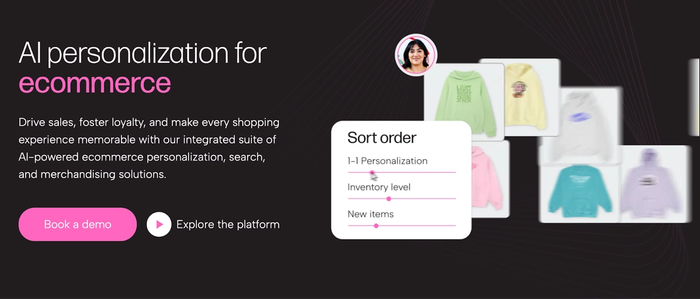
The idea: Online store owners have more data than they know what to do with (purchase history, product usage data, user behavior, user preferences, and browsing patterns) but lack the analytical capacity to turn it into business decisions. An AI-powered e-commerce optimisation service uses predictive analytics and machine learning to identify which products to promote to which segments and surface valuable insights that improve conversion rates and reduce operational costs.
Why it works: E-commerce is a data-rich environment where better decisions about inventory, pricing, and targeting compound quickly into revenue. Most small online store owners are making these decisions on instinct when they could be making them on data.
What you need: Familiarity with e-commerce platforms (Shopify, WooCommerce), experience with analytics and data analysis tools, and the ability to translate what the data shows into practical recommendations a small business owner can act on. The value isn't the analysis; it's the business decisions it enables.
Revenue model: Monthly retainers based on store size and scope. Performance-linked pricing (a percentage of measurable revenue improvement) is a strong option for clients who want to tie cost to outcome.
10. AI fraud detection and risk monitoring service
The idea: Small businesses (particularly those in e-commerce, financial services, and professional services) are increasingly exposed to fraud, whether through payment fraud, fake account creation, or suspicious customer behavior patterns. Large companies have dedicated fraud and risk teams. Small businesses have nothing. An AI fraud detection service uses AI-driven solutions to monitor customer data and transaction patterns in real time, flagging anomalies and surfacing key points of risk before they become costly problems.
Why it works: Fraud losses compound quietly. By the time a small business owner notices the pattern, significant damage is often already done. AI applications that monitor data continuously and flag suspicious behavior are doing something a human simply can't do at the same scale or speed. The target audience (small e-commerce operators, independent financial advisors, SaaS businesses with sensitive customer data) has clear pain and limited existing solutions at an accessible price point.
What you need: Familiarity with AI agent frameworks, an understanding of how to build and train models on relevant customer data, and the ability to communicate risk clearly to non-technical clients. Positioning as a specialist in a specific sector is a stronger startup idea than going broad.
Revenue model: Monthly monitoring retainers with tiered pricing based on transaction volume or data size. Combining fraud detection with broader risk advisory adds scope and justifies premium pricing for clients who want a more comprehensive service. Improving sales operations and overall efficiency for clients is a natural expansion as the own business grows.
11. AI virtual assistant service for professionals

The idea: Lawyers, accountants, consultants, and other professionals spend a lot of time on tasks that require their name but not their full attention – drafting routine client communication, summarizing documents, preparing meeting notes, handling initial client queries. An AI virtual assistant service can handle that layer, with a human operator ensuring quality control and managing the client relationship on behalf of the professional.
Why it works: Professionals bill by time. Every hour spent on administrative tasks is an hour not billed. The value proposition (more billable hours, less administrative overhead) is immediate and quantifiable.
What you need: Strong written communication skills, the ability to manage sensitive data and proprietary information responsibly, and familiarity with the specific workflows of your target professional sector. Optical character recognition tools for document processing and AI tools for summarisation are the core technical components.
Revenue model: Monthly retainers based on hours or task volume. Vertical specialisation – positioning as the virtual assistant service specifically for accountants, or specifically for independent consultants – commands premium pricing and reduces sales effort.
No matter the idea, the client relationships are the business
Every idea on this list is ultimately a service business. The AI is the delivery mechanism – the thing that makes the service faster, more scalable, or more affordable than the traditional alternative.
But the business itself runs on client relationships, and those relationships require the same fundamentals regardless of which idea you pursue: consistent follow-up, accurate contact records, clear visibility into where each client and each deal stands, and communication history that means you never walk into a conversation underprepared.
That's what a CRM does, and it's the infrastructure that most new service businesses underinvest in until the client base is large enough that the absence of it becomes painful.
An AI automation agency managing twelve clients across different project stages, an AI content studio handling five retainers simultaneously, an AI virtual assistant service onboarding new professionals every month. All of them hit the same operational wall when client management is running on memory.
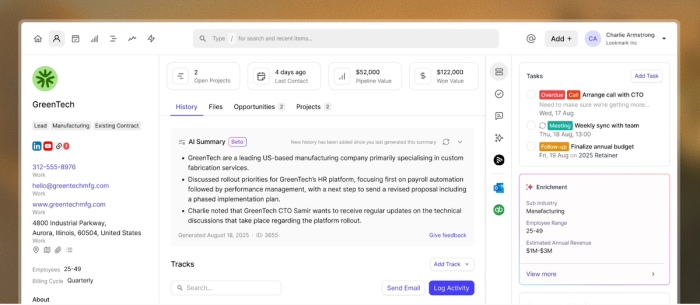
Capsule's contact management, visual sales pipeline, and Tracks automation cover the core of what a growing service business needs without adding overhead.
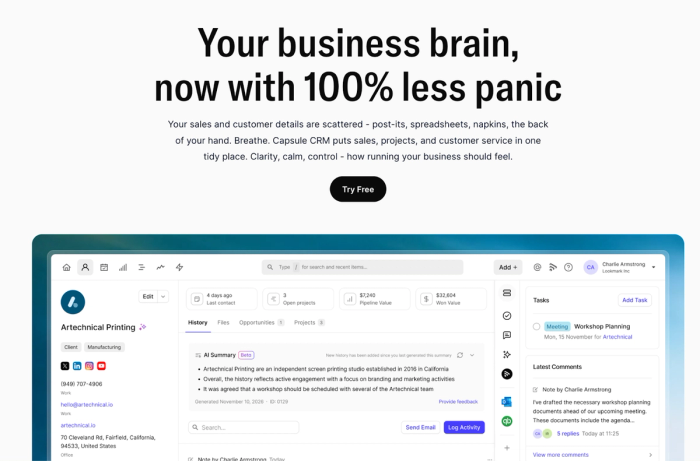
The AI features (Summaries, Email Assist, Contact Enrichment) mean the CRM itself uses artificial intelligence to reduce the admin that surrounds client relationships, which is particularly useful for a solo operator or small team running an AI-powered business who wants the back office to be as lean as the front.
Starting lean matters. Most of these ideas can be validated with minimal upfront investment – the right CRM is part of that lean foundation, not an afterthought for when the business is bigger.
How to choose which idea fits you
The most common mistake with AI business ideas is treating the list as a menu and trying to pick the most impressive option. However, the ideas that work are almost always the ones closest to skills and experience already in place.
A useful filter: which of these ideas would you be able to deliver competently within sixty days of starting, using tools that already exist? That question eliminates the ideas that require months of learning before any revenue is possible, and focuses attention on the ones where the AI is a capability multiplier on something you already do well.
The second question worth asking is what the ongoing client relationship looks like. Most of these ideas are service businesses – which means winning clients and managing those relationships over time is as important as the quality of the work itself.
That's where Capsule becomes the system that keeps the business behind it running cleanly as the client base grows.