
Most agents start a real estate business with a license and a vague idea of how it's going to work on the real estate market. That's fine for the first few months. It stops being fine the moment you're trying to scale or explain your numbers to a lender or partner.
A solid real estate business plan template forces you to make decisions that most agents defer until they're problems: your niche, your lead sources, your financial floor, and how you'll handle growth. This guide walks through every section with templates you can copy and adapt, not just descriptions of what each section should contain.
Why most real estate business plans go nowhere
The plans that collect dust are the ones built to impress rather than to use: they are usually written once. The ones that drive real business growth get updated quarterly, shared with an accountability partner, and referenced when a decision needs to be made.
A good business plan for a real estate business is a set of commitments to a target market, a service model, a revenue target, and a way of working. The document just makes those commitments legible.
With that said, here's what a working plan looks like, section by section.
How to build a real estate business plan
If you’re serious about growing a real estate business, having a clear plan can make all the difference. But not everyone has the time (or patience) to build one from scratch – and that’s okay. If you prefer to skip the heavy lifting and start with a ready-made structure, you can use a proven template to guide you.
Download it below and customize it to fit your goals, market, and strategy.
Get your free copy of real estate business plan template
Section 1: Executive summary
Write this last, even though it sits first. The executive summary is a one-page overview of everything else in your plan: your market, your model, your goals, and why your business exists in the first place.
What to include
- Your business name and legal structure
- Your primary service or niche
- Your target market area and client profile
- A brief overview of your financial projections for year one
- What differentiates you from competing agents or brokerages
Template
[Business Name] is a [solo agent / team / brokerage] operating in [city/region], focused on [niche — e.g., first time buyers, residential sales, commercial real estate, investment properties]. We provide [core services — e.g., buyer representation, seller representation, property management] to [target client description].
Our goal in year one is to close [X] transactions, generating [$ gross commission income]. We will reach this through [primary lead sources — e.g., referrals, online listings, paid advertising, open houses].
What separates us: [unique value proposition — one or two sentences, specific and honest].
Keep it short: three to five paragraphs maximum. Anyone reading your plan should be able to understand what you do and who you do it for in under two minutes.
Section 2: Mission statement and vision statement
These aren't just corporate filler. A clear mission statement makes dozens of small decisions easier: which clients to take, which referral partners to pursue, whether a particular marketing tool fits your brand, and more.
Mission statement template
Our mission is to help [target audience] [achieve what outcome] by providing [what service] with [what distinguishing quality].
Example:
Our mission is to help first-time buyers in the Denver metro navigate their purchase with clarity and patience, from pre-approval to close.
Vision statement template
In [X years], [Business Name] will be [what the business looks like — scale, recognition, impact].
Example:
In five years, we will be the most referred buyer's agency in Jefferson County, known for turning complex transactions into straightforward experiences.
Keep both grounded! Vague aspiration ("be the best") is harder to build toward than something specific.
Section 3: Business model and legal structure
This section answers: how does the business make money in the real estate industry, and how is it structured?
Legal structure options
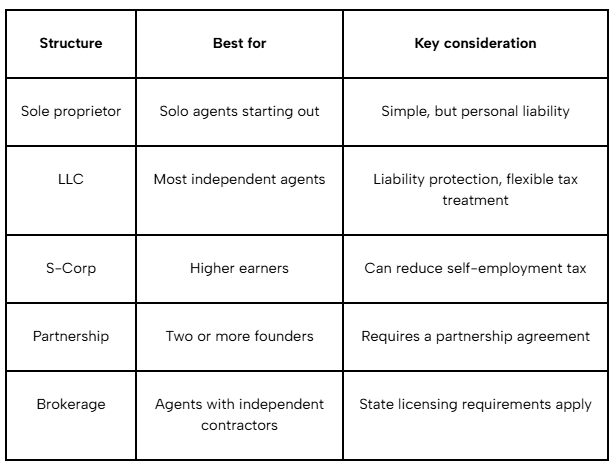
Note: if you're building a team that will bring on independent contractors, check your state's rules carefully. Most states have specific requirements before an agent can operate as a brokerage and supervise other licensees.
Revenue model
List out every income stream clearly.
- Buyer commissions: percentage of sale price at close
- Seller commissions: listing side, typically 2.5–3%
- Referral fees: paid for referring clients to other agents or specialists
- Property management fees: monthly percentage of rent collected
- Consulting or advisory fees: for investors, developers, relocation clients
Key partnerships
Who does your business depend on to function?
- Mortgage lenders and brokers
- Title companies and escrow officers
- Real estate attorneys
- Home inspectors
- Contractors and stagers
- Other agents (for referrals and co-listings)
Mapping these out early helps you build relationships intentionally instead of scrambling when a deal needs them.
Section 4: Market analysis
A market analysis is not a summary of things you already know. It's a structured look at where opportunity actually exists, and where competition is heavy enough to require a different approach.
Local market overview
Answer these questions in writing:
- What is the current inventory level in your target market area, and how has it changed over the past 12 months?
- How are interest rates affecting buyer activity in your area?
- What price ranges are moving fastest, and which are sitting?
- Are there specific neighborhoods, property types, or buyer segments that are underserved?
- What are the dominant market trends: population growth, employer relocation, zoning changes, opportunity zones, or something else?
Competitive analysis
List three to five competitors (other agents, teams, or brokerages competing for the same clients) and assess each honestly.
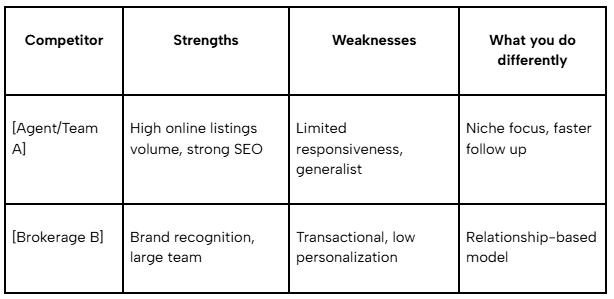
This isn't about disparaging competitors but understanding where gaps exist that your business can genuinely fill.
SWOT analysis
Run a SWOT analysis specific to your business, not the industry.
Strengths (internal, things you control)
- Existing referral network for real estate services
- Specialist knowledge in a specific property type or neighborhood
- A real estate license with additional designations (ABR, SRES, CCIM, etc.)
- Systems that make you faster or more organized than your competitors
Weaknesses (internal, things you need to fix)
- Inconsistent lead generation
- Limited marketing budget
- No CRM or client management system in place
- Reliance on a single lead source
Opportunities (external, things you can take advantage of)
- Population growth in specific corridors
- First-time buyer incentives or government incentives in your area
- Gaps in commercial real estate or industrial properties coverage locally
- Underserved demographics (relocating professionals, downsizing retirees, etc.)
Threats (external, things you need to plan around)
- Highly competitive local market
- Commission compression from discount brokerages
- Changes to buyer representation rules post-NAR settlement
- Rising property values are pricing out your target buyer segment
Section 5: Target market
Knowing your target market is not the same as saying "anyone buying or selling a home." The more specifically you can describe your ideal client, the more effective every marketing and client acquisition decision becomes.
Client profile template
Complete one for each primary segment you serve:
Client type: [e.g., First-time buyer / Move-up buyer / Investor / Seller / Relocation client]
- Demographics: Age range, household income, employment type, family situation
- Goals: What outcome are they trying to achieve?
- Pain points: What do they find confusing, stressful, or frustrating about real estate transactions?
- How they search: Online searches, referrals, social media, open houses?
- Decision timeline: Are they ready now, or 6–12 months out?
- What they value most: Speed, price, guidance, responsiveness?
Niche market considerations
Specializing in a niche market (single-family homes in a specific ZIP code, investment strategies for first-time investors, commercial real estate for restaurant operators, etc.) makes your marketing more targeted.
If you're choosing a niche, ask:
- Is this segment large enough to sustain my income goals?
- Is there a clear gap in how this segment is currently served?
- Do I have genuine knowledge or interest here?
Section 6: Services offered
List everything you offer clearly and honestly. Don't pad it. Clients and partners reading your plan will notice if your services offered section doesn't match how you actually work.
Standard services
- Buyer representation (search, offer, negotiation, closing coordination)
- Seller representation (pricing, marketing, negotiation, closing)
- Relocation services
- Investment property analysis and acquisition
- Property management (if applicable)
- Short sale and REO representation (if applicable)
- New construction liaison services
Service delivery model
How do you actually deliver each service? What does a client experience from first contact to closing? Writing this out – even briefly – helps you identify gaps, inconsistencies, and opportunities to improve client satisfaction.
For example, a well-run buyer process might look like:
- Initial consultation (virtual or in-person) — 60 minutes
- Pre-approval referral and confirmation
- Customized property search setup with automated alerts
- Property tours with same-day or next-day availability
- Comparative market analysis before each offer
- Offer preparation and submission within 24 hours of the decision
- Inspection coordination and repair negotiation
- Weekly updates through to close
- Post-close follow-up at 30 days and 1 year
Mapped out like this, your service becomes something you can not only replicate, but also delegate and improve.
Section 7: Marketing plan
The marketing plan is where most real estate business plans get vague. "Build a social media presence." "Get more referrals." These aren't plans; they're intentions.
A working marketing plan specifies channels, tactics, frequency, and budget. It distinguishes between what you'll do yourself and what you'll pay for.
Lead source analysis
Before deciding what marketing strategies to invest in, know where your business has actually come from. If you've been working in real estate for more than 12 months, fill this in:
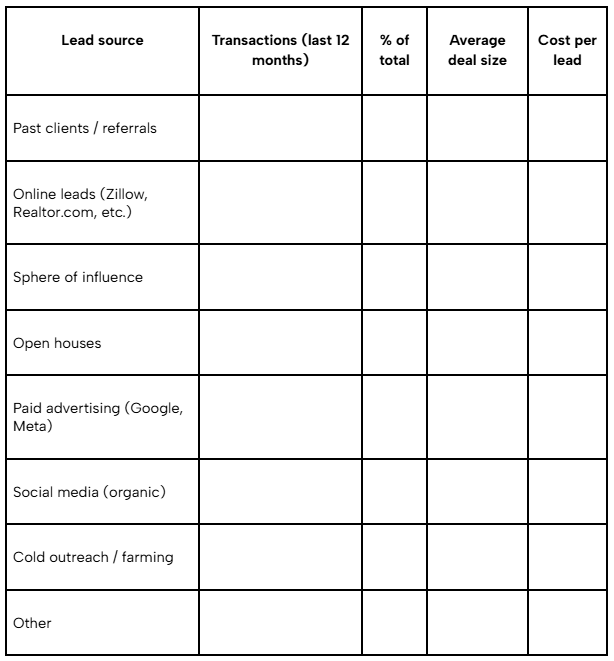
If you're newer, fill this in as a projection, then update it quarterly.
Marketing channels and tactics
Referral and relationship marketing
- Monthly check-ins with past clients (calls, texts, or handwritten notes)
- Annual market update for everyone in your database
- Client events (once or twice per year)
- Referral partner program with mortgage, title, and legal contacts
- Building relationships with HR departments at major local employers for relocation referrals
Digital marketing
- Optimized Google Business Profile with current reviews and regular posts
- Property photos that are professionally shot (non-negotiable)
- Virtual tours on all listings above a certain price point
- Online listings on Zillow, Realtor.com, and your brokerage's syndication network
- Email newsletter to your database
- Content on local market trends published to your website or LinkedIn
Paid advertising
- Google Ads targeting local search terms (e.g., "[city] homes for sale," "[neighborhood] real estate agent")
- Facebook/Instagram lead generation ads targeting specific demographics
- Retargeting campaigns to website visitors
- Set a monthly cap and track cost per lead, not just impressions
Community and visibility
- Geographic farming – consistent direct mail to a defined neighborhood over 12+ months
- Sponsorship of local events or community organizations
- Speaking at first time buyer seminars or investor meetups
- Partnerships with builders for new development representation
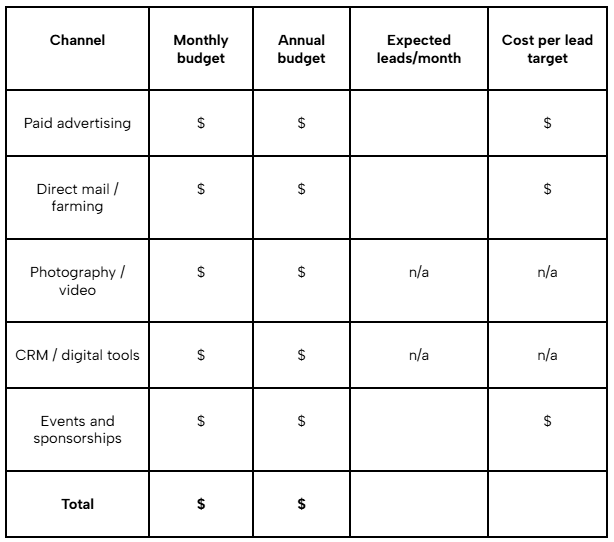
Marketing budget template
Section 8: Financial plan and projections
This is the section most agents either skip or treat as a formality. It shouldn't be. A financial plan is what tells you whether your business model actually works at the scale you're planning, and how much runway you have if it doesn't.
Income goals and transaction math
Work backwards from your income target:
Step 1: Set your net income goal
What do you need to take home, after taxes and expenses? Be specific – include personal living costs, savings targets, and any business reinvestment.
Step 2: Calculate the required gross commission income
If your effective tax rate is roughly 30% and your business expenses run $2,000–$4,000/month, your gross income needs to cover both.
Formula: (Net income goal + Annual business expenses) ÷ (1 - tax rate) = Required GCI
Step 3: Calculate required transactions
Divide your required GCI by your average commission per side.
Example: $120,000 net income goal $36,000 annual expenses 28% effective tax rate $156,000 ÷ 0.72 = ~$216,667 GCI needed Average commission per side: $9,000 Transactions needed: ~24
Step 4: Calculate required leads
If your lead-to-close rate is 10%, you need 240 leads to close 24 transactions.
Cash flow planning
Real estate income is lumpy. Commissions arrive in clusters, not monthly. Plan for this by:
- Maintaining 3–6 months of personal and business expenses in reserve
- Tracking pending deals and projecting closing dates
- Knowing which months are historically slow in your market
Expense budget
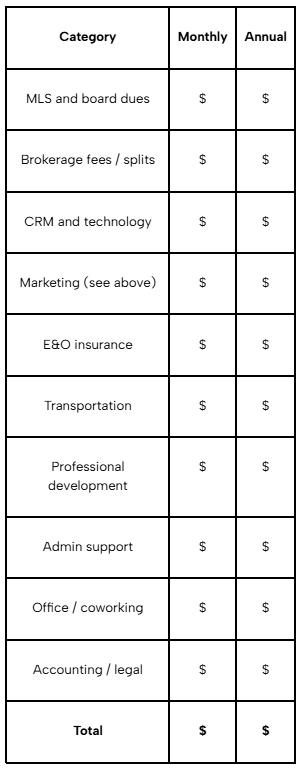
Year 1–3 projections
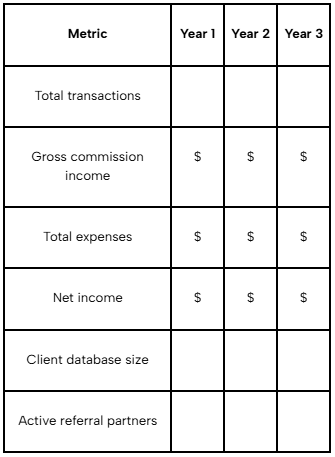
Section 9: Operations and systems
A business plan that ignores operations is a business plan for a perpetual freelancer, not a scalable real estate business. This section documents how work gets done.
Core systems to document
Lead management
How do new leads enter your system? What happens in the first hour, first day, first week? Using a CRM for real estate agents means every lead is logged, tagged, and scheduled for follow up, not tracked in your head or a spreadsheet.
Transaction coordination
From accepted offer to close: who does what, and when? If you're a solo agent, this is your checklist. If you have a transaction coordinator, this is their process guide.
Client communication cadence
Active clients should hear from you at defined intervals — not just when there's something to report. During a listing, weekly updates even when there's no activity. During a buyer search, bi-weekly check-ins. Post-close, a 30-day follow up call.
Database management
Your client database is a long-term business asset. It needs a system: how contacts are tagged, or how you handle unsubscribes. A contact management system helps you keep this organized.
Technology stack
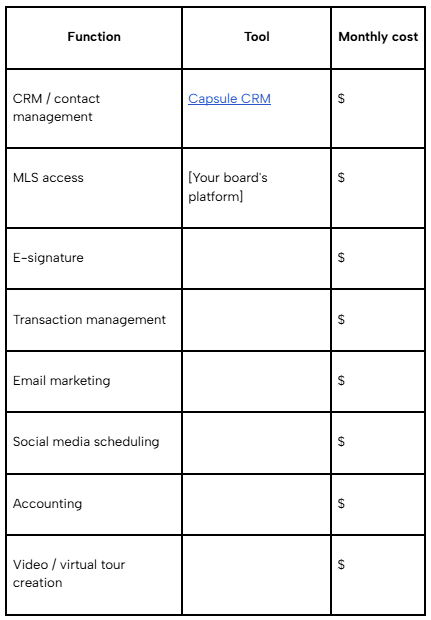
Section 10: Growth plan
This section answers a question most early-stage agents don't ask clearly enough: how much growth do you actually want, and what does getting there require?
Sustainable growth in real estate usually follows one of a few paths:
- Volume growth (solo): Do more transactions as a solo agent by investing in systems, lead generation, and leverage (virtual assistants, transaction coordinators). Ceiling is typically 30–50 transactions per year for one person, depending on market and niche.
- Team model: Add buyer's agents and/or a listing manager to increase capacity. Requires a shift from doing the work to managing the work – a significant transition that not every agent makes successfully.
- Brokerage model: Recruit and support independent contractors under your license. Revenue comes from splits, not your personal production. Requires a real estate license at the broker level, recruitment skills, and training infrastructure.
- Specialization model: Go deeper rather than broader; become the recognized expert in a specific niche (luxury, commercial real estate, industrial properties, a specific geographic area) and charge accordingly.
Document which path you're on, what the milestones look like at 12, 24, and 36 months, and what you'll need to invest to get there.
Building your own plan: a practical note
A business plan is most useful when it reflects how you actually work, not how you think a business plan is supposed to sound.
Write yours in plain language. Use numbers wherever possible. Be honest about weaknesses in the SWOT analysis, because those are the things that will get you if you ignore them. And build in a quarterly review – 60 minutes, four times a year, to check your projections against reality and update accordingly.
If you're using a CRM like Capsule, a lot of the data you need for that quarterly review – deal pipeline, close rates, lead sources, revenue – is already there. The plan and the system should feed each other.
Frequently Asked Questions
Yes, but it doesn't need to be 30 pages. Even a condensed version (mission, target client, financial projections, and a marketing plan) will put you ahead of most of your competition.
At minimum, quarterly. Markets shift. Your lead sources change. What worked in year one may not work in year two. A plan that doesn't get updated is nothing more than a historical document.
A marketing plan is one component of a comprehensive plan. The business plan covers your model, market, operations, and financials. The marketing plan covers how you'll attract and convert clients. Both are necessary.
If you're an independent contractor under a brokerage, sharing your plan can help you negotiate splits or access resources. Be selective about what you share, though; particularly the competitive analysis.
Build scenario planning into your financial projections. What happens if your average deal size drops 15%? Or, what if interest rates push buyers to the sidelines for two quarters? Having a contingency in writing means you're not making reactive decisions under pressure.