Most companies spend their time chasing more customers. Very few spend the same energy earning more trust. That imbalance shows up quickly once a business starts to grow.
Early on, customer relationships work because they are simple and personal by default. Conversations sit with one or two people. Context feels obvious. Follow-ups happen because everyone remembers what was said.
Growth changes these circumstances drastically.
More customers, more messages, more handovers. What used to feel natural starts to fracture. Trust erodes quietly, without a single dramatic failure.
That’s not a people problem. It’s a scale problem.
Customer relationship management exists to solve this exact tension: how to keep relationships intact when growth makes memory, consistency, and accountability harder.
This guide looks at customer relationship management as a discipline first, not a piece of software. You’ll learn what it actually means, why it matters, how it affects retention and long-term value, and which principles make it work in practice.
Along the way, it draws on real experience from people who have managed customer relationships through growth, friction, and change, and who have learned where modern systems help and where human judgment still matters most.
If you want fewer customers but stronger ones, you’re in the right place.
What is customer relationship management?
Customer relationship management is the practice of deliberately managing how a company builds, maintains, and develops relationships with its customers over time. It is a business discipline, not a department, and not a piece of software.

At its core, customer relationship management focuses on continuity. It answers simple but important questions:
- Who is this customer?
- What has already happened in the relationship?
- What was promised, and by whom?
When those answers are clear, customers feel known rather than processed.
Good customer relationship management covers the full customer lifecycle. That includes first contact, evaluation, onboarding, delivery, support, and the long stretch that follows after the sale. The goal is not to push people through stages faster, but to keep the relationship coherent as it evolves.
This is where the term often gets confused with CRM software. CRM tools exist to support customer relationship management by storing context, tracking interactions, and helping teams stay aligned. They make good practice easier to maintain at scale. They do not define the practice itself. Without clear intent and shared standards, a CRM system quickly becomes a database rather than a relationship aid.
In short, customer relationship management is about protecting trust as complexity grows. Software can help with that, but the discipline comes first.
Benefits of customer relationship management
Customer relationship management pays off in ways that go straight to the bottom line. When relationships are managed deliberately and consistently, the impact goes far beyond nicer support emails. Here’s the proof.
Increased customer retention and loyalty
Retaining an existing customer costs far less than winning a new one. Across industries, research consistently shows that acquiring a new customer can cost between five and 25 times more than keeping an existing one. That alone makes retention a smarter investment than acquisition in most contexts.
Even small improvements in retention deliver disproportionate rewards. According to Bain & Company research, increasing retention by just five percentage points can increase profits anywhere from about 25% to almost 95%.
These numbers reflect something simple: customers who feel known and valued come back. Once someone has bought from you, the probability they’ll buy again grows with each additional purchase; roughly 27% return after the first, nearly 50% after a second, and over 60% after a third.
In the context of customer relationship management, this matters because quality relationships reduce churn.
Revenue growth and lifetime value
Customers who stick around tend to spend more. Existing customers are significantly more likely to try new offerings and to buy repeatedly, which boosts their lifetime value. Existing customers are more likely to try additional products and increase their average spend than new ones.
Good customer relationship management deepens context and reduces friction in these conversations. Rather than treating every sale as a new encounter, teams leverage accumulated insight to make offers at the right time, in the right way, to the right people.
Operational clarity and efficiency
Deliberate relationship management reduces costly confusion and wasted effort. That translates straight into better service and lower internal friction.
Tools that support CRM – done right – make data accessible to everyone who needs it, shortening internal cycles and helping people act with confidence. Organizations that tie process and context together typically see improved productivity as a result.
Stronger reputation and referrals
Good customer relationships drive advocacy. Nearly all customers are willing to make repeat purchases when they feel satisfied with their experience.
Satisfied customers talk. They recommend brands they trust, post about positive experiences, and effectively become unpaid evangelists. That kind of reputation is built by consistent, thoughtful engagement over time.
Core principles of effective customer relationship management
Most customer relationship problems don’t start with bad intent. They start when growth stretches habits that used to work just fine.

Effective customer relationship management rests on a few principles that help relationships survive that stretch. They aren’t clever, and they don’t change every year. They simply describe what strong relationships look like once a business is no longer small.
Continuity
Continuity is about the relationship surviving change.
Customers don’t care who is on shift, who changed roles, or which tool you now use internally. They assume the relationship carries on. When it doesn’t, they feel it immediately. Having to re-explain their situation or re-justify earlier decisions sends a clear signal that the relationship has a short memory.
In practice, continuity shows up when past conversations still matter. Decisions don’t reset with every handover. New people joining the thread pick up where things left off, rather than starting again from zero.
Consistency
Consistency is what makes a relationship feel safe.
Customers can handle bad news, delays, or constraints. What they struggle with is unpredictability. When answers change depending on who responds, or when tone shifts from warm to dismissive overnight, trust takes a hit.
Consistent relationships feel steady. The standards stay the same even when the outcome isn’t ideal. Customers know what kind of experience they’ll get, which removes friction long before anything goes wrong.
Context
Context is what separates service from interaction.
Without context, every exchange becomes transactional. The customer asks, the company responds, and nothing accumulates. With context, conversations build. Advice becomes sharper, and decisions feel considered rather than convenient.
You see context at work when teams reference earlier discussions naturally, when recommendations reflect what the customer actually needs, and when people don’t have to explain why something matters for the third time.
Accountability
Accountability is what turns intention into trust.
Relationships weaken when responsibility is vague. “Someone will get back to you” rarely reassures anyone. Customers feel more confident when they know who owns the next step and when they’ll hear back.
In real interactions, accountability looks simple. Mistakes are acknowledged instead of softened away. When something slips, the response is clear and human, not defensive.
Best customer relationship management practices: expert takes
Personalise beyond surface details
Personalisation stops working the moment it becomes obvious.
Using a name, a birthday, or a generic preference doesn’t make customers feel known. It makes them feel categorised. Real trust forms when someone demonstrates that they understand the customer’s specific situation.
Good customer relationship management goes deeper than templates. It pays attention to what makes this customer different, then acts on it.
That’s the approach Daniel Nyquist, CMO, Crosslist, took when automation alone wasn’t enough.
“I noticed a user struggling with our listings. Instead of sending a generic support article, I looked at their account and saw they were selling high-end vintage denim. I wrote them a personal email explaining how to tweak the tool so it would catch tag details better next time. No template. Just a real note. They became one of our biggest advocates. The automation got their attention, but the specific advice kept them around. ”
The same tension shows up in how Michelle Gean, Marketing Coordinator, Achievable, thinks about scale.
“Real personalisation often needs human judgment. The strongest relationships come from showing clients you’ve taken the time to understand them — not just that you’ve pulled data about them.”
Personalisation works when it feels earned. AI can help spot patterns, but trust forms when someone chooses which details actually matter.
Treat customer relationships as shared memory
One of the easiest ways customer relationships break is also the quietest: the memory of the relationship stays locked in one person’s head.
Early on, that works. Decisions feel obvious because they were made last week, often by the same people. But when memory doesn’t travel, customers feel it immediately.
Good customer relationship management treats memory as something shared and intentional. Important decisions get captured while they still matter. Context doesn’t disappear when a meeting ends. The relationship moves forward instead of resetting with each interaction.
This is exactly how Tanya Donska, founder and creative director at DNSK.WORK, learned to protect trust while working long-term with enterprise clients across time zones.
“I started using transcription tools to document every sync call, then automated summaries into our shared workspace. At first, clients felt like they were being ‘recorded for quality assurance’: very corporate, very cold. What changed was how I framed it. I stopped calling it automation and started calling it shared memory. After each call, I reviewed the transcript myself, pulled out the decisions we actually made, and wrote them in plain language with a note: ‘Here’s what we decided, correct me if I’m wrong.’ Clients stopped feeling monitored and started trusting the system. One product manager told me, ‘You remember our conversations better than I do.’”
Radek Kaczynski, CEO of Bouncer, approached partner relationships that were starting to feel heavier than they needed to in a similar way:
“After each call or long email thread, I’d turn everything into a clean recap: what we agreed, what was still open, what we needed from them, and what we were responsible for. Then I rewrote it in my own voice and sent it as a simple one-page note. That changed everything. It reduced friction and stopped that quiet erosion of trust that happens when people feel confused or unheard.”
Shared memory works when someone is responsible for deciding what matters and carrying it forward. When that happens, customers don’t feel like they’re dealing with a system. They feel like they’re dealing with a company that pays attention.
Automate the timing, never the relationship
As businesses grow, good intentions give way to volume. Months can pass without contact, not because anyone stopped caring, but because there was no clear moment telling someone now is the time. From the customer’s side, that silence rarely feels neutral. It feels like neglect.
Strong customer relationship management separates when from how. Timing can be systemised. The message itself should stay human.
That’s the approach Austin Benton, marketing strategist at Gotham Artists, took when he realised client relationships were drifting between bookings.
“Automation would remind me to check in after an event or around a client’s usual booking cycle, and even generate a draft. I never sent those drafts. I’d rewrite them based on something real: a post they shared, an announcement they made, or photos from their event. It took a couple of extra minutes, but clients told us we felt more attentive than other vendors. Early on, I let a few automated messages go out unchanged. Response rates dropped immediately, and one client asked if the email was automated. That moment made everything feel transactional in a way that was hard to undo.”
Automation protects consistency by making sure relationships don’t go quiet. Trust stays intact because the message still sounds like it came from a person who knows the customer, not a system that noticed a date on a calendar.
Use AI to create space for better conversations
AI creates the most value when it gives people their time back — and then gets out of the way.
Used well, it shortens preparation, speeds up analysis, and removes busywork. Used poorly, it replaces thinking with output. The difference shows up in the quality of conversations customers remember.
Good customer relationship management treats AI as preparation, not performance. The work happens before the call so that the call itself can focus on judgment, strategy, and context.
That’s exactly how Rob BonDurant, VP of Marketing, Osprey, approaches automation in client work.
“We use AI to automate reporting and identify retail trends quicker, but we never let it come between us and the human element of our partnerships. Instead of just delivering analytics, we use them as a talking point in monthly calls. That lets us focus on strategy rather than tactics. It’s the dialogue clients remember, not the report.”
The same pattern shows up in how John Karsant, Founder and CEO, LevelUp Leads, uses AI in his own preparation.
“AI cut my research time from nearly an hour to a few minutes. That gave me time to write a proper forecast and a personalised message that showed I understood the client’s challenges. We tried automating more than that, and it didn’t work. AI is powerful, but it still needs skilled people guiding it”
The common thread here isn’t efficiency. It’s intent.
AI earns its place when it helps people show up better prepared, not when it tries to do the showing up for them.
Step in personally when trust is fragile
Not every interaction carries the same weight. Some moments can tolerate speed and automation, but others cannot.
Trust becomes fragile when the stakes rise. Legal exposure, financial risk, emotional stress, or uncertainty about outcomes all change how customers interpret your actions. In those moments, efficiency stops being reassuring, and judgment matters more.
Good customer relationship management recognises this boundary. Humans take over when consequences become real. That line became clear for Andrew Franks, Co-Founder, Reclaim247, while working in claims and automotive finance.
“In claims and automotive finance, speed without judgment can cause real damage to trust. We deliberately bring senior humans back into the process where liability, eligibility, or emotional stress are highest. Relationships improved when clients felt shielded from the process. AI worked best when it acted as a blanket, freeing our team to spend more time explaining trade-offs, risks, and outcomes. Systems don’t earn trust. People do.”
What this shows is restraint, not resistance to technology.
Protect your voice
Speeding up communication is tempting. Cleaning it up is sensible. Handing it over entirely is where relationships start to thin out.
Tone, phrasing, and emphasis all hint at how much attention someone is paying. When communication starts to sound generic or overly polished, customers notice. And even if they can’t quite explain why, trust takes a small hit.
Strong customer relationship management draws a clear line: AI can help shape and refine messages, but the voice stays human.
That balance is something Luther Yeates, Co-Founder, Head of Mortgages, UK Expat Mortgage, is very deliberate about in his day-to-day client work.
“There’s a fine line between tidying up communication and damaging relationships with messages that feel robotic. The biggest opportunity to build trust is when you communicate with clients. If you outsource that entirely, you give up the chance to show expertise and genuine care. We use AI to sense-check emails and speed things up, but the insight and personality always come from us. If a message can be created one hundred percent by AI, then what value are you really adding?”
Customers trust messages more when they feel written for them, not generated about them. AI can help remove friction and save time, but relationships grow through judgment, emphasis, and intent: things that only show up when someone takes responsibility for the final word.
Explain decisions, don’t just deliver reports
Data rarely builds trust on its own. In fact, in high-stakes environments, it often does the opposite. More charts, more numbers, more detail can leave customers feeling overwhelmed rather than informed.
Good customer relationship management recognises the difference between having insight and helping someone decide. Reports show what happened. Relationships move forward when someone explains what it means and what to do next.
That distinction sits at the heart of how Mario Hupfeld, CTO and Co-Founder, NEMIS Technologies, works with food producers dealing with constant audits and operational pressure.
“What I see repeatedly is that clients respond far better when we walk through what the data is already showing them, instead of just sending reports. Even if AI is doing much of the analysis in the background. Our clients are swamped. What they really need is someone explaining the biology and helping them decide what makes sense to fix next. When we sat down and looked at the data together, patterns became obvious. The positives weren’t random. They clustered around the same transition areas. That’s when clients finally felt calm and trusting again.”
Customers don’t build confidence from precision alone. They build it when someone takes responsibility for translating information into judgment. Walking through data together, answering questions, and naming trade-offs turns insight into reassurance.
In customer relationship management, that human layer is often the difference between a customer who feels informed and one who feels supported.
Reduce anxiety with clarity, not constant contact
When there are long gaps between updates, people fill the silence themselves. They assume nothing is happening, something is wrong, or they’ve been forgotten. That anxiety makes every future conversation harder, even when the work itself is going well.
Strong customer relationship management doesn’t mean checking in all the time. It means removing uncertainty at the right moments, so customers don’t have to chase reassurance.
That’s the approach Michael Ripia, Founder & Director, Halo Marketing, took when vendor trust started to slip despite good performance.
“The issue wasn’t results. It was communication. Vendors felt anxious between touchpoints and assumed silence meant nothing was happening. We introduced light automation to handle operational updates like timelines and performance snapshots, but we were very deliberate about what stayed human. Strategy conversations and tough calls never went near automation. What worked was using automation to remove uncertainty, not replace relationships. When tech reduced anxiety, trust grew faster.”
Automation works best when it answers the questions customers are silently asking: Is this moving? Am I in good hands? Do I need to worry? When those answers are clear, live conversations become calmer and more productive.
In practice, clarity builds trust faster than constant outreach ever will.
Interpret change instead of forwarding updates
In regulated environments, information arrives constantly. New rules, updates, guidance notes. Forwarding them is easy. Helping someone understand what they mean is harder — and far more valuable.
Good customer relationship management draws a clear distinction between keeping customers informed and helping them decide. When the stakes are high, customers don’t want speed alone. They want orientation.
That’s how Phil Cartwright, Head of Business Development, Octopus International Business Services Ltd, supports cross-border clients navigating regulatory change.
“We scan regulatory updates and flag anything that might affect our clients. But instead of forwarding summaries, I jump on short calls to explain what the changes actually mean in practice — what’s solid, what’s still in flux, and where the risks sit. The technology gives us speed and precision. The relationship is built in the conversations that follow, especially when the rules aren’t clear and the implications aren’t straightforward.”
What customers remember in moments like this isn’t how quickly they received an update. It’s who helped them make sense of uncertainty.
Automation is excellent at spotting change. Trust grows when someone takes responsibility for interpreting it, naming trade-offs, and standing behind the advice. In customer relationship management, that interpretive layer is often where long-term loyalty forms.
Common mistakes in customer relationship management
Most mistakes in customer relationship management don’t feel like mistakes when they happen.

They feel efficient. Sensible. Even professional. The damage shows up later, often as quiet churn or customers who stop engaging without ever complaining.
Treating CRM as data entry
Many teams turn CRM into a reporting exercise. Interactions get logged because they should be logged, not because the information will help anyone handle the relationship better next time.
The result is a system full of activity but short on meaning. Notes lack nuance. Decisions lose their history. And when someone new steps in, they still have to reconstruct the story from scratch.
The corrective mindset is simple: capture context, not just actions. If an update won’t help someone understand the customer or make a better decision later, it probably doesn’t belong there.
Automating relationships too early
Automation often arrives with good intentions: faster responses or better coverage. The problem is timing.
When automation replaces unfinished relationship habits, interactions start to feel generic. Customers may get quicker replies, but they feel less seen. While speed matters up to a point, loyalty drops when communication loses relevance and tone.
The better approach is to earn automation. First, decide how relationships should feel when handled well by a human, and only then use systems to protect that standard at scale.
Measuring activity instead of trust
What gets measured shapes behaviour. In many organisations, that means counting emails sent, calls made, or tickets closed.
Those numbers are easy to track, but they’re poor proxies for relationship health. High activity can coexist with rising churn, and low activity can still support strong loyalty if interactions are timely and clear.
A healthier mindset is to treat activity metrics as operational signals. Retention, repeat business, escalation patterns, and how often customers need to repeat themselves tell you far more about whether relationships are actually working.
Confusing speed with quality
Speed is visible. Quality is quieter.
Teams are often rewarded for fast response times, which pushes behaviour in a predictable direction: quick replies, shallow answers, and more follow-up later. Once basic response expectations are met, customers care far more about resolution and understanding than about shaving off a few extra minutes.
The corrective shift is to use speed to remove anxiety, then slow down where judgment matters. A thoughtful response that closes the loop builds more trust than three fast messages that leave things unresolved.
The thread running through these mistakes
All of these missteps come from the same place: optimising for internal convenience rather than customer experience.
Customer relationship management works best when systems support attention, clarity, and accountability. When the focus flips the other way around, relationships adapt to the system instead of the system supporting the relationship, and customers feel the difference.
Customer relationship management self-assessment
Score how your relationships actually work.
For each statement, score yourself honestly:
- 0 = rarely true
- 1 = sometimes true
- 2 = consistently true
Don’t overthink it; first instinct wins.
Clarity and continuity
- We have a shared definition of what a “good customer relationship” looks like. Not in a slide deck somewhere; in how people actually behave.
- Important decisions and context survive handovers. Customers don’t have to re-explain history when someone new steps in.
- Customers always know who is responsible right now. Ownership never feels blurry from the outside.
Communication and trust
- Follow-ups happen when they should, not just when someone remembers. Timing is reliable, even during busy periods.
- Messages sound like they were written for a person, not a segment. Tone feels human and specific, even at scale.
- High-stakes moments trigger personal involvement automatically. Risk, emotion, or buying intent never gets stuck in a system loop.
Insight and judgment
- We explain what information means, not just what it says. Reports lead to decisions, not confusion.
- Customers feel informed between touchpoints. Silence doesn’t create anxiety or guesswork.
- Personalisation reflects real understanding, not surface details. Customers can tell we know their situation, not just their name.
Systems and signals
- Automation supports relationships instead of replacing them. Customers don’t feel processed; they feel supported.
- We measure relationship health, not just activity. Retention, repeat engagement, and escalation patterns matter more than volume.
- Teams are trusted to use judgment, not just follow scripts. People know when to adapt instead of escalating everything.
How to read your score
- 20–24 points → Relationships are a strength. Your systems reinforce trust rather than erode it. Focus on protecting what already works as you scale.
- 14–19 points → You’re doing many things right, but cracks will appear under pressure. Small changes in ownership, clarity, or automation boundaries will have an outsized impact.
- 8–13 points → Relationships depend heavily on individuals. Expect inconsistency as the business grows. Start with shared standards and clearer handoffs.
- 0–7 points → Customer experience is likely shaped more by systems than by intent. Before adding tools, reset expectations around accountability and communication.
Don’t aim for a perfect score. Aim for fewer surprises for customers and fewer recoveries for your team.
How Capsule CRM helps you improve customer relationship management
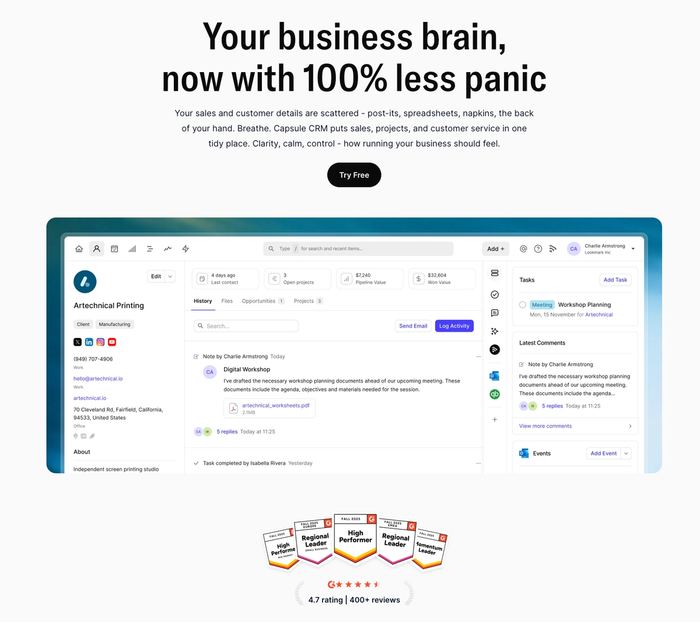
Rather than cluttering teams with features they don’t use, Capsule CRM focuses on the capabilities that truly support relationships. It’s especially well-suited to small and medium-sized businesses that want practical tools that actually get used.
Keep the full customer picture in one place
Good relationships start with clarity about history and context. Capsule gives you a 360-degree view of every contact: names, roles, interactions, emails, calls, files, and notes all live where your team can actually see them.
It’s especially helpful when the same customer interacts with different team members over time: everyone sees the same timeline, so continuity isn’t lost as volume increases.
Make the most of integrations and flexibility that keep context flowing
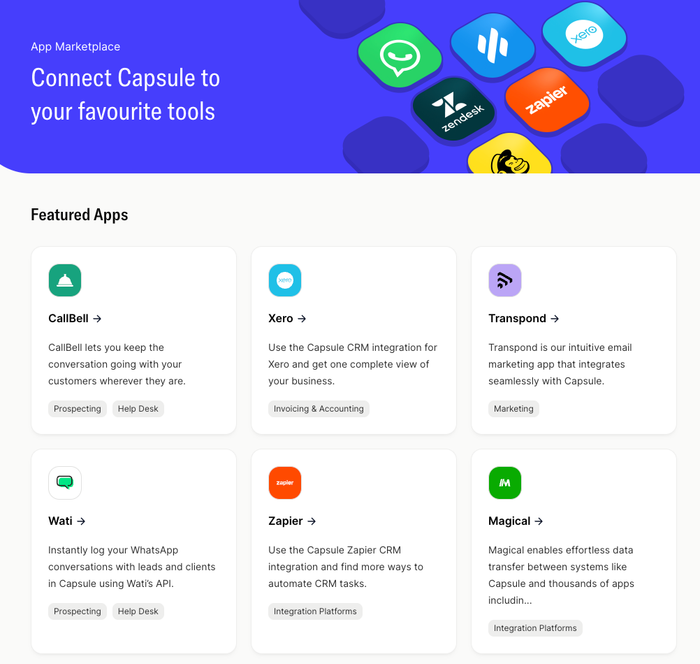
Capsule works with the tools you already use – from email to calendars and accounting systems – so information doesn’t get siloed. You can connect with platforms such as Google Workspace, Outlook, and others to make sure customer data stays in sync across workflows.
Capsule CRM stays out of the way of good relationships while helping teams do the basics consistently. For many small and medium-sized businesses, that’s exactly the kind of support that turns occasional clients into loyal ones.
Use visual pipelines and straightforward tracking
Capsule helps you see where opportunities and relationships stand with intuitive pipeline and stage views. You can customise pipeline steps to match how your business works, and track progress without getting lost in spreadsheets or ad-hoc notes.
It also integrates tasks and activities with those pipelines, so you aren’t just tracking status; you’re tracking next actions, which keeps customers feeling looked after rather than forgotten.
Leverage automation that takes the grunt work out
Capsule includes workflow automation that takes repetitive tasks off your team’s plate. You can trigger reminders, create tasks when deals move stages, and automate parts of your routine without replacing the human judgement that customers still need.
This supports relationship management by letting automation handle what it’s good at, so your team can focus on interpretation, follow-through, and judgement in customer conversations.
Make relationships your advantage
At its simplest, customer relationship management isn’t about software; it’s about continuity, clarity, and trust. But when those qualities start to fade away, the right tool can make a genuine difference.
Capsule CRM gives you a single home for customer information, interactions and follow-ups that your whole team can rely on, helping you preserve context. It supports pipelines and tasks in a way that feels natural, and gives you enough structure to act confidently as you grow. You don’t need to overink it to start benefiting; even a basic setup brings today’s conversations into tomorrow’s context.
If managing relationships better is a priority (not just for today, but for the future of your business), giving Capsule a try is one of the simplest ways to bring that into practice.
Ready to see it in action?
Start with a free account today.