
Best CRM for prospecting in 2026: our picks
Prospecting is one of the highest leverage activities in sales, and one of the easiest to derail.
Poor data leads to wasted outreach. Weak follow-up systems kill deals. And before long, pipeline health depends more on individual memory than on process.
This is where CRM software becomes decisive.
The right CRM acts as the command centre for sourcing and qualification. The wrong one becomes a passive contact archive that reps avoid.
In this guide, we compare the best CRMs for prospecting in 2026 and show how each one impacts structure, visibility, and execution across the sales process.
What level is your prospecting CRM at?
Not every CRM supports prospecting in the same way. Some simply store contacts. Others actively shape behaviour and drive execution.
Before comparing tools, identify where your current setup sits.
Level 1: Contact storage
At this level, the CRM functions mainly as a database.
- Leads are stored, but not actively worked on
- Follow-ups depend on memory or personal task lists
- Pipeline stages exist, but movement lacks discipline
Prospecting here feels manual. Activity happens, but structure is weak, and the results depend heavily on individual effort.
Level 2: Process support
Here, the CRM introduces a basic structure.
- Simple automations trigger reminders or task creation
- Pipeline stages reflect a defined sales process
- Emails and notes live in one central timeline
This level reduces chaos, but prospecting still requires a lot of manual coordination. The system supports work; it doesn’t yet drive it.
Level 3: Execution engine
Now the CRM actively enables outbound discipline.
- Automated sequences standardize outreach
- Data sync and enrichment reduce admin
- Prioritisation logic helps reps know who to contact next
Prospecting becomes repeatable. Managers gain visibility without chasing updates, and performance improves because structure removes friction.
Level 4: Scalable prospecting system
At the highest level, the CRM operates as the operational core of your prospecting stack.
- Multi-channel outreach is coordinated from one place
- Reporting supports forecasting and coaching
- Process discipline holds even as lead volume grows
Prospecting no longer depends on heroic effort. It becomes a predictable, scalable system.
Most teams believe they operate at Level 3. In practice, many still function at Level 1 with disorganized tools and manual follow-ups.
The CRM you choose determines where you land and how far your prospecting motion can scale without breaking.
Best sales prospecting CRM software in 2026
#1 Capsule CRM: simple, prospecting-ready CRM that helps reps act faster
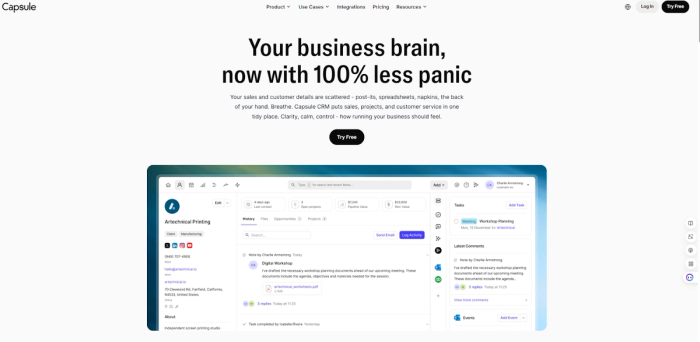
Capsule CRM is a simple CRM built for small and mid-sized sales teams that want to turn contacts into pipelines. It focuses on clean contact data and disciplined activity tracking, making it feel like the CRM you actually use every day instead of one you dread opening.
What makes Capsule effective for prospecting
1. Centralized contact intelligence
Capsule gives every prospect a 360° profile with interaction history and notes in one place, so your team always knows the full context before reaching out.
2. Customizable and visual sales pipelines
Prospecting isn’t just capturing leads; it’s moving them forward. Capsule’s pipeline lets you name and organise stages your way and switch between Kanban, list, or dashboard views.
3. Smart task automation and AI-assisted workflows
Capsule automates routine follow-up reminders and tasks, keeping reps focused on outreach rather than admin. Its automation tools act almost like an AI assistant by nudging prospects at the right cadence.
4. Inbox add-ins and email sync
Capsule integrates tightly with Gmail and Outlook, so you can log emails and add prospects without leaving your inbox. This makes outreach faster and captures communication automatically in the CRM.
5. Segmentation and dynamic lists for prioritization
Leads can be filtered and grouped using custom tags, fields or pipeline stages, helping teams prioritise the prospects most likely to convert and craft more relevant outreach sequences.
These features combine into a prospecting workflow that feels purposeful instead of piecemeal; essential when you want a CRM that drives action.
⭐ Real user feedback
Users consistently praise Capsule for its clarity and daily usefulness:

One reviewer highlights how Capsule’s simplicity helps them integrate trade show leads from spreadsheets, track progress through the funnel, and keep the sales process organised, ultimately improving sales tracking.

Another user emphasises how easy it is to set up Capsule, customise fields to match unique workflows, and apply it not just for prospects but for broader team processes; a testament to its flexibility and intuitive design.
This aligns with broader reviews noting Capsule’s intuitive interface and task features that help teams stay disciplined with follow-ups and outreach.
Pricing (2026)
Capsule lets you start without risk and scale as your needs evolve:
- Free plan: $0; basic CRM functionality, ideal for solo sellers or very small teams.
- Starter: ~$18 per user/month; core contact management, pipelines, and calendars.
- Growth: ~$38 per user/month; adds automation, advanced tasks, and more contacts.
- Advanced / Ultimate: up to ~$72 per user/month; higher limits, premium integrations, and support.
Capsule also offers a 14-day free trial on paid plans so you can test the prospecting features before committing.
For teams searching for the best CRM for prospecting in 2026, Capsule stands out as a practical and structured choice: one that actually supports daily outreach, keeps your team in the flow of work, and helps you move prospects forward. If your priority is clarity, consistency, and action-oriented pipelines without over-engineering, Capsule’s approach will feel like a breath of fresh air.
Try Capsule CRM and start building a prospecting system that reps will actually use and that drives measurable pipeline progress.
#2 HubSpot CRM (Sales Hub)
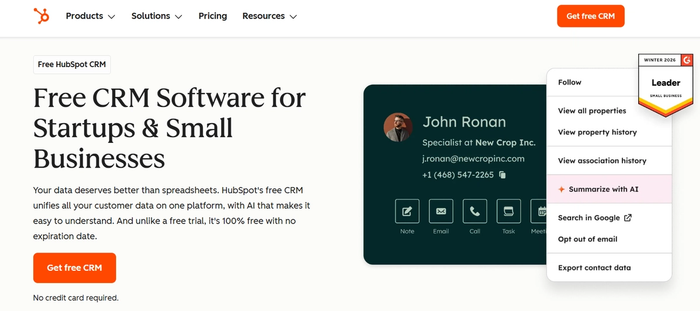
HubSpot’s CRM and Sales Hub sit near the top of the CRM market thanks to a broad feature set, strong ecosystem, and well-executed automation. Built as part of a unified sales, marketing, and service platform, it can handle everything from contact management to advanced reporting and AI-assisted outreach. That said, for teams specifically searching for the best CRM for prospecting workflows, there are some practical trade-offs to consider, especially around pricing and complexity.
Key features for prospecting
1. AI-powered lead prioritization and workflows
HubSpot embeds AI tools across the platform (including prospecting and data agents) that can help research leads, personalize outreach, surface buying signals, and automate task suggestions; useful for prospecting scale.
2. Sequences and automated follow-ups
Sales Hub lets you build email sequences with automated follow-ups, reminders, and task triggers so reps can execute multi-touch outreach.
3. Advanced contact and pipeline insights
With detailed contact profiles, engagement tracking, and visual pipelines, HubSpot helps teams prioritise outreach based on behaviour and deal stage, bridging prospecting and pipeline management in one view.
Note: While HubSpot provides strong automation and AI, its prospecting capabilities are part of a broader sales platform rather than specialised cold/outbound workflows. Some users and implementations find dedicated prospecting automation (like automatic lead enrichment or advanced sequencing cadence logic) less intuitive or as powerful as standalone outreach tools.
Considerations
- Broad vs. specialized: HubSpot’s strength is its unified platform. It excels at combining CRM, sales engagement, and marketing automation, but it isn’t built solely around high-velocity outbound prospecting the way some specialised tools are.
- Complexity at scale: For teams without dedicated CRM admins or RevOps support, the depth of features and configurations can become overwhelming and lead to slower adoption.
- Cost vs. focus: Smaller teams focused purely on outreach and disciplined prospecting may find that costs scale faster than the incremental value received, especially compared with simpler, sales-centric CRMs.
- Feature fragmentation: Some features are limited to specific tiers or tied into other hubs, which means you may end up paying for broader capabilities you don’t need just to unlock good prospecting tools.
In short: HubSpot CRM is a powerful platform that can support prospecting at scale, especially when integrated with its AI tools and automation layers, but its broad focus and tiered pricing make it a bigger, more complex choice compared with more lightweight, prospecting-lean CRMs.
#3 Pipedrive
Pipedrive CRM is a widely used sales-focused CRM that centres around simple pipeline visibility, contact tracking, and deal management. It’s designed to help teams organise sales activities, automate basic workflows, and keep momentum moving through the funnel. While it offers solid core CRM capabilities and automation options, it’s not built from the ground up specifically for high-velocity prospecting workflows in the way some dedicated outbound-oriented stacks are.
🔑 Key features for prospecting
1. Visual pipeline and activity management
Pipedrive’s drag-and-drop pipeline view makes it easy to see where each prospect sits in the deal journey. Teams can customise pipelines to match their sales stages and track activities tied to each contact, giving reps clear visibility of what to act on next.
2. Email sync, templates, and follow-up automation
With two-way email sync, tracking, and bulk templates (at mid-tier plans), reps can send and log emails directly inside the CRM and standardize follow-up activity. Workflow automations help nudge reps toward next steps.
3. Built-in AI assistance for sales tasks
Pipedrive includes an AI-powered assistant that suggests actions, generates insights and helps automate routine sales tasks. These AI elements aim to streamline prioritisation and response-based triggers, though they remain more general sales aids than laser-focused outbound prospecting automation.
Note: Pipedrive’s strength is pipeline and activity management. It lacks deeper, prospecting-centric tools like advanced behavioural prioritisation or multichannel outreach automation found in dedicated prospecting platforms.
Considerations
- Prospecting isn’t the core design: Pipedrive supports pipeline tracking and basic outreach sequencing, but its automation and AI are geared toward overall sales process efficiency, not deep outbound prospecting workflows.
- Add-ons drive up price: To use tools like lead capture bots or visitor tracking (which some teams might mistake for prospecting features) you’ll likely pay extra beyond the base plan costs.
- Feature gaps at lower tiers: Essentials plans lack features most revenue teams rely on (like full email sync and automation), meaning rising to a higher tier becomes necessary to unlock prospecting-friendly functions.
- Less multichannel focus: Pipedrive doesn’t provide native outbound automation across channels (e.g., social outreach, SMS workflows) without third-party tools.
In short: Pipedrive is a solid CRM for visual pipeline management and basic sales automation, especially for small to midsize teams that want simplicity and structured deal tracking. However, for prospects specifically looking for a CRM that actively drives disciplined prospecting workflows, its core feature set may feel less specialised and more general than tools designed around high-velocity outreach and prioritisation.
#4 Salesforce Sales Cloud
Salesforce Sales Cloud is one of the most comprehensive CRM platforms on the market and is often marketed as the #1 AI-powered CRM for sales. It centralises contact and opportunity data, automates routine tasks, and offers powerful analytics and AI tools to support large, complex sales organisations. That depth of capability can be invaluable in enterprise environments, but for teams specifically focused on high-velocity prospecting, its scale and complexity introduce trade-offs.
Key features for prospecting
1. AI-driven prioritization and insights
Sales Cloud uses built-in AI (including Einstein and Agentforce capabilities) to surface priority leads, suggest next actions, and help reps focus on the prospects most likely to convert.
2. Multi-channel engagement sequencing
Salesforce supports sales engagement workflows that let reps build personalized sequences of emails, calls, and tasks and automatically record those touches in the CRM, helping standardize outreach cadences at scale.
3. Enterprise-grade pipeline and analytics
With deep customization of objects like leads, contacts, accounts, and opportunities, Salesforce gives teams detailed pipeline views and forecasting dashboards, useful for large teams needing cross-team visibility and performance tracking.
Note: While Salesforce can integrate with specialised prospecting tools and data providers via its AppExchange, many advanced lead-generation and sales engagement features aren’t native and require additional add-ons.
Considerations for prospecting teams
- Best suited for complex organisations: Salesforce shines in enterprise contexts where sales processes are complex and need heavy customization, cross-functional integration, and deep reporting. Smaller teams with narrow prospecting workflows may find it more than they need and harder to adopt quickly.
- Steep learning curve: Admin configuration, custom objects, and setup often require dedicated CRM or operations resources. Without that, teams risk low adoption and inconsistent use.
- Cost vs. focus: For teams whose core goal is straightforward prospecting execution (lead prioritisation + disciplined outreach) rather than enterprise forecasting and automation at scale, the price-to-value ratio can be less compelling compared with lighter, more prospect-oriented CRMs.
In short: Salesforce Sales Cloud packs powerful AI, customization, and analytics, making it a compelling choice for large sales organisations that need a CRM platform to manage every step of the revenue process. But for sales teams primarily focused on finding, engaging and moving prospects quickly, its complexity and cost may outweigh the benefits.
#5 Zoho CRM
Zoho CRM is a comprehensive CRM platform designed to centralise sales, marketing and customer support activities in one place. It offers strong lead and deal tracking, automation and customization capabilities that appeal to growing sales teams, especially those already invested in the broader Zoho ecosystem. That breadth of features can be useful for many sales organisations, but in the context of high-velocity prospecting, there are some obstacles to be aware of.
🔑 Key features for prospecting
1. Lead scoring and behavioural insights
Zoho CRM offers lead scoring and engagement signals to help reps focus on higher-potential prospects without manually reviewing every contact.
2. Workflow automation and task triggers
Automate repetitive tasks like follow-ups, lead assignment and status updates, helping reduce manual admin during outbound sequences.
3. AI assistant (Zia)
The built-in AI assistant Zia can surface insights, suggest next actions and help prioritise prospects based on engagement and deal progression — bringing intelligence into everyday prospecting decisions.
Considerations for prospecting teams
- Wide feature set, not exclusively prospecting-focused: Zoho CRM is broad; it blends CRM, sales automation, marketing, live chat, and analytics. That’s valuable for many teams, but not every feature directly accelerates cold or outbound prospecting performance. Its setup and customization can also feel complex to teams that want a CRM focused on simple, repeatable prospecting sequences.
- Learning curve and usability: Reviewers commonly note that while Zoho CRM is powerful, there’s a learning curve to mastering its interface and workflows, which can slow down adoption for teams who want immediate prospecting gains.
- AI features gated to higher plans: Some of the more advanced AI-driven tools, like Zia’s deeper forecasting and recommendations, are only available on upper-tier plans, which increases the cost for teams that want those capabilities.
- Integration overhead: If you’re not already using Zoho’s broader ecosystem, unlocking the full value of Zoho CRM’s integrations may require additional setup or training.
In short: Zoho CRM offers a robust set of CRM and automation tools that can support effective prospecting, especially in structured sales environments that benefit from AI assistance and analytics. However, compared with simpler, prospecting-lean solutions, it demands more setup and isn’t designed solely around outbound workflows; something teams focused on rapid, repeatable prospecting execution should weigh carefully.
Final thoughts: choose a CRM that DOES prospecting
Throughout this guide, you’ve seen how different CRM platforms support sales teams; from pipeline visibility and automation to AI-assisted workflows and enterprise-grade analytics.
But here’s the honest takeaway: many CRMs are built as broad sales platforms first and prospecting systems second. They give you a lot of tools, but not all of them are designed to make daily outreach, follow-up discipline, and pipeline clarity effortlessly repeatable for a growing sales team.
That’s where Capsule CRM stands out.
Capsule strips away the noise and focuses on what truly matters for prospecting success: organised contact data, clear pipeline stages, activity discipline, and lightweight automation that keeps reps acting instead of just clicking around. Its intuitive interface and easy setup mean your team can stop wrestling with software.
For sales teams looking for a CRM that feels like it was built for prospecting rather than against it, Capsule hits the sweet spot between capability and simplicity.