
Small businesses play a big part in the overall business landscape.
A huge share of entrepreneurship now happens through microbusinesses and nonemployer firms that don’t show up neatly in traditional reports, even though they still contribute to growth and local stability.
That’s why surface-level statistics rarely help on their own. The real picture sits in the details.
This roundup pulls together 100+ small business statistics from reliable sources like GoDaddy’s Small Business Research Lab, the U.S. Small Business Administration, and U.S. Bank’s 2025 Small Business Survey.
If you want the numbers behind business creation, digital adoption, and more, you’ll find them below.
Size of the microbusiness economy
- Microbusinesses account for a large share of US businesses. In 2020, there were about 20 million online microbusinesses across retail, food, and professional and business services. These are often one‑person operations, with small business ownership concentrated in local communities. (GoDaddy Small Business Research Lab)
- In 2021, that number stayed close to 20 million despite economic challenges. Many microbusinesses are so small that they don’t show up in U.S. Small Business Administration or United States Census Bureau statistics. They operate outside the counts of traditional employer firms, yet they still contribute to private sector payroll and the US economy. (GoDaddy Small Business Research Lab)
- By 2023, the total grew to more than 21 million online microbusinesses, and 2025 data show momentum continuing. States like Arizona, Florida, and South Carolina have seen a surge in new microbusinesses, while places like the District of Columbia remain dense hubs for them. (GoDaddy Small Business Research Lab)
- The vast majority of microbusinesses have fewer than 10 employees, with the founder/owner taking responsibility for most tasks across the business. Due to their size, smaller and individually owned businesses aresometimes excluded from top small business statistics like annual payroll surveys. However, they still provide valuable insights into how local economies grow. (GoDaddy Small Business Research Lab)
- Many people start microbusinesses to become their own boss but it is common for small businesses to fail. Most businesses that close do so within a few years because of high operating expenses, difficulties securing financing, and the simple fact that small businesses fail at higher rates than mid‑sized or large businesses. (GoDaddy Small Business Research Lab)
- According to the SBA’s small business report, America is home to 36.2 million small businesses, which represent 99.9% of U.S. businesses and employ 62.3 million people, nearly half of all U.S. workers. These key statistics highlight how dominant small enterprises are in the U.S. economy. (U.S. Small Business Administration)
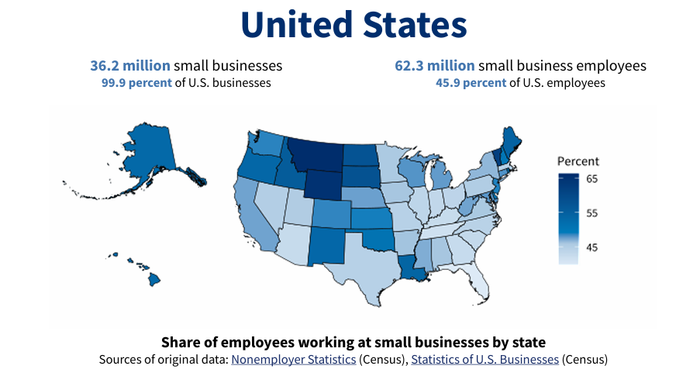
- In wholesale and retail trade, there are about 720 thousand small businesses. The sector includes 445,919 nonemployer firms and 236,359 businesses with fewer than 20 paid employees, showing that most operators are tiny and often family-run. (U.S. Small Business Administration)
Business creation and new starts for small business owners
- In 2020, Americans created 2.8 million more microbusinesses than in 2019. This wave of new ventures is highlighted in the small business owners report produced by Guidant Financial and other sources. It shows that small businesses create opportunity even in hard times. (GoDaddy Small Business Research Lab)
- About 15% of all microbusinesses operating in 2020 were started that same year, underscoring how quickly people turned to entrepreneurship when traditional jobs faltered. Many owners used bank loans, average SBA loans, or personal savings to get started and relied on simple marketing strategies to build their customer base. (GoDaddy Small Business Research Lab)
- New business formation remained strong in 2021, as aspiring owners filed more business applications than in previous years. Women‑owned businesses increased rapidly, and Hispanic-owned businesses and veteran-owned businesses also grew, showing how diverse owners are stepping into entrepreneurship. (GoDaddy Small Business Research Lab)
- By 2023 and the past year, online business creation continued to outpace closures. Although some small businesses struggle and the failure rate remains a significant aspect of entrepreneurship, many small firms still succeed because they embrace technology and adapt quickly. (GoDaddy Small Business Research Lab)
- Recent data indicate that most of these new ventures are not counted as employer firms. They have little or no annual payroll, yet they generate new jobs and shape their communities. Compared with big businesses, microbusinesses operate on thin margins but provide flexibility and a path to success for people who might lack access to skilled workers or traditional capital. (GoDaddy Small Business Research Lab)
- Between March 2023 and March 2024, 1.28 million establishments opened while 1.13 million closed, for a net increase of 155,311. Small firms were responsible for 1.1 million openings and about 983 thousand closings, underscoring how small businesses succeed despite churn. (U.S. Small Business Administration)
- During the same period, opening and expanding establishments added 14.4 million jobs, while closing and contracting establishments lost 13.0 million, giving a net gain of 1.4 million jobs. Small businesses created 1.2 million of those jobs, or nearly 89% of the total. (U.S. Small Business Administration)
- Nine in ten owners say they launched their business to be their own boss; roughly 72% are first‑time owners, and 70% think now is a good time to start a small business. About 80% would start again if given the chance. (U.S. Bank, 2025 Small Business Survey)
Demographics of owners
- Microbusiness ownership has grown across all age groups, revealing a generation gap in motivations. Younger entrepreneurs tend to start online shops or app‑based services and use technical knowledge to innovate, while older owners often run local retail or food operations and draw on decades of experience. (GoDaddy Small Business Research Lab)
- The share of new businesses started by Black owners rose from 15% to 26% in 2020. Women‑owned businesses increased from 48% to 57% in the same year. Hispanic-owned businesses and veteran-owned businesses also grew during this period, showing broad participation. (GoDaddy Small Business Research Lab)
- New businesses owned by people without a college degree rose from 36% to 44%, proving that a four‑year degree isn’t required to succeed in entrepreneurship. Many owners enter business from trades or service jobs and learn through experience. (GoDaddy Small Business Research Lab)
- By 2023, ownership remained diverse across race, gender and education. States like South Carolina, Arizona, and the District of Columbia have seen particularly strong growth among underrepresented groups. (GoDaddy Small Business Research Lab)
- Many small firms are single‑owner operations. Small businesses owned by individuals make up a big share of businesses in the U.S., and this small business ownership drives inclusive economic growth. (GoDaddy Small Business Research Lab)
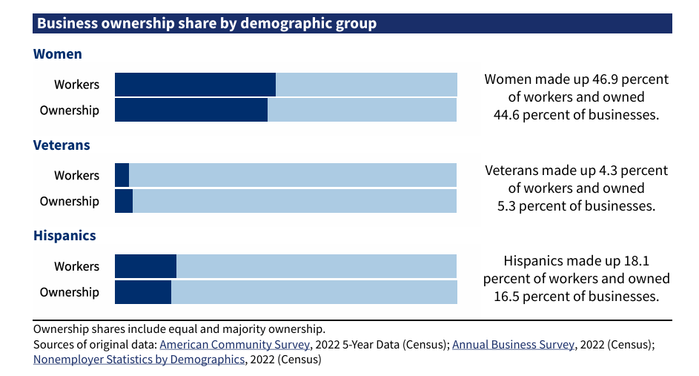
- Women own 44.6% of U.S. businesses while making up 46.9% of workers, meaning nearly half of all businesses are female‑owned. (U.S. Small Business Administration)
- Veterans own 5.3% of businesses but represent only 4.3% of workers, showing above‑average entrepreneurship among veterans. (U.S. Small Business Administration)
- Hispanics own 16.5% of businesses, compared with 18.1% of workers. (U.S. Small Business Administration)
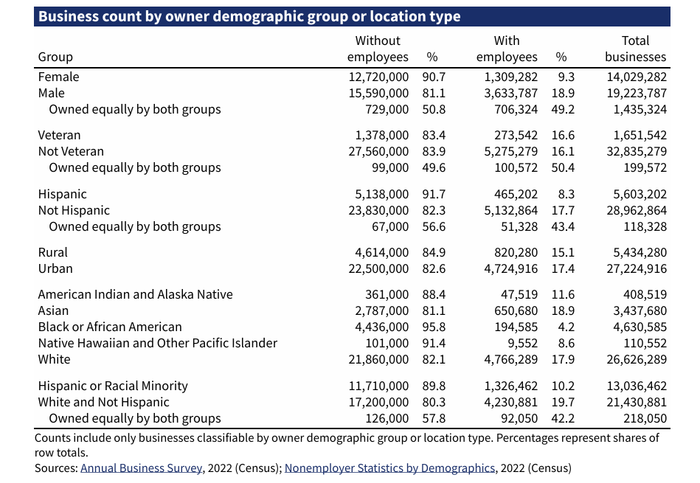
- The count of female‑owned small businesses is about 14 million (12.7 million without employees plus 1.3 million with employees), whereas male‑owned small businesses number about 19 million. (U.S. Small Business Administration)
- Rural owners operate 5.4 million small businesses, while urban owners run 27.2 million - proof that local businesses are critical in both the countryside and cities. (U.S. Small Business Administration)
- Ownership diversity is notable: there are 5.6 million Hispanic‑owned firms, 4.6 million Black‑owned firms, and 3.4 million Asian‑owned firms. (U.S. Small Business Administration)
Motivation and mindset
- In 2021, many owners said they started their business to gain control over their income and become their own boss. For them, entrepreneurship was a way to design a better work‑life balance. (GoDaddy Small Business Research Lab)
- GoDaddy’s 2025 survey found that over 70% of small business owners are confident they will achieve their definition of success. This optimism persists even when news headlines focus on uncertainty. (GoDaddy Small Business Research Lab)
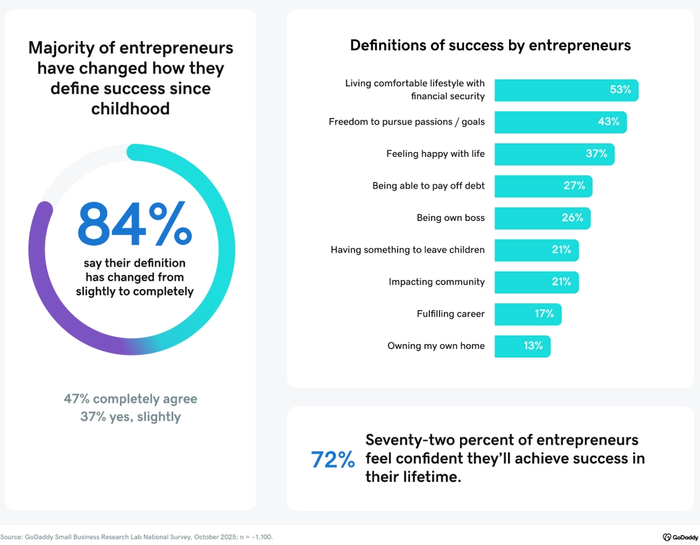
- Positive online reviews, loyal online shoppers, and a supportive community boost confidence. Owners who build steady revenue streams tend to feel more secure and satisfied. (GoDaddy Small Business Research Lab)
- A generation gap is evident: younger owners are quick to adopt AI, automation, and social platforms, while older entrepreneurs often rely on relationships and personal referrals. Both approaches work, illustrating that success can come from many directions. (GoDaddy Small Business Research Lab)
- An impressive 96% of owners rate their business as successful, up from 90% in 2024 and 86% in 2023, and 88% report growth in the past year. (U.S. Bank, 2025 Small Business Survey)
- 81% believe success hinges on the owner and staff, not external factors, while 83% think modern tools and technologies are critical. (U.S. Bank, 2025 Small Business Survey)
- Most owners (70%) still think it’s a good time to start a business, yet 79% feel competition is tougher, 70% say funding is harder to secure, and 63% say economic uncertainty would discourage them. (U.S. Bank, 2025 Small Business Survey)
- Nearly half of owners (48%) are hitting revenue targets, 35% are managing workload and time, 48% are adopting digital tools, 33% have enough staff, and 29% are actively adjusting to inflation and recession risks. (U.S. Bank, 2025 Small Business Survey)
- Only 24% have assessed the value of their business, but 37% plan to sell within the next 12 months; younger owners are more likely to plan a sale (41% vs. 33% of older owners). (U.S. Bank, 2025 Small Business Survey)
- Besides wanting to be their own boss, owners report other top reasons: 88% wanted control over their financial future, 88% had deep expertise they wanted to leverage, 86% wanted to align work with passions, and 80% didn’t want a 9‑to‑5 schedule. (U.S. Bank, 2025 Small Business Survey)
- Two‑thirds (67%) come from entrepreneurial families, and 62% took over a relative’s business. (U.S. Bank, 2025 Small Business Survey)
- About 53% of female owners took over a relative’s business, compared with 66% of male owners. (U.S. Bank, 2025 Small Business Survey)
- Most owners (72%) are first‑time entrepreneurs, while 28% have launched previous businesses. (U.S. Bank, 2025 Small Business Survey)
- Younger generations are more likely to start a business because they couldn’t secure a job elsewhere - 52% of Gen Z and Millennials vs. 44% of Gen X and Boomers. (U.S. Bank, 2025 Small Business Survey)
Education and skills
- Many microbusiness owners start without formal business training or extensive technical knowledge. They learn by doing, often while holding down another job. (GoDaddy Small Business Research Lab)
- Digital platforms and business applications help close skill gaps. Tools for accounting, marketing strategies and online sales let owners handle tasks that used to require specialists. (GoDaddy Small Business Research Lab)
- Owners gain skills in areas like customer service, supply management, and digital marketing, which can lead to new jobs or better opportunities later. These skills also transfer to other professional and business services. (GoDaddy Small Business Research Lab)
- Marketing strategies vary widely. Some owners rely on social media marketing and online reviews; others network through local chambers of commerce and US Small Business Administration programs. (GoDaddy Small Business Research Lab)
Online presence and digital tools
- In 2020, most microbusinesses relied on websites, online payments and email to reach customers. The shift to remote work and online shopping meant that having a digital presence was vital for survival. (GoDaddy Small Business Research Lab)
- In 2021, online‑first businesses adapted faster to pandemic restrictions because they had embraced e‑commerce and social media marketing. This helped them keep revenue flowing when foot traffic dropped. (GoDaddy Small Business Research Lab)
- By 2023, microbusinesses that invested in digital tools showed lower failure rates than those relying only on a physical location. Online shoppers and positive online reviews drove sales and built trust. (GoDaddy Small Business Research Lab)
- Despite these benefits, many owners must finance website improvements and marketing themselves. Bank loans and credit lines are harder to get at this scale, so business owners often use personal funds to pay for website hosting, shipping software, and email marketing. (GoDaddy Small Business Research Lab)
- 57% of owners are already using or plan to implement generative AI in the next year. Among users, 68% spend less than $50 monthly, and 18% use free tools. (U.S. Bank, 2025 Small Business Survey)
- Owners primarily use AI for content creation (44%), data analysis (41%), and marketing and sales (39%). Other uses include project management (36%), HR and recruiting (35%), supply‑chain management (33%), personalized recommendations (33%), staff scheduling (32%), finding new software (29%), customer support (28%), and automating invoicing or payment reminders (27%). (U.S. Bank, 2025 Small Business Survey)
- AI users are more likely to say their business is extremely successful (29% vs. 22% non‑users), has grown significantly (29% vs. 22%), and are very optimistic about the future (33% vs. 25%). Nearly 88% of users say AI frees them to focus on customer relationships. (U.S. Bank, 2025 Small Business Survey)
- While 81% find tech advances like AI stressful, 58% feel pressured to adopt more, and 56% worry about being replaced by automation, 61% plan to leverage AI to reach goals, and 78% want their bank to offer AI‑powered digital solutions. (U.S. Bank, 2025 Small Business Survey)
- 87% now see digital tools as essential, up 15 points from 2024; 80% say they need more tools and 82% want to consolidate them. (U.S. Bank, 2025 Small Business Survey)
- More than 84% believe digital marketing helps grow their business. 80% need digital payroll solutions, 82% seek to minimize fees, 63% feel overwhelmed by tool bloat, and 88% want all bills and invoices centralized, with 87% desiring payment flexibility. (U.S. Bank, 2025 Small Business Survey)
- Owners accept a mix of payment types - cash (48%), debit cards (45%), credit cards (42%), mobile tap‑to‑pay (42%), QR codes (32%), checks (27%), and Buy Now, Pay Later services (25%). (U.S. Bank, 2025 Small Business Survey)
- The top solutions owners currently use include payment processing and merchant services (40%), contactless payment tools (38%), HR management platforms (37%), payroll solutions (33%), integrated bill‑pay/invoicing (30%), and accounts payable automation software (29%). (U.S. Bank, 2025 Small Business Survey)
E-commerce and revenue trends
- E-commerce activity jumped sharply in 2020, becoming a key source of revenue. This trend continued into 2025 as owners leveraged social media ads and search engine optimization. (GoDaddy Small Business Research Lab)
- In 2021, many microbusinesses maintained strong online sales even when stores reopened, highlighting the power of digital channels to reach online shoppers. (GoDaddy Small Business Research Lab)
- By 2023, online revenue remained a steady driver of stability for small firms. Businesses selling online were more likely to report year‑over‑year revenue growth than those selling only in person. Revenue statistics show that e‑commerce helps buffer against local downturns. (GoDaddy Small Business Research Lab)
- That said, owners still face financial challenges like fluctuating shipping rates, changes in tax laws, and rising operating expenses. Managing inventory, handling shipping costs, and dealing with customer returns all require careful planning. (GoDaddy Small Business Research Lab)
Jobs and employment impact
- From 2020 to 2022, each new online microbusiness owner was linked to roughly six to seven new local jobs. This pace of job creation has been documented in labor statistics and shows how microbusinesses offset losses at other firms. (GoDaddy Small Business Research Lab)
- By 2025, the impact has grown: each microbusiness owner now supports more than eight jobs. These positions can include part‑time employees, independent contractors, and skilled workers in fields such as IT or professional and business services. (GoDaddy Small Business Research Lab)
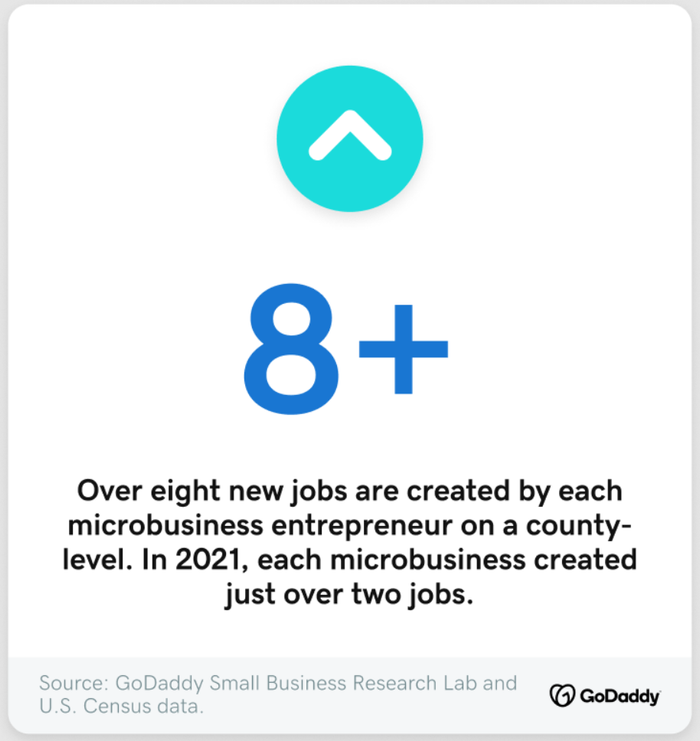
- Counties with a high density of microbusinesses tend to have lower unemployment rates, especially in sectors like retail, social assistance and local services. Areas with more microbusinesses also report stronger social services, since owners buy from local suppliers and reinvest in their communities. (GoDaddy Small Business Research Lab)
- Microbusiness owners contribute to employment indirectly by spending on supplies and services. Their purchases support other small firms and reduce reliance on public social assistance programs. (GoDaddy Small Business Research Lab)
- Nevertheless, high operating expenses, shipping costs and the challenge of securing financing mean that some microbusinesses close each year, underlining how fragile the private sector payroll can be at this scale. (GoDaddy Small Business Research Lab)
- The U.S. small business workforce grew 13.1% between 1998 and 2022, reaching 62.3 million paid employees. This growth shows how vital micro and small firms are to local economies. (U.S. Small Business Administration)
- In professional, scientific, and technical services, small businesses make up 99.6% of employers and provide over 55% of paid jobs, showing that high‑skill sectors rely heavily on small operators. (U.S. Small Business Administration)
- Wholesale trade reflects a similar story: small businesses account for 98.8% of employers, 52.3% of employees, and 45.6% of payroll. These numbers underscore the outsized role of small companies in supply chains and distribution. (U.S. Small Business Administration)
Household income and financial support
- In 2021, about 33% of U.S. microbusinesses provided at least half of household income for their owners. For many households, business income covered rent, food, utilities, and healthcare. (GoDaddy Small Business Research Lab)
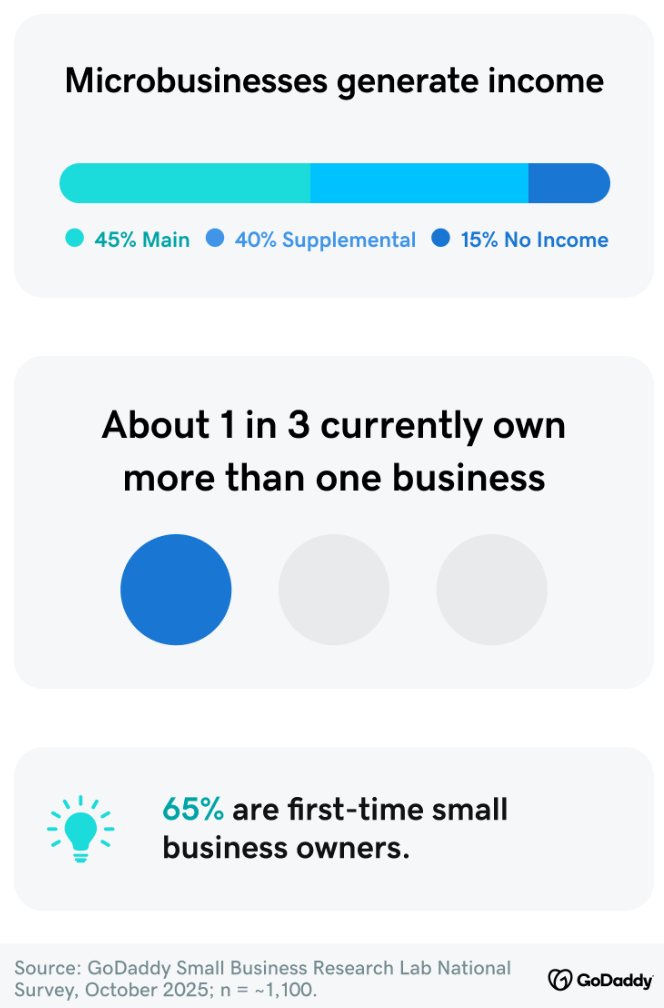
- By 2025, 45% of owners say their business is their main source of income, while 40% use it as supplemental income. This highlights how microbusinesses help fill gaps in private sector payroll and support everyday living expenses. (GoDaddy Small Business Research Lab)
- Every 1% increase in microbusiness ownership correlates with roughly a 2% rise in local household income, or about $1,500 over three years. This shows how closely microbusiness growth and local prosperity are linked in the US economy. (GoDaddy Small Business Research Lab)
- Owners must manage operating expenses, such as rent, inventory, shipping costs, and digital services. Many rely on personal savings, bank loans, and average SBA loans to bridge cash‑flow gaps, which can be difficult when the global economy slows. (GoDaddy Small Business Research Lab)
- Regions with strong online activity often see higher income impact, thanks to broadband access, social media marketing, and the ability to reach online shoppers anywhere in the world. These areas also benefit from better social services and community infrastructure. (GoDaddy Small Business Research Lab)
Economic resilience and recovery
- In 2020, microbusinesses helped cushion job losses in lower‑income and rural areas. Their flexibility made it easier to pivot to delivery, curbside pickup, and other services that large businesses struggled to implement quickly. (GoDaddy Small Business Research Lab)
- In 2021, counties with more microbusinesses recovered faster from early economic shocks. Local owners forged networks, cooperated on marketing, and supported each other with referrals. (GoDaddy Small Business Research Lab)
- By 2023, microbusinesses continued to bolster local economies during inflation and rising costs. They adapted to economic challenges and kept businesses in the U.S. running when supply chains were disrupted. (GoDaddy Small Business Research Lab)
- Compared with big businesses, micro firms have smaller safety nets. They often rely on bank loans or credit cards, making them vulnerable when interest rates rise. Still, their resilience shows how nimble, community‑focused enterprises can thrive alongside larger corporate players. (GoDaddy Small Business Research Lab)
- Overall, microbusinesses illustrate how entrepreneurship strengthens the US economy. They demonstrate that economic recovery happens not just through top‑down policy, but also through bottom‑up innovation and persistence. (GoDaddy Small Business Research Lab)
- The economic environment is the top stressor for 98% of owners, followed by competition (92%), inflation and higher material costs (92%), national economic conditions (88%), workload and time management (86%), concern over consumer spending (86%), local economic conditions (86%), fraud and cyber threats (85%), and competition from both large and small businesses (85%). (U.S. Bank, 2025 Small Business Survey)
- 79% say competition has intensified, 70% find funding harder to secure, and 63% say economic uncertainty would discourage them from starting a business today. (U.S. Bank, 2025 Small Business Survey)
Succession planning & retirement
- Owners expect to retire at age 65 on average, and 85% feel confident they can meet that goal. (U.S. Bank, 2025 Small Business Survey)
- Although 78% have at least thought about succession, only 54% have a formal plan. (U.S. Bank, 2025 Small Business Survey)
- Younger owners target age 62 for retirement, compared with 68 for Gen X and Boomers. (U.S. Bank, 2025 Small Business Survey)
- The most common plan is to transition the business to children (45%), followed by gifting it (10%), selling to outsiders (10%), passing it to a family member (10%), selling to a partner (9%), transitioning to employees (8%), or dissolving it (7%). (U.S. Bank, 2025 Small Business Survey)
- Only 24% have evaluated their business value, yet 37% intend to sell within a year; 32% plan to acquire a business from a retiring owner, with younger owners more likely to do so (36% vs. 28%). (U.S. Bank, 2025 Small Business Survey)
- 62% find succession planning overwhelming, 56% worry they’ll get a low price, 53% feel they lack resources, and 74% are stressed about deciding the business’s fate at retirement. Younger owners feel these pressures more acutely. (U.S. Bank, 2025 Small Business Survey)
- Owners are taking action - 38% opened retirement savings accounts, 32% met with a financial advisor, 30% invested in other income streams, 30% set a retirement timeline, 29% created a plan with an advisor, and 26% set up a trust or similar tool to transfer wealth. (U.S. Bank, 2025 Small Business Survey)
Long-term economic role
- Microbusinesses are often a first step into entrepreneurship. People launch them to gain independence and test ideas on a small scale. Even if small businesses fail, they help owners gain experience and valuable insights. (GoDaddy Small Business Research Lab)
- These companies generate new jobs and support local communities by offering services, donating to charity, and sometimes providing essential goods. They complement public social services and reduce reliance on aid programs. (GoDaddy Small Business Research Lab)
- Although the failure rate is high, micro firms that survive contribute to long‑term economic stability. They demonstrate how people without access to capital or formal business education can still succeed by staying adaptable and learning quickly. (GoDaddy Small Business Research Lab)
- Together, microbusinesses show that success and failure vary widely across industries and regions. They remind us that economic growth comes not just from headline‑grabbing corporations, but also from the everyday entrepreneurs who keep businesses in the U.S. vibrant and adaptable. (GoDaddy Small Business Research Lab)
- Small firms punch above their weight in trade. Nearly all U.S. exporters (97.2%) are small businesses, and they shipped goods worth $588.4 billion, about 33% of total U.S. export value. (U.S. Small Business Administration)
- The small business report notes that in 2023, banks issued $84.2 billion in loans to businesses with revenues under $1 million, part of $242.9 billion in total new small‑loan lending. This access to credit helps ensure that small businesses succeed and grow over time. (U.S. Small Business Administration)
Conclusion
The main takeaway from these statistics is that small businesses are expanding and evolving, but the “typical” small business is often far smaller than most people assume.
These numbers also highlight the tension owners live with every day: optimism and growth on one side, and rising competition, funding pressure, and economic uncertainty on the other. The businesses that adapt fastest tend to report stronger confidence and better outcomes.
As solo operators turn into growing teams, the right tools matter: light enough to stay out of the way, yet powerful enough to grow with you.
That’s where Capsule CRM comes in – so you can get organized now and scale smoothly when you’re ready.
Try it today.