
The best salespeople aren't the ones who pitch the hardest – they're the ones who know exactly when to reach out and who can make an introduction on their behalf.
That kind of precision doesn't come from gut instinct alone.
It comes from relationship intelligence that helps you understand your network at a deeper level.
In this guide, we'll explain what relationship intelligence really means and share the tools and tips to help you turn your network into your strongest competitive advantage.
What is relationship intelligence?
Relationship intelligence is the automated process of capturing and analyzing data from your business interactions to reveal patterns. Every email, meeting, and calendar event contains valuable information. Relationship intelligence extracts that information and turns static contact records into a dynamic map of who you know and how strong those connections actually are.
The concept emerged from a basic problem: traditional CRMs store data well but do very little to make sense of it. Sales teams log contacts and deals, yet still rely on memory to decide who deserves attention next. It's a widespread issue. Forrester found that 47% of organizations struggle with CRM data quality, and it was reported that 32% of sales reps spend over an hour each day on data entry alone. Despite all that effort, the critical question – who in our network can help us close this deal? – often goes unanswered.
Relationship intelligence closes that gap. It applies AI and data analysis to interactions your team is already having, surfacing insights that would otherwise stay buried:
- Which contacts are going cold?
- Where do warm introductions exist?
- How deep is your team's connection to a target account?
It shifts the focus from recording relationships to genuinely understanding them.
The CAPSULE framework: 7 key components of relationship intelligence
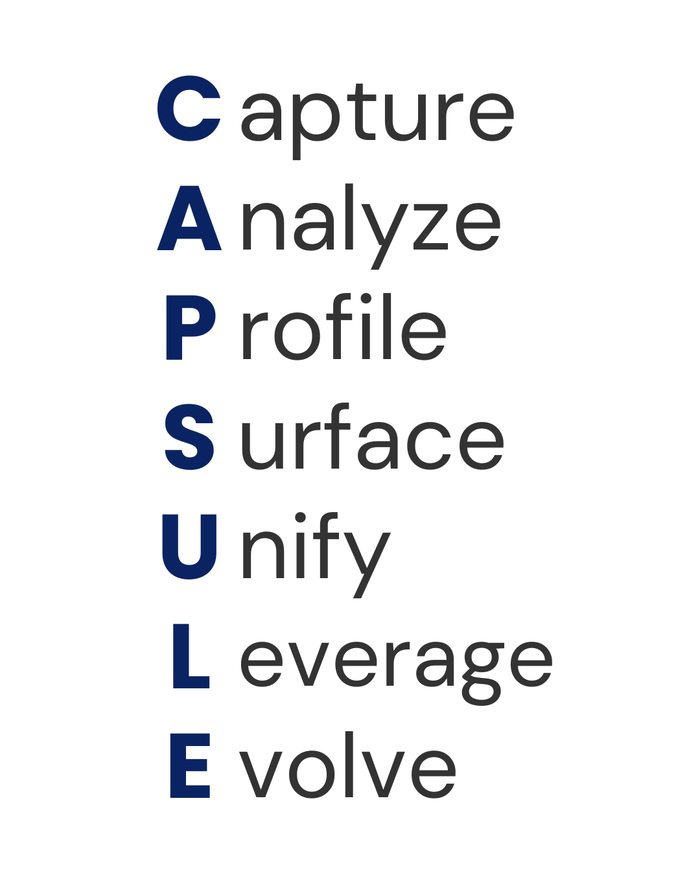
C for Capture
Everything starts with data capture… and it works a lot like fishing. You can stand at the shore with a single rod and hope for the best, or you can cast a wide net that catches everything worth keeping. Most businesses are still fishing with a rod. Their sales reps manually save certain emails and completely forget about that promising conversation from last week's conference.
Effective relationship intelligence takes the opposite approach. It automatically captures every meaningful interaction across your communication channels, without reliance on someone's memory at the end of a busy Friday. The system does the work silently, building a rich picture of every relationship in real time.
This matters more than most teams realize. Research shows that sales reps spend only 28% of their week actually selling. The rest disappears into admin work. Automated capture gives your team those hours back while producing more complete data than any human ever could.
Put it into practice: Connect your email and calendar to your CRM so interactions are logged automatically. If your team uses multiple communication channels, make sure each one feeds into the same central system.
A for Analyze
Captured data is useless if nobody makes sense of it. Most teams do attempt some form of analysis, but it tends to be shallow and inconsistent. A sales manager eyeballs the pipeline once a week. A rep scrolls through recent emails before a call to jog their memory. That's not analysis but guesswork dressed up as process.
Relationship intelligence replaces it with systematic, data-driven analysis.
Here's what that shift actually looks like:
- Gut-feel prioritization → Relationship scoring. Instead of a rep deciding who to call based on instinct, RI scores contacts by interaction frequency and recency, so the warmest leads rise to the top automatically.
- Reactive follow-ups → Pattern detection. Instead of waiting until a deal stalls to investigate why, RI flags declining engagement early, right before the relationship goes cold.
- Anecdotal reporting → Measurable relationship health. Instead of asking "how's that account going?" and getting a vague answer, RI provides concrete data on how many touchpoints occurred and how recently.
- Individual knowledge → Team-wide visibility. Instead of one rep hoarding all the context about a key account in their head, RI makes relationship data accessible to everyone who needs it.
Put it into practice: Audit how your team currently evaluates relationships. If the answer involves phrases like "I think" or "last time I checked," that's a sign you need better analytical tools in place.
P for Profile
There's a persistent myth in sales that a good contact record means having someone's name, job title, and email address. That's not a profile; that's a business card. And just like a business card sitting in a desk drawer, it tells you almost nothing about the actual relationship.
True profiling goes far deeper. Relationship intelligence continuously enriches your contact records with fresh data, such as:
- company updates,
- role changes,
- social media activity,
- recent funding rounds.
It builds a living document that evolves alongside the relationship itself. So when your rep opens a contact record before a call, they're not staring at a name and a phone number. They're seeing that this person got promoted two months ago, their company just expanded into a new market, and your colleague Sarah had coffee with them at an industry event last quarter.
This is where the myth breaks down completely. Static contact data creates a false sense of preparedness. You think you know your prospect because their details are in the CRM, but you're actually working with a snapshot that might be months or even years out of date. Relationship intelligence replaces that frozen snapshot with a continuously updated picture that reflects reality.
Put it into practice: Pick ten of your most important contacts right now and check their CRM records. If any of them contain outdated job titles or missing context about recent interactions, your profiling needs work.
S for Surface
Your colleague had lunch last month with the exact person you've been cold-emailing for weeks. Neither of you knew.
This happens more often than most teams realize. The most valuable connections in your network are frequently the ones nobody is aware of. A colleague might have a strong relationship with the decision-maker you've been chasing, and an existing client might share a board member with your top prospect. These hidden pathways exist in almost every business,; but without the right system, they stay hidden.
Relationship intelligence acts as a radar for these buried opportunities. It maps the web of connections across your entire team and highlights overlaps that no single person could spot on their own. Instead of sending a cold email, you discover your head of marketing already knows the prospect from a previous role. Instead of spending weeks trying to get a meeting, you find a mutual connection who can make an introduction in minutes.
This is arguably where relationship intelligence delivers its biggest ROI. Warm introductions convert at dramatically higher rates than cold outreach – the difference can be as high as five times. Yet most teams leave this advantage on the table simply because they have no way to see the connections already sitting inside their own data.
Put it into practice: Before your next outreach campaign, run your target list against your existing CRM contacts. Look for shared connections or past interactions that could open a warmer door.
U for Unify
Your sales rep tracks prospects in the CRM. Your marketing team runs campaigns from a separate email platform while customer support logs tickets in yet another tool. And, on top of that, the CEO keeps their most important contacts in a personal spreadsheet. Sound familiar?
Relationship intelligence only works when all of this data lives in one place.
Unification means breaking down the silos between systems and teams so that every interaction (regardless of where it happened) feeds into a single source of truth. Here are some of the most powerful pairs worth connecting:
- Email inbox + CRM → so every conversation is automatically tied to a contact record instead of being buried in someone's personal inbox.
- Calendar + CRM → so meetings, attendees, and follow-up context are linked together without anyone having to log them manually.
- Marketing platform + CRM → so your sales team can see which campaigns a prospect engaged with before they ever hop on a call.
- Customer support tool + CRM → so your account manager knows about an open complaint before they pitch an upsell.
When these pairs are disconnected, your team operates with blind spots.
When they're unified, every person in your organization sees the full picture of every relationship.
Put it into practice: Map out every tool your team uses to communicate with prospects and clients. If any of them don't feed data back into your CRM, that's a unification issue.
L for Leverage
Relationship intelligence gives you something most sales teams don't have: a window. A brief moment where the data is telling you now is the time to act.
The problem is that windows close fast. A prospect who engaged heavily with your content this week won't remember it next month, or that client whose engagement score just dropped is already halfway to evaluating your competitor.
Leverage is about speed. It's the difference between reaching out while a prospect is actively thinking about you and sending a "just checking in" email two months too late. Research found that responding to a lead within five minutes makes you 100 times more likely to connect than waiting just 30 minutes. The same principle applies to every relationship signal your RI system surfaces: the insight has a shelf life, and it's shorter than you think.
This is what separates teams that have relationship intelligence from teams that actually use it. The data means nothing if it sits in a dashboard for a week. It means everything if it triggers the right action within 48 hours.
Put it into practice: Create a daily 15-minute "signal review" ritual for your sales team. Check what your RI flagged in the last 24 hours and assign immediate next steps. Treat every insight like a countdown… because it is.
E for Evolve
Relationship intelligence isn't a set-it-and-forget-it system. Your network changes constantly: people switch jobs, companies pivot, acquisitions happen, new stakeholders enter the picture. The way you approached relationship management six months ago might already be outdated. Evolution means regularly refining how you capture, analyze, and act on your relationship data.
The teams that get the most out of RI treat it as a living practice. They revisit their processes, question their assumptions, often apply last-minute changes, and adapt based on what the data is actually telling them. They usually focus on three activities:
- Audit dead zones. Every quarter, they identify contacts and accounts where interaction has completely flatlined. Then, they decide whether to re-engage or remove the contacts; a bloated database is just as dangerous as an empty one.
- Reassess scoring criteria. The signals that indicated a strong relationship last year might not hold true today. If a team has shifted focus to a new market or customer segment, the relationship scoring should reflect that.
- Debrief wins and losses. When they close a deal, they trace back through the relationship data to understand what path led them there. When they lose one, they do exactly the same. Over time, these patterns become their most reliable playbook.
Put it into practice: Schedule a quarterly relationship intelligence review. Look at what's working, what's gone stale, and where your biggest blind spots are. Then adjust your setup accordingly.
Top relationship intelligence tools
Building a relationship intelligence system doesn't require one massive platform that does everything. In most cases, the smartest approach is to start with a strong CRM as your central hub and then layer in complementary tools that enhance specific parts of the CAPSULE framework.
Capsule CRM: your relationship intelligence hub
Capsule is where all your relationship data comes together.
Every contact, every email thread, every meeting note, and phone call; it all lives in one place, tied to the person or organization it belongs to. That alone puts you ahead of teams still piecing together client history from inboxes and spreadsheets.
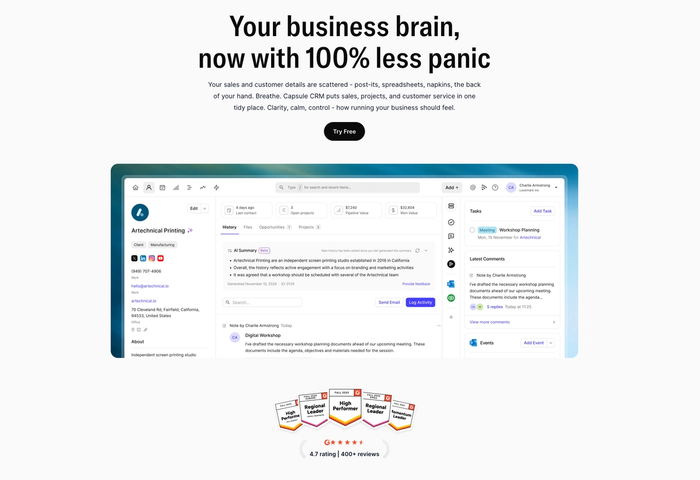
But what makes Capsule particularly well-suited for relationship intelligence is how it goes beyond simple storage into four key areas, each one mapping directly to the CAPSULE framework.
Context capture (supports: Capture + Profile)
Custom fields and tags let you record the kind of detail that generic CRMs ignore — how you first met a contact, what their priorities are this quarter, which of your colleagues has the strongest connection to them. This is the raw material that relationship intelligence runs on. With zero rich context, your CRM is just an expensive address book.
Capsule's AI Business & Contact Enrichment takes this even further.
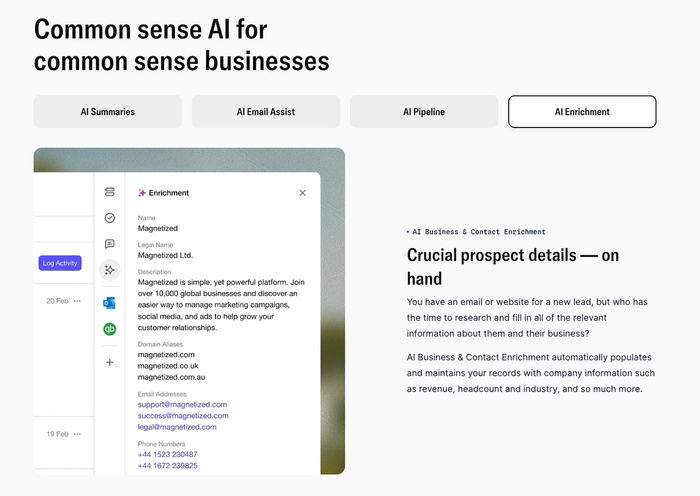
Add a new lead with just an email or website, and Capsule automatically fills in the rest: company description, revenue, headcount, industry, domain aliases, phone numbers. Your contact records stay rich and current, on the spot.
Automated follow-through (supports: Leverage + Evolve)
Tracks lay out a predefined sequence of tasks that activate one after another, removing the guesswork from what happens next.
- A new client signs on? Capsule automatically kicks off your onboarding process.
- A deal moves to negotiation? The right follow-up tasks appear for the right team member.
Workflow automation takes it further: when an opportunity hits a specific milestone, Capsule can reassign it, apply a Track, create a linked Project, or send a personalized email without anyone lifting a finger.
Intelligent outreach (supports: Analyze + Surface)
The AI Content Assistant helps you craft the right message when it matters most. Tell it what you need, choose the tone, and it drafts relevant copy in seconds.
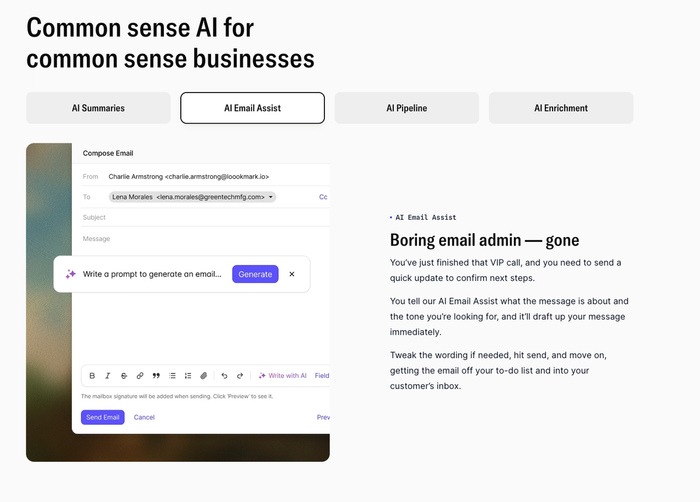
It's especially useful for those re-engagement moments when a contact has gone quiet and you need the right words to restart the conversation.
Relationship health monitoring (supports: Analyze + Evolve)
Capsule's reporting tracks activity across your entire team: who's doing what, which deals are progressing, which ones have stalled, which ones need a nudge. Stale opportunity alerts flag deals sitting idle too long, so you can intervene before a promising connection fades. You stop asking questions about relationship health and start measuring it.
The real power, though, is in how easily Capsule connects to the complementary tools below – creating a unified relationship intelligence system:
Transpond by Capsule: for turning relationship insights into targeted outreach
Transpond is Capsule's dedicated email marketing integration, and it's where relationship intelligence becomes action. Segment your Capsule contacts based on engagement level, tags, or pipeline stage, then build email campaigns that speak directly to where each contact sits in the relationship. It turns your RI data into personalized communication at scale.
RI role: Powers the Leverage part of the framework, helping you act on insights in a timely manner.
Gmail / Outlook integration: for automatic interaction capture
This one is foundational. Capsule's native integrations with Gmail and Microsoft Outlook mean every email conversation is automatically tied to the relevant contact record. Your team's inbox becomes a direct feed into your relationship intelligence system.
RI role: Handles the Capture component, keeping all interactions on track.
Zapier: for connecting your wider tech stack
Not every tool in your business has a native Capsule integration, and that's where Zapier fills the gap. It connects Capsule to over 1,000 apps, letting you automate data flows between platforms, for example:
- A new lead from a webinar platform automatically creates a contact in Capsule.
- A support ticket closure triggers a follow-up task for the account manager.
These small automations compound into a much richer relationship picture.
RI role: Strengthens the Unify layer, breaking down silos between disconnected systems.
Zendesk / Help Scout: for support-side relationship context
Your support team talks to clients more often than your sales team does. Integrating Zendesk or Help Scout with Capsule ensures those conversations feed into the same relationship record. When an account manager opens a contact profile, they see the full picture, not just the sales interactions but the support history too.
RI role: Adds depth to the Profile and Analyze components, coming with a 360-degree relationship view.
Dripify: for LinkedIn relationship building
For B2B teams, LinkedIn is where many relationships start. Dripify automates LinkedIn outreach and syncs lead data directly into Capsule, so those early-stage connections are captured in your CRM from day one instead of living in a separate silo.
RI role: Extends Capture and Surface into your social selling efforts.
Turn your network into your biggest asset
Relationship intelligence isn't reserved for enterprise sales teams with six-figure software budgets. It's a mindset shift: from passively storing contacts to actively understanding and leveraging the connections your business already has. The CAPSULE framework gives you a clear path to get there, and you don't need a complicated tech stack to make it work.
Most businesses already have the raw data. It's sitting in email threads, calendar invites, and half-updated spreadsheets. So, the gap isn't information but having a system that turns that information into insight, and insight into action.
That's exactly what Capsule was designed to do.
Try Capsule CRM free for 14 days and see how much more your network can do for you.