
Most consultants are excellent at the work they do, and deeply uncomfortable with selling it.
The pipeline fills up during quiet periods, empties during delivery, and the cycle repeats – feast, famine, panic, repeat. The problem isn't a lack of expertise or even a lack of contacts! It's that marketing stops the moment a consulting project starts, and by the time the project ends, the visibility that generates new business has evaporated.
Today, we’ll cover eight strategies for consultants that actually work for solo practitioners and small consultancies.
Why consulting marketing is different from every other kind
Standard marketing advice doesn't translate well to the consulting world. Digital marketing strategies built for e-commerce, social media marketing playbooks designed for product businesses, lead generation funnels optimized for volume – and none of these map cleanly onto how consulting services are actually bought and sold.

Consulting is bought on trust, not impulse. The sales cycle is long, the work is often confidential, the best case studies can't be published, and the most powerful marketing channel – referrals – is one that most consultants leave almost entirely to chance. A consultant competing for high-value clients has to manage a network of relationships 24/7, and the ones who do it systematically win more consistently than the ones who do it well occasionally.
The other reality specific to small consultancies: time and budget are constrained. Marketing activities that require large ongoing investment (e.g., paid online advertising, large-scale content creation, expensive industry events) are difficult to justify when every pound spent on marketing is a pound not spent on delivery or taken home.
The strategies that work for small consulting firms tend to be low-cost, relationship-intensive, time-efficient, and sustainable across the inevitable peaks and troughs of project work.
A consulting marketing plan doesn't need to be complicated. It needs to be honest about the constraints (time, budget, confidentiality) and built around the marketing methods that actually convert in a high-trust, long-cycle business.
The visibility problem no one talks about
The most common problem in the consulting business is NOT a shortage of market potential or a failure to meet client expectations.
A consultant deep in a six-month project stops posting on LinkedIn, stops attending networking events, stops following up with contacts, and stops being visible to their existing network. By the time the project ends, the people who might have referred work have referred it to someone else, not because that someone else is better, but because they stayed visible, and the consultant didn't.
Visibility in consulting isn't about reach. It's about consistency. Showing up regularly in the professional lives of the people most likely to hire or refer you – with something worth reading, saying, or sharing – matters more than any single high-effort marketing push. The consultants who never seem to struggle for more clients aren't necessarily better at marketing; they've just never stopped doing it.
Eight strategies that actually work for small consultancies
1. Systematize your referrals instead of hoping for them
Referrals are the primary source of new clients for most consulting firms, and most consultants manage them entirely passively. They do good work, hope clients mention them, and occasionally get lucky.
But that's not a referral strategy. It's a referral lottery.
The consultants who generate referrals consistently do three things differently. They ask explicitly, at the right moment. They make it easy: a specific name, a specific context, a specific ask rather than a vague "let me know if you know anyone." And they follow up with the person who referred them, which reinforces the behaviour and makes a second referral more likely.
Timing matters significantly here. The right moment to ask isn't at the end of an engagement when the client is thinking about invoices and handover.
It's at the point of highest satisfaction, e.g.,:
- when a key deliverable lands well,
- when a problem gets solved,
- when the very first feedback round is successful,
- when the client expresses genuine appreciation.
The other referral source most consultants underuse is other consultants. People with complementary expertise and no conflicting services are often willing to refer work they can't take on, but only if the relationship has been maintained. Treating other consultants as part of your referral network is a consistent pattern among small consultancies that grow steadily.
Real example: Andrew Sobel, author of Clients for Life and one of the best-known voices on relationship-based consulting, built his entire practice on a disciplined referral and relationship system: tracking every key contact and treating past clients as the primary source of future work.
He attributes a huge portion of his consulting success specifically to staying in touch with former clients long after engagements ended, not starting the new business development process from scratch each time.
In Capsule, you can tag every past client and strong referral contact.
Set a recurring task to reach out every 90 days, and log every referral conversation in the contact's activity timeline. Referral management done systematically produces materially different results.
2. Stay in touch with past clients
Past clients are the highest-converting source of new consulting business, either directly through repeat engagements or indirectly through referrals. Most consultants let those relationships go cold within six months of a project ending.
The reason is that staying in touch with no specific reason feels awkward, like a sales call disguised as a catch-up.
Specific and useful looks like:
- sharing research directly relevant to a challenge the client mentioned during the engagement,
- flagging an industry trend or regulatory change that affects their sector before they've heard about it elsewhere,
- sending a short note about a result from the work you did together that's now visible in their data.
None of these require a long email or a formal meeting request. A two-line message with a relevant link is enough to stay top of mind without feeling like a solicitation.
The rule worth following: every contact with a past client should give them something before it asks for anything. Done consistently, it builds the relationship where the client thinks of you first when a new consulting project emerges – not because you've been following up relentlessly, but because you've been consistently useful.
Capsule's communication history means you never lose the context of what was discussed during a previous engagement.
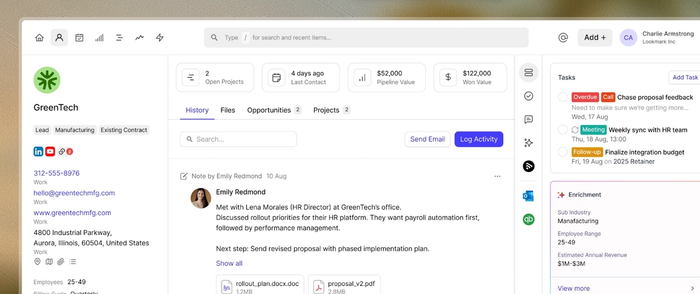
Before reaching out to a past client, reviewing their activity timeline takes thirty seconds and makes the contact feel personal.
3. Build a point of view, not just a presence
Thought leadership is one of the most overused terms in the consulting world and one of the most underexecuted strategies. Most consulting firms interpret it as "publish content regularly", which produces a stream of generic industry commentary that no one reads and no one remembers.
The thought leadership that actually builds a reputation is specific, takes a position, and is occasionally uncomfortable. It's the analysis that reaches a conclusion your target audience hasn't considered. The industry insight that reframes how a problem is understood rather than describing the problem everyone already knows exists. The goal is to become the go-to expert in your specific niche; the person whose name comes up when that problem is being discussed in a room you're not in.
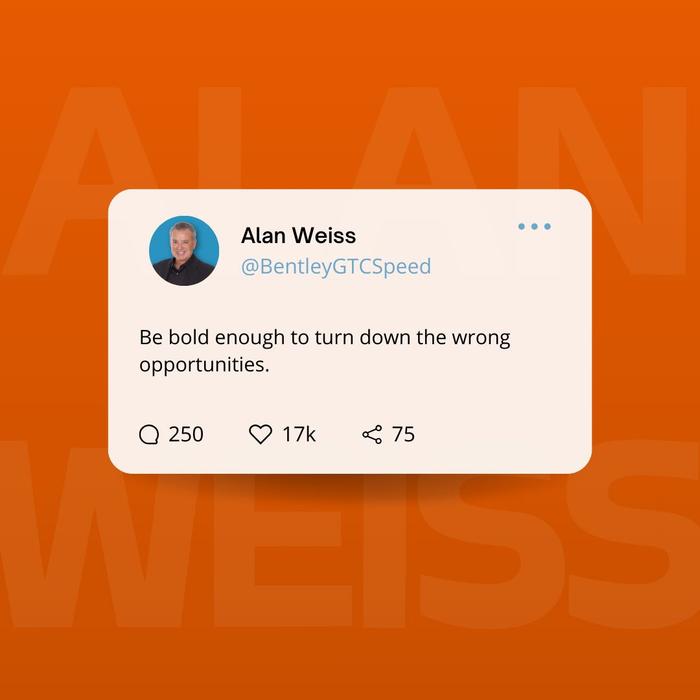
Real example: Alan Weiss built his entire consulting reputation on a contrary point of view.
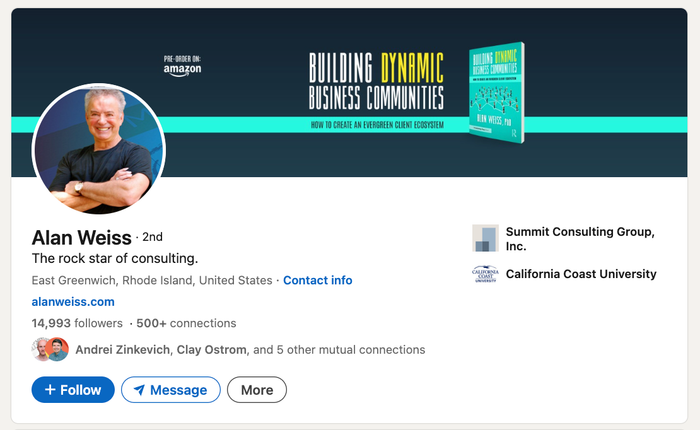
He made a habit of disagreeing publicly with received wisdom and defending the position: "hourly billing is unethical", "you can't talk to anyone who's not a buyer." His observation: the people who didn't like what he was saying weren't the clients he wanted anyway – but the ones who agreed formed a loyal following that sustained decades of work. His core advice to any consultant: take a position people can see, defend it publicly, and train your audience to treat you as a source of ideas.
This doesn't mean you have to publish a new blog post every second day. You can publish just one piece a month, but long enough to be substantive, specific enough to be memorable, and distributed directly to the people most likely to value it.
4. A targeted newsletter is more effective than broad digital marketing efforts
Most consultants who try content marketing spread their marketing efforts across multiple digital channels simultaneously and see limited return from any of them. However, a focused email newsletter sent to a carefully curated list of past clients, potential clients, and referral contacts can outperform a broad digital marketing strategy for consultants.
Email marketing works in consulting for a simple reason: it lands directly in the inbox of someone who has already opted in to hear from you, instead of competing for attention in a feed algorithm. A short, regular email that shares one useful insight, one piece of market research relevant to your niche, or one observation from recent client work (anonymized appropriately) is enough to reinforce your expertise.
Real example:
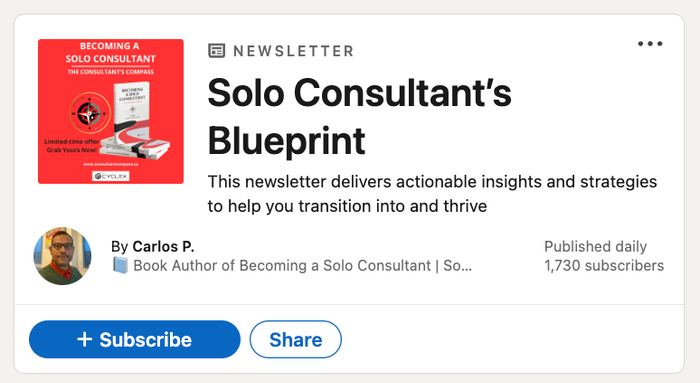
Many successful consultants rely on a simple newsletter. For instance, Solo Consultant’s Blueprint by Carlos P. and Indispensable Consulting by Richard Millington demonstrate how focused newsletters can build an audience of decision makers over time.
Carlos P.’s newsletter targets independent consultants who want practical advice on building a solo practice. Instead of marketing content, each issue delivers specific operational insights on pricing and client acquisition. Despite a modest subscriber base, the audience consists largely of consultants and professionals already interested in the topic, which makes the channel highly relevant for consulting-related offers.
Richard Millington uses a similar strategy. His newsletter focuses on building and scaling independent consulting businesses and has grown to more than 15,000 subscribers. Instead of publishing across many social platforms, he concentrates on delivering detailed insights directly to readers’ inboxes.
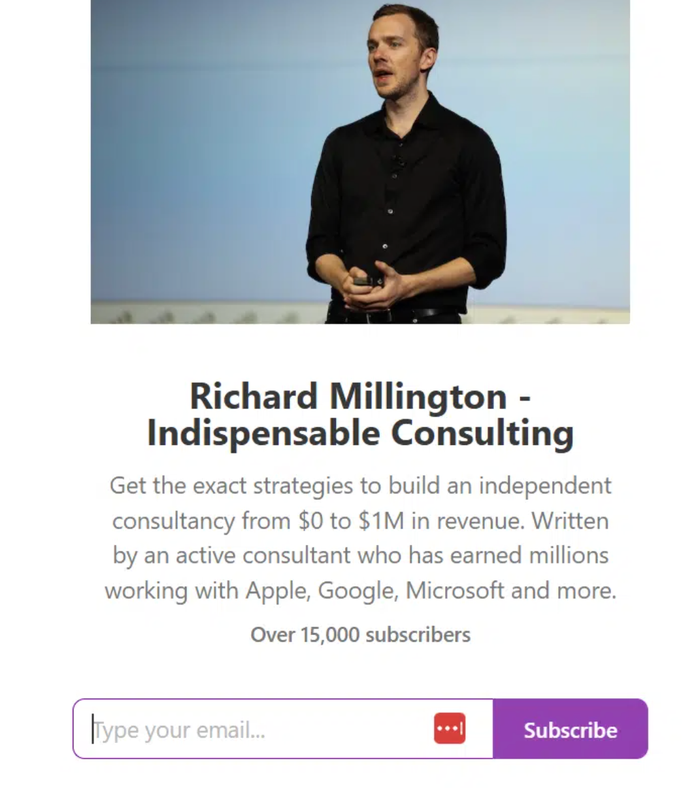
Both examples illustrate the same principle: a niche newsletter sent to a relevant audience can steadily build credibility, maintain visibility with potential clients, and position a consultant as a trusted source of expertise – often with far less effort than managing multiple marketing channels simultaneously.
The goal isn't traffic or open rates. It's to ensure that the 200 people most likely to hire or refer you hear from you regularly enough that your name comes to mind when a problem in your area emerges.
5. Position yourself in a specific niche
The most common positioning mistake in the consulting world is trying to appeal to everyone. Generalist management consultants compete against thousands of other generalist consultants, and the buyer has no compelling reason to choose one over another beyond price and availability.
A specific niche does three things simultaneously:
- it makes marketing easier because you know exactly who your potential clients are and where to find them,
- it justifies premium pricing because specialist expertise commands more than generalist advice,
- it generates better referrals because people can describe precisely what you do and who you do it for.
Your unique value proposition becomes clear — not just to you, but to everyone who might refer or hire you.
Real example:
One strong example of a consultant who niched down is Laura Meyer, who specializes in helping non-profit programs grow their operations and impact.
Meyer shifted from general consulting to targeting non-profits specifically, addressing their unique funding challenges and mission-driven goals.
By niching, she became the obvious choice for non-profit leaders, justifying higher fees through proven expertise and simplifying her marketing to targeted networks like grant organizations and charity events. Referrals surged as clients could easily describe her precise value: "growth for non-profits."
6. Use LinkedIn as a relationship tool
LinkedIn is where most of your prospective clients spend part of their professional lives, which makes it useful. It's also where most consultants broadcast into a void and wonder why nothing converts.
The social media marketing approach that generates consulting business isn't posting content and waiting for inbound enquiries.
It's using the platform to deepen specific relationships:
- commenting thoughtfully on the posts of people in your target market,
- congratulating contacts on role changes or company milestones,
- sharing industry trends directly with individuals,
- sending relevant direct messages.
A social media presence built on 200 genuine relationships with people in your target market is worth more than 5,000 connections who have no idea what you actually do. The practical approach: identify 50 to 100 people who are either ideal clients, strong referral sources, or influential voices in your specific niche.
Follow them, engage with their content consistently, and treat LinkedIn as the warm-up to a real conversation rather than the conversation itself. Most consulting relationships that start on LinkedIn convert because of something that happened off it.
Real example:
A prime example of using LinkedIn as a relationship tool comes from Jay Acunzo, a former corporate video producer turned positioning consultant for B2B brands.
Jay focused on a tight list of 50-75 marketing leaders in his niche (positioning for SaaS and tech firms), regularly commenting with specific insights on their posts along with publishing his own posts.
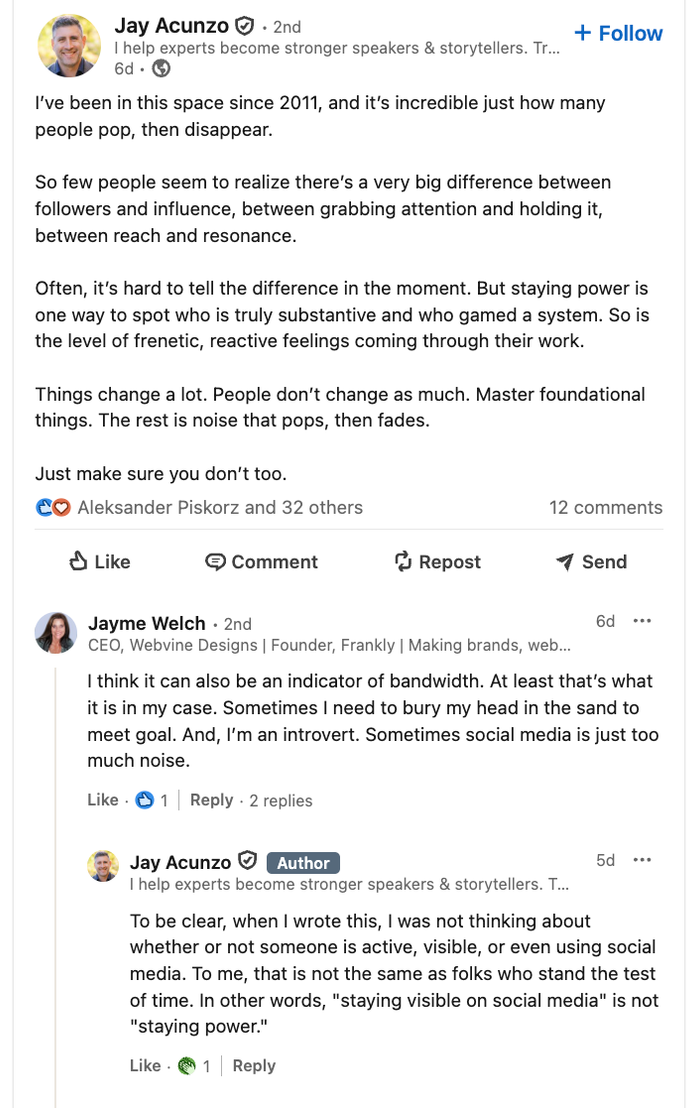
He shared personalized industry reports or podcast clips via direct messages tied to their recent announcements (e.g., "Congrats on the VP role – here's how this tactic helped a similar SaaS CMO"), warming up conversations. This built familiarity over months, turning casual interactions into off-platform calls.
7. Speak and write where your clients already pay attention
The fastest way to build credibility in a specific niche is to appear in the publications, events, and communities your ideal clients already trust. A guest article in a trade publication your target audience reads regularly does more for new business than ten articles on your own professional website. A talk at an industry event your prospective clients attend does more than a polished homepage.
This requires proper research. Find out which industry events your best past clients attend, which publications they read, and which podcasts come up in their professional conversations. Use data analytics if you have it, even simple web analytics on your own content, to understand what topics your audience actually engages with versus what you assumed they'd care about. Then target those channels specifically.
Local networking events are also underrated by consultants who assume that business development happens at national conferences.
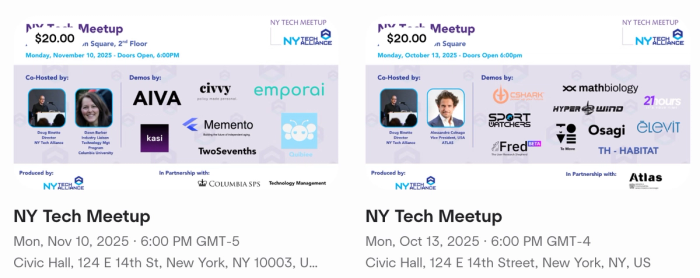
For consultants serving small businesses or regional markets in particular, a consistent presence at local professional gatherings often converts faster than any digital marketing approach, precisely because the relationships are easier to deepen.
Real example:
Brené Brown exemplifies a speaking-driven consulting scale-up.
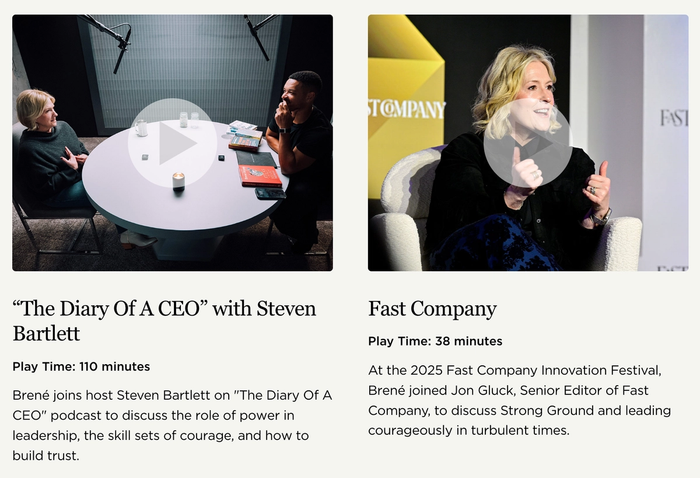
Though known for books, Brown's early career as a leadership consultant exploded via TED Talks and keynotes on vulnerability and courage, attracting corporate clients like Pixar and the NFL. She funnels speaking leads into high-ticket programs via backstage meetups and follow-up emails, turning emotional resonance into multimillion-dollar engagements with Fortune 500 firms. Her strategy – researching audience pain points for tailored stories – shows how speaking in trusted venues outperforms solo webinars.
8. Don't dismiss direct mail; it works because everyone else has abandoned it
Most marketing advice for consulting firms focuses entirely on digital channels: search engines, LinkedIn, content marketing. That's exactly why a well-executed piece of direct mail to a carefully selected list of prospective clients can cut through in a way that an email almost never does.
This isn't a high-volume strategy, though.
Sending 20 personalized, physically mailed letters to senior decision-makers in your target market (each referencing something specific to their business, their industry, or a challenge you know they're facing) is not mass marketing. It's targeted outreach that signals care, effort, and seriousness in a way that an email sequence cannot replicate. For consultants targeting a small number of high-value organisations, the cost-per-contact is modest relative to the potential value of a single engagement.
The same logic applies to automation tools used thoughtfully. Setting up automated follow-ups with warm contacts doesn't feel automated if the content is relevant and the timing makes sense. The automation handles the consistency; the quality of the message handles the relationship.
Real example:
In 2022, Alex Hormozi executed a targeted email sequence to land high-ticket consulting clients for his Gym Launch and Acquisition.com ventures. He focused on gym owners and agency owners (his ideal prospects) using a low-volume, hyper-personalized approach with automation for follow-ups.
Embed: https://www.youtube.com/watch?v=7C11f5mfNNQ
This campaign reportedly generated over $1M in deals from just a few dozen sends, proving the "don't dismiss direct channels" point by blending email with physical gifts (e.g., custom books) for standout impact.
The CRM as a marketing tool
A CRM is the infrastructure behind relationship-based marketing. It’s the system that makes it possible to manage a network of past clients, referral contacts, and potential clients.
Capsule's contact management gives every relationship a full activity timeline — past conversations, proposals sent, referrals made, context from previous consulting projects — so every outreach feels informed.
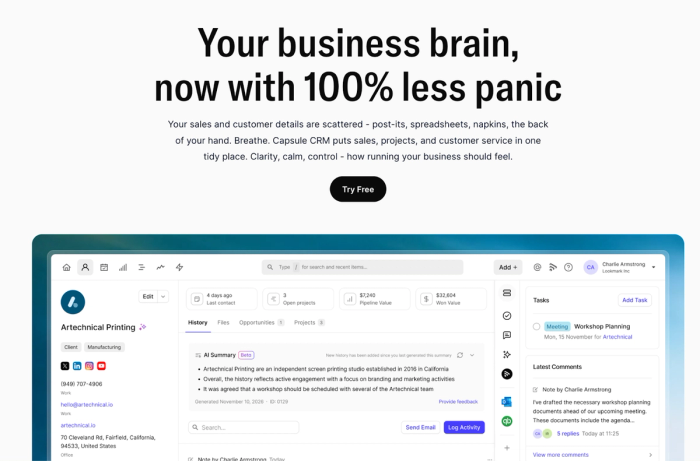
The visual sales pipeline tracks where each new business conversation stands. Automated follow-ups via Tracks mean the 90-day check-in with a past client happens because the system surfaced it, not because you happened to remember. AI Summaries pull together the full context of any relationship before a call — so the conversation that re-engages a past client feels personal.
For a consulting business where the difference between a thriving pipeline and an empty one is often just consistent relationship maintenance, that operational support is worth considerably more than its subscription cost.
Capsule's free plan covers up to two users and 250 contacts — enough for a solo consultant to get started without any upfront commitment.