Acquiring a new customer costs five times more than retaining an existing one.
Most businesses know this, but still carry on prioritizing new customer acquisition anyway – chasing first contact conversions, optimising for most sales in the shortest window, and treating retention as someone else's problem.
Long-term customer relationships don't usually fail dramatically.
They erode quietly, through accumulated small failures of attention, follow-through, and communication, until the customer leaves for a competitor without ever having made a complaint. This piece is about building the systems and habits that prevent that erosion – and why, in a market where larger companies can outspend almost any small business on acquisition, loyalty is the most defensible competitive advantage available.
Why long-term relationships are harder to build now
The same technological advances that make it easier to reach customers have made it easier for customers to leave.

Switching costs have dropped across most industries. A dissatisfied customer can find an alternative, read reviews, sign up for a trial, and cancel their existing subscription in the time it used to take to get a sales rep on the phone. Customer loyalty is no longer a default; it's something that has to be actively earned – repeatedly – across every interaction a customer has with your business.
At the same time, the economics of long-term partnerships have never been more compelling.
Customer lifetime value (the total revenue a business can expect from a single customer relationship over its duration) increases substantially when customers stay. Loyal customers spend more, refer more often, require less support, and are usually more forgiving of occasional mistakes than new customers are. The most loyal customers are also the most valuable source of honest feedback a business has, precisely because they care enough about the relationship to tell you what isn't working.
The businesses that build strong customer relationships consistently don't treat retention as a cost centre or a customer service team's problem. They treat it as a company culture question: one that shapes how every function, from sales teams to product to support, thinks about the clients it serves.
What actually erodes long-term relationships
Most businesses lose customers to quiet operational failures.
The customer who switches to a competitor rarely does so because of a single catastrophic experience.
They do so because of accumulated friction:
- the customer inquiry that took three days to get a response,
- the renewal that arrived with a price increase and no explanation,
- the account manager who changed without anyone introducing the new one,
- the personalized experience that stopped feeling personal the moment the contract was signed.
These are the pain points that customer feedback surveys rarely capture, because customers don't always articulate them; they just leave.
Understanding customer behavior means looking beyond what customers say to what they do: declining engagement, reduced purchase frequency, shorter response times to your outreach, and a drop in referrals. These are the leading indicators that a relationship is cooling, and they appear well before a cancellation.
The businesses actively working to prevent churn monitor these signals rather than waiting for the customer to raise a concern. By the time a customer raises a concern, the decision to leave is often already made.
Five things businesses that retain customers do differently

#1 They make customers feel valued between transactions
The most common mistake in customer relationship management is treating the relationship as a series of one-off transactions linked only by invoicing. A customer who hears from you only when a renewal is due, or when you have something to sell, doesn't feel like a partner. They feel like a revenue line.
The businesses that build lasting relationships treat the space between transactions as relationship time.
Regular check-ins that have nothing to do with selling. Personalized emails that reference something specific to the customer's business, not a template with a first name inserted. The occasional handwritten note that acknowledges a milestone – a company anniversary, a product launch, a piece of coverage. None of these require significant investment.
Customers feel valued when they can tell the difference between a message written for them and a message written for a segment. That distinction is getting harder to fake as customers become more sophisticated, and personalized experiences are now the baseline expectation.
#2 They close the loop on customer feedback
Most businesses collect customer feedback. Far fewer act on it visibly, and fewer still tell the customer what changed as a result of what they said. That last step is where most of the relationship value lies.
When a customer shares feedback – about a pain point in your service, a gap in your product, a frustration with your process – and subsequently sees that feedback reflected in a change, the relationship deepens in a way that no loyalty programme can replicate.
They become invested. They feel heard. They tell other people.
The inverse is equally powerful and far more common: a customer shares feedback, receives a polite acknowledgement, and sees nothing change. They stop sharing feedback. They start looking elsewhere. Closing the loop – even to say "we heard this, but here's why we're not changing it right now" – is more effective at building customer retention than a discount or a free month of service.
#3 They use data-driven insights to anticipate needs
The difference between a transactional business and one that builds lasting customer relationships is often the difference between reactive and proactive communication.
Reactive businesses respond to customer inquiries when they arrive.
Proactive businesses use data to anticipate what customers need before they have to ask.
All it requires is paying attention to what existing customers actually do:
- which features they use most,
- where they get stuck,
- how their usage patterns change over time,
- what questions they ask repeatedly.
A business that notices a customer hasn't used a key feature and reaches out with a helpful tip (before the customer decides that feature isn't working) is doing something most competitors aren't.
Key performance indicators for long-term relationship health go beyond revenue and renewal rate. Engagement frequency, response time to customer outreach, referral rate, and net promoter score all provide valuable insights into how the relationship is actually performing, not just how it looks on a sales dashboard.
#4 They don't treat customer service as a separate function
In businesses where long-term relationships are strong, building customer relationships isn't the sole responsibility of a dedicated team. Everyone who touches the customer – sales, account management, product, leadership – understands that every interaction either builds or erodes the relationship. A sales team that overpromises to close a deal and leaves customer service teams to manage the fallout is front-loading satisfaction at the cost of retention.
The businesses with the most loyal customers are typically the ones where the internal definition of success includes customer outcomes, not just customer acquisition.
That means:
- sales teams are incentivized on retention as well as new business,
- customer inquiries get escalated with context rather than transferred with none,
- overall customer experience is treated as a design problem that the whole company owns.
#5 They get the small things right, consistently
Building trust with customers is rarely the result of a single impressive gesture. It's the result of doing ordinary things well, repeatedly, over time:
- responding promptly,
- delivering what was promised,
- communicating proactively when something changes
- being honest when something goes wrong.
These aren't differentiating actions in isolation; every business claims to do them. The differentiation comes from consistency.
Customers happy with your service after one interaction are satisfied. Customers who have experienced consistent reliability across dozens of interactions over the years are loyal, and loyalty is what drives the relationship where a client calls you before they call a competitor.
BASIC: the framework that most businesses underestimate

B: Be proactive with communication
Effective communication is the most cited factor in customer satisfaction, and the most frequently broken promise in practice. The instinct is to reach out when there's good news, and go quiet when there isn't. That's exactly backwards. Customers don't need everything to go perfectly; they need to know what's happening. A client who receives a timely update (even one that says "we're still working on it, here's why") stays satisfied far longer than one left in silence while everything runs smoothly behind the scenes.
What this looks like in practice:
- A supplier emails a customer before they notice a shipment delay, with a revised timeline and a reason
- A SaaS company sends a status update within 30 minutes of an outage, not after it's resolved
- A freelancer flags a scope issue early rather than delivering late with a surprise explanation
The goal is to make sure the customer is never in a position where they have to chase you for information.
A: Accessible, frictionless experience
If a customer has to work to do basic things (find their invoice, update their billing details, get an answer to a standard question), that friction accumulates. It rarely shows up in exit surveys as the stated reason they left. But it's present in the background of every interaction that makes the relationship feel harder than it needed to be.
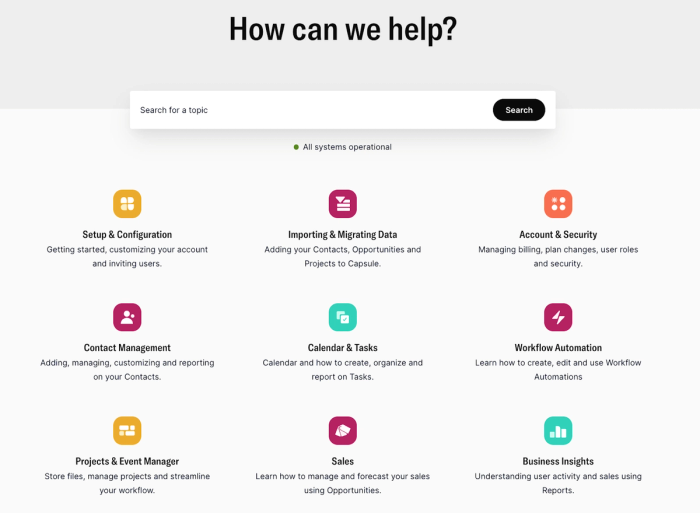
A user-friendly experience across every touchpoint, digital and human, is one of the most cost-effective investments a business can make and one of the most frequently deprioritized in favour of acquisition spend.
What this looks like in practice:
- a self-service portal where customers can download past invoices, update contact details, or raise a support ticket,
- a help centre with genuinely useful answers to the ten questions your team gets asked every week,
- a checkout or onboarding flow that someone can complete without needing to read the instructions.
Keeping customers coming back is almost always cheaper than replacing them. Friction is one of the quietest drivers of churn.
S: Solve problems promptly and transparently
Speed matters when something goes wrong, but transparency matters more. A customer who receives a fast but vague response is only slightly better off than one who receives nothing. What actually retains customers through difficult moments is being kept in the loop: what happened, why it happened, what you're doing about it, and when they can expect a resolution. That combination – honesty, accountability, and a clear timeline – is what turns a service failure into a demonstration of reliability.
What this looks like in practice:
- A product arrives damaged → the replacement is dispatched the same day, with a tracking link and a brief apology that acknowledges the inconvenience specifically.
- A software bug causes data export to fail → the team posts a plain-language explanation of the cause and a fix timeline before customers start submitting tickets.
- A missed deadline is flagged to the client proactively, with a revised plan attached.
The customers most likely to stay after a problem are often those who felt genuinely looked after during it.
I: Individualize every interaction
Personalisation doesn't require advanced technology: it simply means remembering what a customer told you and acting on it. Most businesses capture this data; they just don't use it as relationship intelligence.
What this looks like in practice:
- A B2B account manager opens a quarterly call by referencing the specific challenge the client mentioned three months ago, and reports back on it.
- An e-commerce brand surfaces relevant products based on past purchases.
- A professional services firm sends a relevant article or case study to a client because it genuinely applies to something they're working on, not as part of a mass newsletter.
Customers notice when you remember them. They notice even more when you don't.
C: Command your social presence
Social media is where customer relationships often play out publicly, and where businesses quietly lose them. A customer who complains on a public channel and receives a prompt, human response is more likely to stay than one who submits a support ticket and waits for a week. But the stakes go beyond the individual customer. Every other person who sees that complaint is also watching how you respond.
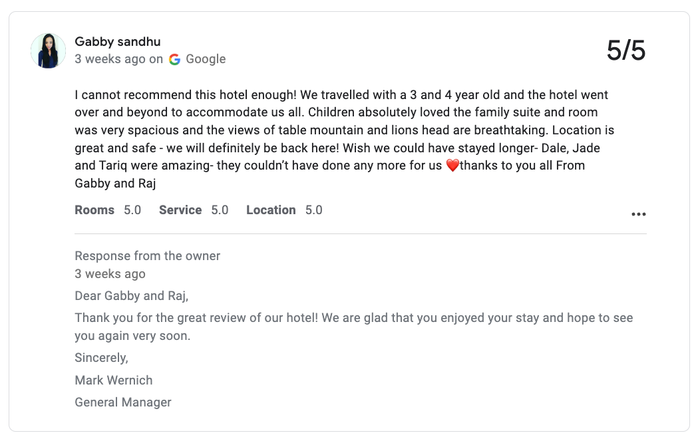
A professional, empathetic, timely reply signals to everyone observing exactly how they'd be treated.
What this looks like in practice:
- A restaurant responds to a critical Google review within 24 hours, acknowledging the experience, apologizing specifically, and offering a path forward.
- A brand monitors LinkedIn/X mentions and responds to product complaints in the thread instead of redirecting everything to a support email.
- A small business owner personally replies to a frustrated comment on an Instagram post, resolving it publicly so other followers see the outcome
Getting this right isn't just good service – it's a visible, compounding competitive advantage. Every well-handled complaint is a public demonstration of how your business operates.
What AI can and can't do for long-term relationships
AI is genuinely useful for customer relationship management. It can show data-driven insights about customer behavior, flag accounts that show early signs of disengagement, draft personalized emails at scale, and automate the routine touchpoints that would otherwise get missed when a team is busy. Used well, it makes a small business capable of maintaining a level of personalized communication that would usually require a much larger team.
What it can't do is replace the judgment that makes communication feel human.
An automated check-in that arrives at exactly the wrong moment, or a personalized email that gets the tone slightly off, doesn't strengthen the relationship: it weakens it, because it signals that the personalization is mechanical The most effective use of automation tools in customer relationship management is to handle the consistency and timing so that the human interactions, when they happen, can focus entirely on the relationship.
The businesses building the strongest long-term customer relationships use AI to make space for the interactions that genuinely can't be automated: the conversations where someone listened carefully, responded thoughtfully, and made the customer feel like they were talking to a person who understood their business.
How Capsule supports long-term customer relationships
Good intentions don't maintain customer relationships at scale. Systems do; and the right CRM is the difference between a relationship strategy that works when the team is small and one that holds up as the business grows.
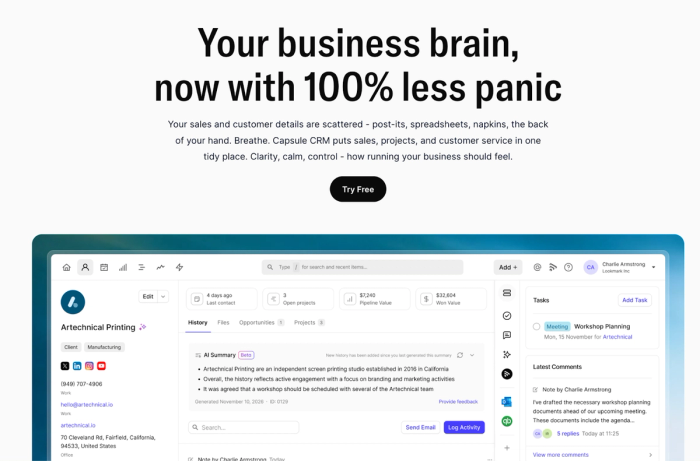
Capsule's contact management gives every customer relationship a full activity timeline – every conversation, purchase, complaint, referral, and piece of feedback logged in one place, visible to everyone who touches the account. A client who spoke to someone six months ago doesn't have to repeat themselves. Context survives staff changes. The relationship belongs to the business, not to whoever last worked the account.
The sales pipeline tracks renewal and upsell conversations so they happen proactively, before a customer starts wondering whether anyone remembers they exist. Tracks automate the regular check-ins, follow-ups, and milestone touchpoints that are the first things to slip when the team is stretched.
AI Summaries ensure that every interaction is informed by the full history of the relationship, so even a first contact from a new team member feels like a continuation.
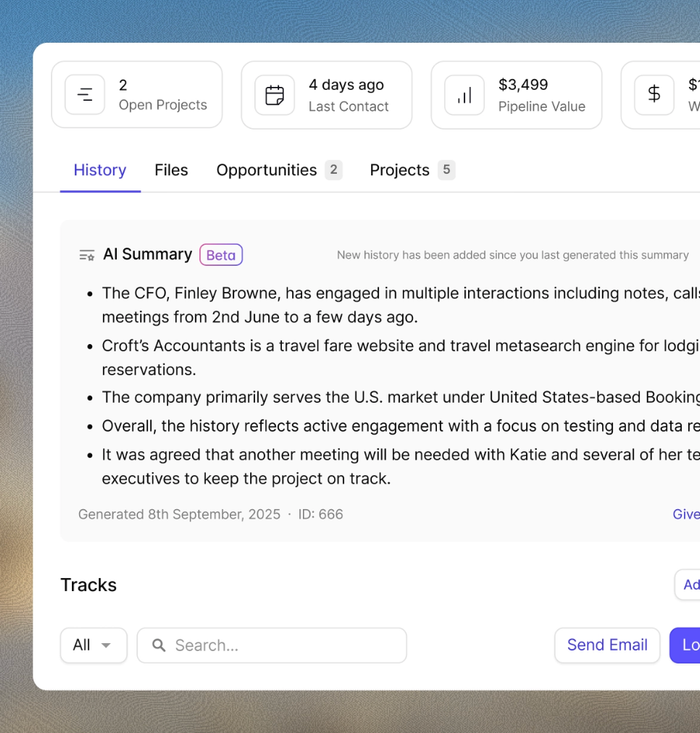
And because Capsule never uses customer data to train its AI models, the sensitive context your clients share with you stays exactly where it belongs.
Customer retention should be a habit, and Capsule is the system that makes the habit stick.
Build relationships that outlast the competition
The businesses with the strongest long-term customer relationships aren't necessarily the ones with the best product or the lowest price. They're the ones that made every client feel like the relationship mattered: not just at the point of sale, but in every interaction that followed.
That requires intention, consistency, and the operational infrastructure to deliver both at scale. Better customer relationships start with a decision to treat retention as a strategic priority and the right tools to back that decision up.