![Business statistics every business owner should know [2026]](data:image/jpeg;base64,/9j/2wBDAAYEBQYFBAYGBQYHBwYIChAKCgkJChQODwwQFxQYGBcUFhYaHSUfGhsjHBYWICwgIyYnKSopGR8tMC0oMCUoKSj/2wBDAQcHBwoIChMKChMoGhYaKCgoKCgoKCgoKCgoKCgoKCgoKCgoKCgoKCgoKCgoKCgoKCgoKCgoKCgoKCgoKCgoKCj/wAARCAALABQDASIAAhEBAxEB/8QAGgAAAQUBAAAAAAAAAAAAAAAAAAECAwQFBv/EACEQAAEEAgICAwAAAAAAAAAAAAEAAgMRBCEFBhJRE3GR/8QAFgEBAQEAAAAAAAAAAAAAAAAAAgAG/8QAGhEAAgIDAAAAAAAAAAAAAAAAAAECAxESgf/aAAwDAQACEQMRAD8A6rqEGJk83DFnlvxOuvI6JSdtxsXB5qeHELTEN202AfSzmNFXW1Xftxvf2gaR1Ny2zwjMrR7/ABCeAEKGf//Z)
![Business statistics every business owner should know [2026]](https://cdn.sanity.io/images/poftgen7/production/5619faf6a65f53406d3e554c11c9e894402d4397-5760x3240.jpg?w=800&h=450&q=70&fit=max&auto=format)
Running a business in 2026 means operating in an environment shaped by rapid technological change and uneven economic readiness across regions.
From AI adoption and skills shortages to regulatory pressure and workforce wellbeing, today’s business decisions are increasingly driven by data.
The statistics below bring together the most important global trends every business owner should understand to plan and adapt with confidence.
Global business readiness & regulatory environment
- Economies facing the most critical need to create more and better jobs, largely young‑workforce economies, tend to be the least business-ready. Many young‑workforce countries have average B‑READY pillar scores below the global median. (World Bank Group)
- Across all income and regional groups, there is a gap between the Regulatory Framework (laws and rules) and Public Services (supporting services). This gap is 2.8 times wider in young‑workforce economies than in mature ones. (World Bank Group)
- A mismatch exists between the strength of regulations (Regulatory Framework) and how easy they are to comply with (Operational Efficiency). Low‑growth economies, especially those with young workforces, exhibit the largest efficiency gaps. (World Bank Group)
- Skills gaps are the single biggest barrier to business transformation, cited by 63% of employers, followed by organisational culture and resistance to change (46%) and outdated or inflexible regulatory frameworks (39%). (World Economic Forum)
- Only 29% of employers expect talent availability to improve by 2030, while 42% expect it to worsen, creating a net-negative talent outlook for most economies. (World Economic Forum)
- The most effective public-policy levers to improve talent availability are funding for reskilling and upskilling (55%) and the direct provision of such programmes (52%). (World Economic Forum)
Takeaway: Business readiness is more than good laws, as governments need efficient public services and streamlined processes. Business owners operating in low‑growth or young‑workforce economies should anticipate greater administrative burdens and advocate for digitalised services.
Macrotrends shaping labour markets & job outlook
- Technological change, economic uncertainty, the green transition, demographic shifts, and geoeconomic fragmentation are simultaneously reshaping labour demand and supply. (World Economic Forum)
- Structural job churn between 2025 and 2030 will affect roughly 22% of all current formal jobs globally. (World Economic Forum)
- Frontline roles, care-economy jobs, and education roles are expected to see the largest absolute job growth, alongside continued expansion in technology- and sustainability-related occupations. (World Economic Forum)
Takeaway: Multiple macrotrends, from technology to climate and demographics, are simultaneously reshaping the job market. Understanding these drivers helps business owners identify growth sectors and anticipate labour‑market churn.
Adoption & impact of AI in business
- 88% of organisations use AI in at least one business function, yet nearly two‑thirds remain in experimentation or pilot phases, and only about one‑third have begun scaling AI across the enterprise. Larger companies (>US$5 billion revenue) are nearly twice as likely to scale AI as smaller firms. (McKinsey)
- 62% of respondents’ organisations are experimenting with AI agents, and 23% are scaling an agentic AI system. However, in any given function, fewer than 10% of organisations have scaled agents. (McKinsey)
- 64% of respondents say AI enables innovation, while only 39% report any EBIT impact (most under 5%). 80% set efficiency as an objective of AI initiatives, but high‑performing companies also target growth and innovation. (McKinsey)
- Cost benefits are most often reported in software engineering, manufacturing, and IT. Revenue gains are concentrated in marketing, sales, strategy, and product development. (McKinsey)
- Opinions differ on AI’s effect on headcount. 32% expect AI to reduce workforce size, 43% foresee no change, and 13% anticipate increases. (McKinsey)
- Broadening digital access (60%), AI and information-processing technologies (86%), and robotics and automation (58%) are identified as the most transformative trends shaping business models through 2030. (World Economic Forum)
- AI and information-processing technologies are expected to create roughly 11 million jobs while displacing 9 million, producing both growth and disruption rather than net job loss. (World Economic Forum)
- Robotics and autonomous systems are projected to be the largest net job displacer, with a net decline of around 5 million jobs. (World Economic Forum)
- Employers expect the share of tasks performed mainly by humans to fall from 47% today to about 33% by 2030, with the remainder split between automation and human-machine collaboration. (World Economic Forum)
- Half of employers plan to reorient their business strategy around AI, two-thirds plan to hire talent with AI skills, and 40% anticipate workforce reductions where automation is feasible. (World Economic Forum)
Takeaway: AI adoption is now routine, but scale and enterprise‑level value remain elusive. Business owners should move beyond isolated pilots. They can do it by redesigning workflows, investing in capabilities, and linking AI projects to growth and innovation to realise real productivity gains.
GenAI adoption & ROI patterns
- Despite US$30-40 billion invested in generative AI, 95% of organizations derive zero return. Only 5% of integrated pilots deliver measurable value. (MLQ.AI)
- More than 80% of organizations have explored or piloted tools like ChatGPT and Copilot, and nearly 40% report deployment, yet these tools primarily improve individual productivity rather than P&L performance. These results resemble a normal distribution of outcomes. Most businesses cluster around experimentation, with only a few achieving transformational change. (MLQ.AI)
- Using a composite AI Market Disruption Index built from numerical measures such as market‑share volatility, revenue growth of AI‑native firms, emergence of new business models, shifts in user behaviour, and executive turnover, the report finds that only the Technology and Media sectors show significant structural disruption. Seven of nine sectors, including healthcare, finance, and manufacturing, remain largely unchanged. This analysis demonstrates how statistical techniques applied across various domains can identify industries where AI is truly transformative. (MLQ.AI)
- Only about 5% of custom enterprise AI tools reach production. (MLQ.AI)
- Generic LLM chatbots have high pilot‑to‑implementation rates (~83%), but their perceived value splits sharply because they seldom integrate into critical workflows. Larger enterprises lead in pilot count but take nine months or more to scale, whereas mid‑market firms move from pilot to full implementation in about 90 days. This underscores the importance of aligning the dependent variable (return on investment) with the right business applications and workflow fit. (MLQ.AI)
- Executives allocate roughly 50% of AI budgets to sales and marketing functions because these outcomes are easy to measure (e.g., demo volume, response times), while back‑office functions (finance, procurement, and operations that often yield higher ROI) receive far less investment. (MLQ.AI)
- Organizations that cross the GenAI divide report back‑office wins such as eliminating BPO contracts (saving US$2-10 million annually) and cutting agency spend by 30%, while front‑office gains include a 40% faster lead‑qualification process and a 10% improvement in customer retention. Focusing on hidden value within different customer segments helps businesses achieve their desired outcomes. (MLQ.AI)
- Knowledge-work roles such as Graphic Designers and Legal Secretaries appear among the fastest-declining jobs for the first time, signalling GenAI’s growing capacity to perform cognitive and creative tasks. (World Economic Forum)
- AI-driven disruption increasingly affects white-collar and clerical roles rather than only manual or routine physical work. (World Economic Forum)
Takeaway: Generative AI is heavily adopted but rarely delivers enterprise‑wide transformation. Business owners should analyse sector‑specific market trends and ROI metrics, prioritise high‑value workflows and back‑office automation, and make sure that adoption decisions are driven by value rather than visibility.
Barriers & learning gap in GenAI
- A core barrier is the learning gap. Most AI systems lack memory and adaptability. They cannot retain feedback or context across sessions, forcing users to re‑enter information repeatedly. (MLQ.AI)
- Users praise ChatGPT’s flexibility for simple tasks but abandon enterprise tools for mission‑critical work when they don’t learn from interactions. (MLQ.AI)
- For high‑stakes tasks, 90% of users prefer humans to AI, while 70% favour AI for drafting emails and 65% for basic analysis. They overwhelmingly rely on people for complex projects because current tools lack memory and contextual understanding. This underscores that business strategic decisions still depend on human judgment and careful experimental design when testing hypotheses about AI capabilities. (MLQ.AI)
- Surveys identify unwillingness to adopt new tools, concerns over model output quality, poor user experience, lack of executive sponsorship and difficult change management as the leading obstacles to scaling AI. Even avid ChatGPT users distrust internal AI tools that don’t match their expectations, highlighting the need for systems that adapt and learn. (MLQ.AI)
- A significant portion of workers already use personal AI tools. Over 90% of employees surveyed regularly use LLMs for their jobs, even though only 40% of companies have official subscriptions. This shadow usage shows that workers will adopt tools that solve business problems and match their customer preferences, even without formal approval. (MLQ.AI)
- Skills gaps (63%), organisational culture and resistance to change (46%), and regulatory rigidity (39%) are the dominant constraints preventing effective technology adoption. (World Economic Forum)
- By 2030, 59 out of every 100 workers will require training, yet 11 are expected to receive neither reskilling nor upskilling, increasing structural labour-market risk. (World Economic Forum)
- The declining share of human-only tasks reflects automation pressure rather than effective human-machine augmentation, underscoring the need for better learning-enabled systems. (World Economic Forum)
Takeaway: AI adoption stalls when tools lack memory and adaptability. Business owners should prioritise systems that learn and customise to specific workflows, recognise the enduring importance of human expertise for complex tasks, and address user experience and change‑management challenges to turn pilots into productivity gains.
Strategies & success factors for crossing the GenAI divide
- Organisations that succeed in scaling AI typically buy adaptive solutions rather than build their own. Strategic partnerships with external vendors achieve deployment about 67% of the time, whereas internally built tools succeed only about 33%. These findings suggest that the null hypothesis, that internal development is always better, should be rejected. (MLQ.AI)
- Executives prioritise vendors they trust, who understand their workflows, minimise disruption to existing systems, respect data boundaries, improve over time, and flex when processes change. They treat vendors like business service providers, not software sellers, and measure success on operational impact rather than model benchmarks. Peer recommendations and existing relationships outweigh marketing claims. (MLQ.AI)
- High‑performing startups customise AI solutions for specific workflows (e.g., voice AI for call summarisation, document automation for contracts, code generation for repetitive engineering tasks) and deliver immediate, visible value before expanding. They leverage referral networks and channel partners to build trust. (MLQ.AI)
- Top‑quartile startups reach US$1.2 million in annualised revenue within 6-12 months of launch. Like selecting the right variables in linear regression, focusing on narrow, high‑value use cases yields stronger correlations with ROI. (MLQ.AI)
- There is a rise of agentic systems that embed persistent memory and iterative learning by design. Frameworks such as NANDA, Model Context Protocol (MCP), and Agent‑to‑Agent (A2A) enable interoperability and coordination across agents. Early experiments show customer‑service agents handling complete inquiries, financial processing agents approving routine transactions, and sales pipeline agents tracking engagement across channels. An agentic web is emerging in which autonomous agents can discover vendors, negotiate terms, and coordinate workflows across various domains without human mediation. (MLQ.AI)
- Significant value resides in back‑office functions (operations, finance, and procurement), where AI eliminates outsourcing and reduces external agency spend. Reported gains include US$2-10 million annual savings in customer service and document processing, and 30% reductions in creative‑agency costs, achieved without major workforce reductions. These examples show how AI is a valuable tool for enabling businesses to optimise processes and improve business applications beyond front‑office metrics. (MLQ.AI)
- Employers plan to respond primarily through workforce upskilling (85%), accelerated automation (73%), and hiring new skill profiles (70%).
- Over half of organisations expect to transition workers from declining to growing roles, while 41% anticipate reducing roles that become obsolete. (World Economic Forum)
- Supporting employee health and wellbeing (64%) and offering effective reskilling and upskilling pathways (63%) are now the most important practices for improving talent availability. (World Economic Forum)
- Employers view public funding and delivery of reskilling programmes as the most impactful external enablers of successful workforce transformation. (World Economic Forum)
Takeaway: To cross the GenAI divide, business owners should partner with trusted vendors, choose adaptive systems that learn and fit their workflows, start with narrow, high‑value use cases, leverage referral networks, and focus on back‑office automation where the greatest returns often lie. By following these strategies, organisations can achieve desired outcomes and prepare for the agentic future of AI.
GenAI job impact & skills
- Generative AI is not driving broad layoffs. Job reductions of 5-20 % are concentrated in outsourced functions such as customer support, administrative processing, and standardized development tasks. (MLQ.AI)
- In sectors showing little AI disruption (healthcare, energy, and advanced industries), executives expect no reduction in hiring, whereas more than 80% of executives in technology and media anticipate reduced hiring within 24 months. (MLQ.AI)
- Organisations increasingly prioritise candidates with AI tool proficiency. Some executives note that recent graduates often outperform experienced professionals due to their familiarity with AI. This shift underscores the need for employees to learn foundational concepts and become comfortable with AI‑enabled workflows. (MLQ.AI)
- MIT’s Project Iceberg estimates that 2.27% of current U.S. labour value could be automated now, but latent automation exposure could affect US$2.3 trillion in labour value across 39 million positions as AI systems gain memory and autonomy. Job transformation will occur gradually. Until systems achieve contextual adaptation, impacts will manifest through external cost optimisation rather than internal restructuring. (MLQ.AI)
- As agentic AI emerges, organisations need to design training programmes that balance AI proficiency with human‑centric skills. Understanding population means, variation, and other statistical concepts helps leaders evaluate AI performance, while training in AI literacy, problem‑solving, and judgment lets workers collaborate effectively with AI. Like experimental design that controls for two variables to determine causality, companies should test AI deployment strategies to achieve desired outcomes while supporting employee growth. (MLQ.AI)
- Structural labour-market transformation is projected to create 170 million jobs and displace 92 million by 2030, resulting in net global job growth of 78 million roles. (World Economic Forum)
- The fastest-growing roles include Big Data Specialists, AI and Machine Learning Specialists, FinTech Engineers, Software Developers, and green-transition engineers. (World Economic Forum)
- The fastest-declining roles are clerical and administrative positions such as cashiers, data-entry clerks, bank tellers, and executive secretaries. (World Economic Forum)
- Analytical thinking, resilience, flexibility and leadership remain the most valuable core skills, while AI and big data, cybersecurity and technology literacy are the fastest-growing technical skills. (World Economic Forum)
- Manual dexterity, endurance and precision are among the skills with the steepest projected declines in demand. (World Economic Forum)
Takeaway: Generative AI is reshaping workforce dynamics slowly and selectively. Business owners should plan for targeted job displacement in outsourced functions, prioritise AI literacy in hiring and training, and design development programmes that balance human skills with new technologies.
Skills disruption & reskilling priorities
- 39% of workers’ core skills are expected to change by 2030. Lower‑ and upper‑middle‑income economies anticipate greater disruption than high‑income ones. (World Economic Forum)
- AI and big data, networks and cybersecurity and technology literacy top the list, while creative thinking, resilience, flexibility, agility and lifelong learning also rise in importance. (World Economic Forum)
- Manual dexterity, endurance and precision are predicted to decrease in demand, with 24% of employers forecasting lower importance. (World Economic Forum)
- 59% of the workforce will need training by 2030; 29% can be upskilled in their current roles, 19% can be redeployed and 11% may not receive training. (World Economic Forum)
- 86% of companies expect to fund their own programmes, while enhanced productivity (77%), improved competitiveness (70%) and talent retention (65%) are the most expected outcomes. (World Economic Forum)
Takeaway: Significant skill disruption is on the horizon. Businesses must fund comprehensive reskilling initiatives that focus on fast‑growing technical and human‑centric skills to maintain competitiveness.
AI’s career impact & needed skills
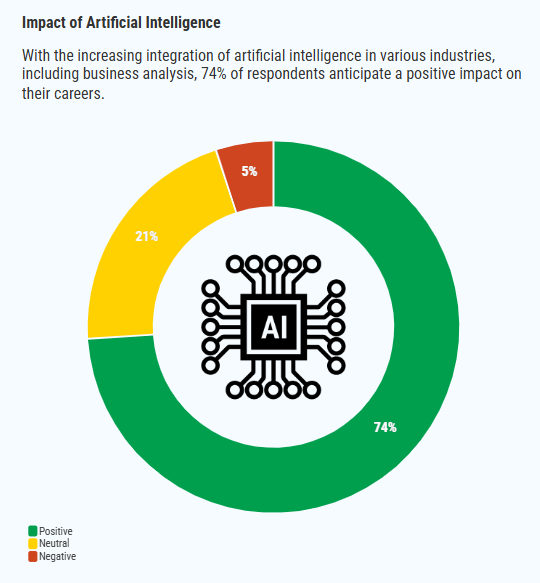
- 74% of business analysts anticipate a positive impact from AI on their careers, 21% are neutral and only 5% expect a negative effect. (IIBA)
- Respondents rank problem‑solving (17%), communication (16%), creative thinking (13%), data literacy (13%), organisational knowledge and specialised skills (12% each) as the most important data‑analytics capabilities. Facilitation (9%) and leadership/influencing (8%) follow. (IIBA)
- Workers can expect 39% of their core skills to change by 2030, a slower pace than during the pandemic but still structurally significant. (World Economic Forum)
- Nearly 60% of the global workforce will need some form of reskilling or upskilling, with most employers planning to fund training internally. (World Economic Forum)
- Employers increasingly prioritise candidates who combine AI literacy with human skills such as problem-solving, adaptability, and judgment. (World Economic Forum)
Takeaway: Professionals are largely optimistic about AI, but human strengths (communication, critical thinking and problem‑solving) remain paramount. Business owners should complement AI investments with training that develops these soft skills.
Global employee engagement & wellbeing
- Gallup’s survey shows global employee engagement fell from 23% to 21% in 2024 - the second two‑point drop in twelve years and equal to the fall during COVID‑19 lockdowns. (Gallup)
- Manager engagement declined from 30% to 27%, while individual contributor engagement held steady at 18%. Young managers (under 35) saw engagement fall by five points and female managers by seven. (Gallup)
- Global life evaluation, workers saying they are “thriving”, fell to 33%. Managers experienced the steepest decline, with older managers down five points and female managers down seven. (Gallup)
- Half of engaged employees are thriving in life, compared with one‑third of unengaged employees, and engaged employees are less likely to report daily stress. (Gallup)
- Supporting employee health and wellbeing has become the single most important strategy for attracting and retaining talent, cited by 64% of employers. (World Economic Forum)
- Diversity, equity and inclusion initiatives are now in place at 83% of companies, with nearly half of employers viewing diverse talent pools as critical to future workforce availability. (World Economic Forum)
Takeaway: Engagement and well-being are dropping worldwide, particularly among managers. Business owners must prioritise engagement and mental health to maintain productivity and resilience.
Workforce strategies & talent management
- Skills gaps, organisational culture and outdated regulations are the top obstacles (63%, 46%, and 39% of employers). (World Economic Forum)
- Only 29% of employers expect talent availability to improve; 42% expect deterioration. (World Economic Forum)
- will prioritise upskilling (85%), automation (73%), hiring new skills (70%), human‑machine augmentation (63%), transitioning staff internally (51%) and reducing staff with obsolete skills (41%). (World Economic Forum)
- Supporting employee well‑being (64%), effective reskilling/upskilling (63%), improving promotion processes (62%), offering higher wages (50%), and tapping into diverse talent pools (47%) are the top business practices to increase talent availability. (World Economic Forum)
- Diversity, equity and inclusion programmes are now in place at 83% of surveyed companies, and tapping into diverse talent pools has quadrupled in importance since 2023. (World Economic Forum)
Takeaway: To navigate talent shortages and technological change, businesses must pair upskilling and automation with strategies that prioritise well‑being, diversity, and policy advocacy.
Management training & productivity gains
- Seventy percent of team engagement is attributable to the manager, yet less than half (44%) of managers worldwide report receiving any management training. (Gallup)
- Gallup estimates that a fully engaged world workforce would add US$9.6 trillion in productivity, roughly 9% of global GDP. (Gallup)
- Providing basic manager training can cut extreme disengagement in half. (Gallup)
- Participants in a manager‑development programme experienced up to 22% higher engagement, and their teams saw engagement gains of up to 18%. (Gallup)
- Manager performance metrics improved by 20-28 %. Ongoing development and encouragement boosted manager's thriving from 28% to 50%. (Gallup)
Takeaway: Managers are the linchpin of engagement and productivity. Investing in robust management training and providing ongoing support yields substantial returns in engagement, well‑being, and economic output - an essential strategy for business owners facing talent and productivity challenges.
Conclusion
Taken together, these business statistics tell a clear story: growth in 2026 depends less on size and more on adaptability.
Companies that invest in skills, redesign workflows around technology, and stay close to their people are better positioned to navigate disruption and capture opportunity.
To turn insight into action, business owners need systems that keep relationships and processes organised as complexity grows.
Capsule CRM helps growing businesses stay in control without adding friction – all so you can focus on decisions that matter.
Try Capsule CRM free for 14 days and see how simple scaling can be.