
Most small businesses don’t struggle with marketing ideas – they struggle with executing them consistently. The strategy is roughly there: post more consistently, follow up with warm leads, send the email campaign, and optimize the website for search.
What's missing is the time, headcount, and budget to actually do it. AI marketing for small businesses solves the execution gap – and for a small business owner trying to create content, manage campaigns, and answer customer questions while running everything else, that's a very valuable fix.
The gap AI actually closes
A dedicated marketing team handles content creation, campaign management, audience segmentation, search engine optimization, social media management, and performance analysis simultaneously.
Small business AI can now make that same output achievable, but only if the owner is willing to trust AI as a genuine execution partner rather than an occasional shortcut. The tools have become accessible enough for small businesses to streamline processes that previously required a business plan with a marketing budget and months of setup time.
In 2025, 74% of marketers said AI is either critically important or very important for their marketing success – an eight-point jump from 2024. The reason isn't that AI has suddenly become more capable, but it offers tools that have become easy and practical enough for small businesses to use.
The specific gap AI closes is the volume of repetitive tasks that marketing requires, which accumulates faster than one person can keep up with. AI handles the volume. The human handles the judgment.
Four marketing jobs AI makes manageable
Content creation and copy
Generative AI has changed the economics of content marketing for small businesses. Writing relevant content for a blog, drafting posts across multiple platforms, producing sales emails, and creating copy for ad campaigns used to require either significant time or a copywriter. Neither is straightforward for a small business owner managing everything else at the same time.
AI tools can produce first drafts across all of those formats from a brief, reducing the time from idea to published content by 50% or more, according to early adopters. Creating new content no longer competes with running the business – the blank page problem, which is where most small business content strategies stall, disappears. The output requires human editing and brand voice oversight to avoid AI-generated content that reads generically, but the hardest part of content creation is no longer the bottleneck.
For search engine optimization specifically, AI tools surface powerful insights from search engines and online sources that small businesses previously needed an agency to deliver. A coherent, research-backed SEO content strategy is now achievable, even with no specialist resources or expensive agency support.
Audience segmentation and targeting
Effective marketing depends on knowing who you're talking to. The challenge for small businesses is that customer data exists across email, CRM, purchase history, and website behaviour, but pulling it together and drawing useful conclusions from it manually isn't practical.
Machine learning tools can analyze customer interactions across those sources. Which potential customers are most likely to buy? Which leads have gone cold, which segments respond to which messages? AI shows all these patterns – and more – from data the business already has, turning it into informed decisions about where to focus marketing efforts on the web and beyond.
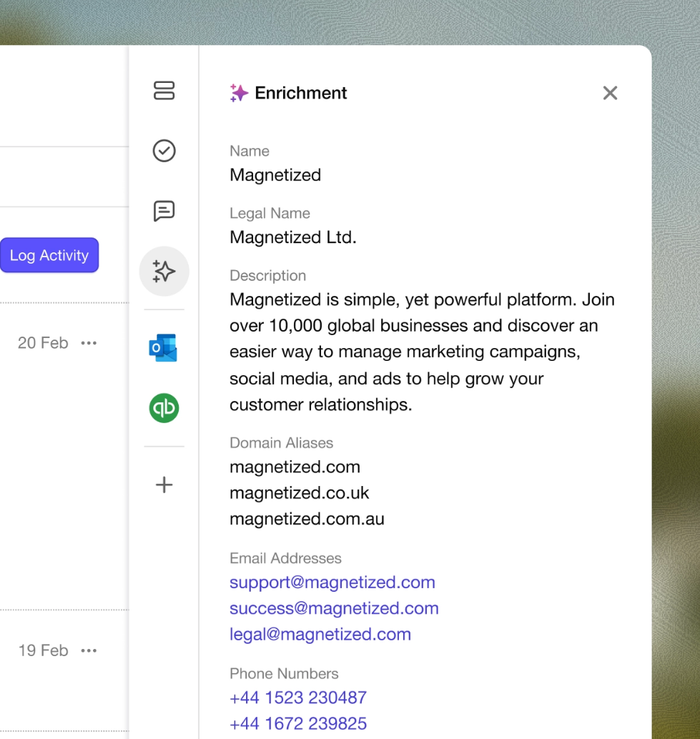
This is where a CRM with strong contact management becomes the foundation of AI marketing. Capsule's contact management and activity timeline give small business owners a clean customer data layer. AI Contact Enrichment keeps that data accurate automatically, which means the segmentation AI tools generate is based on reliable information.
Campaign execution and email marketing
Running marketing campaigns across multiple platforms with zero automation is a full-time job. Scheduling social media posts, managing email sequences, adjusting ad campaigns based on performance data – each of these is manageable in isolation. Together, they represent more repetitive tasks than a small business owner typically has time for, which is where AI use pays for itself most visibly.
AI tools automate tasks across all of those channels, running campaigns in the background and adjusting based on performance. For email marketing specifically, send-time optimisation has become one of the more impactful applications of AI technology at a small business scale.
Campaign performance and data analysis
Understanding what's working in marketing requires data analysis, which typically means either hiring someone who understands the numbers or spending hours in dashboards that don't always show the right conclusions clearly.
AI tools that sit across campaign performance data can gain insights and flag what's working. Which ad campaigns are generating the best cost per acquisition, which marketing content is driving the most engagement, and where the sales funnel is leaking: these are the insights that change decision-making, and AI analyzes them from the data that's already being generated.
Six real examples of AI marketing in action
Nutella: generative AI for creative at scale
Nutella used AI to generate 7 million unique label designs for a limited edition packaging campaign. Every single jar sold out. The creative output would have been impossible to produce manually at that scale, and the campaign demonstrated that AI-generated content, applied to the right brief, can produce results that neither budget nor headcount alone could replicate.
JPMorgan Chase: AI-written ad copy outperforming human copy
JPMorgan Chase tested AI-generated ad copy against human-written alternatives across digital campaigns. The best-performing AI-written version lifted click-through rates by as much as 450% compared to human-written ads. The implication for small businesses isn't that AI always writes better – it's that generating and testing multiple variants quickly. This makes AI practical and produces better outcomes than committing to a single piece of copy based on instinct.
Kalshi: high-impact video ad on a minimal budget
Finance platform Kalshi needed to make an impact during the 2025 NBA Finals without an enterprise production budget. Using AI tools to generate visuals, storyboards, and character animations, the team produced a witty, visually engaging video ad in under 72 hours for just $2,000. The spot aired during the NBA Finals broadcast and generated widespread attention – a result that would have cost multiples of that figure using traditional production.
Invalid YouTube URL: https://x.com/Kalshi/status/1932891608388681791
Yum Brands: AI for email retention
Yum Brands, which operates Taco Bell, KFC, and Pizza Hut, integrated reinforcement learning into its email marketing workflows. By continuously adjusting email timing and offering content based on customer behaviour patterns, Yum improved repeat purchase rates and reduced churn. The principle – using AI to make email marketing adaptive rather than static – applies directly to small businesses running email sequences to existing customers.
Sephora: personalized recommendations driving conversion
Sephora's AI-powered Virtual Artist tool, paired with targeted in-app campaigns, increased engagement by 28% in Southeast Asia, with the tool having been used over 200 million times globally. For small e-commerce businesses, the takeaway is that personalized recommendations driven by customer data consistently outperform generic product promotion, and AI tools that deliver those recommendations are no longer exclusively available to large companies.
What AI marketing still needs from YOU
AI handles volume and pattern recognition exceptionally well. It does not handle brand voice, strategic judgment, or the human oversight that keeps marketing credible.
Brand voice in particular is an area where small businesses need to stay hands-on. The default output of most generative AI tools produces marketing content that is competent but generic. Training AI tools on existing content, editing outputs for tone, and maintaining a clear brief about what the brand sounds like are ongoing human responsibilities that can't be delegated to the AI model itself.
Strategy is the other area where human intelligence remains essential. AI can tell you which content is performing best. It can't tell you whether you're marketing to the right audience in the first place. And while it can optimize ad campaigns for clicks, it can't determine whether clicks are the right metric for your business goals. Informed decisions about what to market, to whom, and with what message still require a person who understands the business. AI executes that strategy more efficiently than any small team could manually, but it doesn't replace the thinking behind it.
Human oversight also matters for customer engagement, which requires context and empathy. AI chatbots and automated responses handle straightforward customer questions well. Complex or sensitive interactions still need a person, and the businesses that get this wrong tend to find out through the customer feedback that follows.
Over to you
The small businesses getting the most from AI marketing aren't running complex systems. They're using a small number of well-chosen tools that connect to each other and cover the core execution jobs.
A practical starting point:
- a CRM with strong contact data as the foundation (Capsule covers this, with AI features that keep data accurate and surface the right context for outreach),
- a generative AI tool for content creation and copy (ChatGPT or Claude for drafting, editing, and brainstorming ideas),
- an email marketing platform with automation (like Transpond),
- and an SEO tool for search engine optimization and content strategy.
Premium plans and custom pricing exist across all of these categories for businesses that need more depth, but most small businesses find that the base tiers of a small number of focused tools outperform a wider stack that's only partially used.
The marketing technology utilisation rate across businesses currently sits at around 33% – meaning most are paying for tools they barely use. The goal is to benefit from the right ones, and measure what's working without adding more overhead than they remove.