Small businesses have always had to do more with less. What's changed is that artificial intelligence AI is starting to level the playing field – allowing small businesses to compete at the same level as larger corporations that have had these advantages for years.
The data is beginning to reflect that, and for small business owners who embrace AI now, the competitive advantage is real and measurable.
What the numbers actually show
The case for AI for small business growth isn't theoretical anymore. AI-powered tools that improve efficiency report meaningful reductions in time spent on repetitive work, with some studies showing operational efficiency gains of 40% or more.
The competitive picture is equally stark. Larger corporations have been using AI systems and cloud-based services at scale for years, building advantages in data-driven decision making, resource allocation, and customer experience that smaller organizations struggled to match. That playing field is leveling. AI-powered tools that once required technical expertise and enterprise budgets are now accessible to businesses of all sizes – and the small enterprises adopting them earliest are pulling ahead of those that aren't.
Perhaps most importantly for growth, businesses using AI to analyze data and improve customer experience report improved customer satisfaction scores and measurably better retention. AI that helps small businesses enhance efficiency across customer-facing processes is one of the clearest paths to inclusive growth: expanding what's possible with lower operational costs.
Where AI creates growth leverage for small businesses
Not all AI adoption delivers the same return. The small businesses getting the most from AI technology tend to focus on four specific areas where AI creates real leverage rather than just automating what was already working.
Winning MORE of the right customers
Many small businesses spend time and energy on leads that were never going to convert. AI-powered tools that analyze large volumes of data on customer behaviour and deal history can help small business owners make more informed decisions about which opportunities are worth pursuing and which aren't.
AI powered marketing tools take this further, helping small businesses reach the right audience with marketing campaigns that are more targeted and more personalized than most small teams could produce manually. Generative AI makes it faster to create marketing materials, AI-generated content reduces the time from brief to published, and AI-powered chatbots can handle simple transactions at any hour.
Keeping the customers you have
Growth isn't only about acquisition. For most small businesses, the fastest growth lever is retention, and retention is driven by relationship quality. AI that helps small business owners stay on top of customer communications, remember context before every conversation, and follow-up consistently, is directly contributing to increased customer satisfaction that keeps customers coming back.
This is where AI can help small businesses punch significantly above their weight.
A local restaurant using AI to personalize communications with regulars, a consultant using AI to prepare for every client call with full context, and a retailer using AI to anticipate customer questions before they become complaints. These are growth advantages that don't require a marketing department or a customer service team to deliver.
Moving faster than the competition
Speed is one of the clearest advantages AI offers small businesses. Larger companies move slowly. Complex systems, approval chains, and legacy processes mean that even when they have greater resources, they can't always act on information quickly. Small enterprises can. For a small business with no dedicated computer system or IT resource, cloud-based AI tools that require no technical setup make this kind of efficiency accessible immediately.
AI-powered tools that show real-time insights, automate follow-ups, and streamline operations allow small business owners to respond to opportunities and customer needs faster than competitors who are still doing these things manually. In markets where the first credible response wins the deal, that speed is a big competitive advantage.
Making better decisions with the data you already have
Most small businesses are sitting on more useful data than they realize: customer interactions, sales patterns, pipeline history, and email engagement. The challenge is that processing large volumes of data manually is impractical for a small team. AI systems that can perform data analysis and provide actionable patterns make informed decisions accessible to small business owners.
Better decisions about resource allocation, inventory management, timing of marketing campaigns, and where to reduce operational costs – these compound over time into a meaningfully better-run business.
What AI-driven growth looks like in practice
Understanding the growth levers is one thing. Seeing what they look like in an actual business process is another.
Capsule CRM's AI features illustrate how AI-powered tools can work across multiple growth levers simultaneously without requiring complex systems, technical expertise, or significant investment to implement. That combination of capability and simplicity is what makes AI adoption extremely practical.
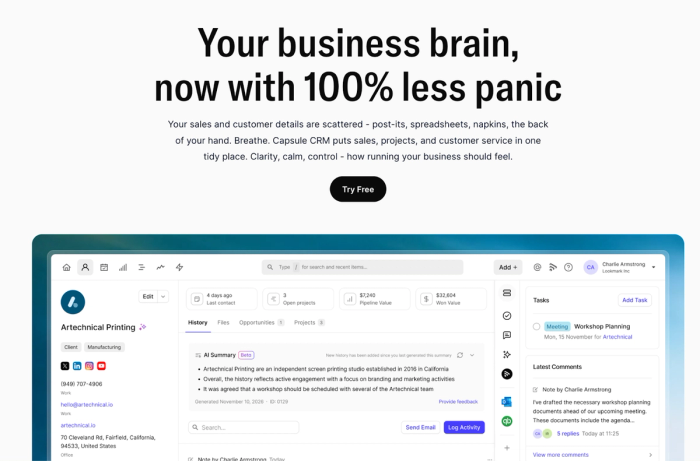
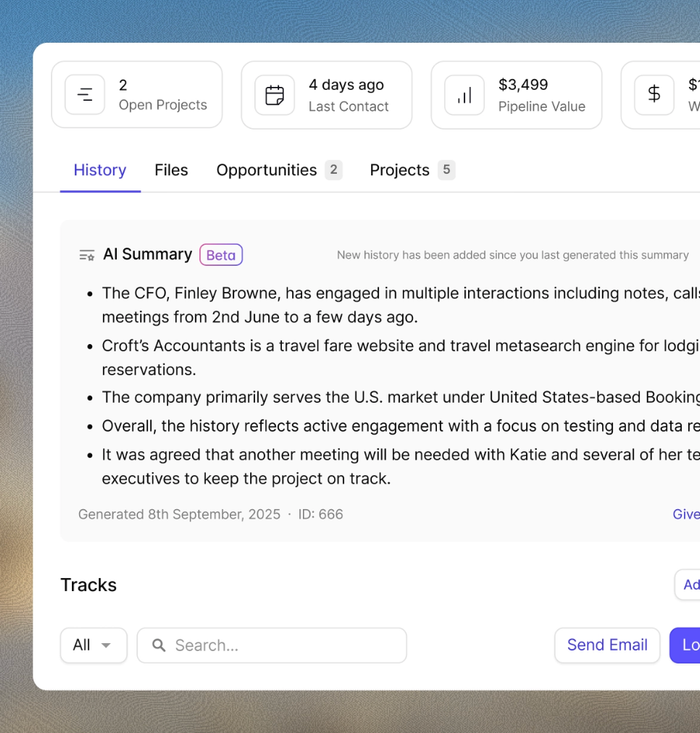
AI Summaries pull together the last customer interactions before any call or meeting, giving small business owners the full context of a customer relationship in seconds. Such preparation directly improves the quality of customer communications, which drives increased customer satisfaction.
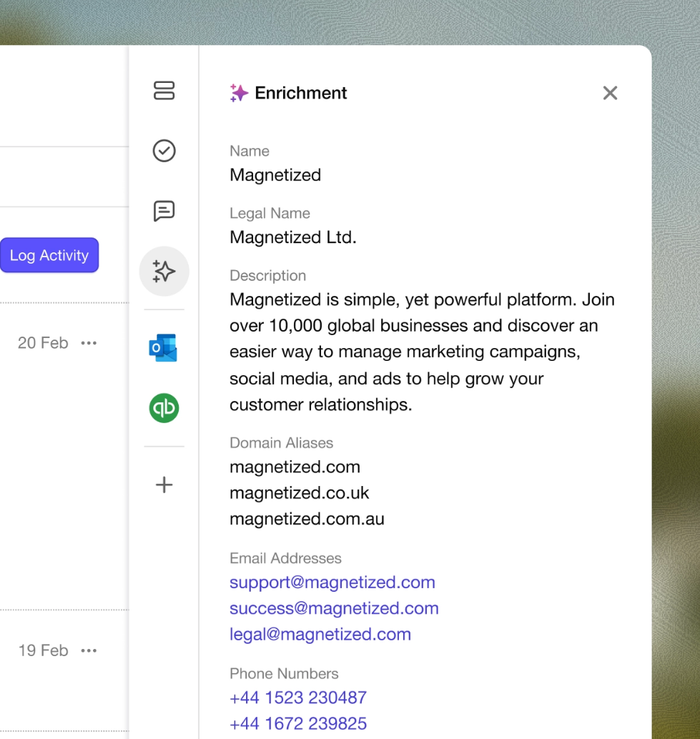
AI Contact Enrichment automatically populates contact records with company data, eliminating the manual data entry that keeps decisions less informed than they should be. When the contact database is accurate and current, every other decision that depends on customer data gets better.
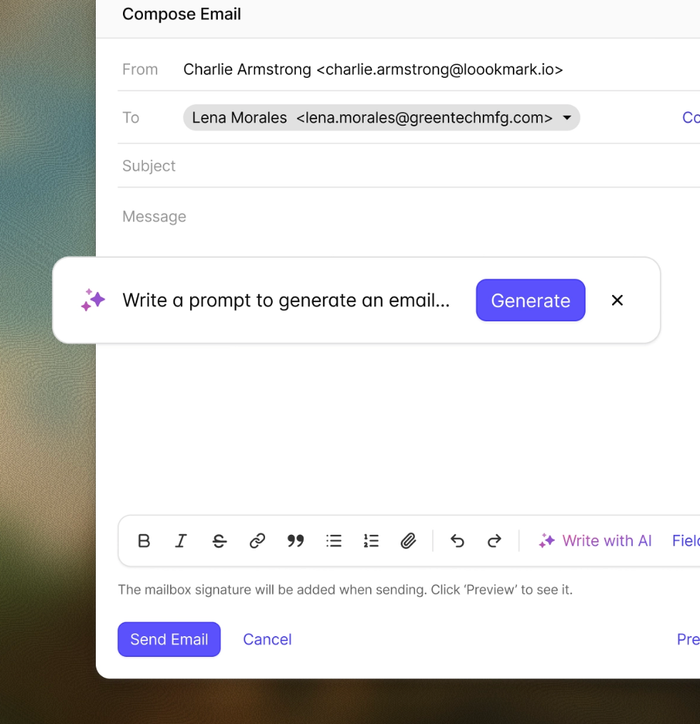
AI Email Assist drafts follow-up emails using the context already in the CRM, reducing the time between a conversation and a response. It can often close deals that a slower follow-up would lose.
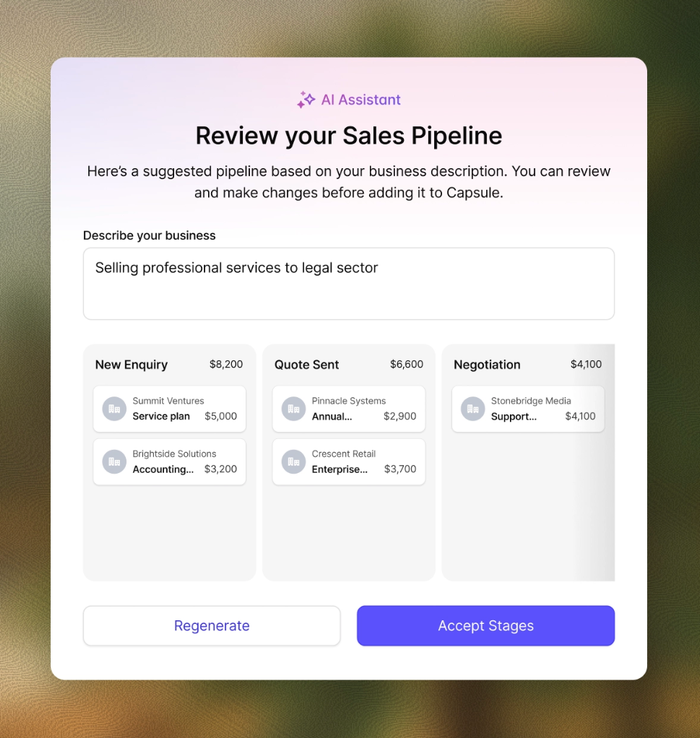
AI Pipeline Generator builds a customized sales pipeline based on business type and needs, removing the setup barrier that prevents many small businesses from getting a structured sales process operational at all.
Capsule does not use customer data to train its AI models, which is an important consideration for small business owners with ethical concerns around data privacy and sensitive data. AI features are available on the Growth plan and above, with a 14-day free trial on all paid plans.
What AI can't do for your growth?
Honest framing matters here. AI for small business growth is a genuine opportunity, but it isn't a substitute for the things that actually build a business.
Human intelligence remains the core of small business success. AI can help a small business owner prepare better for a client conversation – it can't have it for them. AI-powered marketing can reach the right audience more efficiently since it simply can't replace a product or service that people actually want. Virtual assistants can handle questions, but they can't build the kind of trust that turns a customer into a long-term advocate.
There are also legitimate considerations around data privacy, ethical concerns about AI-generated content, and the question of how smaller organizations handle sensitive data responsibly when adopting new AI tools. These aren't reasons to avoid AI, though. There are reasons to choose AI solutions thoughtfully and understand what any given tool does with your data before committing.
AI works best as a multiplier of human effort, not a replacement for it. Small businesses that treat it that way get the most from it.
Over to you
The small business owners who get meaningful growth from AI are the ones who identify one or two specific problems and find AI tools that solve them directly.
Map the parts of your day that are high-frequency, low-complexity, and currently manual.
These are the tasks where AI creates the fastest return, saving time immediately while helping businesses prepare for more advanced AI use as the operation grows.
From there, the question shifts from "should we embrace AI" to "where does AI help most next." That's a better problem to have, and it's where the advantage of early AI adoption starts to show up in growth outcomes that larger competitors, moving more slowly through complex systems and approval processes, will struggle to match.