
Running a small business means a disproportionate amount of time goes to work that isn't actually the business – data entry, follow-up emails, scheduling appointments, updating records, and generating sales reports. Artificial intelligence has made it possible to automate most of that. The small business owner who gets this right doesn't just save time – they free up the focus that business growth actually requires. Today, you’ll learn how to do that.
Why AI automation matters more for small businesses than anyone else
Large companies have always been able to hire people to handle operational workflows. A full-time job exists at most bigger organisations specifically to manage the kind of administrative overhead that a small business owner handles alone, between client calls, before 9am, or not at all.
That asymmetry is what makes AI automation for small businesses such a significant opportunity – and the data is beginning to reflect it. Research found that 89% of small businesses are now leveraging AI, particularly for automating repetitive tasks and improving efficiency. That's not a future trend, but a present reality that small business owners who haven't yet embraced AI are already behind on.
The productivity case is equally compelling. Employees using AI report an average 40% productivity boost, with frequent users saving over nine hours per week. For a small team, nine hours a week is a material advantage – time that goes back into customer relationships.
Industries that have leveraged AI are seeing labour productivity grow 4.8 times faster than the global average, with sectors showing high AI exposure reporting three times higher revenue growth per worker compared to those slower to adopt. Small businesses competing with large corporations that have far greater resources see that gap as the most important number in the discussion.
What AI automation actually covers
The range of everyday tasks that artificial intelligence can now handle reliably is broader than most small business owners realize. A practical way to categorize it:
#1 Administrative work
Data entry, expense tracking, scheduling appointments, updating contact records, generating sales reports – these are tasks like the ones that consume the first and last hour of most business owners' days. AI tools that connect to existing systems can handle all of them automatically, pulling client data from emails, updating records, and producing reports that would otherwise require someone to build from scratch.
Automation can reduce costs by 10–50% by reducing labour costs and manual processing, and for small teams, that's not just cost savings in theory. It's hours back every week and fewer errors across operational workflows that compound over time.
#2 Customer-facing work
AI chatbots that answer questions and handle customer queries outside business hours, automated follow-up sequences that trigger based on customer behaviour, and generative AI that drafts follow-up emails using existing customer data – these all improve the customer experience.
For a small business owner trying to deliver a consistent, high-quality experience to every customer simultaneously, AI automation in this area directly supports customer trust. 53% of small business owners report noticeable improvements in customer experience after implementing AI solutions, which matters because improving customer service and retention is a faster growth lever than acquisition for most small businesses.
#3 Marketing and content
Marketing campaigns that would previously require a dedicated marketing team can now be planned, personalized, and partially executed using AI tools. Social media posts, email sequences, and campaign copy can be drafted using generative AI, reducing the time between idea and execution. 58% of marketing decision makers automated email in 2024, 49% automated social media, and 70% of marketing leaders plan to increase their investment in marketing automation in 2026.
For small businesses doing AI-powered marketing on their own, that shift in what's operationally possible is huge.
#4 Business intelligence
Machine learning tools that spot trends across sales data and customer behaviour give small business owners access to the kind of informed decisions that were previously only available to businesses with a dedicated analyst. Among finance teams using AI, the most common applications are data analysis at 55% and predictive modelling at 47% – capabilities that are now accessible to small businesses with zero technical expertise or enterprise budgets.
Small business owners need to know which new leads are most likely to convert, which customers show early signs of churning, or where costs are running above expectation, to plan their business roadmap.
Where Capsule fits into an automated small business
Capsule's automation capabilities illustrate what practical AI automation looks like when it's built into the system where customer data already lives, rather than bolted on via a separate AI automation tool that requires its own technical setup and maintenance needs.
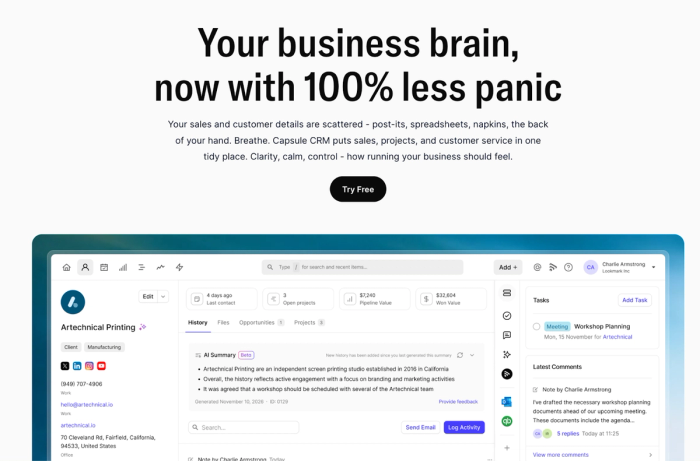
Tracks: automated workflows
Capsule's Tracks feature lets small business owners build automated task sequences that trigger based on pipeline stage changes, deal activity, or contact updates. When a deal moves to a new stage, the next set of tasks is created automatically and assigned to the right person.
Small teams managing a growing number of customer relationships rely on this kind of workflow automation to keep processes running reliably. It removes the overhead of tracking where every deal and every customer relationship stands, and replaces it with a system that surfaces the right action at the right time.
The practical result: fewer things fall through the gaps, follow-up happens consistently, and the customer experience improves without anyone having to work harder to deliver it.
AI Summaries
Before any client call or meeting, Capsule's AI Summaries pull together the last 50 interactions for that contact and show a clear picture of where the relationship stands. That preparation used to be a manual process that ate into selling time. Now it's automatic.
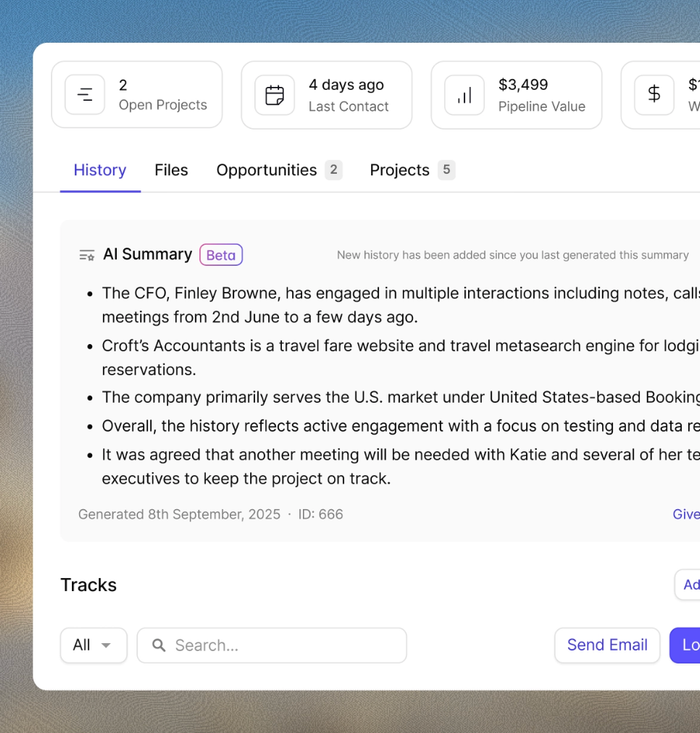
The downstream impact is meaningful: a personalized engagement that builds customer trust over time.
AI Contact Enrichment
Keeping customer data accurate is one of the most persistent sources of inefficiency in small business operations. Incomplete or outdated records make every process that depends on them less reliable – from marketing campaigns to sales reports to informed decisions about resource allocation.
Capsule's AI Contact Enrichment automatically populates contact records with company data.
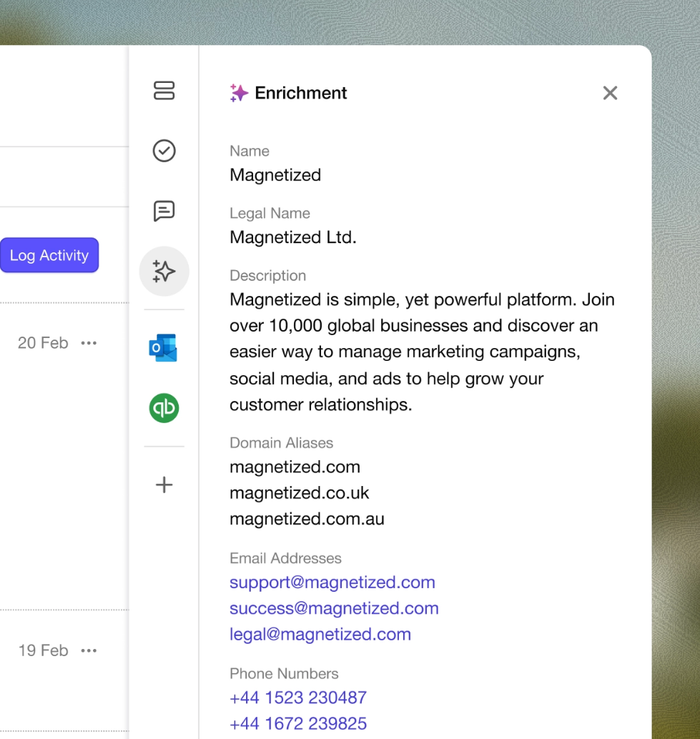
For small business owners who know their client data is never quite as accurate as it should be, this addresses the root cause rather than the symptom – and the accuracy it creates makes every other AI usage within the CRM more effective.
AI Email Assist and Pipeline Generator
AI Email Assist drafts follow-up emails using the context already in the CRM — the contact's history, the open deal, and the last conversation. Such an automation reduces the time cost of each email without sacrificing the quality that customer relationships require.
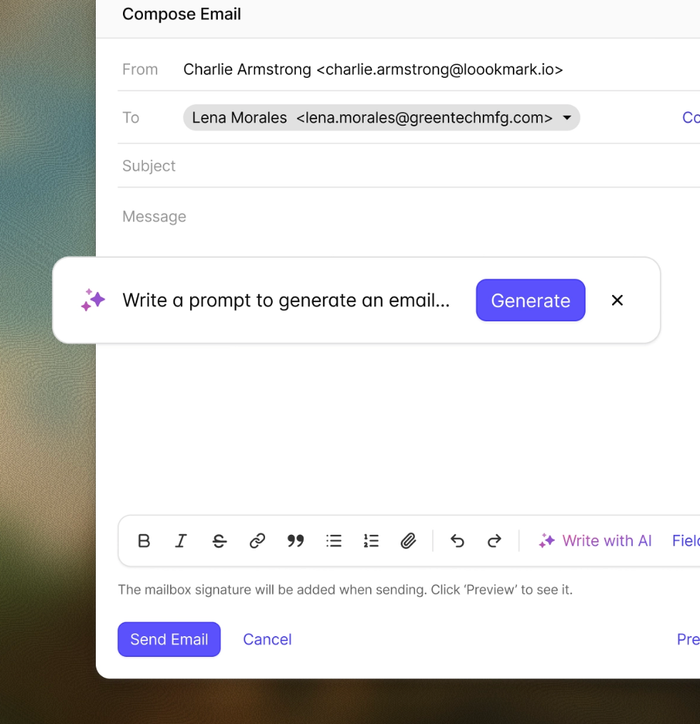
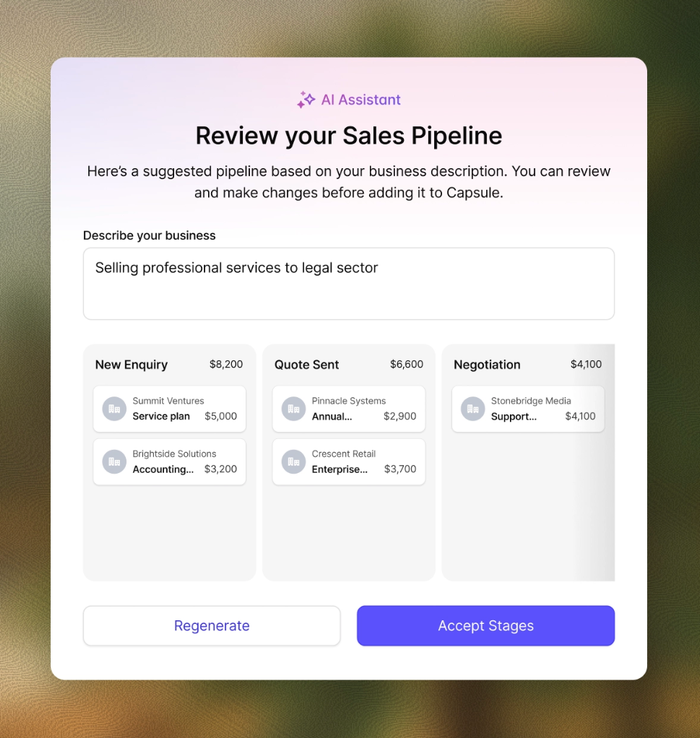
AI Pipeline Generator builds a customized sales pipeline based on business needs, removing the setup barrier that prevents many small businesses from getting a structured sales process in place. An automated, well-structured pipeline doesn't just improve efficiency – it generates the data that makes future decision-making processes more reliable.
Capsule does not use customer data to train its AI models, which matters for small business owners with concerns around data breaches. AI features are available on the Growth plan and above, with a 14-day free trial on all paid plans.
Four myths about AI automation that small businesses need to drop TODAY
AI automation gets talked about in ways that put small business owners off before they've started. Some of the most common assumptions about what AI automation can do for small businesses is actually wrong, and worth addressing directly.
Myth 1: AI automation is only for big companies
The assumption that AI products are built for enterprises with dedicated IT teams and six-figure implementation budgets hasn't been accurate for some time. The majority of AI tools available today are designed specifically for small teams, with simple setup, accessible pricing, and no requirement for technical expertise. The increased efficiency that larger corporations have been getting from AI for years is now available to a business with three employees and a laptop.
Myth 2: AI will replace your team
AI helps with the tasks that shouldn't require human attention in the first place – data entry, scheduling, routing customer queries, and drafting routine emails. What it doesn't do is replace judgment, relationships, or the team communication that holds a small business together.
The businesses getting the most from AI automation aren't smaller teams. They're the same teams doing more valuable work because the low-complexity volume has been removed from their day.
Myth 3: You need vast amounts of data before AI is useful
A common misconception is that AI requires vast amounts of historical data before it delivers any value. In practice, most AI automation tools are useful from day one – automating a follow-up sequence doesn't require a data warehouse, and an AI that drafts emails based on CRM context works from the first record in the system. The value grows as data accumulates, but waiting until you have enough data to start is waiting for a problem that doesn't exist.
Myth 4: AI automation means a worse customer experience
The concern that automating customer-facing processes leads to impersonal interactions is understandable — and occasionally justified, when automation is applied without thinking about customer needs first. But used well, AI automation produces the opposite result. A customer who receives a prompt, contextually accurate response at any hour has a better experience than one who waits. For example, a small business using automated follow-up sequences triggered by deal stage changes ensures every customer hears back at the right moment, not when someone remembers to send the email. Consistent, timely communication is a better customer experience, not a worse one.
What to automate and what to leave alone
Not everything should be automated, and small business owners who try to automate too broadly tend to create new problems instead of solving existing ones.
The tasks worth automating share a few characteristics:
- they happen frequently,
- follow a predictable pattern,
- and the output can be verified with no significant effort.
Data entry, scheduling appointments, follow-up sequences, expense tracking, inventory management, standard customer support responses to customer queries – these fit the profile. Automating them creates cost savings and frees the team to focus on work that actually requires human judgment.
The tasks that shouldn't be automated are those where nuance and relationship matter. Complex tasks that require empathy and context, strategic decisions about business direction, conversations where the human element is part of the value – these aren't tasks where AI usage creates return. Attempting to automate them with AI chatbots or an AI agent that isn't equipped for the complexity tends to damage customer trust rather than build it.
A useful test:
- If the task would produce the same output regardless of who completed it, it's a candidate for automation.
- If the output depends on who's doing it, keep the human in the loop.
The practical case for embracing AI automation now
The window in which AI adoption is a competitive advantage is narrowing. Small businesses that embrace AI and build automated operational workflows now are accumulating two advantages simultaneously: the immediate efficiency gains from removing repetitive tasks, and the data foundation that makes machine learning tools more useful over time.
Workflow automation can reduce repetitive tasks by 60–95%, leading to time savings of up to 77% on routine activities – a return that compounds as the business grows and the volume of those tasks increases.
The small business owners who stay ahead won't necessarily be the ones who automate the most. They'll be the ones who automate the right things: enhancing efficiency in the places it matters most, and freeing up the relationship-building capacity that AI can support… but never replace.