IA é um tema polêmico no mundo da tecnologia – mas, como proprietário de uma pequena empresa, você pode não saber como implementar ferramentas de IA em projetos do dia a dia. Embora os modelos de IA possam parecer algo que só grandes empresas conseguem utilizar, a inteligência artificial e o aprendizado de máquina são, na verdade, mais acessíveis do que você imagina.
Desde automatizar tarefas repetitivas até melhorar a visualização de dados, há muitos motivos para você aprender mais sobre IA. Não sabe por onde começar? Este guia vai apresentar o essencial de IA para pequenas empresas, explicando o que é, como pode beneficiar suas operações e quais são os passos práticos para iniciar sua jornada de aprendizado em IA.
O que é IA?
Inteligência Artificial (IA) é um ramo da ciência da computação voltado para a criação de sistemas capazes de realizar tarefas que normalmente exigiriam inteligência humana. Essas tarefas incluem reconhecer fala, interpretar dados, tomar decisões e aprender com a experiência.
Os sistemas de IA usam algoritmos e grandes quantidades de dados para se “treinar” e melhorar o desempenho ao longo do tempo, de forma semelhante aos humanos aprendendo com a experiência. Isso pode então ser usado para criar assistentes virtuais, análises preditivas e reconhecimento de imagens.

Compreendendo ciência de dados, inteligência artificial, aprendizado de máquina e aprendizado profundo
Estes são os termos mais comuns que você ouvirá ao considerar IA. Embora não existam definições rígidas ou oficiais para cada um desses termos, há um consenso geral sobre as distinções entre eles.
Aqui estão os detalhes:
- Inteligência artificial (IA):IA descreve sistemas de computador projetados para executar tarefas que exigem inteligência semelhante à humana. Isso inclui raciocínio, tomada de decisão e aprendizado. Em essência, a IA diz respeito à criação de sistemas capazes de simular funções cognitivas humanas.
- Aprendizado de máquina (ML):Aprendizado de Máquina é um subconjunto da IA, focado no desenvolvimento de algoritmos, conhecidos como algoritmos de aprendizado de máquina. Eles permitem que sistemas aprendam e melhorem a partir de dados sem serem explicitamente programados.
- Deep learning: Este é um subconjunto especializado de aprendizado de máquina responsável por muitos avanços recentes em IA, incluindo carros autônomos e o ChatGPT. Os algoritmos de deep learning são inspirados na estrutura do cérebro humano. Eles são particularmente bons em processar dados não estruturados, como imagens, vídeos e texto.
- Ciência de dados:A ciência de dados utiliza IA, ML e deep learning, juntamente com estatística, análise de dados e visualização, para extrair insights significativos a partir dos dados. É a aplicação de diversas ferramentas e técnicas para transformar dados em conhecimento acionável.
Quem está usando IA no local de trabalho?
A IA está sendo adotada rapidamente pelas empresas. Um relatório recente constatou que 68% das grandes empresas, 33% das organizações de médio porte e 15% dos pequenos negócios integraram pelo menos uma tecnologia de IA em suas operações.
Here are some of the most popular ways that are being adopted:
- Customer service (56%) – AI-driven chatbots and virtual assistants are providing 24/7 support, answering common inquiries, and freeing up human agents for more complex issues.
- Cybersecurity and fraud management (51%) – AI’s ability to detect anomalies helps businesses identify threats and prevent cyberattacks, making it essential for secure operations.
- Customer relationship management (46%) – AI enables personalized interactions and data-driven insights that help businesses deepen customer engagement and retention.
- Digital personal assistants (47%) – AI-powered assistants streamline workflows and manage tasks like scheduling, reminders, and data access, enhancing productivity.
- Inventory management (40%) – AI systems analyze demand patterns and optimize inventory levels, helping businesses reduce costs and improve availability.
- Marketing use case? For instance, writing copy, data analysis, etc

How can AI benefit businesses?
Enhanced efficiency and automation
AI can improve operation efficiency by automating repetitive and time-consuming tasks. This includes data entry, appointment scheduling, and inventory management. You’ll free up employee time allowing your team to focus on more strategic and creative initiatives and eliminate the risk of human error.
This boosts and drives business growth and improves overall productivity reducing operations costs. This helps small businesses allocate resources more effectively saving them both time and money.
Improved customer service
With enhanced natural language processing, AI chatbots and virtual assistants can provide 24-hour customer support. These tools quickly address common inquiries and issues and enhance customer satisfaction. By managing routine queries with AI, you can help your employees focus on more complex issues improving the overall quality of your customer service. This leads to stronger customer relationships and higher retention rates which are crucial for business growth.
Interpret large datasets
AI can handle large amounts of data quickly to identify patterns and trends in customer behavior and market dynamics. Utilizing AI projects can help businesses make the most of these data-driven insights helping them make better-informed decisions about product development, marketing strategies, and customer engagement.
Understanding what drives customer preferences allows businesses to tailor their offerings and messaging. This helps to improve their relevance and effectiveness while identifying new growth opportunities, giving you a strategic advantage.
Personalized marketing
With the help of AI, businesses can create highly targeted marketing campaigns that resonate with specific customer demographics or even individuals. By analyzing large amounts of customer data quickly and efficiently, AI can identify any preferences and behaviors allowing businesses to send personalized recommendations or messages.
Better personalization improves connections with customers helping to increase both engagement and conversion rates. Delivering content that aligns with customer interests helps to build brand loyalty and drive repeat business.
Cost savings
Automating tasks and streamlining processes can lead to significant cost savings for businesses. By reducing the need for extensive manual labor and minimizing human error you can improve efficiency, lower operation costs, and enhance your overall service quality.
You can also utilize AI-driven analytics to make better marketing investments by pinpointing the most effective strategies and channels. This can help small businesses improve their ROI by maximizing their marketing budget and driving growth and revenue.

Scaling your business
Most AI solutions can grow alongside your business. This flexibility allows you to adapt to increasing demands without compromising efficiency. As small businesses grow, AI can help you manage larger volumes of data to streamline operations.
This scalability helps businesses to maintain their high-quality service without the risk of operational bottlenecks. This allows small businesses to confidently grow their business by pursuing new opportunities and markets without worrying about resource constraints.
Competitive advantage
Leveraging AI for personalized customer experiences, operational efficiencies, and data insights, allows you to offer unique solutions that resonate with their target audience. This not only attracts new customers but also builds loyalty among existing ones. Having a technological edge can be a game-changer for small businesses looking to establish themselves as leaders in their field.
Streamlined supply chain management
Forecasting demand and managing inventory levels enhance your logistics operations. Get it wrong and you could be stuck with a costly mistake. With AI, you can accurately predict your demand reducing the chances of an overstock or low supplies allowing you to meet customer needs while making cost savings.
AI can also identify supply chain inefficiencies enabling your business to streamline operations and improve delivery times. Maintaining a response and efficient supply chains allows businesses to improve customer satisfaction and strengthen their market position.
How to get started with AI as a small business:
Getting started with AI in a small business can seem daunting, but it helps enhance efficiency, improve customer experiences, and drive growth.
Here’s a step-by-step guide to help you begin your AI journey:
Identify business needs and objectives
The first step is to evaluate your specific business needs and objectives. Analyze your current operations and identify any challenges or areas of improvement. For example, issues with customer service response times or repeatedly missing sales targets. Pinpointing these issues helps you create clear objectives to help guide your focus.
Once you've identified these areas of improvement you can prioritize them based on urgency and feasibility. This approach helps you select the most relevant solutions tailored to your unique circumstances.

Utilize online courses and webinars.
Understanding AI and its capabilities is a crucial part of utilizing its benefits effectively. This learning process allows you to better understand key AI concepts like neural networks, machine learning models, and programming languages.
Beginner-friendly AI courses are a great place to understand the basics of AI. These programs help to simplify some of the more complex elements of AI and machine learning and show you how they can be applied in your business.
Elements of AI by the University of Helsinki
This is one of the best free online courses for gaining a solid foundation in AI basics. It covers topics like machine learning, neural networks, and the ethics of AI.
Designed for beginners it's a great starting point for small business owners who want to understand, broadly, how AI can be used.
AI for Everyone by Coursera
Created by globally recognized AI leader, Andrew Ng, this course introduces business to AI. Using real-world projects as examples, it's perfect for anyone looking to explore how to apply AI projects to their day-to-day work. It’s a great choice if you’re interested in using AI tools for customer service, marketing, or data analysis.
Introduction to Artificial Intelligence by Udacity
This course provides a great hands-on overview of AI tools and their applications. It covers areas like predictive analytics and automation with easy-to-follow modules. Perfect for anyone interested in gaining practical skills that they can quickly apply to their work.
AI and ChatGPT prompts for beginners with Luis Sousa
This webinar covers key differences between AI platforms like ChatGPT, Google Bard, and Bing Chat, helping you select the best tool for your needs. It teaches key techniques to craft effective prompts that improve response quality and discover ready-to-use prompts tailored for sales and marketing.
How to build your GPT in ChatGPT
Here you'll find AI insights specifically tailored for business owners. Focusing on practical applications for daily operations, this session featured live demos on creating custom GPTs for specific use cases, showing participants how to tailor AI tools to meet unique business needs.

Start small with pilot projects
Implementing AI algorithms isn't an all-or-nothing approach. Start with pilot projects that utilize essential AI tools to avoid overwhelming your resources. Identify a specific process that could benefit from AI and measure its effectiveness before committing to larger-scale projects.
The more data you gather the better insights you can gain on performance, user experience, and return on investment. These findings will validate your future AI strategy and help you build a stronger case for further investment in AI technologies.
This is also a good time to explore emerging AI agent use cases that can automate entire workflows across sales, support, IT, or operations.
Choose the right tools
There are hundreds of AI tools and platforms available, many of which are free to use, so its easy to get overwhelmed with choice. Fortunately, we have a comprehensive guide of the best free AI tools specifically designed for small businesses and their needs. Look for features that align with your objectives to streamline your decision-making process. Explore AI developer tools to build smarter, custom-fit solutions.
Prioritize tools with robust support and documentation to ensure a smooth implementation process. Remember to consider scalability as your business grows. This ensures you can adapt to your evolving needs and support your long-term goals.
Collect and prepare data
Data is the cornerstone of all successful AI projects, so gathering and preparing the right data is essential. Start by assessing the data you already have like customer interactions in your CRM, sales figures, and website analytics. Organizing this data correctly will help facilitate your AI model training and ensure that its decisions are based on accurate and relevant data.
After identifying your data sources you need to clean and format them for consistency. This includes removing duplicates, correcting any errors, and structuring the data in a format that's easy for your AI applications to analyze, such as computer vision. The better quality data you provide, the better an AI models perform so ensure take your time to get this step right.

Monitorar e avaliar os resultados.
Depois de implementar suas soluções, você deve continuar monitorando e avaliando regularmente o desempenho delas. Estabeleça indicadores-chave de desempenho (KPIs) que estejam alinhados com seus objetivos iniciais, como índices de satisfação do cliente ou taxas de conversão. Eles ajudam você a avaliar a eficácia de suas iniciativas de IA e permitem identificar áreas que precisam de trabalho adicional.
3 maneiras simples de pequenas empresas usarem IA (com ferramentas reais!)
Agora que você sabe que a IA pode ajudar o seu negócio, vamos colocá-la em ação. Aqui estão cinco maneiras práticas de começar a usar IA — cada uma leva cinco minutos ou menos para implementar.
1. Escreva e-mails em segundos
Olhando para uma tela em branco tentando escrever um e‑mail? A IA pode cuidar disso. Com ferramentas como Capsule CRM’s AI Content Assistant, você pode gerar textos de e‑mail rápidos e profissionais em segundos – seja um e‑mail de acompanhamento após se reunir com um cliente ou uma campanha promocional.
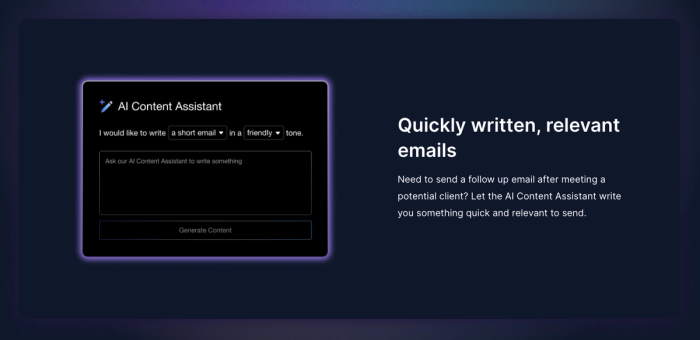
Chega de bloqueio criativo: é só enviar e seguir em frente!
2. Crie visuais chamativos
Criar gráficos de alta qualidade é um desafio para muitas pequenas empresas – mas a IA torna isso mais fácil. Precisa de posts para redes sociais, panfletos ou anúncios? Ferramentas com IA, como o Magic Design do Canva, permitem criar visuais profissionais em poucos minutos, sem precisar de experiência em design. Quer algo personalizado? O Ideogram pode gerar artes exclusivas a partir de um simples comando de texto.
Por exemplo, se você tem uma padaria e lança uma torta de amora, pode usar IA para gerar imagens de dar água na boca que combinem com a estética da sua marca. Aqui está a nossa versão desse prompt:
Uma torta de amora-preta dourada e quentinha, recém-assada e reluzindo com um fio de mel, repousa sobre uma mesa rústica de madeira em uma charmosa padaria em Manhattan. A torta é recheada com amoras-pretas grandes e suculentas e tem uma massa folhada e amanteigada, com um raminho de hortelã fresca acrescentando um toque de cor. Ao fundo, tudo está suavemente desfocado, revelando a atmosfera acolhedora e convidativa da padaria, com o brilho suave da iluminação ambiente e o aroma de pão recém-assado, destacando a movimentação intensa do lugar.

Ou, em:
Uma ilustração de um profissional confiante em pé na interseção entre a prática jurídica e o marketing digital. A pessoa tem cabelo curto e está usando um terno. Ela segura um tablet que exibe um gráfico. Ao fundo, há um escritório moderno com plantas e o horizonte de uma cidade.

3. Crie apresentações de slides completas em minutos
Preparar apresentações pode consumir muito tempo, mas ferramentas de IA como Gamma.app transformam prompts de texto simples em apresentações de slides totalmente elaboradas.

https://gamma.app/example/Disney-Designing-Magic-kcpky6omz40q0o8?mode=doc
Basta escrever seus pontos principais e a IA os organiza em uma apresentação com aparência profissional. Perfeito para propostas a clientes ou reuniões internas.
Conclusão
Começar com IA pode parecer intimidante. Mas, com as ferramentas e o conhecimento certos, a IA pode transformar o seu pequeno negócio. Desde a compreensão dos conceitos básicos até a exploração de cursos para iniciantes e a prática de habilidades aplicadas, pequenas empresas podem aproveitar a IA para aumentar sua eficiência, obter melhores insights sobre os clientes e impulsionar o crescimento.
Ao integrar a IA gradualmente ao seu negócio, você pode otimizar suas operações e ganhar uma vantagem competitiva no seu setor. Ao começar em pequena escala, você dá passos incrementais para impulsionar o crescimento da sua empresa e aumentar a receita.
Pronto para utilizar IA no seu negócio? Experimente o Capsule gratuitamente por 14 dias e veja como as ferramentas com IA podem transformar a gestão de clientes e a estratégia do seu negócio.